Categories
Review

Poetry from Korea: Offerings of Hope

Book Review by Dustin Pickering

Title: Prescriptions of Civilization

Author: Wansoo Kim

The increasingly complex world or society we live in today allows little room for reflection. Technology fuels growth and sophistication while the population increases exponentially. The old plagues are still with us: famine, disease, war, and poverty. These social ills overwhelm us and often make us feel powerless.

In Prescription of Civilization, Wansoo Kim, an academic in Korea, tackles these harsh truisms. He is willing to look at them both objectively and sympathetically. In the poem “Science” he writes:

Though you act big pretending to know everything

Always tapping on a calculator

And arranging numbers

Looking into a microscope or telescope,

Aren’t you a hardheaded rube

That doesn’t know or feel

what is love

That two souls meet to become one?

In these stanzas, Kim divorces himself of modern conceptions out of frustration with their lack of human desire and spirit. We are often told science can eliminate the worst of human problems. In all truth, it is working hard to improve the human condition. This, however, does not distance us from its over-rationalizations and lack of humanism. The poet here introduces us to an often-overlooked insight. The contemporary world is difficult precisely because the humanity we wish to save is lost in the very means we employ to save it.

Early verses in this collection serve as reminders of the worst of disasters humans have inflicted on their fellow humans. The poet’s broad range of experience helps him identify with suffering all over the globe. As a South Korean, he is sorely hurt by the suffering in neighboring North Korea.

Kim further writes:

Even though I often ruminate

It’s written in the legal document,

Why do I live as the servant of fear and anxiety

Bound up in fetters of doubt

Not dancing with the wings of joy?

There is a distinct sense reflected upon in this poem “An Adopted Son”. The poem is a Christian plea to fellow Christians. An exclamation of joy in the resurrection of Jesus Christ is a cry of relief at the human condition. In an earlier poem, “Tears of the Moon”, the moon is personified as a woman who has lost her lover. The ultimate symbolism is how distant we are from approaching Creation as a work of art to be appreciated. In neglecting to live in awe of Creation and instead see her as an instrument of our devices, we banish the Creator and disappoint Him. Civilization then is our downfall if we refuse to understand its ultimate purpose.

Kim reminds his readers that the sound and the fury of life is necessary for our redemption—our despair turns us into children seeking a Father; we become again as babes. This is the meaning of resurrection for us. In this startling realisation, Kim is in league with admirable poets and mystics like Rumi.

The Abrahamic faiths are powerful for the fact that they open the mind to spiritual dimensions and truths that the wise can perceive. In Proverbs 9:10, Solomon writes, “The fear of the Lord is the beginning of wisdom and the knowledge of the Holy One is understanding.” Yet fear is not the act of being afraid. It is the sense of being alone in dread and anxiety, the existential condition. It is in realizing that your salvation depends on acknowledging you are a creation, a being wisely framed and entrusted with a task. Reverence and awe are rooted in fear. The sacred sense is developed by learning to approach objects of veneration with calm resolution. When an object, whether of contemplation or being, is properly understood it is given its faith because the faith within it is realised.

In “House of a Poem”, the poet reflects on the meaning of art itself, especially the art of poetics:

I’ll build a house of a poem

Even tearing all the flesh of my soul to pieces

Because it doesn’t prevent all the things of life

From going into the tomb

But it can be a work of art to make alive forever

Brilliant moments of disappearing things.

Poetry is life and life is poetry. We cannot escape our mortality, but we can preserve the most uplifting of our sentiments and moments in history. Our struggles and dreams are kept within the glass of poetic sensibility like the objects of reverence previously mentioned. Poets can live in a state of awe, deep reflection, and mystery at once. John Keats called this state “negative capability”. Kim astonishes the reader with his ability to be entranced in this state in works such as “Tears of the Moon”. The poem is a cry for the lost humanity that becomes a victim in a long war against vulnerability and prayer. In a sense, the poem “House of a Poem” recognizes that civilization is humanity’s Nature. We are creating a world of our own through work and self-domestication. Yet something must relieve us of our fears and hopelessness. We must release tension from the bitter efforts of the day somehow. Kim gives us the reason for the arts — they relax us, reflect our deepest emotions, move the spirit, and keep us in touch with the reason we live. The arts are a prescription for civilization as well.

It seems as though Kim’s prescription for civilization is recognizing the reality of life’s purpose, of stepping away from the pragmatic capitalism that considers only use-value, distraction, entertainment, and profit. Did God condemn greed, gluttony, lust, and the like because these primal vices anchored us in materiality rather than the search for spiritual depth? As we remember the words of the Preacher in Ecclesiastes, “All is vanity!” it is safe to say that this truth is understood but ignored. The world doesn’t seek God. The fundamental revelation in the Scriptures is that God alone is rest, shelter, and peace. Material comforts are short-lived and ephemeral. Too much obedience to the world and its will is a recipe for disaster—each person is created distinctly, given a purpose and pursuit of happiness, and faces a challenge to love fully. The enjoyment of the arts, the exercise of restraint and compassion, and strugglng against the dark principalities are the true wellsprings of life.

Suffering is something we cannot eliminate entirely. We try to reduce it and often it takes us when we least expect it. Civilization is cause for a curse, but it makes individual lives more fulfilling and challenging. Christians believe that Jesus Christ suffers with them and they are not alone. This is the meaning of the Crucifixion. With Christ’s resurrection, we are granted immortality. Through death and resurrection, Jesus saves our souls.

The prescription for civilization, then, is a holy devotion to Christian principles. The fact we need a prescription shows us what sort of malady causes our suffering. While other humans are not to be trusted, God Himself was willing to lay his own life down to testify to His mercy. Living within civilization is stress and life is a disappointment, but a reminder that Love is universal, and we are all deserving of it is a positive message. Kim writes this collection not for moral instruction or harsh denunciation, but for the purpose of offering hope in a bleak world of continuous conflict and misery.

In the poems, we see a man who is raised from the death of his fears and desires into the proper understanding of living. Forgiveness is a release from debt. Christ’s Passion was a forgiveness of all debts. His final moments on the Cross tell us that he wanted the redemption of sinners—even in their last moments. He knew human nature because he was human and divine. In his understanding, he too wrote a prescription for human suffering. The forgiveness of sins, unbridled compassion, pity for those unfortunate, and strong faith in God and His plan are Jesus’ living legacies.

Kim realises the need the world has for such a message and explores it in Prescription for Civilization creatively and fondly. His anger, sadness, fear, and doubt are all on display to remind us of our humanity. This is a task only a poet accepts.

.

Dustin Pickering is the founder of Transcendent Zero Press and editor-in-chief of Harbinger Asylum. He has authored several poetry collections, a short story collection, and a novella. He is a Pushcart nominee and was a finalist in Adelaide Literary Journal’s short story contest in 2018. He is a former contributor to Huffington Post. 

.

PLEASE NOTE: ARTICLES CAN ONLY BE REPRODUCED IN OTHER SITES WITH DUE ACKNOWLEDGEMENT TO BORDERLESS JOURNAL. 

Categories
Poetry

November Fire

By Fizza Saeed


Image courtesy:  Photo by Yaoqi LAI on Unsplash

A winter chill circles the city

Amidst howls of forgotten dogs and invisible people

Cars whizz by, cutting through a summer in transition 

In Lahore, wandering lanes and kicking pebbles

A lone stranger walks, a sound of cracking fallen leaves  

A Bob Dylan song plays in the mind

The road is long and to kill time

Is not such a bad proposition

It is November now

On the news are buildings, bodies aflame

The stranger, a citizen, with hands buried deep in an old, cheap coat

Breathes deeply, walks on, the night is long

In the morning, winter will arrive with her icy embrace

A fire will have to be made

Out of stones and yesteryear’s hopes

To keep warm a heart inside a cheap coat.  

.

Fizza Saeed is a student of English Literature at Government College University, Lahore. She is the Editor-in-Chief of the varsity’s magazine, The Ravi. 

.

PLEASE NOTE: ARTICLES CAN ONLY BE REPRODUCED IN OTHER SITES WITH DUE ACKNOWLEDGEMENT TO BORDERLESS JOURNAL.

Categories
Slices from Life

Me and James Joyce in Trieste

By Mike Smith

I visited the city in the year of the Brexit vote, conscious that I might never set foot on the mainland of my own continent again. I always give Trieste that extra lift at the end: tree-est-ee. Some say it flat: tree-est. I wondered which was right and kept my ears open. I heard both but I like to think that as you read you pronounce it Trieste.

The buildings of Trieste are massive, solid, and looked recently restored, seeming too new to be as old as they are. This was once the only port for the whole of the Austro-Hungarian Empire, and its fourth largest city. One time naval officer, Baron Von Trapp, must have known it and his first father-in-law’s British torpedoes must have been deployed here. High, squared city blocks with rows of filing cabinet windows housed thousands of administrators, civil servants and shipping agents who ran the empire’s import and export trade.

Umberto Saba’s statue at Trieste

A cold wind blew through the square the afternoon that I was there, though the sky was sheer blue and the autumn sun harsh. That wind blows often, I suspect. The statue of Italian poet, Umberto Saba, outside the bookshop he used to run shows the hem of his long coat flapping, the collar turned up. I’d never heard of Saba, but the cafes around the city centre have his photograph and information panels as well as those for James Joyce.

James Joyce lived here briefly, writing Ulysses, and I wonder to what extent the city reminded him of Dublin. No Liffey sticking out its tongue, but the more formal Canal Grande, straight sided and stone lined, runs down from the Piazza Saint Antonio towards the sea, crossed by the bridge on which Joyce stands — loiters, one commentator says.

The statute seemed somehow smaller than life sized. Joyce seems dazed, hand in pocket, dreaming, perhaps, of Molly Bloom’s ‘melons melonous’, or recalling the windows of high class clothes shops in the city centre, filled with ladies’ lingerie, “wondrous gowns and costliest frillies. For him!”

Could it have been the shops here, rather than Brown Thomas on Dublin’s Grafton Street, that really inspired the scene in which Bloom himself gazes on silks and satins, and ‘mutely’ craves ‘to adore’? Leaning against a wall, high up above the city I recalled the wall against which Milo O’Shea leans in Joseph Strick’s film of the Ulysees. Were it not so clean and well tended, I might think Trieste reminiscent of ‘dear, dirty, Dublin’.

A friend had driven me the two thousand kilometres to see that Joycean statue and to be seen by it — in both senses of the phrase. A pointless piece of literary homage that we’d talked about making for a decade and more.

Trieste seemed a cold city, and not just because of that wind. The people here look you in the eye and weigh you up. They don’t fawn or fall over you with welcomes, but judge, perhaps rightly, that you have done wisely to visit them. It was late October, and though unseasonably sunny the sensible tourists, and perhaps all of the English save us, had gone. A few kilometres out of the city a grid of buoys floated, bereft of their summer moorings. Beyond the flat-calm, azure Adriatic, towards the west, the buildings of — could it be? –Venice, caught the autumn sun and glistened like sugar cubes.

 A broad, stone pier juts out into the water at the centre of the bay. Here large ships must once have landed their cargoes. Now the curious and the adventurous risk that biting wind and stroll out to take in, briefly, the view back across the city, which folds out on each side, and climbs in orange pan-tiles the hill behind the crust of square-set buildings to lose itself in the thick mixed woods of the hinterland.

 Abandoned cranes and the shells of warehouses stand beyond the railway station to the west, and to the east a skyline of newer warehouses and cranes shows. An old stone fortress sits dead centre among the rooftops.

Between the promenade and the city, Mercedes, BMWs, and Audis fill the main road. We crossed into the Piazza del ‘Unita Italia’, and considered briefly a table at Harry’s, but settled for a local pizzeria where we dined beneath a garish painting of Westminster Bridge.

 Just off that square a band of locals stood a folding table bearing leaflets of a Trieste independence party and the flags of America and the UK. We wandered over to find out more. Trieste had been ‘given’ to Italy after the First World War but after the Second it was made over to an Allied Commission. A friendly English speaker explained to us. Out-Brexiting the Brexiteers, this happy band saw themselves as citizens of a potential city state and why not, if those up-market shops were anything to go by? I can imagine London with its Home Counties going the same way one day. 

There were beggars, such as we had seen all the way across Europe – our sensitivity heightened by the refugee crisis, and a post-Brexit sense that we were seeing a continent that would not be the same, for us at least, ever again. The supplicants seemed mostly of Eastern origin and in the Piazza Saint Antonio, hidden entirely beneath an orange cloak, richly embroidered, was one especially chilling. She — for some reason, though I could see no face or body, I thought of it as a woman — had placed a plastic cup on the ground, and wore a black sheep’s head, curled horns as dark as the tight curls of wool that covered it. The lower jaw, with slow, un-rhythmic persistence, made a flat, un-resonant clack, clack, clack, clack, that haunted the streets around the square.

James Joyce’s Statue Via Roma, 34122 Trieste TS, Italien. Courtesy: Wiki

To fulfil my bucket-list desire, I would not merely see, but be photographed not noticing the statue of James Joyce. I took an ancient Sony Handycam. Just get me crossing the bridge and passing him by, I told my friend. It’s easy to use, I said. Hold it like a trumpet, and you can operate all the controls with the fingers of one hand.

When I returned my friend was holding the camera like a saxophone. I think I missed you, he said. Do you want to do it again?

The sheer Joycean comic irony of the situation was too good to undo.

It’ll be fine, I said, and we drove the two thousand kilometres home. 

Curthwaite- Worlington-Heidelberg-Venice-Trieste. October 2016

Mike Smith lives on the edge of England where he writes occasional plays, poetry, and essays, usually on the short story form in which he writes as Brindley Hallam Dennis. His writing has been published and performed. He blogs at www.Bhdandme.wordpress.com 

.

PLEASE NOTE: ARTICLES CAN ONLY BE REPRODUCED IN OTHER SITES WITH DUE ACKNOWLEDGEMENT TO BORDERLESS JOURNAL

Categories
Poetry

‘Festas’

By Navneet K Maun

Madhubani: Art of Mithila. Wiki

Festivals celebrate, the beautiful colours

of cultural heritage.

Keeping alive traditions for posterity.

A respite from the mundane life.

Spreading happiness, joy.

A time to rejuvenate, bond

forgive and forget.

.

The joie-de-vivre

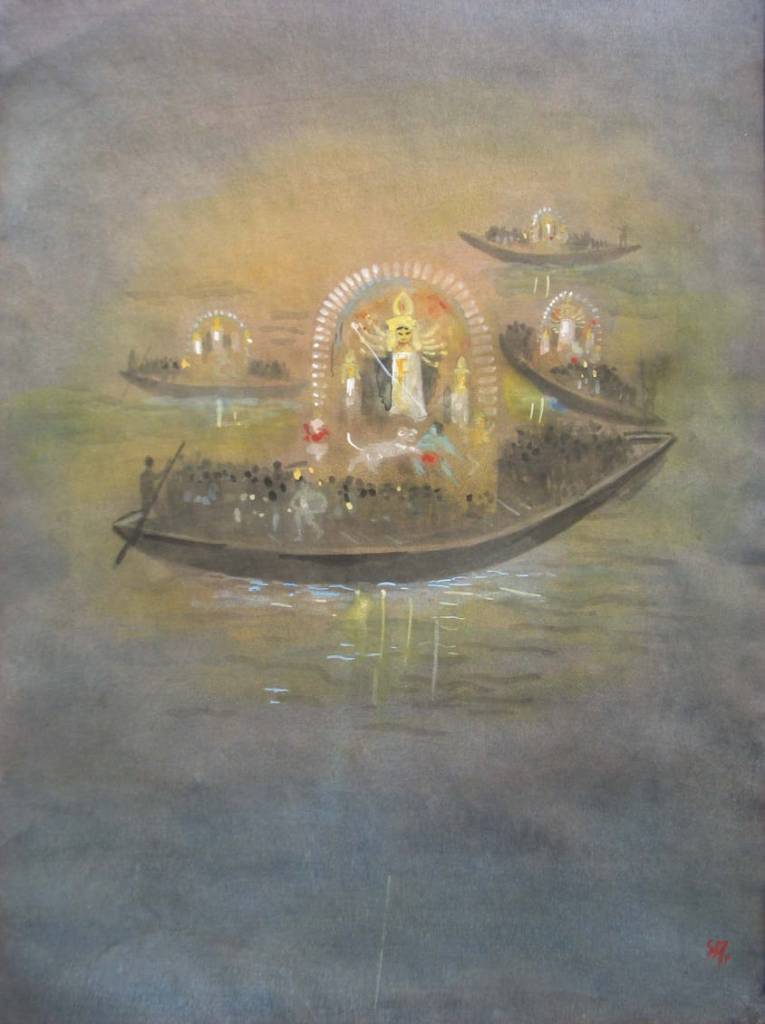
of Durga Puja celebrations.

Pandal* hopping in new attires

the very air abuzz

with excitement, bonhomie, music.

.

Tantalizing smells

of pucchka, ghugni, alur chops*, cuisine

enticing one and all

with gourmet delights.

.

Maa Durga’s matchless, divine beauty

instills in us faith, hope and courage

binding millions of hearts.

.

Each and every festival

propagates brotherhood, peace and harmony

an absolute precedent.

.

The quintessence of festivals

Lost in the metropolis

Of hectic lifestyle, numerous diversions

gridlock acting as dampeners.

.

Where are the folklores

That enthralled children for decades?

Grandmothers, happy narrators

never tiring of replicating them.

.

The magic needs resurrection

from its nemesis, the Internet,

The wizard of all distractions.

.

*Pandal — A fabricated structure in India housing stalls,events or festivals

*pucchka, ghugni, alur chops — Savoury snacks

Mrs. Navneet K Maun was born in West Bengal. Did her initial schooling from Oak Grove School, Jharipani, Mussoorie. She furthered her education from Regional College of Education, Bhubaneshwar. She did her Graduation and BEd from there. She did her Masters in English Literature from Banaras Hindu University, Varanasi. She has vast experience in teaching and has retired as a Senior Teacher from a Public School in Delhi. Her hobbies include reading, travelling, writing and cooking.

PLEASE NOTE: ARTICLES CAN ONLY BE REPRODUCED IN OTHER SITES WITH DUE ACKNOWLEDGEMENT TO BORDERLESS JOURNAL. 

Categories
Musings

The Essential Pujo

By Anasuya Bhar

     Mor bhabonare ki haway matalo o

Dole mono dole okarono  horoshe

My thoughts sway to a breeze unknown o

My mind swings, o swings, to a joy unspecific

              (Song, Rabindranath Thakur, my translation)

An unknown and unspecific joy – that is the tenor of Durga Pujo for me. A Kolkata bound urban inhabitant most of my life, this nameless ‘happiness’ need not always reside in something spectacular or great, but lies in the fulfilment of small wishes and family togetherness. Nature, usually wears a happy look with abundant sunshine, blue azure skies and fluffy candy-floss white clouds. Drizzles do punctuate, but they come with a naughty wish to play with the gaiety of the human moods, occasionally washing the dirt and the sweat away to offer more freshness, like the morning shewli* flowers do.

Pujo is the time for all things new — new dresses, new saris, new music, new poetry, new novels, festival numbers, and new movies. In fact, it is yet another calendar, in our hearts, to usher in the new and the blessed, with the spirit of Ma Durga – durgatinashini – the slayer of all evil, the bringer of goodness and peace. Pujo* also ushers in a season of giving and gifting, frenzied buying and mindless spending over not only clothes and accessories, but also on home decor and other amenities or even luxuries of life. The air and the times are considered to be auspicious – nothing can put a blemish on whatever one does. And of course, there is an unmistakable note of the ‘carnivalesque’ about it all – do whatever you wish, for these four days, all in the name of fun and revelry, there is no stopping you! These are also times of parental license, adolescents’ delights and the old timer’s reunion. These are times for which one waits for the whole year round, to replenish and refurbish the batteries that have not only exhausted themselves, but which have actually almost deadened themselves! It marks the spirit of life. And, as if to reiterate the mood, the darkest corner and even the narrowest of alleys of our Kolkata are lit, wearing smiles never seen before; the happiness is proclaimed loud in the dhaak* beats and the shonkho* sounds and the ululation during arati* and pujo. Rituals there are, but beyond the rituals, there is the celebration for our Uma’s homecoming with her kids, all dressed up to meet their fellow earthlings. It is this joy and homeliness, which has endeared Durga Pujo to all and the sundry, beyond faith and regional narrowness – it is perhaps the only Indian festival which is celebrated not only beyond Bengal, but in almost all other countries, abroad.   

Pujo now, has perhaps, become a little more commercialised than what it was when we were children. There is a huge roll of money and a huge display of public spectacle now, more in the spirit of the ‘carnivalesque’, than what it was when we were children. Sometimes, there is a lack of that familiar intimacy, which marked community or sarbojonin pujo during my childhood. Perhaps our jet-set lifestyle where we think more about our work and our deadlines rather than ourselves, our homes or even our families, is partly responsible for this. We have, undoubtedly, become more mechanical, when we choose to say that we are too busy to ‘stand and stare’.

There is one particular Durga Pujo event, which I would like to share with you – an event which happened long ago, but which has stayed with me in the corner of my mind. When I was, maybe, twelve or thirteen years old, we had ‘enacted’ Sukumar Ray’s ‘Gandha Bichaar’ – ‘The Perfume Crisis’ – as a part of the Cultural Programme for our community or para’s  puja ‘Lake Sarbojonin Durgotsav’ in Lake Terrace of the Deshapriya Park area in south Kolkata.  The concept of the para, Bengali for community / locality is, sadly enough, gradually disappearing. It usually means a community that feels together, enjoys together and even weeps together.  It is a little short of an extended family. Now, we are a little distanced from our own family members as well!

So, there was a certain Chandana di* at our para who showed a lot of zeal in collecting the children and organizing a ‘show’ for the year’s Pujo cultural programme. The venue would be a not-so-formal stage erected for the purpose near the Puja pandal. The piece, a selection from Sukumar Ray’s Aabol Taabol* is a great favourite among children, and this one had many characters, which could accommodate most of us. As is already known, ‘Gandha Bichaar’ is to do with identifying a certain mysterious smell which troubles the nostrils of a fussy king. He calls upon all his important men, who slight him in some pretext or the other, until the show is stolen by an old nonagenarian, who comes forward, to identify the smell, with the fearless of death.

Ray’s poem did not have any female characters, and most of the children in the group were girls, excepting one solitary boy – Jishu Sengupta, the now celebrated icon of Bangla cinema – who was the natural choice for the King. Hence, the added confusion of dressing us all up as men. I, being the eldest in the group, was given the part of the nonagenarian! The only advantage I had was my short hair: the one aspect which did not need to be redone in the disguise as a man.

We were a bunch of busy kids that season! Chandana di arranged for umpteen number of rehearsals in her flat. Many were absent, giving her a headache as to how the show could be pulled off finally. Anyway, on the final day, we did pull through, even with all our faults! We had selected a garage space near the pandal as our ‘green room’. We jostled for space trying to look our best as the king’s men. For me, it was the worst, as someone had the wonderful idea that I should give a guitar recital on that very evening and before the play! Hence, I had to quickly graduate from being my own self to a nonagenarian. This put so much needless stress on my nerves! Our costumes were home-grown ones, selected and approved by Chandana di, our mentor, director and producer.

The performance went by in a whiz! There was someone prompting from behind the arras and there were mikes hung from the impromptu roof of the erected stage. And mistakes were amplified in proportions that perhaps outwitted Sukumar Ray himself! There were instances of complete pauses when the little ones forgot their lines and could make nothing of the prompter. There were instances of moustaches coming off, and spontaneous sneezes at being tickled by the wheezier ones! There were also instances of dhotis* trailing off or tripping others! And the little King sat and gazed with all the dignity of the state!

Our performance was, however, lauded and applauded by most of the para. I remember my mother taking a lot of photographs on her Canon camera, and then making multiple copies of them so that everyone could have a memory of the enactment. (Sadly, I could not locate those photographs.) We spoke of that performance and shared the fun for many more autumns to come. Now most of the players are all women, and yours truly is greying forwards. I have no news of Chandana di, for a long time now. In yet another autumn, one truer to my own life, and during yet another Pujo, I sit here reminiscing this one spring performance of my life, being closeted indoors by yet another theatre – the grimmer one of Covid! Nevertheless, the spirit lives on, as yet another Pujo slowly veers towards closure, we wait for the next one, and for many more to come.

*Shewli — Jasmine

*dhaak — drum

*shonkho — conch shell

*arati — worship with incense

*Pujo — prayer, in this case refers to the festival of Durga Pujo

*di — short for didi or elder sister

*Abol Tabol — Available as The Nonsense World of Sukumar Ray

Dr. Anasuya Bhar is Associate Professor of English and the Dean of Postgraduate Studies in St. Paul’s Cathedral Mission College Kolkata. Dr. Bhar is the sole Editor of the literary Journal Symposium (ISSN 2320-1452)http://www.spcmc.ac.in/departmental-magazine/symposium/, published by her Department. She has various academic publications to her credit. She is also keen on travel writing and poetry writing. She has her own blog https://anascornernet.wordpress.com/.

.

PLEASE NOTE: ARTICLES CAN ONLY BE REPRODUCED IN OTHER SITES WITH DUE ACKNOWLEDGEMENT TO BORDERLESS JOURNAL.

Categories
Poetry

Paradise no more

By Kashiana Singh


*2020 California wildfires are still raging


there is fire, everywhere

an inferno of shadows as

anaemic as the men who

bleached the ground of its

resilience, its benevolence

the ground that rises now

into a billowing cloud, of

lashing tongues that

hiss and piss

at everything

they see below— the ground

is a charred body, dead in

a concentration camp

left

to singe for water—

parched

tall forests are falling

to our fallen grounds

no more their spines

can hold our organs

destroying the path

to verdant morrow’s

no more these tunnels

can hide our shadows

cleansing of terrains

to garish

fire tongues

no more a kiss of love

will erase our own rot

an ash

spitting death

to frescoes on my sky

no more dripping blue

into our deranged souls

the walls are punctured

to gaping battle holes

no more a loving nest

of a futureless hope

the rivers are in wailing

to arson, ignorance

failing

no more erasing pestilence

bleeding into its crust

these patterns repeat

lyrical, a greek poem

unfolding

before and after us

flames into flames

we extinguish

our own

as water rises itself into a

high tide, feverishly some

of us wobble into the

stagnant water

bearing on our backs

fistfuls of these savanna’s

cawing

cooing

crying

into a smokeless horizon

where a weary

Noah

awaits at the edge

of his burning ark

.

Kashiana Singh lives in Chicago and embodies her TEDx talk theme of Work as Worship into her everyday. Her poetry collection, Shelling Peanuts and Stringing Words presents her voice as a participant and an observer. Her chapbook Crushed Anthills is a journey through 10 cities – a complex maze of remembrances to unravel. Her poems have been published on various platforms including Poets Reading the News, Visual Verse, Oddball Magazine, Café Dissensus, TurnPike Magazine, Inverse Journal. You can listen to her reading her work on Rattle, Songs of Selah and Poetry Super Highway episodes. She serves as an Assistant Poetry Editor for Poets Reading the News. Kashiana carries her various geographical homes within her poetry.

.

PLEASE NOTE: ARTICLES CAN ONLY BE REPRODUCED IN OTHER SITES WITH DUE ACKNOWLEDGEMENT TO BORDERLESS JOURNAL
Categories
Stories

Disconnected

By Chaitali Sengupta

Angry clouds gather in the west corner of the sky. Thunder crashes, once in the overcast skies and then in her bosom. Scanning the sky with her nervous eyes, Ms. Bose switches on the TV, her mind in complete turmoil now. Her twenty two year old daughter has not yet returned home and it is past 12 o clock at night. Earlier in the day the KNMI weather bureau had issued a code orange weather warning for Noord- Holland, Friesland and Groningen. Uprooted trees, damaged roofs, closure of roads and highways, her mind briskly translates the Dutch teletext into English, a habit, like so many others, she yet cannot get over, despite her 23 years of stay in the low lands.

Auto slaat over de kop, A20 afgesloten tot nader bericht.(Car overturns; A20 closed until further notice)”  The words jump at her from the screen and she reaches for her mobile, punching Piu’s number frantically, sending silent prayers to the Gods above that she picks it up this time. How would she come home if that highway remains closed? And whose car it was that had overturned, she wonders? Fear dizzies her.

While the ringtone burrows into her ears, her mind goes through the scene from the morning.

Is it necessary to go today, of all days, to the youth day evening party, she had asked, even though she knew the answer she would get. “There is a warning for extreme weather,” she reminded her daughter using Bangla, using which she breathed easily. “You may get stuck. It is not safe to drive…”

With an exaggerated sigh her 24-year-old daughter, Anamika Bose — Anna to the native tongue and Piu to her — refused to listen. “Really Ma, you can’t let weather dictate our lives. I’ll be there before the storms strike.”

It irritated her, this pert brightness in Piu’s voice, but she forced herself to be calm. Incase there is a need, she had continued in her simple way, would she call her parents’ friends, the Rays, who lived only a few blocks away from where the party was held.  I am a grown up girl, Mum, quite capable of looking after myself, she heard Piu snap as she gathered her large bag, stashed her foundation and cream into it and moved out of the bedroom after giving herself a last hurried look in the mirror. While Ms. Bose sat rigid at the edge of the bed, Piu added from the door, “I’ve my mobile, I’ll call you as soon as I reach, Ma. Besides, Martijn is there. He’ll take care of me.”

                                                               *

Martijn. Blue-eyed, tall, white with a sharp European nose. And a few years younger to Piu. She still remembers the silence that had bristled around Piu’s announcement at their dinner table couple of months back.

“Martijn and I, we ’re going steady, wij zijn nu 8 maanden bij elkaar (We’ve been together for eight months now)! It’s serious, and I intend to move in with him soon,” said she, her face gleaming with satisfation.

In the silence that ensued she saw her husband nodding his head and preteding to be interested, encouraging further conversation. “Martijn? The one whom you introduced me at the Kunst Akademie?”

It had prompted Piu to talk in great deatil about Martijn’s love for art pieces and a whole lot more half of which she doesn’t remember anymore. What she remembers is that strange heaviness running through her limbs and those many words swirling around in her head. In her maternal confusion she had only heard herself speaking about the difference in their ages. He’s a couple of years younger to you, she had tried to begin cautiously.

Piu cut her off, offended and almost furious. “What is age, Ma? A number, een getal. Has got nothing to do with love!”

He has dropped college and you are a topper in the university, she had struggled to put the words in their correct mould and had failed miserably in her agaitation. On what basis have you taken this decision Piu?

She knew the collision that her words would produce. But with those very definite notions of womanhood that she had been raised with, those set of dictates that explained who is considered a good woman and how she is to behave, she ignored the outcome, going ahead. It all feels good to you now, Piu. A couple of years later you’ll regret it…

She felt the brittleness in the air around before her daughter spoke up. “Why is it so impossible to talk with you, Ma? You never understand.” Piu’s voice was stretched thin, her hands pushing the plate away. “You’re forever distrusting, forever finding faults with me, my decisions. Whatever I do, it is never right for you.” She picked up her plate, threw the leftover food in the bin and before storming out of the room, had turned to her father, saying, “I hate it here, you know Baba (father). Can’t take it anymore, this perpetual interference.”

The edges of her daughter’s words had cut her to the deep and the bleeding had begun. Can a mother be an enemy to her own daughter, she thought? Her husband moved back to the kitchen with a look of vaccum in his eyes and repeated the same words, like an ancient mantra. “While in Rome, be like Romans. Don’t bring your prejudices into her life, it won’t work. Try and be a part of the society where you are living…

*

And hadn’t she tried? To be a part of this society?

She had adopted this land, learnt the language, exchanged her nationality, included mashed potato & veggies-stamppot in their winter menu, gone to the barbeque party with her neighbors in summer and tried to relish the olliebollens in the winter. Given up adorning her parting with vermilion in public and had gotten used to to wearing trousers in place of her comfortable cotton saris. And yet that link with the land had refused to form; that much awaited bonding remained as elusive as on that very first day when she had landed in Schiphol, a timid bundle of nerves, following her young husband in silent excitement, her eyes wide with wonder and bright with hopes.

That first year was the year of change for both of them. But while the changes transformed her simple husband to a meticulous, ambitious person, all that the new changes did for her was to nurture a dissatisfaction with her own, lonely life.

The harder she tried to fit into the society, the more was her need to recoil back and belong to that old world she had left behind. The inordinate laxity prevalent in this western society, the permissive lifestyle, the non-existence of permanent relationship between man and woman had awakened a kind of wary incomprehension in her in those early years. Later she had tried to strike a balance between her deep-rooted Indian beliefs and modern European outlook. But in the new enviornment, she had found the new ways of life to clash with the importance of values she was raised with.

Once when her colleague Ineke from the small wereldwinkel (shop) where she went twice a week had wanted to know how was it possible for her to be still connected  to the land  she left twenty two years ago, she had just smiled, covering up her frustration of not being able to coin the exact expression in Dutch to her colleague. How was she to explain that her family in that crumbling, old home in Kolkata was still her rock and that she considered the place she left twenty three years back still as her home?

         *

Disruptive, angry winds lashed out at the house like a furious animal kept in chains. Where did she go wrong, she wondered, standing in front of the telephone table and trying to connect with her husband who was at the moment travelling out of Holland. Her very desire to pass on to her child her heritage and to help her to grow so that she could create a space to call her own — was this desire so unfair, one that she didn’t deserve to yearn for? The phone kept ringing somewhere on the other side of the Atlantic, but instead of her husband’s voice she reached his voicemail. Knowing that it was useless to leave a message, she put the phone down. She had to find Piu herself, she knew. But how?

Her back slumping, she walked up the stairs to her own room, watching her own shadow, a silhouette of loneliness and regret. A cup of strong masala tea, that was what she needed now, as she felt the dull, familiar ache returning and pressing on her temples. As she filled water from the tap in her small water kettle, she could not stop thinking about Martijn.

What was it in him that she didn’t like, that she didn’t trust? The way he addressed her by name? The way he held Piu’s hands in front of her? The way he casually spent the night with Piu in her home? Something that she as Piu’s mother found most inappropriate?

Once when she had tried to raise the point to Piu, her daughter had tried to explain hard. “It’s not your fault, Ma, I don’t blame you, she had tried to be sympathetic in her thoughts. It’s all because of that ‘closet culture’ you were raised in, where parents decide their children’s future. It is still so prevalent. You are so used to find happiness in marriage by arrangement. How would you understand the importance of the freedom of choice Ma? You never knew any other man in your life other than Baba.”

She watches the water come to boil; She tries to be honest with herself. No, it wasn’t that she mistrusted Martijn. What she did not, could not bring herself to trust was these modern, temporary, impermanent relationships between man and woman, relationships that needed to be ‘worked out’. “It’s up to us to work out the relationship,” Piu had concluded, finally having no patience left for her mother’s litany on the need to keep the best part of her heritage.

She had then wanted to ask Piu how did one ‘work out’ a marriage, was that a sum, a calculation, or a formula that needed to be worked out? But watching the glittering stars of hope in her daughter’s eyes, the question had died on her lips.

She checked the weather outside, lifting the curtains. The dark outside her window was shattered by the unrelenting zig-zag of lightening. Closing the curtains, she walked back to the sofa, carrying the tea cup in both hands. She felt tired, exhausted, and the pain behind her temple pulled at her eyelids. But she could not sleep. What if Piu phones..? Or anyone else…from the police station…just anyone…?

 And that’s what gave her the idea. Although she knew it would infuriate Piu, she still wanted to try. She lifted the mobile and punched Piu’s friend’s  number. A couple of rings as she sat stiffened and then a high-strung voice mumbled, “Met Myra.(Myra speaking)”. Gripping the mobile in her hand she asks after Piu. “I cannot reach her,” she says, asking her if she could pass on her message. A couple of minutes later the mobile rings. It was Piu. Finally.

“I’m sorry I missed your calls, Ma. Was so busy.”

“You should have called, Piu. I’m alone here, sitting and worrying…when will you be back? Your father is also not here…”

“Why did you have to call Myra, Ma? You know I hate you calling up my friends,” she went on as though her mother hadn’t spoken. “I told you I’ll be fine. Will be staying over at Martijn’s tonight. Don’t worry, I’m fine.Will call you later.”

 “Listen, I was saying, the Ray’s are there, nearby, if you need…”

But she has hung up already. Disconnected herself.

Chaitali Sengupta is a published writer, translator, journalist from the Netherlands. She is involved in various literary & translation projects for several literary and social platforms in the Netherlands and in India. Her works have been extensively published in many Indian literary platforms like Muse India, The Telegraph, Indian Periodical, Eindhoven News, The Asian Age, Borderless Journal, Setu bilingual. Her recently translated work “Quiet Whispers of our Heart” (Orange Publishers, 2020) received good reviews and was launched in the International book fair, Kolkata, India.

.

PLEASE NOTE: ARTICLES CAN ONLY BE REPRODUCED IN OTHER SITES WITH DUE ACKNOWLEDGEMENT TO BORDERLESS JOURNAL

Categories
Poetry

This Island of Mine

By Rhys Hughes

Every year the storms

are far more powerful

and more frequent too

on this island of mine.

The roof of my house

was blown away only

yesterday and my wife

and neighbour just now.

.

I watch through an old

astronomical telescope

as the receding forms of

those sadly supple fliers

dwindle like an eloping

couple, yet the residual

hope in my despondent

heart is still swindled by

climate change deniers.

.

(Liars who sold their

souls to the diabolical

buyers of rotten goods

and wallow in the mire.)

.

My dog, my cat and my

bathroom mat, and also

my geometric lawns, all

are gone thanks to those

violent winds, and even

words I hoarded to use

in this poem have been

blown away. You may

find them at the end of

this verse, all forlornly

disordered as follows…

.

wet

cold exposed

without a home useless

fruitless rootless and doomed

cocooned boiling floods

mudslides in our

eyes

.

Rhys Hughes has lived in many countries. He graduated as an engineer but currently works as a tutor of mathematics. Since his first book was published in 1995 he has had fifty other books published and his work has been translated into ten languages.

.

PLEASE NOTE: ARTICLES CAN ONLY BE REPRODUCED IN OTHER SITES WITH DUE ACKNOWLEDGEMENT TO BORDERLESS JOURNAL. 

Categories
Musings

Blade of Grass: A Lesson Learnt

By Dr. D.V.Raghuvamsi

A blade of grass in my garden dancing in the summer morning breeze has offered a valuable lesson. I need to dismantle my human ego to accept it.

The entire world now grapples with the novel coronavirus that poses a threat to the lives and lifestyle adopted by humans. Of course, there is no doubt that Nature is transformation and transformation is Nature. But speaking on a pessimistic note, the pandemic may be interpreted as a way of the supreme design to balance several aspects. After all, life is all about balancing things!

If I have to come to terms with the fact that a small entity is able to pose a challenge to the technologically developed world, and make the so-called superior species pause, it is time to look within the trivial spaces of the human mind.

Is this pandemic a pre-planned act of Nature? Is this outbreak to make us comprehend that human organism is not the most all-powerful species on Earth? I use the term, ‘human organism’ only to drive home the point that we are a part of multiple species that are supported by the Earth.

I wish to put forward the idea that no other species is under the threat of Covid-19. Does it reinstate that it is the human perspective that has to change? Yes! It’s obvious.

If I have to delve into the deeper spaces, I feel that it is the human ego that pollutes all the entities. If we can take a zoom shot of the things happening around and observe the pattern, I can take home, three important aspects. In the first cycle, it is the human being who started exploiting the other species; in the second cycle, humans moved forward with the exploitation of his fellow beings. In the third cycle, it won’t be an exaggeration if I contend that man is exploiting his own inner self, paving a way for psychological disorders.

Till date, all the viruses disturbed the physiological elements feeding on the different organs of the human body. In future, there may be a day that uproots the so-called most developed entity called, ‘Human Mind’. A microorganism may pose the world’s biggest challenge to the home of thoughts, driving people towards illness that uproots the very foundation of human intelligence.

The whole world is eagerly waiting for a vaccine that treats the coronavirus. Human intelligence is on it and there have been developments on this front. But what if there comes a small entity that threatens the existence of human intelligence? It would be the end of the world for we have made other species subservient to man made technological constructs and they would remain as passive spectators while they watch the last human life on Earth snuff out the species to extinction.

In the name of war over resources, several countries all over the world have completed the second cycle of winning over their fellow beings. Perhaps now, we are headed for the third cycle of destruction. A reorientation of the approach towards other species that abound in Nature is something that demands attention. Living with Nature should be the slogan for today and even tomorrow, for it paves a way for the creation of sensitivity that treats all of living species as one. A moment can be the epitome of transformation. It is the concept of co-existence that constructs it.

.

Dr. D.V.Raghuvamsi has been working as Assistant Professor in MVGR College of Engineering, Vizianagaram, Andhra Pradesh . His interests include penning down short stories that offer a bird eye-view of the varied faces of human psyche.

.

PLEASE NOTE: ARTICLES CAN ONLY BE REPRODUCED IN OTHER SITES WITH DUE ACKNOWLEDGEMENT TO BORDERLESS JOURNAL. 

Categories
Poetry

The Last Dance

By Smitha Vishwanath

I see it steal the lead

break away

and pirouette-

a dancing ballerina

swirling on the open stage,

a Turkish dervish

whirling to a melody I cannot hear,

I strain my ear

.

I watch still

as it pauses

for a beat

It seems forever

and then a final ghoomar*

before it gracefully sways

and lands

nimbly, on the terra-firma.

.

My heart applauds

the performance-

‘The last dance’

Before it bites the dust

joining the rest

who fell before it

after doing their bit

Of living,

.

breathing

giving to the world

now lying dried and curled

on the earth’s bed-

yellow, brown, orange, green and red

united, irrespective.

.

*ghoomar – Rajasthani dance involves twirling of dancers

Folk dance from Rajashthan, Ghoomar

.

Smitha Vishwanath is a banker turned writer. A management professional, she embarked on the writing journey in 2016, with her blog, https://lifeateacher.wordpress.com, while still heading the regional Cards Operations of a bank. After having worked for almost two decades in senior roles in the banking industry, in the Middle East, she quit and returned to India in July 2018 when her husband was transferred on an assignment. Her poems and articles have been published in various anthologies. In July 2018, she co-authored a book of poetry: Roads – A Journey with Verses. Other than writing, she enjoys reading, travelling, and painting.

.

PLEASE NOTE: ARTICLES CAN ONLY BE REPRODUCED IN OTHER SITES WITH DUE ACKNOWLEDGEMENT TO BORDERLESS JOURNAL.