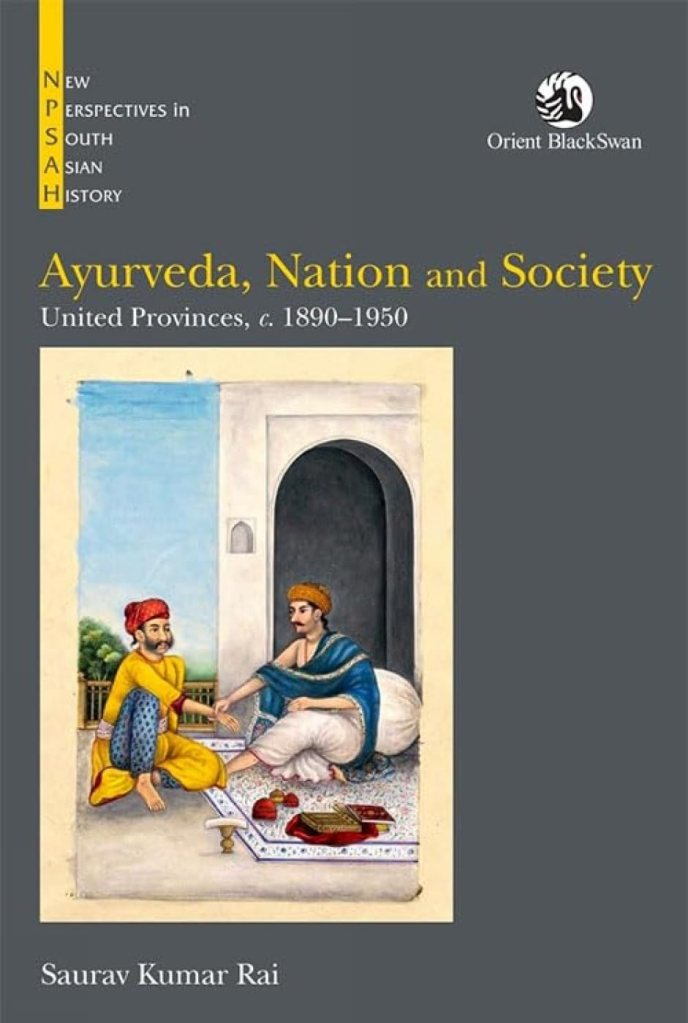
Title: Ayurveda, Nation and Society: United Provinces, c. 1890–1950
Author: Saurav Kumar Rai
Publisher: Orient Blackswan
The ayurvedic revivalist movement significantly influenced medical nationalism in the United Provinces[1] during the late 19th and early 20th centuries. This period saw a concerted effort to re-establish ayurveda as a legitimate and valuable medical system in the face of colonial dominance and the growing influence of Western medicine
The revival of ayurveda was intertwined with the broader nationalist movement in India. Proponents of this school sought to assert an indigenous identity, positioning ayurveda as a symbol of cultural pride and resistance against colonial rule. This was particularly important as the demand for swaraj (self-rule) intensified, necessitating a projection of India as a modern and scientifically progressive nation.
The formation of groups like the All India Ayurvedic Congress in 1907 created an opportunity for the practitioners to come together, exchange insights, and push for the acknowledgment of their stream in the broader national conversation. These meetings encouraged dialogue on blending ayurvedic and wHindu
estern medical approaches, positioning the indigenous school as a legitimate alternative to the colonial healthcare systems.
In a way, the proliferation of ayurvedic literature in various languages during this period helped democratise access to its content. This literature aimed to transform ayurveda from a specialised knowledge system into a shared cultural heritage, reinforcing its relevance in contemporary society. The revivalist discourse often emphasised the scientific basis of ayurveda, thereby aligning it with modernity and progress.
Fascinatingly, the ayurvedic revivalists critiqued colonial medical practices, often blaming external factors, particularly the ‘Other’, for health crises affecting the Hindu population. This narrative not only served to unify the community around ayurveda but also reinforced a sense of collective identity against colonial narratives that marginalised indigenous practices.
Also, the movement led to the commercialisation of ayurvedic medicine, with an increase in its products and practitioners. This economic aspect played a crucial role in embedding ayurveda within the social fabric of the United Provinces, making it a part of everyday life and health practices
It is in this backdrop that this book holds significance. Ayurveda, Nation and Society: United Provinces, c. 1890–195o by Saurav Kumar Rai explores the historical and socio-political dimensions of ayurveda during a transformative period in India. It is part of the New Perspectives in South Asian History series by Orient Blackswan. Saurav Kumar Rai is Research Officer, at Gandhi Smriti and Darshan Samiti, New Delhi.
Says the blurb: “Ayurveda enjoys a growing global appeal, and is often touted as ‘true’ and ‘time-tested’ by contemporary political actors, governments, social groups, practitioners and NGOs in India. With ‘indigenous’ healing systems enjoying increasing state support today, an examination of the socio-political aspects of medicine, in particular Ayurveda, and its role in nation-building is critically important. Ayurveda, Nation and Society, the latest in Orient Blackswan’s ‘New Perspectives in South Asian History’ series, captures the late nineteenth and early twentieth century growth of ‘medical nationalism’ through the Ayurvedic revivalist movement in the United Provinces, and observes the ensuing change and continuity in the attitude towards ‘indigenous’ medicine in independent India.”
This study investigates the emergence of medical nationalism as reflected in the ayurvedic revivalist movement within the United Provinces, focusing on its role in the nation-building process. It offers a critique of the social dynamics of the era, drawing attention to the caste, communal, class, and gender biases that permeated ayurvedic discussions. The author contends that advocates of ayurveda played a significant role in the reconstruction of both tradition and society, frequently attributing health crises affecting the Hindu male demographic to external ‘Others.’
The book contextualises ayurveda as an indigenous medical system, delving into its complexities during the late 19th and early 20th centuries. It examines the involvement of the Indian National Congress in the ayurvedic movement, illustrating how political groups harnessed this school of medicine to foster national identity. The author further explores the influence of print media and organisational initiatives in shaping ayurvedic discourse and rallying societal support. Additionally, the commercialisation of ayurveda is analysed through its print and pharmaceutical markets, investigating the impact of economic factors on health practices. The narrative also encompasses the period surrounding India’s independence, evaluating the evolution of ayurvedic practices during this pivotal transition.
This book stands out as an important resource for those looking to deepen their knowledge of health and medicine during colonial India, attracting both scholars and general readers who are curious about the development of ayurveda and its relevance today.
[1] Present day Uttar Pradesh and Uttarakhand in India was called United Province during this period
Bhaskar Parichha is a journalist and author of Unbiased, No Strings Attached: Writings on Odisha and Biju Patnaik – A Political Biography. He lives in Bhubaneswar and writes bilingually. Besides writing for newspapers, he also reviews books on various media platforms.
PLEASE NOTE: ARTICLES CAN ONLY BE REPRODUCED IN OTHER SITES WITH DUE ACKNOWLEDGEMENT TO BORDERLESS JOURNAL
There is a large grey wave painted in the middle of the canvas. It is falling over a large group of people standing on the edge of a seashore. Many men wear skullcaps. The women have black burkas. The group has widened eyes and open mouths. Some have turned their backs to flee. Others have raised their arms and clenched their fists, as if they are about to break into a run.
At the bottom of the canvas, on the left, there is another group of people. They are also standing on another seashore, with windswept hair. There is a woman with a large sindoor in the middle parting of her hair. A young man, in jeans, has a necklace with a gold crucifix. A boy stands with a placard showing a dove with a leaf in its beak. The words, ‘Let’s all live in peace,’ are written in bold, red letters. Others raise placards with slogans like ‘Say No to communalism’, ‘Syncretism is in our DNA’, and ‘We are all brothers and sisters in this great nation’.
Painter Ashraf Mahmood steps back and stares at the image. A slight smile plays on his lips. He had woken up that morning and this image had come floating into his mental screen. Ashraf kept staring at it, eyes closed, lying on his back. His wife had got up and gone to the kitchen. Alia liked to make her tea using Tata Gold. He preferred Brooke Bond Red Label. So they made separate cups.
When he entered his studio on Mira Road, in Mumbai, at 9 am, he got down to work, using an easel and grey paint.
He worked steadily. It was silent inside. But Ashraf did register the outside sounds of a typical Mumbai street. The horns blowing. Tendrils of smoke from exhaust pipes floated in through the window. His nose twitched as he noticed a foul smell. It seemed as if somebody had thrown garbage on the street. Ashraf closed his nose with the tip of his fingers for a few seconds. “The crazy smells of Mumbai,” he thought.
He grew up near Mandvi Beach in Ratnagiri (343 kms from Mumbai). The air was fresh, and the wind blew constantly. The only sound was the roar of the waves and the beautiful sight of seagulls making circles as they flew above the sea. Ashraf’s father, Mohammed, was a government school teacher. His mother was a homemaker. He had two elder brothers and three sisters. Ashraf was the youngest. He displayed artistic talent from his school days.
Unlike most fathers, Mohammed encouraged his son. His father took him to an art teacher, who taught him how to draw and paint. Ashraf’s major breakthrough happened when he got admitted to the JJ School of Art in Mumbai. After that, there was no looking back…
It was evening when he finished the work. His soles ached. Ashraf had been standing for hours.
This image reflected all that he felt. The grey resembled the growing intolerance towards Muslims. This seemed to be overwhelming especially in places like Uttar Pradesh and Madhya Pradesh. There was the rise of majoritarianism. And the fracturing of relations between people of different communities. And yet, Ashraf felt that the DNA of the people over centuries was syncretic. A ready acceptance of people of all faiths.
It was only the hate campaigns, through speeches, social media, and songs, that had swayed the people. He was sure the fever would die one day. Syncretism would rise again. “After all,” he thought, “throughout human history, love always conquered hate. But it took time.”
Ashraf wanted to tell the viewers of his work not to lose hope. And hence the pigeon and the symbol of peace. For the title, he used a quote by the Greek philosopher, Aristotle, “Hope is the dream of a waking man.”
Ashraf rubbed his chin a few times and walked to a table on one side. A packet of fresh buns lay on the table. Ashraf opened a fridge. He took out a container which contained butter and a bottle of strawberry jam. He sliced the bun into half with a stainless steel knife, placed butter and jam in between, and began eating it. These were fresh buns from a nearby bakery. Ashraf had bought them when he had stepped out for lunch. He made tea on the gas stove. Then he sat on a stool near the table and sipped it.
This was his 35th year as a painter. Now, at 55, he could look back with reasonable pride. He took part in regular exhibitions and won a few awards and grants. Profiles of him appeared in the newspapers and on social media. His paintings sold, thanks to his realistic and simple style. An art sensibility was only gradually building up among the people. Ashraf knew that images drawn from his unconscious mind had a pulling power. Why this was so, he did not know. He remembered how one art critic described a David Hockney painting as having a ‘psychological charge’. Hockney was a renowned English painter. Ashraf realised that art needed to have a psychological charge if it had to have an impact.
But Alia had already made an impact on him. He met her when she came to view his exhibition one day at the Jehangir Art Gallery. She was slim and tall, with curves that were accentuated by the chiffon saree she wore. Like Ashraf, she came from a small town. Through grit and perseverance, she passed competitive exams and got a government job. They went for dates. Ashraf was smitten. Within a year, he proposed and they got married.
Alia was a superintendent in the sales tax department. She would earn a pension once her career got over. She had another ten years to go. Their two daughters had married and settled down in Aligarh and Delhi. Both had two children each, a boy and a girl.
Alia wanted Ashraf to earn more money. But he was not a hustler or a man who liked to build a network. If a buyer came and offered a decent price, he sold it. Most of the time, he remained isolated. Sometimes, he met other artists at exhibitions and art seminars. He would chat with them. But that was all.
He was not keen on extramarital flings or experimenting with drugs or drinking too much. Ashraf led a steady life. In many ways, he was happy with the way his life had turned out.
He washed the cup and the pans. Ashraf placed the cup on a hook which hung on a wall. He had yet to finish the bun.
He made his way back to the painting. It was 5.30 p.m. In half an hour, he would close his studio and walk back to his house, fifteen minutes away. The couple owned their apartment. Alia, with help from Ashraf, had cleared the bank loan over 15 years.
At this moment, he heard a murmur of voices from outside the door. Ashraf wondered what it was. The sound arose. “Was there an emergency?” he thought. “Is the building on fire?”
He came to the door. Ashraf saw that the lock was coming under strain. It seemed to be bulging backwards towards him. Somebody gave a violent kick and the door sprang open. Ashraf moved to one side.
A group of young men rushed in. Some wore red bandanas. Many were in T-shirts and trousers. Some had thick, muscular arms. They were shouting. It seemed like slogans. In his shocked state, Ashraf could not register the words. They rushed to the canvas on the easel. One man, using a long knife, sliced the canvas into two. He pushed the easel. It fell with a clattering sound to the floor.
There were a bunch of finished canvases placed on one side. Ashraf had been doing work to showcase in an upcoming solo exhibition. The group spotted it. They rushed there, pushed the canvases to the floor, and began ripping them one by one with their knives. Within a few minutes, the work of several months lay ripped out. Ashraf remained by the side of the door. He had not moved.
“Hey you Muslim kutta (dog),” one of them said. “We will come again if you carry on working. No art for Muslims. Clean the sewers. That’s the only job you are good at.”
Ashraf half-expected one of them to stab him. But they didn’t. They left as quickly as they came.
Ashraf felt as if a large, round ball had settled at the base of his throat. He could not swallow it nor could he spit it out.
He blinked many times. Ashraf wasn’t sure whether this event had actually happened. It took place so fast. But there was no doubt about the ripped canvases lying all over the floor.
He felt a pain in his heart. Ashraf rubbed the area. “I hope I am not having a heart attack,” he thought to himself, as he took in lungfuls of air to calm himself down. Employees from other offices on the same floor came to the door. They entered. Most had goggle-eyes.
“Sir, what happened?” one young man said.
Ashraf shook his head.
“I don’t know,” he said.
“Who were these people?” a woman said.
“No idea,” Ashraf said, as he surveyed the damage.
“Sir, you will have to call the police,” another man said.
“Yes, I will,” said Ashraf.
A couple of men shook his hand.
All of them surveyed the damage silently. Work was calling them. “All chained to their desks,” thought Ashraf. “At least, that way, I am free. No boss on top of me. No attendance marking every day. No targets to meet. No one shouting at me. But then, no steady income. And no camaraderie. Large amounts of time spent alone.”
Then he returned to the stool, returned to the present, and placed his head in his hands.
‘What’s happening to this country?’ he thought. ‘‘There seems to be a collective madness. Indians attacking Indians. And these young people were ruining their lives by working for political leaders. They will be used and discarded.”
He had not seen them before in the locality. They might have come from some other area. Was it a deliberate ploy to send a shock wave through him and the community? Who knew how they thought?
What should he do now?
Ashraf realised he had to think rationally. He stood up and went to the door. He realised immediately, he could not do anything immediately. A carpenter would have to be called tomorrow.
He called Alia and informed her about what had happened. She said she would come directly to the studio from the office. Ashraf called up his media contacts, both in the print and visual media. They said they would arrive with their photographers and cameramen. Ashraf took several photos and videos on his mobile phone, documenting the damage.
He would have to report the attack at the police station and file an FIR.
Ashraf realised his work had been ruined, but he would recreate it. He had photos of all the canvases.
To prove to himself, he had returned to normality, he went back to the table and finished the rest of the bun. He put the butter and the jam back into the fridge. He washed the plate and the knife.
Fifteen minutes later, Alia arrived.
In silence, she stared at the canvases lying on the floor. Ashraf saw her press her hand against her open mouth. He realised it was a silent scream.
In the end, she came up to Ashraf and said, “They have tried to violate your dignity as an artist and a person.”
The couple hugged.
After a while they broke away.
“Don’t keep the canvases here anymore,” she said.
Ashraf rubbed his chin with his fingers.
Finally, he nodded.
“There was something strange about the attack,” he said. “They didn’t overturn the table or the fridge. And for some reason, they did not assault me. It seemed to me they had to leave in a hurry. So I got saved.”
Alia said, “They are keeping a watch on everybody.”
“Yes, I read online there is a pervasive deep state,” said Ashraf. “In every neighbourhood there are spies who report about all that is happening.”
“What is the next step?” she said.
“I am waiting for the media to come. After that, I will file the FIR,” he said.
At that moment, a few print and TV journalists arrived.
Ashraf spoke to the reporters. The photographers and cameramen began recording all that had happened.
They left after half an hour.
The couple then shut the door, as best as they could. But there was a small gap at one side. They went to the police station. The police allowed an FIR to be filed against ‘unknown persons’. He faced no hindrances because, as Ashraf surmised, the police were aware of his reputation as an artist.
The couple took an autorickshaw and returned to their apartment.
Alia changed into a nightgown. She washed her face, and informed their daughters about what had happened on her mobile phone.
Ashraf changed into a T-shirt and shorts. He made a glass of whisky mixed with water for himself. Every night he had one peg.
As he sat on the sofa, nursing his drink and staring at the TV screen, he felt the pain arise in him. It was an ache in the middle of the chest. To see his work treated in such a callous manner was a calamity. He wondered whether he would ever overcome this fear that had come into him. Work on a piece the whole day and in the evening, somebody could come in and rip it up.
Closed doors did not offer any protection. It was a time of lawlessness. People with criminal behaviour could operate with impunity. Leaders wanted to instil fear in people.
And would he be able to recreate these ripped-up paintings with the same intensity? He was not sure.
On the screen, some leader was having his say. His eyes enlarged, he made violent movements with his hand, and spoke with a loud voice. “Horrific,” thought Ashraf. “How do you create art in this environment?”
Yes, indeed, how do you?
But it did not take long for him to tell himself, “But we must, whatever be the cost. Art is the candle that brings light to the darkness.”
.
Shevlin Sebastian has worked for magazines like Sportsworld, belonging to the Ananda Bazar Patrika Group in Kolkata, The Week, belonging to the Malayala Manorama Group, in Kochi, the Hindustan Times in Mumbai, and the New Indian Express in Kochi. He has also briefly worked in DC Books at Kottayam. He has published about 4500 articles on subjects as varied as films, crime, humour, art, human interest, psychology, literature, politics, sports and personalities. Shevlin has also published four novels for children.
.
PLEASE NOTE: ARTICLES CAN ONLY BE REPRODUCED IN OTHER SITES WITH DUE ACKNOWLEDGEMENT TO BORDERLESS JOURNAL.
Story by Ilma Khan, translated from Hindustani by Janees
Songs of Freedom bring stories from women — certainly not victims, not even survivors but fighters against the patriarchal status quo with support from the organisation Shaktishalini
Dr.Ilma Khan is 24 years old, was born and brought up in Rampur, Uttar Pradesh, India. She is studying BUMS (Bachelor of Unani Medicine & Surgery) and currently practising in the same field. Ilma loves to describe herself as ambitious, flawless and fearless, believing in ‘good vibes’, big dreams, and self-love always.
Dear Me . . .
2023
This year I met the most broken version of me, but also the strongest…
24 years ago…
Wednesday, 11 November 1998,
I was born into a family where when a woman is pregnant, she was expected to deliver a baby boy, but I was born…
I do not remember my childhood, but I do remember my family always wanting a boy. And so here we are with seven sisters now and one brother. I always wonder why they always wanted a son? What would have changed in their lives if they had a male child?
This greatly impacted my life and I decided to take matters in hand. I decided to do all the work which a boy could do. That didn’t seem to help much because I was constantly reminded of my ‘disabilities’, that ‘physically I was a girl and I should know my limits’, that I ‘should remember that one day when I would turn eighteen and I would get married. My parents’ house was just another impermanent motel’.
So, I started believing that this is my parents’ house and after marriage I would go to my husband’s house. But what if … they tell me someday that, ‘this is NOT YOUR home!’.
THEN WHERE EXACTLY IS MY HOME?
— LETTER TO MYSELF —

Dear Ilma,
I am meeting you after so long. You know it's been six years since we talked…
Just wanted to tell you that you were so genuine and innocent. I remember you always worried about little things, but you know this time it's different -- as in a ‘good different’. The Ilma I know now is strong enough to face her own journey. She has faith that she can always stand up for herself. The only things that haven't changed are the fact that she still likes to chill like you, she loves the rain, she does everything which is full of madness and enjoys every little moment of her life, she loves snow too…Though you were quieter than her you know. This Ilma -- she is aggressive, bold -- unlike your shy and scared self…
Oh yes and her nails have finally grown. She doesn't gnaw her nails like you. She loves to put paint on these. Can you imagine that?
Since that time, I started dreaming of having my home, a life full of adventures and freedom. But as I grew older, my family and relatives started asking about marriage. I was studying in college at that time.
I was completely shattered that I was very close to my career goals, but all this will stop me from achieving my dreams. Religion of course played a very important role in my life, as I was allowed to do things under ‘some limits’ because my family believed so.
I was just sixteen years old when my engagement was fixed with one of my cousins while my heart cried out in loud protest. But I was not able to express this to anyone. I decided that I would do something for myself — so that I could respond to all that was happening to me in which family members were complicit.
I had studied hard. When I completed school. I gave entrance exams and got selected for the medical profession. Since that time, I have been trying to tell my family members that I do not want to marry the person they choose.
Everything was going fine. I was living my life, but one call changed everything.
— LETTER TO MYSELF —

Dear Ilma,

I know you always wonder how you will pursue your career, how you will live your life if allowed to live on your own terms, about how smooth things will go if a person or your family will let you go or just abandon you or not want you to live by their rules.
But don't worry now because time has changed things, she is doing every single thing step by step, the way you thought it would be in future.
She is here to fulfill your dreams. I know you love to help the one in need. You know she has got a platform where she learns these things and is helping other ‘survivors’.
I promise when you will see this Ilma, you will be amazed because she is exactly the way you wanted her to be.
My mother called me, and said, “We are coming to pick you up after 3 days. You are getting married. Resign and come back with us. We have to do the preparations.”
I was silent. I could not utter a single word during the call. A feeling of hopelessness and helplessness mauled at me.
Somehow, I managed to muster the courage, assemble my shattered self together and called my mother –
“I don’t want to resign. I want to work. I want to be financially independent. I can’t marry now. This is not the right time.”
“No! You are 23 now and this is the right age. We have made the decision!”
“I don’t want to marry that person. He is annoying and this is final! I am not coming home!”
“How dare you talk like this? We are coming now to get you and you have to come with us. There’s nothing you can do about it.”
I was thinking about my next step. I took help from an NGO2 and they helped me. When my parents came, they promised that they would not ask me to marry any person and they would allow me to study. Somehow, they managed to convince me emotionally, and I decided to go back home with them to celebrate the festival of Eid.
When we were home, suddenly the behaviour of my mother changed, she snatched my phone and said, “Now do whatever you can? We will see how you will say no to marriage. There, we were helpless because of that NGO but now it’s all our say.”
REMEMBER THAT HEIGHT OF FEAR WHEN…

Her parents abused her physically with a belt, blood was coming out from her nose and head.
After all those arguments her parents finally decided to take her life and locked her in a room.
She was locked up in a room, with no hope of light in the darkest time. She was afraid, they were talking outside the room – planning and plotting. Her uncle was fighting with her family members to let her live. He was asking them not to kill her – to spare her. She lost all hope. Every second she was breathing, thinking this could be the last, this could be the last… this could… be the… last.
It was difficult to control her emotions. Her nose was bleeding, her tears were not coming out, her lips were dry with fear, she was shivering that this could be her last day and she could do nothing to save herself.
You’re alive today, Ilma. You lived through that time. The peak of fear.
But somehow, I was saved… and then I was screaming, crying… I wanted to disappear.
The next day I decided to do anything and everything to save myself, my life. I contacted many NGOs and left my home…and never looked back. How did it all happen? I am yet to make sense of it. One moment, I was trapped and hopeless, and the next moment, I was running for life.
Since then, I have been independently living on my own. I am currently studying, and at some point, I think that everything needs to be left alone – your past, even your pain.
But, yes, I remember when I was young, I thought that I would be helping poor people and I would do something through which I could be the person who would make others happy…
I decided to be a doctor and today it gives me hope and happiness which I cannot define in words. The very first time when I went to the gynaecology department and my duty was in the labour room. When I went there regularly for one month, I used to practice how to deliver a baby. After a few months, I learnt to do that on my own and when I helped one of my patients in delivering her baby, that was the best thing that ever happened to me in life…
The smiles on their faces were precious. Her mother-in-law gave me her blessings and all of them were just so happy.
So many times, I have tried to save the lives of people, pushing through to give them hope even if the situations are not in their favour.
Today when I go to the hospital and my patients, who are very ill and are in pain, give their blessings placing their trust in me, I realise what I’m living for.
YOU SHOULD KNOW --

You were in a toxic relationship, you know, you should know about red flags now. Why do you chase such people who don't value you, who don't care about the efforts you put into everything? You know she wants to be valued and respected by every individual she has in her life.
Things are very different now, but those memories of you with your family, she misses that.
Tell everyone in the past that she has moved on from things and no one can make her feel inferior.
And at last, I just want to say that I am so proud of everything you’ve done. Because of you, she discovered that she is fierce, and strong, and full of fire, and that not even she could hold herself back because her passion burned brighter than her fears.
Will meet you soon. Love and only love.
ME. YOU. US.
I faced a lot of hardships in life – mentally, physically, verbally, and socially. Despite being triggered by those memories I chose to live… I chose to live freely, I chose to love myself, I chose to owe myself a life which I dreamt of from an early age.
I was scared, but I realised that I am my own power. On certain days, when self-doubts creep in, I tell myself that I am worth every great thing. All that I have done till now. I am capable of reaching my dreams even if they’re beyond the stars. It’s only a matter of time. You look back and thank yourself for not giving up and for treating yourself with respect and kindness.
Now I am manifesting my life, my dream and everything I have wanted. I am becoming the best version of myself, and I deserve good things. This moment is always precious to me, the most satisfying moment of my life.
And I think once you choose HOPE, everything is possible in life…
“Establishing itself as a premier women’s organisation in India from 1987, Shaktishalini has spread out and deals with all kinds of gender based violence. A shelter home, a helpline and more than that a stunning activist passion are the hallmarks of this organisation. “pandies and Shaktishalini – different in terms of the work they do but firmly aligned in terms of ideological beliefs and where they stand and speak from. It goes back to 1996 when members of the theatre group went to the Shaktishalini office to research on (Dayan Hatya) witch burning for a production and got the chance to learn from the iconic leaders of Shaktishalini, Apa Shahjahan and Satya Rani Chadha. And collaborative theatre and theatre therapy goes back there. It is a mutual learning space that has survived over 25 years. Collaborative and interactive, this space creates anti-patriarchal and anti-communal street and proscenium performances and provides engaging workshop theatre with survivors of domestic and societal patriarchal violence. Many times we have sat together till late night, in small or large groups debating what constitutes violence? Or what would be gender equality in practical, real terms? These and many such questions will be raised in the stories that follow.” — Sanjay Kumar↩︎
Title: I am Not the Gardener:Selected Poemsby Raj Bisaria
Author: Raj Bisaria
Publisher: Terra Firma, Bangalore
Here is a book that I have been waiting for. In several sittings you go through these breathtaking poems by Raj Bisaria. A book that needs to be read with patience and, if you have had the privilege of being taught by him, you read with a curious eye. Soft and gentle – a touch of an artist gently goads you to read it loudly– as if you are in an auditorium reading out to an unknown audience. Who will listen to this voice of a gardener who with I am Not the Gardener weaves seasons of delight “telling of one’s heart is not self-gazing” but divine contemplation?
The book does not carry an introduction to the author. It has forty-three poems with photos capturing moments with family and friends. A few pictures of the domes and spires from Lucknow too add a special meaning to the verses. As director, producer, designer, actor and professor, Raj Bisaria has left an indelible mark. Press Trust of India described him as “Father of the modern theatre in North India”. Raj Bisaria founded Theatre Arts Workshop in 1966 and Bhartendu Academy of Dramatic Arts in 1975 in Lucknow. He taught English literature for more than three decades at the University of Lucknow. He is the first to receive Padma Shree from Uttar Pradesh for his contribution to modern theatre. As a theatre artist his contribution remains unparalleled.
The first poem in this collection is ‘The Curtain Boy’. The poem is a thoughtful mediation on the meaning rather meaninglessness of all our actions. The poet writes “I am not the gardener, / Nor the owner of the garden. / My job is to do odd things/ To weed out little wrongs/ To keep the pathway clean”. ‘Odd’ and “little” acts of “watching” lead to an awareness of the burden of possession and the transitory nature of dreams. And this is followed by a similar concern in the poem ‘To a Young Actor’ – “I was told once to discipline/ Imagination in the rhythm/ of iambs and trochees. Only I wonder / If external form will give / Meaning to chaos.”
The poet, artist, and the philosopher in him create a complex mirage of emotions that reflect the restlessness and the anxiety of a man who finds comfort in words. “In your dying/ My love has found / A new lease:/ For beyond death / Only love goes on”, the poet expresses his love for his mother in the poem ‘Elegy’. Like Hamlet he gives voice to his own fears and then affirms with a defining certitude “Love is a quiet secret, / The seed within the rose.” The images are drawn from garden to the sea and the mountains “And I learnt to be silent / with the unspeakable granite of the mountains.”
Travel as a motif binds his restless spirit and opens the unreachable corners of his heart. Love and fulfilment are contraries in a world trapped in the mundane. In his poem ‘Byzantium’, Yeats refers to “The fury and mire of the human veins”. An artist seeks perfection in this imperfect world. The desire to transcend the ordinary compels him to write. The debut collection of poems gives us fascinating insights as Bisaria draws us to a wide range of experiences with a cry for attention “Do not shut my words out. It is winter.” Here in lies an assertion with a sad awareness that yes, life is ending. The artist within and the performer without must often be traversing contradictory spaces. Both are equally strong and vulnerable.
Sometimes the voice of the performer seems to undermine the anguish of the poet. “He who does not forgive himself/ Forgives others less.” These are poems of love, longing, grief, and interminable loneliness that invades an artist whenever he confronts his inner self. Those familiar with Bisaria’s dramatic productions might find a different voice lurking behind these poems. It requires courage to accept one’s vulnerabilities, to confront the inner daemons and to pour an array of emotions with a faith that only an eternal seeker can display. “To your shrines I came my Lord, / But I came without faith; / To your people I spoke my Lord / But I spoke without love; …Yet give me Lord peace/ To bear my own emptiness, / And your silence /Quieten my doubting mind.” This is not just a poem with the title ‘Prayer’, but a plea that resonates with a quest for self-realisation.
A sadness runs through these poems. Read and receive every word, every glance, every touch of this mortal self where “Love comes slowly by and by…” and the poet firmly believes “Love’s life is more than time…”. “It is a flight in the freedom of self…”. Even if you try hard, it is difficult to run away from oneself. Like a shadow your inner conscience follows you, here, there, and everywhere.
Ranu Uniyal is a poet and a Professor from the Department of English and Modern European Languages, University of Lucknow.
.
PLEASE NOTE: ARTICLES CAN ONLY BE REPRODUCED IN OTHER SITES WITH DUE ACKNOWLEDGEMENT TO BORDERLESS JOURNAL
That day, the vast crowd on the road took me by surprise. I was riding back home from the school in the village where I teach. People had jammed the road near a cremation ground. I stopped my bike to ask a man: “What happened? Why are there so many people on the road? They must be thousands in number, don’t you think?”
“Don’t you know? Manglu died this morning. All these men have come to attend his funeral,” the man told me.
“Oh, was he a great leader or saint?”
“No, he was a great funeral attendee.”
“A funeral attendee! I had heard of poets, leaders, and saints whose funerals attracted a crowd like this but never of someone called a funeral attendee. What was so special about him?” I asked again.
“Manglu never left a funeral unattended if he came to know about any death nearby. It was his legacy.”
“Oh, achha[1]!” interjected I, and, having nothing to say more, started the bike.
“What is so great about that?” I thought. But the crowd I was moving amidst defied the arguments my thoughts provided. This dead man must have been a man extraordinaire in his lifespan.
But who cares?
I made my way somehow into the crowd and moved the bike ahead.
I came home. The day went as usual, but I realised that I could not stop thinking about that funeral attendee.
The next day, in school, during recess, when I put a question about the dead man while chatting with my colleagues, it at once caught everyone’s attention. The head teacher, a greybeard, and a native of the village knew about him. He narrated Manglu’s story:
“About thirty years ago, Manglu had to leave his native village Kherupura due to the disastrous flood. He could never return, for the flood had engulfed his village. The whole of it had vanished into the Rapti.
“Manglu had nowhere to go. His father died in that flood. His mother had died earlier — a few years ago, and, as he had no sibling, he was left alone with his wife, who was pregnant at that time.
“He had to move out. Destiny forced him to live a nomadic life. He came to live in Silva village near the main road, which connected two headquarters of the adjacent districts – Shravasti and Bahraich.
“At first, the couple lived under a tree, but later on, seeing the condition of Manglu’s wife, the village head gave him a small piece of land. On it, he built a mud house. They lived happily for a few months, but Manglu could not save his wife till the following year. She died, I believe, during her childbearing. Manglu was all alone after that tragedy. He had no one whom he could consider as a family. His relatives were living in different places. He could go to any of them, but he decided to live on his own in the village.
“To make ends meet, he worked as a woodcutter, a labourer, and a hawker, but he never left the village. After his day job, he actively participated in village life and attended every function and funeral, either invited or uninvited. Since he had no one he could call his own, he started regarding everyone as his own. No one took him seriously, but he maintained this routine.
“After many years, finding himself unable to do hard physical labor, he opened a kiosk-like shop by the roadside where he sold petty items like cigarettes, tobacco, and paan[2]. He made acquaintance with everyone who came to his gumti[3]. Motorcyclists, bus drivers, hawkers, rickshaw pullers, peddlers, and beggars – men from all walks of life were his friends. In a year or two, Manglu acquired such fame that people started talking about the directions and distances by referring to his kiosk as a distinctive landmark.
“Manglu never indulged in hoarding money; he devoted himself to making friends. Anyone could purchase from him on credit. And such a good-natured man he was that even the vilest man paid him back.
“He widened his social circle. People from adjacent districts knew his name and his thatched kiosk. I would say that he was more famous than a monument. In those days, too, he never left any funeral unattended, either in his village or in any other ones. If the dead belonged to another village, he would take a ride as soon as possible. Sometimes, people at the cremation ground wondered why he had not arrived yet, but he always arrived sooner or later.
“As he grew older, he found himself unable to run the shop. He took shelter in one of his friend’s houses to spend his last days. He could not walk straight then; he suffered from camptocormia–the bent spine syndrome, and he had to take the support of a bamboo staff. He roamed in the village all day with the bamboo staff in one hand and enquired about the well-being of whosoever came in his way. Even at that time, if someone died somewhere, he would try to go there to attend the funeral.
“The villagers thought he had a mania for attending funerals. And thus, in the last days of his life, people started calling him ‘the funeral attendee.’ He had become a piece of curiosity for the youngster in the village.
“And then, he died yesterday. The news of his death spread like wildfire. Can you believe that more than two thousand people attended his funeral? I am not sure what exactly all this resembles, but I would say that Manglu must be smiling in heaven.”
.
Glossary
[1] Connotes– Is that so? Literal translation from Hindi — yes.
Ravi Prakash teaches small kids in a rural primary school. He lives in a small town near the Indo-Nepal border in the district of Shravasti, Uttar Pradesh.
.
PLEASE NOTE: ARTICLES CAN ONLY BE REPRODUCED IN OTHER SITES WITH DUE ACKNOWLEDGEMENT TO BORDERLESS JOURNAL
Bhanu Prakash aka Ravi (Pen-name) is a teacher, poet and writer living in Uttar Pradesh, India. His poems, stories and articles have been published in online journals and in various anthologies like “Rubaroo”, an anthology by Evincepub Publication and “Whisper of Hearts”, an anthology by Oxigle Publication. He is a blogger also and writes regularly on https://www.histolit.com/. Besides writing, he is an avid reader and loves singing a lot. Presently, he is working on his first novel and his collection of stories.
.
PLEASE NOTE: ARTICLES CAN ONLY BE REPRODUCED IN OTHER SITES WITH DUE ACKNOWLEDGEMENT TO BORDERLESS JOURNAL.

 Borderless