I first became aware of the flash fiction form called the ‘mini-saga’ in the mid 1980s. They were invented by the author Brian Aldiss (1925-2017). The British newspaper, The Daily Telegraph, held annual competitions for the public and the winners were published in the newspaper and also in a series of anthologies.
I submitted a few mini-sagas on a number of occasions but never won. I never even made it as a runner-up. All I can remember of those early pieces of mine was that one of them involved a submarine that somehow was turned upside down while it was diving and went the wrong way through the atmosphere and ended up in outer space.
A mini-saga consists of a story told in precisely fifty words. They aren’t easy to do well, but they get easier with practice (like everything else). The title should have an upper limit of fifteen characters, but this rule is not such a strict one. Because there are so few words to work with, the title is often an essential part of the story.
About twenty years ago I wrote a mini-saga that I was pleased with. It was translated into Portuguese and printed on a T-shirt. For many years I regarded this as my only successful mini-saga. Later I wrote another, not as good, and then forgot all about the form.
But when I was staying in Sri Lanka earlier this year, I read Brian Aldiss’ book, 50×50, fifty mini-sagas in total, a very short collection, and I wondered if I might do something similar. But I decided to write 500 instead of 50. This turned out to be perhaps too much to chew on, but I had already bitten it off, and so I persisted and intend to keep persisting.
My book of 500 mini-sagas will be published when it is finished. So far I have written 216. Some are obviously better than others. I am pleased to now present a short selection from this project in progress.
Plate Armour
The army is on the move, crossing borders and conquering new lands, and the key to their success is mobility. They never stop for meals but eat as they go along. They wear armour specially adapted to hold the curries, pickles, bread, cheese, rice and puddings they enjoy. Plate armour.
Odysseus: Binoculars is the name. They permit you to see further. Hold them to your face in this precise position.
Polyphemus: Like this? But I can’t see a thing!
Odysseus: Quick men, let’s escape while he is temporarily blinded.
Bytes, Not Scratches
You are typing on your computer when your cat reaches out a paw and deletes your work. That’s the end of the story. If your dog does the same thing, you can say “Fetch” and it will leap into oblivion, find the document and retrieve it for you, tail wagging.
Pinocchio’s Brother
Pinocchio has a brother whose nose grows shorter whenever he tells a lie. He is the opposite of his more famous sibling in this regard. If he tells enough lies his nose retreats into his face, leaving a deep crater. He is unfortunately too popular with the fraternity of golfers.
In Sheep’s Clothing
An eccentric shepherd in these parts has dressed his sheep in pink frocks. The wolf is reluctant to clothe himself the same way but remembers he is cunning and to fulfil the conditions of his reputation he has no choice. He takes care not to be seen by other wolves.
My Nose
My nose was in the Guinness Book of Records. It’s a volume that lists the most extreme instances of various things. There’s a chapter about the tallest person ever, the longest hair and so forth. My nose was in that book. Then the librarian told me to take it out.
Going for a Walk
She said she was going for a walk with a book. I imagined she wanted to sit and read somewhere, but when I went to the park later, I saw her with a Tolstoy novel on a lead. It was opening its back pages against a tree while she waited.
The Haiku Hiker
The haiku poet went hiking and somewhere along the route he lost count of his syllables, so he just kept going. After walking far, he found an isolated tavern in the enormous forest. He fell on the beer like a shooting star. The syllables could find their own way home.
Runny Honey
Runny honey: see the jar sprinting down the street. It grew legs secretly at night in the cupboard when no one was looking. When I opened the door, it jumped out and escaped! I chase it with a spoon. I will never buy runny honey again, only the solid kind.
He was Mighty
An early start was required. He rose from his bed in the castle and called for his squire, who carefully dressed him. A frown for his forehead, an increased pulse for his chest, perspiration for his skin. Now the mighty worrier was ready! Off he went to do anxious battle.
The Toothbrush Duel
There were no other weapons available, all the swords and pistols were missing or broken, so they decided to duel with toothbrushes. They met at dawn, saluted each other, then battled for an hour on the field of honour. Toothpaste squirted into the air. It was a good, clean fight.
Something More Comfortable
The woman took the man home. They had met only an hour before but had felt an instant attraction. “Allow me to change into something more comfortable,” she said. He nodded eagerly. In a flash she transformed into a big fluffy white dog that jumped up to lick his face.
.
Rhys Hughes has lived in many countries. He graduated as an engineer but currently works as a tutor of mathematics. Since his first book was published in 1995 he has had fifty other books published and his work has been translated into ten languages.
.
PLEASE NOTE: ARTICLES CAN ONLY BE REPRODUCED IN OTHER SITES WITH DUE ACKNOWLEDGEMENT TO BORDERLESS JOURNAL
Chapter 7: Better To Enclose A Cat Than to Scold It
Clothes shops kept irregular hours in Takayama. Three different days, at three different hours, we tried to visit a local vintage store, and each time we found it closed.
It was refreshing to see that a country that had appeared, at first, such a stickler for rules, actually had a whole community that seemed to do the opposite of what was expected.
‘It is ikigai,’ explained James, the bald Kiwi ALT whom we had called Jēmusu (the Japanese word for James) as a joke.
‘What is ikigai?’ I asked. ‘A fish?’
‘No,’ he said with a grin. ‘Ikigai means finding your purpose, your meaning in life, and combining it with your profession, your work. It is the balance of doing what you love while making a living and letting neither path control your life.’
I didn’t really understand ikigai until one spring day I actually found the vintage clothing shop open and went inside to explore as I’d longed to do for over a month. The owner, G-Kun, a snowboarder in his early thirties who wore his long black hair tied back in a ponytail, was busy checking orders on his computer.
Ryan was looking at skateboard tee shirts while I browsed some different-coloured beanies made from hemp that I loved and would probably never wear.
‘I’m so glad I finally got to come in,’ I said to G-Kun.
‘Why has your store been closed so often? Were you ill?’
‘Not at all,’ he replied with a friendly smile. ‘I have just been concentrating on something else.’
‘Like what?’
‘My music career.’
I stared at him.
‘I travelled in Europe some years back and became friendly with some European DJs,’ he continued. ‘I ended up co-producing some dance tracks with them.’
He had my rapt attention. To my very British mind, this was an entirely new concept. I had been told as a child to forget working with horses and get a job in a bank, because in England I was supposed to be a responsible adult with a steady good-paying job doing something I loathed rather than something I loved.
But in Takayama . . . Was what G-Kun telling me real? Could an avocation and a job actually be combined? And if they could, did I have my own ikigai, something that would bring deep satisfaction to my life?
Once I understood ikigai, I saw it all around me. In Takayama, many people had turned their passions into businesses from which they earned an actual living wage. Of course, that’s not to say all Japanese follow ikigai but it seemed widely practiced here. And then there was Keisuke, who worked in a brewery and wanted to start his own saké company someday.
Twenty-something Keisuke was not particularly well educated or rich, but he seemed more contented than anyone I’d met in a long time. In fact, he was so happy and so passionate about his job that I never saw him in anything other than his cream-coloured brewery overalls.
One night in Keisuke ’s apartment, he proudly poured me his employer’s clear rice wine into a tiny white and blue ceramic cup, beaming with something more than pride.
Ryan took the first sip and beamed back at him. ‘This is good stuff! You’ve got the saké magic, Keisuke-san. Like Harry Potter.’
‘So, so, so,’ Keisuke said and paused for a moment to think. ‘You know what, I am not Harry Potter. But I am . . . the Saké Potter.’
And from that day on, that’s exactly what we called him.
A few nights later, while out for dinner with some friends, we came across a stray cat that was to begin my search for ikigai.
‘Kawaisō, it’s such a shame,’ Sayuri said. ‘There’s so many noranekos [stray cats] in Takayama. It’s sad.’
I leaned down to pat the bedraggled kitten and he tapped me with his paw, as if begging for more. ‘Poor baby,’ I said. ‘He must hang around the restaurant in the hope of getting food scraps,’ I said.
‘The staff probably feed him,’ Ryan said as he joined us, the kitten instantly turning to him for attention.
‘What should I do?’ I asked.
‘Why do you have do anything?’ Mike said, joining us.
Takako, our friendly waitress was standing at the door and confirmed our suspicions about the kitten. ‘Hai.Nora-neko desu.’ (Yes. It is a stray.)
‘Come on, you can’t save them all,’ said Dominic as he marched off down the pavement.
Reluctantly, I followed him, along with the others. But, as we wandered tipsily back to our apartment, the kitten tried to follow us. He looked unwell. Snot was dribbling down his scrawny face. Everyone picked up their pace.
I forced myself not to turn around as we walked back home. If I had, I’d have scooped that kitten up and to hell with the consequences. Actually, that would have saved me time and trouble, because when we got back to the apartment, all I could think about was the abandoned kitten with the big affectionate personality struggling to survive outside all by himself.
Our friends stood in the kitchen noisily making plans about how to get to the next party, oblivious to the kitten’s plight. I was unable to even smile, let alone participate. ‘I’m sorry. I’m not going to make it to any more parties or bars tonight. I’ve got a headache, so I’m going to stay here,’ I said.
After the noisy crowd, including Ryan, had left, I tried going to bed, but I couldn’t sleep. I was unable to purge the image of the friendly little feline from my mind. Finally, fuelled by Chu-Hai and cheese sticks, I got dressed, crept outside, grabbed my bike, and cycled along the fluorescent-lit pathway armed with dry cat biscuits and a cat carrier.
Sure enough, with no other place to go, the kitten was still at Murasaki begging for food and attention. He didn’t struggle one bit as I lifted him into the cat carrier and set it in the front basket of my bicycle. Apparently, taking his chances with the kindly stranger and her weird contraption was better than spending another dangerous night on the street.
I knew that Ryan would not be impressed with my philanthropy, and less than thrilled about this new addition to our household, but I also knew that this little boy didn’t stand much chance of survival if we left him on the streets. I also felt I could relate to the kitten’s predicament of abandonment. After all, I’d faced similar emotions myself as a child. Displeased boyfriend versus dead kitten? It was no contest.
Still, when I carried the cat carrier into the apartment, the enormity of what I had done hit me. Just as a matter of practicality, we couldn’t take on another kitten. We already had three cats we would have to re-home before we returned to England in December. Plus, this little guy was clearly sick. His eyes looked rheumy and painful. His nose was dripping. He might infect Iko, Niko, and Gershwin. I’d have to keep them apart. Into the laundry room he went with food, water, a litter box, and bedding. Fortunately, he had no interest in hiding under the washing machine.
Ryan got back the next morning looking a bit worse for wear, possibly hungover, and definitely sleep-deprived. Perfect. This was the right time to tell him what I’d done, while he was in a weakened state.
‘Don’t get angry,’ I said. ‘But there’s someone you might want to meet in the laundry room.’
Ryan looked at me with bloodshot green eyes. ‘Oh no! You didn’t. Did you?’
‘I couldn’t leave him there. Anyway, you’ve been gone nearly all night,’ I said, trying to shift the focus onto his fictional misdeeds.
‘Have you introduced him to the other cats yet?’
‘No, I’m waiting until I’ve taken him to the vet.’
‘Good idea,’ Ryan said wearily. He gave me a kiss and crawled into bed, leaving me to keep the cats separate as best I could, which was difficult, because Gershwin was eager to meet our houseguest.
It was at this moment that I realised I had found the start of my own ikigai. I wanted to incorporate my love of animals into my life’s work, but in order to do that, in the future I would need to find a healthier way to do so. So, my other cats didn’t get hurt.
I went to the vets that morning, surprising Dr. Iguchi when a bedraggled tabby kitten strode confidently out of the carrier, rather than Gershwin. Surprise turned immediately to concern as the kitten sat on the exam table, smiled at both of us, then sneezed violently, sending lots of yellow discharge all over the vet’s pristine white smock.
The prognosis was not good. ‘He could have feline flu,’ Dr. Iguchi announced. ‘Very contagious. Very bad. It could be much worse. He might have FIV virus.’
My stomach clenched. The dreaded and deadly cat AIDS.
‘There is a vaccine for your other cats,’ he continued. ‘For now, you must quarantine this kitten until we get his test results back.’
‘I think Gershwin has had the vaccination already,’ I said hopefully, ‘but I’m not sure about Iko and Niko.’
‘So, so, so. Gershkun had the vaccinations before, not the sisters. But you must keep all the cats away from the kitten for now.’
There was no alternative. If I didn’t want a house full of sick cats, and I didn’t, this was the only way. I just had to pray that the others hadn’t already been infected. I told myself they were strong, genki [healthy] animals and I was blithely certain they could fight off any infection, not realising in my ignorance how contagious and potentially deadly feline flu really was.
I drove home and put the kitten back in the laundry room, praying that he didn’t have anything that could kill him, or the other cats.
It wasn’t long before Gershwin wanted to go in and carouse with the kitten. He knew something was wrong straight away. He was always good at reading situations. So, he sat by the door and started meowing to be let in. When I came to see what was bothering him, he stared at me with every ounce of his feline superiority and demanded to see his potential Best Friend Forever. He uttered a particularly piercing nyan [meow] in protest at my having exiled the kitten to the laundry room.
‘You mustn’t go near him for a while,’ I said.
Gershwin rubbed his soft furry body against my even furrier legs and looked me straight in the eyes as if to say ‘Think again.’
When I wouldn’t give in to his demands, he started playing angrily, jumping onto the bookshelf, hurling himself off the top, somersaulting in mid-air, and landing unceremoniously a few centimetres from my feet.
‘Right, that’s it,’ I said as I picked him up, carried him to the bedroom, and shut the door.
It was always the same with Gershwin. Despite being a Ninja Attack Kitten, he had a delicate soul. Whenever he was reprimanded, he would become so hurt by the scolding that he’d disappear for hours (and once, for days) at the shock of being chastised. Then, it could be days before he would actually forgive us. He could out-sit our most ardent lures to be returned to his good graces. If I tried to tempt him with his favourite treats, he would sniff them with disdain, turn his back, and walk off scornfully. I was always the first to give in and let him have his way.
This time, Gershwin didn’t know best. He was banned from the laundry room. Iko and Niko took one look at the closed laundry room door, sniffed the scent of an unfamiliar feline, and avoided that part of the apartment just as they tried to avoid Gershwin when he came over all Ninja Kitten.
That night, I lay awake in bed worrying about what the test results would be. What if, in bringing this stray kitten home, I had inadvertently infected the other cats with the FIV virus? I felt deeply guilty at potentially jeopardising their wellbeing, even their lives. In trying to do the right thing by the sick kitten, I may have done an incredibly wrong thing by Iko, Niko, and Gershwin. If anything happened to them, it would be entirely my fault.
For the next week, while we waited for the test results, the poor kitten, whom I named Takashi after a jovial Bagus bartender, suffered from inflamed and discharging eyes and a badly running nose. I had never seen a cat in this condition before. His tatty coat needed some love and his sore eyes needed constant care. The vet had told me to wash them twice daily with saltwater, which helped them tremendously. He had also given me a medicinal orange powder that I was supposed to mix into his food. Cats being cats, he could smell the concoction a mile off and he was having none of it. I ended up mixing the powder with butter and rubbing it around his face, so he was forced to lick it off.
I agonised all that week. Ryan was equally concerned for the poor little guy. ‘When are you going back to the vets?’ he asked me daily. ‘You’re sure the other cats won’t get it?’ I dared not answer.
Finally, the dreaded, long anticipated morning arrived. A week after I had confined Takashi to the laundry room, I plopped him back into a cat carrier and drove off to see the vet and get the test results.
By now, I had become a regular and familiar face at the animal hospital. I was the only pet-owning gaijin in the vicinity, as far as I was aware, which meant I was a bit of a novelty in the waiting room. People stared at me and some smiled, a few of the braver ones even made conversation, which helped distract me from the potentially dreadful news I might be getting today.
Finally, Takashi’s name was called and, cat carrier in hand, I was ushered into an exam room. I waited nervously as the vet found the kitten’s file.
‘No Katto Eizu,’ he said.
Oh, thank God. Takashi didn’t have the FIV virus!
Before I could celebrate, he continued. ‘But Takashi-kun is very sick,’ Dr. Iguchi said in a somber tone. ‘He has cat flu.’
The tone of his voice was my first clue that feline flu was a far more serious disease than I had believed.
‘Very contagious,’ he continued. ‘Other cats should be immunised against the virus immediately, and Takashi-kun should be isolated from them for another week, maybe more. Keep giving him the medicine and bathing his eyes.’
My enormous relief that Takashi didn’t have a death sentence, and my fears for Iko, Niko, and Gershwin, warred within me all the way home.
CJ Fentiman with her cat
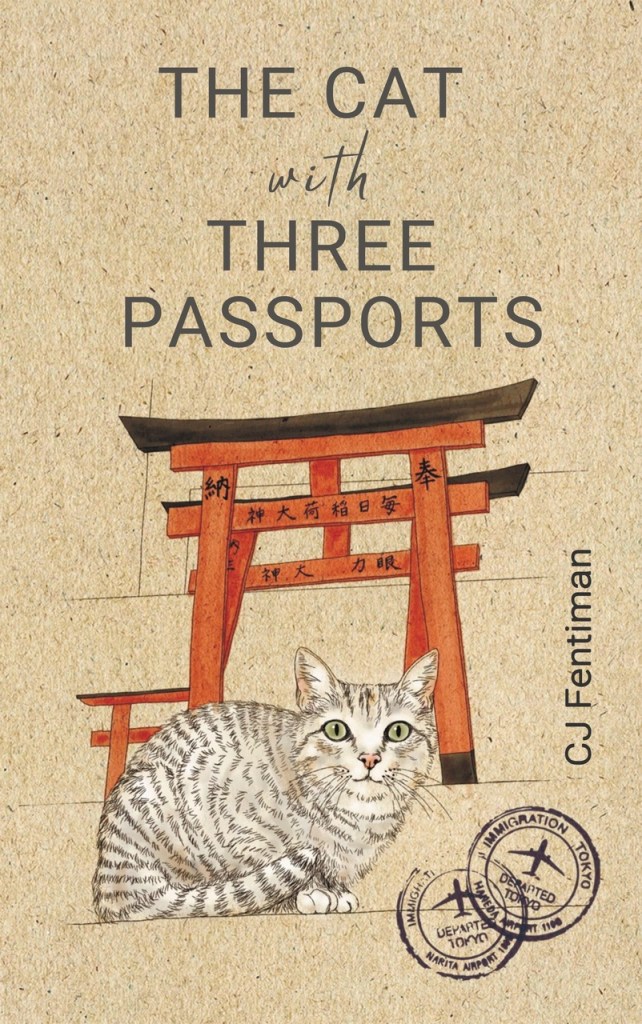
About the book: A girl struggling to fit in. A homeless kitten. An unexpected job offer in an unfamiliar country that changes everything. CJ had a long history of escaping places and people she wasn’t fond of. But for the sake of a silver tabby, she decided to stay in Japan for a while. This decision helped her open her heart and mind, revisit her way of thinking, and reconnect with her estranged family. Let this heartwarming memoir take you to the land of cats and cherry trees as you read about CJ’s adventures — from the craziness of Furukawa’s naked men festival, the experience of forest bathing and the significance of finding a life purpose or ikigai, to the temples of Takayama, and wonders of Cat Island — you’ll see what a homeless kitten found outside a temple in Japan taught her about an old culture and new beginnings.
About the author: CJ Fentiman is a British writer whose work has appeared in a wide range of the publications, from the Japan Times and Caravan World to Horses & People and Pets Bar. An expert on pet travel, she has featured in media in the UK and Australia including Readers Digest, SBS radio, Books on Asia, The Daily Telegraph, Herald Sun, the Courier Mail, and one of the biggest blog platforms on cats, Katzenworld. Her memoir, The Cat with Three Passports, received the award in animal narrative in the 2021 International Book Awards.


 Borderless