Categories
Poetry

Dusk Descends on the World

Poetry by Masud Khan, translation from Bengali by Professor Fakrul Alam

MOTHER


In the dust smeared evening
Far away, almost at the margins of the horizon,
The one who is resting all by herself

In a bed laid out under the open sky
Is my mother.
Her bed smells of grass and the antiseptic Dettol.
A tube in her nose supplies her with oxygen,
A saline bottle is attached to her arm,
And she is tied to a catheter too—
It is as if she is getting entangled inextricably
In a jungle of plastic and polythene reeds.

A smoky surreal unreal canopy encircles her bed.

Seemingly after ages, dusk descends on the world,
A few birds and insects form a chorus,
Wailing throatily obscure and dissonant tunes
In amateurish over-excited zeal,
Seeking refuge timorously in that plastic hedge,
At the margin of the horizon,
In the shadow of primeval motherhood.


A FRAGRANT TALE

The world is full of misleading, minus signs and foul smells.

At times, the world feels as heavy and unbearable
As the weight of a son’s dead body on his dad’s shoulder,
Or as stressful as playing the role of a dead soldier,
Or as formidable as a physically challenged person’s ascent up a mountain
Or as painful as caring for a precocious, traumatised child...

Nevertheless, occasionally such stress-laden memories will blur,
And suddenly, wafting on the wind’s sudden mood swing,
A fragrant moment comes one’s way!

Masud Khan (b. 1959) is a Bengali poet and writer. He has, authored nine volumes of poetry and three volumes of prose and fiction. His poems and fictions (in translation) have appeared in journals including Asiatic, Contemporary Literary Horizon, Six Seasons Review, Kaurab, 3c World Fiction, Ragazine.cc, Nebo: A literary Journal, Last Bench, Urhalpul, Tower Journal, Muse Poetry, Word Machine, and anthologies including Language for a New Century: Contemporary Poetry from the Middle East, Asia, and Beyond (W.W. Norton & Co., NY/London); Contemporary Literary Horizon Anthology,Bucharest; Intercontinental Anthology of Poetry on Universal Peace (Global Fraternity of Poets); and Padma Meghna Jamuna: Modern Poetry from Bangladesh(Foundation of SAARC Writers and Literature, New Delhi). Two volumes of his poems have been published as translations, Poems of Masud Khan (English), Antivirus Publications, UK, and Carnival Time and Other Poems (English and Spanish), Bibliotheca Universalis, Romania.  Born and brought up in Bangladesh, Masud Khan lives in Canada and teaches at a college in Toronto.

Fakrul Alam is an academic, translator and writer from Bangladesh. He has translated works of Jibonananda Das and Rabindranath Tagore into English and is the recipient of Bangla Academy Literary Award (2012) for translation and SAARC Literary Award (2012).

PLEASE NOTE: ARTICLES CAN ONLY BE REPRODUCED IN OTHER SITES WITH DUE ACKNOWLEDGEMENT TO BORDERLESS JOURNAL

Click here to access the Borderless anthology, Monalisa No Longer Smiles

Click here to access Monalisa No Longer Smiles on Amazon International

Categories
Poetry

Demanding Longevity

Poetry by Quazi Johirul Islam, translated from Bengali by Fakrul Alam

The Creation of Adam by Michelangelo(1475-1564), Sistine Chapel. Courtesy: Creative Commons
One day I too burst into protest like marginal people do
Clamouring for longevity. 

Despite evolving for millions of years
How could us civilised, highly intelligent creatures
 have such short life spans?
This should never have happened!
When a man succeeds to stand tall on his own merit
Comes the call: “Exit from this world….”
How ridiculous! No way one should accept such a summon!
A man with a life span of only 60, 70 or 80?
Maximum 90, or—with an exception or two—a century—
Does this make any sense?

Humans should live as long as they want to.
Like a ruler of any impoverished nation, 
God has seemingly dictated even our retirement age! 
Look at the developed countries of the world, O God,
No retirement age there! One retires when one wants to
And no one is forced into retirement.
Humans should live or die as long as they want to.
I want the freedom to choose death
I called out to all at the top of my voice—
“Let us all die only when we want to!”
To my protests the Compassionate Almighty paid heed
And came down to our protest meet.
Putting a hand on my shoulder, he said,
“How long would you like to live?”
I could have asked Him then to give me
Four or five hundreds, or even a thousand years of life,
But I didn’t, not being the kind of opportunistic leader
Who’ll slow down a movement by accepting bribes!
I had confronted the Almighty face to face
And told him: “Till the time you can ensure the right
To die, only when a human being wants to die,
Our movement for this cause will go on and on!      
A smile on his face, God said: “Haven’t you realised yet
It’s up to every human being to decide his or her fate!
I’ve shark bone hangers holding up millions of fleshy dresses
All kinds of fleshy dresses sway in the breeze,
But what makes you think such dresses equate life?”

“Life, for sure, is strewn across the ways of the world
Marked by the footsteps of your kind
Every day you fidget and frown
And draw images one way or the other
Serve those who are in distress or need help
Embrace trees and burst into tears
Such going-on typify your lives.

“Clothes wear and tear
There comes a day when they have to be thrown away
Do you want eternal life for your attire? 

“You’ll live by the footsteps you etch on earth
Didn’t your predecessors themselves decide on how long they would live?
Didn’t Moses, Christ, Mohammed, Buddha, Socrates, Rabindranath and Einstein
Decide in their own ways how long they would be living?

“Decide on your own how long you want to live
Stop worrying about how long your clothes will last!”  


Quazi Johirul Islam has been writing for over 3 decades. He has published more than 90 books, 39 of them are collections of poetry. His travelogues are very popular. He has been with United Nations, has traveled all over the world, worked in conflict zones, his bag is full of colourful experiences. In 2023, Quazi was awarded Peace Run Torch Bearer Award by Sri Chinmoy Centre, New York. He has also received many awards and honours in Bangladesh, India and abroad.

Fakrul Alam is an academic, translator and writer from Bangladesh. He has translated works of Jibonananda Das and Rabindranath Tagore into English and is the recipient of Bangla Academy Literary Award (2012) for translation and SAARC Literary Award (2012).

PLEASE NOTE: ARTICLES CAN ONLY BE REPRODUCED IN OTHER SITES WITH DUE ACKNOWLEDGEMENT TO BORDERLESS JOURNAL

Click here to access the Borderless anthology, Monalisa No Longer Smiles

Click here to access Monalisa No Longer Smiles on Kindle Amazon International

Categories
Poetry

Kurigram

By Masud Khan: Translated from Bangla by Professor Fakrul Alam

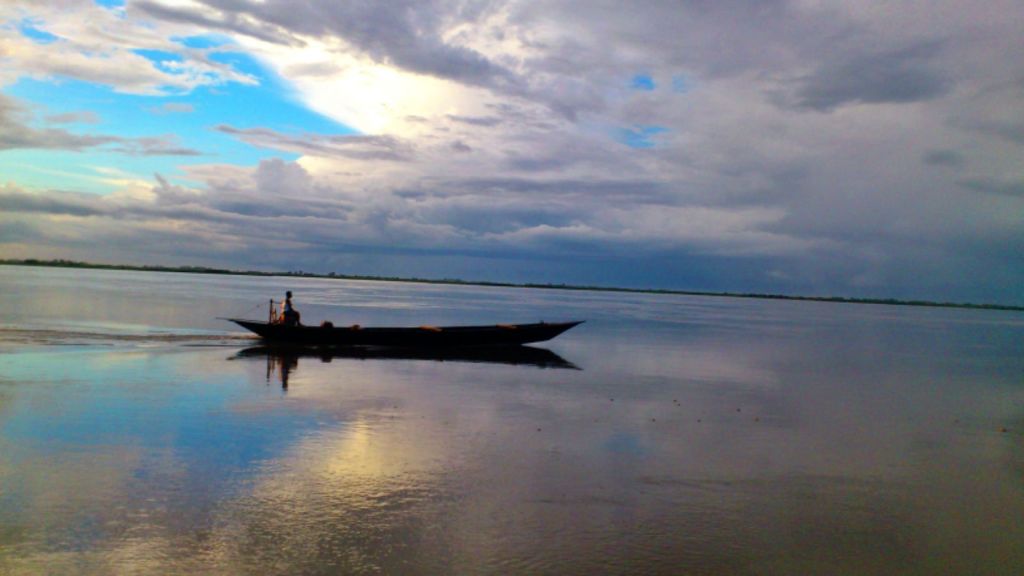
Courtesy: Creative Commons
I’ve never been to Kurigram.

In the dead of night, sleeping Kurigram steadily detaches itself 
From the world that we know.
Ignores gravity completely 
Taking off with its tiny kingdom 
To some far-off galaxy.

We keep looking then at the deep blue of the sky 
While the tiny village becomes a speck up high.

For a long while Kurigram floats from one dome of heaven to another.
Till that star in the southern sky that pursued it so single-mindedly 
Settles by its side and claims it as its own.
Then from this new luminary
A mild red vaporous smell wafts across the sky.

In that realm, in Kurigram,
The Kingfisher and the Pankouri bird are stepbrothers. 
When all the rivers of Kurigram become calm
The two brothers make the river their home 
Squabbling with each other like families bickering!

When the river calms down again
The womenfolk, once bound by scriptural edicts, 
Throng to the riverbank.
Breaking all barriers,
They sparkle like large resplendent crystals.
 
Suddenly, a lonely babui bird, sans weaving skills, 
Perched on a battered old mast, starts swinging,
Finally settling down on the translucent steel-foiled river water. 
Kurigram, ah Kurigram!

Where Kurigram used to be
Is a dark and solitary space now.

Alas, I’ve never been to Kurigram
And I don’t think I ever will!

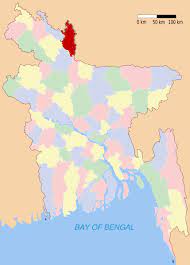
Kurigram—An innocuous town located in the northern region of Bangladesh
Paankouri—A species of bird, black in colour, found in marshes and rivers
Babui—A species of weaving bird
Kurigram is marked in red. Courtesy: Creative Commons

Masud Khan (b. 1959) is a Bengali poet and writer. He has, authored nine volumes of poetry and three volumes of prose and fiction. His poems and fictions (in translation) have appeared in journals including Asiatic, Contemporary Literary Horizon, Six Seasons Review, Kaurab, 3c World Fiction, Ragazine.cc, Nebo: A literary Journal, Last Bench, Urhalpul, Tower Journal, Muse Poetry, Word Machine, and anthologies including Language for a New Century: Contemporary Poetry from the Middle East, Asia, and Beyond (W.W. Norton & Co., NY/London); Contemporary Literary Horizon Anthology,Bucharest; Intercontinental Anthology of Poetry on Universal Peace (Global Fraternity of Poets); and Padma Meghna Jamuna: Modern Poetry from Bangladesh(Foundation of SAARC Writers and Literature, New Delhi). Two volumes of his poems have been published as translations, Poems of Masud Khan(English), Antivirus Publications, UK, and Carnival Time and Other Poems (English and Spanish), Bibliotheca Universalis, Romania.  Born and brought up in Bangladesh, Masud Khan lives in Canada and teaches at a college in Toronto.

Fakrul Alam is an academic, translator and writer from Bangladesh. He has translated works of Jibonananda Das and Rabindranath Tagore into English and is the recipient of Bangla Academy Literary Award (2012) for translation and SAARC Literary Award (2012).

PLEASE NOTE: ARTICLES CAN ONLY BE REPRODUCED IN OTHER SITES WITH DUE ACKNOWLEDGEMENT TO BORDERLESS JOURNAL

Click here to access the Borderless anthology, Monalisa No Longer Smiles