Categories
Tagore Translations

Suprobhat or Good Morning by Rabindranath Tagore

Tagore’s poem Suprobhat or Good morning was originally published in in Purabi (Name of a Raga) in 1925 by Vishwa Bharati.

Art by Sohana Manzoor
Sunshine, your radiance 
Bursts through the doorway.
Like lightning, it has stunned
Penetrating the dreamworld.
I was wondering if I should arise,
If the blinding darkness has passed,
If I should open my closed eyes
Redolent with sleep.
Meanwhile, the northeast
Heralds your arrival.
Amidst the bright sky
Clouds waft,
As if set aflame.
The Eastern breeze
Stunned awake, blushes red.

Bhairav*, in what guise have you come?
Snakes twine around your fron,
The Rudra bina* plays a melody
To welcome the ragini of the morn.
Does the enchanted koel coo?
Do the flowers in the woods bloom?
After eons, suddenly,
The dark night has split.
Your sword has sliced
The darkness into two.
In pain, the universe
Shivers, bleeding light,
And spills it across the skies.
Some have woken up with the tremor,
Some continue to dream with fright.

Though hungry after the night
At the cremation ground, your followers,
Moisten and wet their lips
To scream, to holler.
They are our guests.
They dance in our yards.
Open, O householder, open
Your door, do not hide —-
Bring everything you have.
You will have to give your all.
Do not sleep any more.
Rend your heart,
Pour your being.
O devout, why are you
Attached to false affections?

As the sun rises, I hear an unknown voice:
“There is no fear. O, there is no fear —
In the final reckoning, he who gives up
His life is immortalised in eternity.”
Oh Rudra, I sing for you.
Tell me how to invoke you.
I will drum the tabor in rhythm
With the dance of death.
I will decorate your offering
With a basket of pain.
The morning has come.
The destroyer of darkness,
Shiva, roars with laughter.
The hearts of the awakened
Flow with joyous contentment.

A new entity will emerge by
dedicating life to the life force.
Invoking your glory,
All fears can be overcome.
It is good that the storm
Has destroyed the decadent.
It is good that the morning arrived
Riding the lion-cloud—
The union will be set aflame
By a fiery bolt of lightning.
For you, I will give up
All my wealth.
Life can be eternalised by ambrosia,
Partaken with your grace.

*Bhairav is another name for Shiva. It is also the name of a morning raga.
*Rudra bina is a type of vina. Rudra is another name for Shiva.

(Translated from Bengali by Mitali Chakravarty with editorial input by Sohana Manzoor)

.

PLEASE NOTE: ARTICLES CAN ONLY BE REPRODUCED IN OTHER SITES WITH DUE ACKNOWLEDGEMENT TO BORDERLESS JOURNAL

Click here to access the Borderless anthology, Monalisa No Longer Smiles

Click here to access Monalisa No Longer Smiles on Kindle Amazon International

Categories
Tagore Translations

Pochishe Boisakh: Rabindranath Tagore’s Birthday Poem

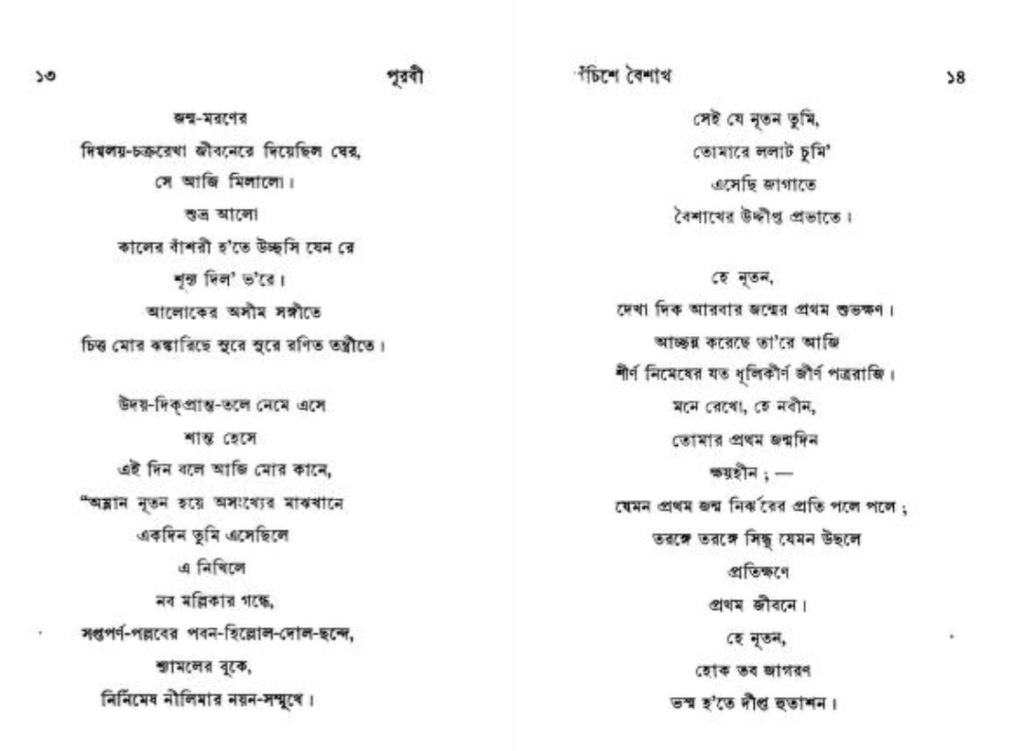
Pochishe Boisakh[1] was written by Tagore on 8th May 1922, and published in a collection called, Purabi [name of a raga] by the poet himself under the aegis of Vishwa Bharati.

Night gives way to dawn.
I bring to you
By hand,
The full saga of
My birth written
By the rays of
The morning sun.

A blood smeared sun rises out of the horizon.
Faint shadows of the woods play lonely notes of the Bhairavi.
Saal, palm and sisir trees murmur to
Break the silence of the outskirts.
On the dry fields, a blood-red path resembles
The forehead of a sanyasi* smeared with holy paste.

This day returns every year
In different guises on this earth —
Sometimes, filled with copper-coloured mangoes,
Or rustling with young palms,
Or, crackling with dry leaves in the mid-day sun,
Sometimes rushing to free itself
Like the clouds of the
Unshackled kalbaisakhi*.
And it comes to me
When I am alone,
Drunk with the northern breeze,
Hands me a gift —
A plate made of the blue sky
And then a zephyr filled cup of nectar.

This day has dawned today.
My heart beats rapidly
As if someone is blowing a conch resonating
With the susurration of infinite oceans.
Birth and death like
The skyline meet in the circle of life.
Today they come together.
A white radiance seems
To overflow with music from
The flute of Time, filling the emptiness.
Endless music irradiates
My soul singing from within.

Morning descends with a
Calm smile and
Whispers into my ears:
“I have come anew amidst many.
One day, you arrived
In this universe
Redolent with the perfume of fresh mallika blooms,
Amidst the breezy caresses of the chattim tree,
In the heart of darkness,
Under a steadfast, azure gaze.
I kiss the forehead
Of the new you.
I have come to awaken you
On this exciting day.

“Oh, newly fledged,
Let’s revisit the start of your life.
Today your existence is overwhelmed
With transient dusty correspondence.
Remember, O youth,
Your first birthday…
Unblemished —
Pure, like the first moments of your life;
Like the waves of the ocean, revive
Every second of
Your first day.

“Oh, newly fledged,
Arise, illumined
Out of the ashes of past.
Anew,
May you shine out of the mists
like a rising sun.
Holding the vernal flag,
Fill youthful moments with lush foliage —
In this way, newly fledged,
Pierce the emptiness, reveal yourself.
Revel in the exuberance of life,
Reveal the eternal wonders of the universe within your being.
The horizon reverberates with notes from the auspicious conch.”

In my heart,
Eternal new notes peal
On pochishe boisakh!

*Sanyasi- mendicant
*Kalbaisakhi— nor’wester thunderstorms

In 1941, Tagore adapted the last part of the poem, changed a few words and made it into a song for his last birthday, acceding to the request of a birthday song to his family and friends. The song, ‘Hey Nutan[2], has been translated by Aruna Chakravarti in her historical novel, Daughters of Jorasanko, as the last birthday song by Tagore. You can access the translation of the song and his last birthday celebrations depicted by Aruna Chakravarti by clicking here.

[1] Pochishe Boisakh is the 25th of Boisakh. Boisakh is the first month of the Bengali calendar coinciding with mid-April to mid-May. Tagore was born on 25th Boisakh, which is a date that shuttles between 7th to 9th May every year on the Gregorian calendar.

[2] Aruna Chakravarti translates this as ‘Oh ever new’. In the poem, it has been translated as ‘Oh newly fledged’. It is from that point that Tagore made the changes and converted the poem into a song. He changed a few words, a few lines, giving it a new life as a song.  

(This poem has been translated by Mitali Chakravarty with editorial input by Sohana Manzoor)

.

PLEASE NOTE: ARTICLES CAN ONLY BE REPRODUCED IN OTHER SITES WITH DUE ACKNOWLEDGEMENT TO BORDERLESS JOURNAL

Click here to access the Borderless anthology, Monalisa No Longer Smiles

Click here to access Monalisa No Longer Smiles on Kindle Amazon International

.