Categories
Review

A Sagacious Tale of Oppression & Turmoil

Book Review by Rakhi Dalal
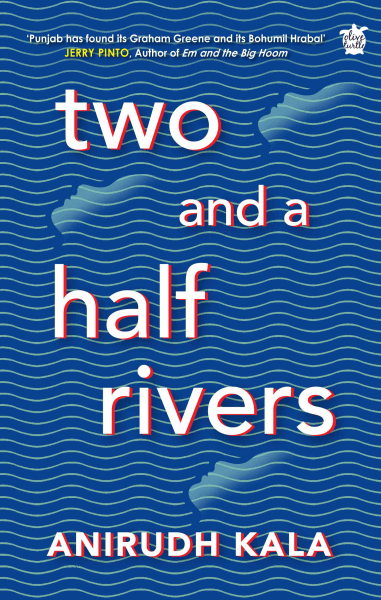
Title: Two and a Half Rivers

Author: Anirudh Kala

Publisher: Niyogi Books, 2021

How do we understand a land and its people? How do we look at its history, at a phase of turbulence which once ravaged the lives of its people? At the social structures rarely talked about? And how do we make sense of it? Can the perception be whole if only selective truths are voiced?

The Partition of India in 1947 had left Punjab with only two and a half rivers out of a total of five. From the early 1980s onwards, a state which had witnessed much violence and bloodshed at the time of Partition, began to be devastated by the spread of militancy again. This period of unrest spanning almost a decade was the time when common people, who had yet not recovered from the trauma of partition, faced the torment of not only terrorism but also counter insurgency. And though there are numerous reports on the violation of Human rights during counter insurgency in Punjab, both the Central and the State Governments have continually refuted such reports.

Two and a Half Rivers is a fictionalised account of those troubled years of Punjab through the lives of three main characters — a clinically depressed doctor, trying to take on life one day at a time, and Shamsie and Bheem, both Dalits, struggling to make their dreams a reality. Writing with keen perception, the author, Anirudh Kala, not only offers a striking account of the many ordeals that people went through that period and the solidarity which helped them keep afloat but also of the less addressed issue of oppression of lower castes and their sufferings.  

Kala is a psychiatrist by profession. His aim is to educate people about mental health and mental illness, focusing on eradicating stigma, labels, and prejudice. His debut fiction The Unsafe Asylum: Stories of Partition and Madness was published in 2018. Two and a Half Rivers published by Niyogi Books is his second work of fiction.

In this novel, he juxtaposes the situation of state with that of the mental illness of the doctor who is also the narrator. As the fog of depression descends on his mind, the state is also veiled by the layers of sorrows and anxieties from which no escape seems visible. With the increase in terrorists activities, the rivers start filling with the dead again as if to devour those who had somehow survived the Partition. An increase in extortion, abduction and killing by the terrorists leads to the nabbing of common people on doubt by police. The custody, seldom resulting in the release of those apprehended. Jails become torture centres and those captured subjects of experiments for effective torturing. The unrest that follows compels Shamsie and Bheem to shift to Bombay in search of a peaceful life only to return back few years later in the aftermath of a crackdown on Dance bars.

Following the timeline of those difficult years, the author looks at the tragic events which made the ‘Punjab problem’ worse in succeeding years. He takes into account Operation Bluestar, the assassination of the Prime Minister (who he names as Durga), the pogrom of November 1984 and counter insurgency. The novel offers a commentary upon the inept tackling of the situation by the state including ruling dispensation and police. The narrator minces no words while observing that the State and Army had conveniently forgotten that there were to be a large number of pilgrims in the Golden Temple at the time of that operation as it was the celebration of the martyrdom day of a Sikh guru or that more common people began disappearing after the police chief announced incentives and rewards to curtail terrorism.

While the narrator narrowly escapes the custodial torture after being picked for alleged connection with militants, Bheem isn’t that lucky. His identity becomes the final noose around his neck. Shamsie suffers assault too, a punishment for escaping advances of an upper caste boy in her teenage. Whilst common people die and more disappear, Punjab is steeped in sorrow of losing loved ones from which only the tears of grief bring some respite. We are told that more than eight thousand young people have not come home, and never will.

With the poignant telling of this tale, the author also prompts the reader to ask why the lives of those from lower castes are far more easily dispensable, why are they inconsequential, why this malaise is so deeply ingrained in the minds of upper caste and why is it a normal way of life. In a religion which believes “Awwal allah noor upaya qudrat keh sab banday, aik noor toh sab jag upjaiya kaun bhale ko mande” (All humanity was born from a single divine light, and everybody is born equal. All are the children of nature, and no one is good or bad), how can there really be a discrimination based upon caste?

Sensitive is one word that can be best used to describe Kala’s writing. He writes not only from a place of awareness but perhaps also pain and anguish. His description of the distressed years of Punjab carries a rare sensitivity which warrants a deeper understanding of the place as well as its people. That he chooses to tell it through the lives of two Dalit characters, also bring forward his focus on the otherwise lesser talked about issue of caste discrimination in Punjab. The narrative voice is subtle and sometimes seems distant, which works well for the reason that it gives the narrative a sagacious tenor, making it compelling and very moving.

.

Rakhi Dalal is an educator by profession. When not working, she can usually be found reading books or writing about reading them. She writes at https://rakhidalal.blogspot.com/ .

.

PLEASE NOTE: ARTICLES CAN ONLY BE REPRODUCED IN OTHER SITES WITH DUE ACKNOWLEDGEMENT TO BORDERLESS JOURNAL. 

Categories
Interview National Day Special

In Conversation with Kirpal Singh

Dr Kirpal Singh
we are known globally
as a nation of multi-cultures
but we are united as one people.

not an easy goal to realise
knowing how differences divide
and make unity problematic.

-- Reaching Out... Kirpal Singh, 2021

Kirpal Singh is a poet and a literary critic from Singapore. An internationally recognised scholar whose core research areas include post-colonial literature, Singapore and Southeast Asian, literature and technology, and creativity thinking,  Singh has won research awards and grants from local and foreign universities. He was one of the founding members of the Centre for Research in New Literatures, Flinders University, Australia in 1977; the first Asian director for the Commonwealth Writers’ Prize in 1993 and 1994, and chairman of the Singapore Writers’ Festival in the 1990s. In 2004, he became the first Asian and non-American to be made a director on the American Creativity Association’s board. He retired dean of Singapore Management University.

Singh was born as a part of Malaya in 1949 to a father of Sikh descent and a Jewish-Scottish mother. He lived through three regimes in this part of the world: colonial, Malayan and Singaporean. His poetry is perhaps what best tells us about his faith in the little island state that came to its own in 1965. In this interview, he shares his life story with us, the last being a huge donation of books that he is making to the National Library of Singapore – a donation of 3,000 books collected over decades.

You are an academic, critic and writer who stretches out across SE Asia. When did your ancestors move to Singapore from India and why?

My paternal grandparents moved to Singapore from Punjab in 1901. They came to the then Federation of Malaya in search of a better life.

You have never lived in India but shuttled between Singapore and Malaysia. Probably at that time it was all part of Malaya. Can you recall Singapore/Malaya during your childhood?

Yes, though born in Singapore in March 1949, I was taken back to be with my dadiji (paternal grandma) in Malaya when I was two months old.  However, I was brought back to Singapore when I was seven to begin school. My grandparents thought Singapore was a better place to receive an English education.

Your mother was Scottish and father, an Indian. What languages did you grow up speaking? What language is most comfortable for you to write in? 

I grew up speaking bits of Punjabi, Malay and, of course, English. In my teenage years I also picked up some Chinese dialects. Though I did study Mandarin in school, I am not too good at it. I can only speak a smattering of it. I am most comfortable writing in English.

You have seen Singapore move from infancy to its current state. Can you tell us what this journey has been like?

It has been an astonishing journey. When I was young-preschool age — Singapore was a British colony. In 1963, Singapore joined Malaya to become part of a new entity then known as Malaysia. However due to basic differences, Singapore pulled out of Malaysia and became an independent, sovereign nation in August 1965.

You are an academic who retired dean of Singapore’s major management institute. And yet, you write poetry. Can you tell us a bit about your journey?

At the then newly established Singapore Management University which I was invited to join as Founding Faculty in 1999, I was told to introduce Creative Thinking as a new mandatory module for all undergraduates. I helmed this exciting and new programme for ten years. SMU was the first University in the world to make Creative Thinking a compulsory course for all undergraduates. Sadly in 2010 this was made optional.

You have a huge collection of books —25,000. How long has it taken you to collect these books?

It has taken me more than 50 years.

Tell us a bit about your book collection. What are your favourite books?

My collection is eclectic. Most of my books, however, belong to the humanities, and within this, most belong to the literary genre. I loved reading from a very young age (being alone at home, reading brought me solace and also knowledge). Among my favourite books, the tragedies of Shakespeare and Sophocles feature prominently. Some 20th century books (those of D H Lawrence and Aldous Huxley in particular), I value tremendously. I should also add that I have been very blessed to have met many of the more well-known/established writers of the 20th century and blessed to have been given signed copies by these wonderful authors: among them Doris Lessing, William Golding, Brian Aldiss, and numerous others.

Did your reading impact your writing?

Quite naturally, yes. I think it’s hard not to be affected by what one reads when it comes to one’s own writing. Even with writers who consciously try to ensure that no clear influences obtain, critics have frequently found far too many disguised references not to infer which authors influenced those writers.

Recently, you made an announcement that you will donate 3,000 books to promote love of reading in Singapore. Do you think donating these books will be enough to make book lovers of non-readers?

I doubt if the mere act of donating will create readers. However, I feel that having a few thousand additional books in a library will, hopefully, draw at least the attention of a few readers and maybe among these will be new readers.

Most people read bestsellers.  What do you think will attract more to appreciate literature like EM Foster, DH Lawrence, and Coleridge?

Yes, in the age of commercialisation, classic writers may not obtain immediate readership– hence schools and colleges/universities play a vital (and necessary) role to ensure that our graduates are educated– at least minimally– in the works of writers who helped change and shape new sensibilities.

Thank you for your time. 

Click here to access poetry by Kirpal Singh

.

PLEASE NOTE: ARTICLES CAN ONLY BE REPRODUCED IN OTHER SITES WITH DUE ACKNOWLEDGEMENT TO BORDERLESS JOURNAL