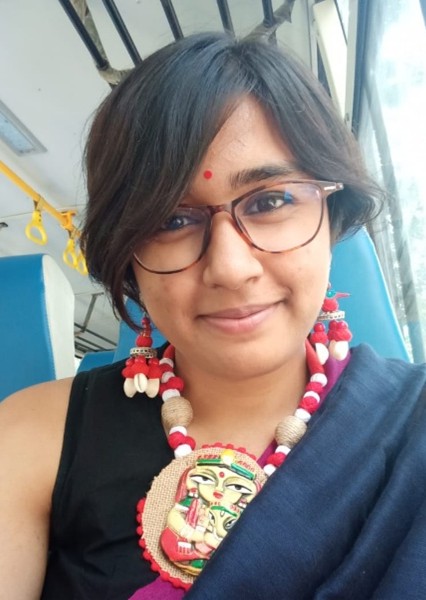
By Priyanjana Pramanik
My dida, my maternal grandmother, is perpetually dissatisfied. It is better to die young, my mother often says, than to live to ninety and be like her. For as long as I can remember, she has not smiled. Her face has twisted into a permanent grimace at the torments that each passing day on earth brings.
“After a certain age,” she sighs as she sips her morning tea, “living itself becomes a sin.”
When I was younger, these pronouncements would worry me, and I’d consider my mother’s laughter the height of callousness. With time, I’ve changed my tune.
“Have you considered dying?” I ask her conversationally in response. “I can make arrangements.”
She harrumphs at me and tells me that when she does die, I’ll be sorry. I reply that she’ll outlive her daughter, not to mention me. I hear my mother, who has just entered the dining room, mutter that death will be a sweet release.
“What did you say?” Dida demands, cupping an ear in one hand. “I’ve told you not to mumble, Mishti, no one can understand a word you say.”
Mishti vanishes again. Dida, thankfully, has been overcome by a fit of coughing and has already forgotten what we were talking about.
The cough had appeared approximately one week ago, the day after Dida’s ninetieth birthday, and she is sure that is it, her time has come. After tea each morning, she opens the drawer to her bedside table and takes out an aluminium case that houses several dozen strips of medicines. She inspects each one carefully. Then, it is time to call Ujjal.
Ujjal is our neighbour – and a medical doctor besides. Dida likes to catch him before he leaves for the hospital.
“Hello Ujjal?” she bellows into her mobile phone. “No, I feel terrible – this cough will be the end of me. Is it allergic, do you think? Should I take the Levocetirizine and Montelukast combined tablet? No? How about some Paracetamol? No, you’re right, sometimes home remedies are the best, who needs these newfangled medications? You’re right, Ujjal, what a good boy you are. What a blessing it is to have you so close by. If not for you… I have no one, you know. Nobody to take care of me, or care whether I live or die.”
After this conversation, she chews on some dried clove, that tried and tested home remedy, and then takes a nap. Ujjal calls up my mother and pleads with her to hide Dida’s medicine stash – my mother replies wearily that she would if she could.
After her nap, it is time for Dida to call up various relatives and let them know that she is not being taken care of. Their commiserations, stories of their own aches and pains, and reassurances that she if comes to visit, they will keep her in the lap of luxury, has her happily occupied until lunchtime.
“I won’t eat anything,” she announces when she emerges from her room for lunch. “I have no appetite because of this sickness.”
“Ma made goat curry,” I tell her. This is considered. Then – “I suppose I can force myself to have a few bites,” she concedes grudgingly. “Otherwise, I’m just wasting away.”
She eats three helpings with gusto, pausing to point out that the curry could do with a little more salt and two more minutes in the pressure cooker, but is otherwise not too bad. My mother drops a courtesy and is heading back to the kitchen when Dida makes her announcement.
“Mousumi and her husband are coming to visit me this evening,” she says with some satisfaction. “At least my sister’s children love me, even if my own daughter… No, I can’t even say it.”
She remains in good spirits all afternoon, only half-heartedly telling me that I don’t love her. After lunch, she shoos my mother out of the kitchen and does all the dishes. Then, she changes the sheets on her bed. Finally, she changes from her usual nightgown into a white saree with blue border. Now that all the props have been arranged, it is time to set the scene.
Carefully, she arranges herself on the bed and lets out an experimental cough.
“Is there anyone there?” she calls in a weak but carrying voice. “Could someone at least fetch me a glass of water?”
“Coming, Dida,” I call, heading to the kitchen and coming back with a bottle and glass.
She drinks deeply and hands it back to me before another fit of coughing overtakes her.
“I think my temperature is rising,” she says sadly. “This is what will kill me. And no one to switch the fan off, even!”
I turn off the ceiling fan and beat a hasty retreat.
My mother’s cousin Mousumi, or Mou for short, and her husband Somnath ring the doorbell at five p.m. sharp. I let them in and take them to Dida’s room, where the old lady is in bed, as I have left her – but hadn’t I left the lights on? She is silent – she does not move or say a word as we enter the room, and a moment of disquiet steals over me.
At that moment, she tosses her head and moans weakly.
“Oh, Mani!” cries Mou, rushing to her side. “I’m here, Mani. Tell me what I can do for you.”
“Mou, my dear sister’s child,” comes my grandmother’s frail voice in the darkness. “How good of you to come all this way to see your poor old aunt… I fear it may be for the last time.”
She moves to sit up, ignoring her niece’s protests.
“I’ll make you some tea,” she announces in a quavering voice.
“No, no Mani!” Mou says, aghast. “How can you be made to do these things in your condition! Mishti will make you tea, of course. And we’ll have some too, just to keep you company.”
My mother, as always, is amused by the old lady’s antics. As she and I bring in a tea tray loaded with snacks, including fresh samosas from our local sweet shop, we hear Mou earnestly reasoning with Dida.
“You must come stay with us,” Mou Mashi is saying. “We will make sure you’re comfortable – you won’t have to lift a finger.”
“I couldn’t possibly,” replies Dida tremulously. “It would be such an imposition. How could I ask so much of my only niece?”
“No, no, ask anything you want of me! We just moved to a new apartment – it has a brand-new elevator, and a clinic with a doctor available 24/7, and all the comforts you can imagine! And I’ll make all your favourite foods…you look so thin, Mani, it just breaks my heart to look at you.”
“How wonderful that sounds… No one lets me eat anything nice anymore,” Dida says sadly. “It’s all watery dal and plain rice and boiled papayas.”
Mou made appropriately soothing noises.
“I’m here for you, Mani,” she says, holding Dida’s hand. “I’m going to take good care of you.”
The visit is cut short because Mou needs to let her driver off for the night, but she leaves Dida with several more promises of a visit soon-to-be-planned. Before she departs, though, she has some stern words for my mother.
“If you can’t take proper care of a frail old lady,” she fumes. “At least have the decency to put her in a good care home!”
And on that parting note, she and her husband get into their car and drive off.
“Do you think they’ll take Dida away?” I ask my mother after they are out of sight.
“Wouldn’t that be nice,” Ma replies. “The old lady would never agree to leave!”
“What’s that?” calls Dida from her room, with her unerring sixth sense for whenever she is the subject of discussion. Her voice has entirely returned to normal.
“Nothing, Dida,” I tell her, going in to switch on the mosquito repellent and administer her eyedrops. “So, when are you going to stay with Auntie Mou?”
“Uff, now I’ll have to visit her for politeness’ sake,” the old lady says, sounding disgruntled. “Isn’t she so tiring? Turned out just like my sister, she has. Won’t let me lift a finger, indeed! She makes me sound completely helpless!”
And on that note, she bites into her third samosa with gusto.
Priyanjana Pramanik is a doctoral student of geography and writer of fiction and popular science articles, splitting their time between Kolkata, India, and Hobart, Australia, and a parent to seven cats.
.
PLEASE NOTE: ARTICLES CAN ONLY BE REPRODUCED IN OTHER SITES WITH DUE ACKNOWLEDGEMENT TO BORDERLESS JOURNAL
Click here to access the Borderless anthology, Monalisa No Longer Smiles
Click here to access Monalisa No Longer Smiles on Kindle Amazon International
 Borderless