Photographs and Narrative by Suzanne Kamata
I’d wanted to go on the Shikoku Mannaka Sennen Monogatari (One Thousand Year Story in the Middle of Shikoku) train trip ever since I saw it advertised on a poster in the window of Tokushima Station. When I investigated, however, I discovered one couldn’t begin the journey in Tokushima, where I live. Although it starts (or ends, depending on which way you’re coming from; it’s a one-way trip) deep in the mountains of Tokushima, I would have to change trains a few times before boarding the special sightseeing train. It would take hours to get there. A better way would be to board in Tadotsu, which is in the neighboring prefecture Kagawa. I could drive there in a little over an hour, take the fancy train to Oboke, and return by express train.
I decided to take a ride on the spur of the moment. The train was pretty much booked for the rest of the season, at least on the days when I didn’t have other plans, like my job. I did find one last seat on a train in mid-November. It might have been more fun to go with someone else, but I didn’t have time to coordinate with friends. I immediately booked the seat, reserving my lunch as well.
The morning of my train trip was chilly, but sunny. I donned a thin tunic and a long cardigan, wondering if it would be cold in the mountains. Maybe I should bring my down jacket? I rolled up a windbreaker and stuffed it into my backpack. I entered my destination – Tadotsu Station – into my phone’s navigation app, selected a podcast for the drive, and set off.
Tadotsu turned out to be a sleepy little town, which makes sense. These are the kinds of places that need something special to attract visitors and their money. If the whole purpose of these sightseeing trains is to rejuvenate dying towns, then Tadotsu seemed like a good choice. I could see that some construction was in progress, perhaps to accommodate the hordes of new visitors brought by the train. Porta potties temporarily served as bathrooms.
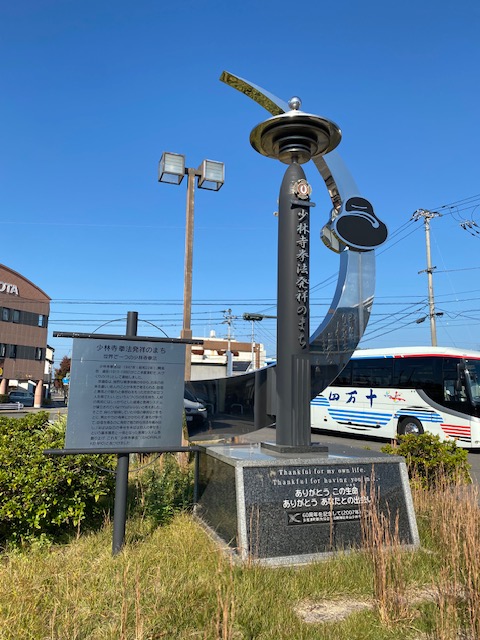
In front of the station, an intriguing sculpture attracted my attention. To me, it looked like a tall armless man wearing a hat, backed by a sickle. There was an emblem like a coat of arms where the neck of the man would be. At the base of the sculpture was a plaque with the words: “Thankful for my own life. Thankful for having you in it.”
Later, I discovered that it was meant to commemorate Doshin So, nee Michiomi Nakano, a former military intelligence agent who spent many years in China. After returning to Japan, he was stationed in Tadotsu, where he established a cram school to teach Buddhist philosophy and martial arts.
In 1947, he founded Shorinji Kenpo, a Japanese martial art with a holistic system. The training methods are divided into self-defense training, mental training, and health training. According to his philosophy, spirit and body are as one, and they must be trained together as such. His teachings emanated from this small town of about 20,000 people to the rest of the world. The emblem, as it turned out, was the symbol for Shorinji Kenpo.
I took a photo of the monument and proceeded to the train platform, where I was met with heavy equipment surrounded by a chain link fence. A sign apologised for this inconvenience, and explained that construction was underway to make the station barrier-free.
I was twenty minutes early, but my fellow passengers – Japanese, as far as I could tell – were already milling about, taking selfies and photos of each other in advance of their train trip. The group was mostly female, middle-aged, and older. Many people were wearing masks.
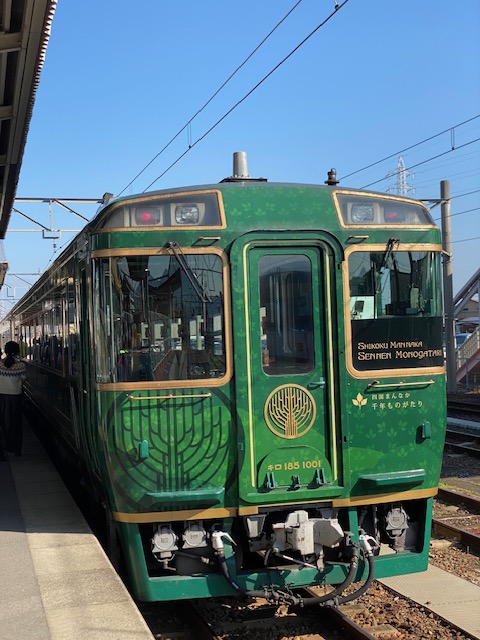
A cinematic melody heralded the approach of the train, accompanied by another rush for selfies and photos. The three cars, all different colors, were named after spring, summer, and fall. What happened to winter? A small doormat with the train’s motif, which resembled a stylized tree, was positioned on the platform at the entrance to the train. I boarded the green “spring” car, Haru Akari, and found my seat, a fuzzy green upholstered chair at a table against the wall, facing the window. The two seats next to me were unoccupied.
Most people wore casual clothes. I rarely saw folks from Tokushima get dressed up, unless it was for a wedding, say, or a graduation ceremony. One woman at the four-top on the other side of me was striking in a sumptuous Chinese-style jacket and gold barrettes. I wondered for a moment if she might be some kind of celebrity. I tried not to stare.
I examined the orange cloth placemat, again with the tree motif. Already my mouth was watering. Disposable chopsticks and a wet napkin were aligned at the bottom, while a spoon rested on a rectangle of granite. Paper napkins, toothpicks, and creamers were tucked into a small basket made of vines. Brochures detailing the train’s route, souvenirs for purchase, and additional menu items were laid out.
You could use your phone to scan a QR code and order keychains, sweet potato cakes, or a yusan-bako, a traditional lunch box which originated in Tokushima. This one was made of Japanese cypress adorned with Kagawa lacquerware. It had three drawers for various delicacies, which fit into a box with a handle, perfect for toting to a picnic in a meadow somewhere. You could also buy a CD with the train’s theme song.

I had already ordered my lunch, but I glanced at the menu anyway. Fish cutlets, another specialty of Tokushima were available, along with bamboo shoots, and ice cream made with sake lees. The sweet potato crumble, with a dollop of whipped cream, was also tempting, but I summoned my willpower.
One of the uniformed attendants pointed out the wooden box under my car for storing my backpack and purse. I got those items out of the way. She also handed me a coupon for soup and water to be redeemed at our first stop. And then finally, the train began to move. A whistle blew. Japan Railway employees and others lined up with flags and round paper fans and began waving at us. We all waved back.
After that enthusiastic send-off, the train began to trundle along the tracks, picking up speed as we zipped past backyards of houses, apartment buildings with laundry hanging on balconies, convenience stores, crows alighting on power lines, an empty playground. We passed rice paddies, some surrounding family gravestones; a construction site with bright blue, green, and yellow earth moving machines.
As we neared Kotohira Station, our first stop, a young woman chirped that Kotohira’s brass band had been declared second best in the country. She reminded us to redeem our coupons in the welcome center. After the train had stopped, I followed everyone into a small room adjacent to the station where we lined up at a counter. I handed over my little piece of paper and received a bottle of water and a small China cup of kabocha 1potage. I perched on the padded bench to drink it, while gazing around at the proud display of photos of the award-winning high school band. A white-gloved attendant came around with a tray to collect my empty cup, and I got back on the train.
A young Chinese family – a couple and their plump baby – were now occupying the seats beside me. The train moved on. The view outside my window was now more expansive – terraced fields, occasional houses with tiled roofs and walled gardens, tufts of pampas grass, a patch of pink and magenta cosmos.
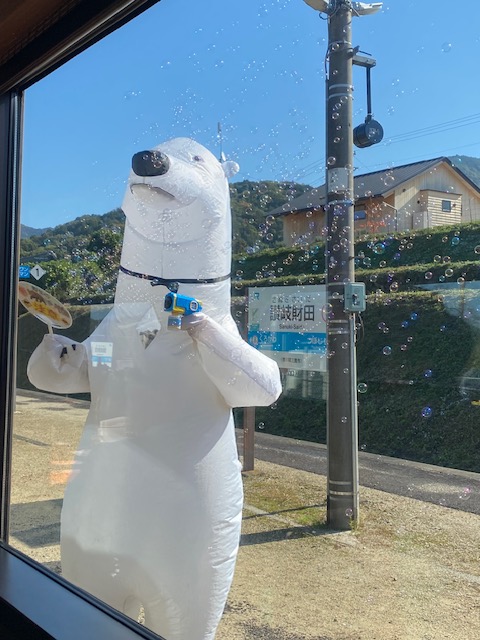
The voice announced that we were nearing Sanuki Saida Station, which boasts a 700-year-old tabunoki tree, said to be a “power spot.” Apparently if you stand under the tree, you can absorb some of its spirit and energy. The tree has also been designated a Kagawa Prefectural Protected Tree. The train came to a stop again, but this time we didn’t get off. Instead, we all whipped out our smartphones to take photos of the person dressed in a polar bear costume shooting soap bubbles from a bubble gun. The baby was delighted.
Once we were again underway, the attendant distributed large square bento boxes with gold-rimmed lids. I opened mine to find an array of chilled meat dishes – the first course. I unsheathed my disposable chopsticks and broke them apart. “Itadakimasu!2”


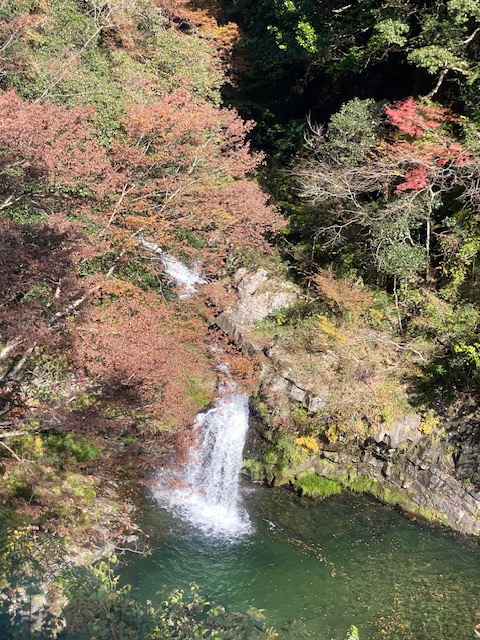
Out the window, farmland had given way to gnarly brush. `Although the foliage wasn’t quite at its peak, swatches of scarlet and gold popped against the greenery. I wondered about the wildlife in the mountains. I knew that there were monkeys, boars, and deer. The latter two appeared on menus deep in the interior of Shikoku. You could get a burger made with game meat, or “peony hot pot,” in which thin slices of pink boar meat curled up like flower petals after being cooked in miso broth.
Next to me, the young parents passed their good-natured baby back and forth. When I caught his eye, I smiled at him, and he showed his dimples, smiling back. I remembered how, when I had first come to Japan, whenever I had tried to engage with a stranger’s baby on the train, the baby’s face had crumpled up in terror. Apparently, big-nosed foreigners were scary even for infants. At least back then. It was nice to be able to engage with a small child without causing tears.
We made a brief stop at Tsubojiri Station, a small, unmanned station accessible only by switchback, surrounded by trees. “You can get off the train and smoke,” the voice announced. We all scampered off the train, but I didn’t see anyone light up a cigarette. Instead, passengers posed in front of the station’s sign and the weathered wooden building.
Back on the train, the next course was served – buttered rice and pork, arranged on a gold-rimmed China plate. The narration continued. “Please look to the right. You will be able to see Mount Hashikura. You can take a ropeway to Hashikura Temple, which was established by the famous Buddhist monk Kukai, also known as Kobo Daishi.”
Kobo Daishi is known as the father of Shikoku’s 88-Temple Pilgrimage. Hashikura Temple is not one of the 88, but is considered to be an associated temple. According to the Tourism Shikoku website, the name “Hashikuraji” contains the character for “hashi,” or chopsticks, “an everyday unifying ubiquitous tool of daily life for all Japanese. In 828 [CE], Konpira Daigongen revealed himself to the priest Kukai and promised to save all who use chopsticks, a pledge of salvation for all.”
According to an announcement, we would soon have a good view of the Yoshino River, the majestic “wild” river which runs west to east across Shikoku. Its rushing waters carved out the Oboke Gorge over millennia. This river flows 121 miles, past Tokushima City, and the house where I live, and into the Kii Channel. At one time, it flooded repeatedly. The “Tora-no-Mizu” (“Tiger’s Water”) flood of 1886 (Year of the Tiger), one of the worst floods in Japanese history, led to the deaths of an estimated 30,000 people. Now, however, strong levees keep the waters in check, though heavy rains can still shut down the roads nearest the river. These days, the Yoshino River is more known as a place where visitors can enjoy various forms of recreation including swimming, fishing, and white-water rafting.
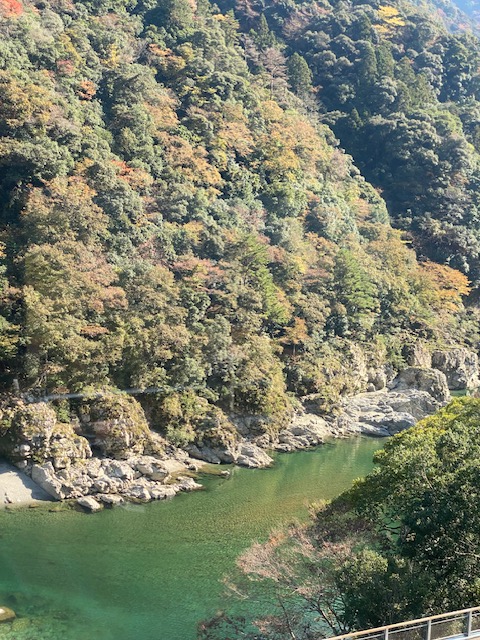
As I gazed out at the glassy emerald waters, which reflected the rocky banks, the voice announced that we were approaching Awa-Ikeda. High school baseball, I thought. Sure enough, the voice told us that we would soon have a view of baseball players practicing at Ikeda High School’s diamond, and that they had once won the National High School Baseball Tournament at Koshien.
The train chugged on. We passed another station, Awa Kawaguchi, where another person in a polar bear suit filled the air with soap bubbles. A sign on the platform declared that this was a town where tanuki (an indigenous animal that is often called raccoon-dog, and is a notorious trickster in Japanese folklore) and people live together.

After traversing another tunnel, coffee was served with a petite madeleine. Outside the window, I could see the water rushing through the gorge, frothing over rocks. We were almost at the end of our thousand-year journey. It had lasted a little over two hours.
The train pulled into Oboke Station, in the town of Miyoshi, and we got off. We were greeted by a man wearing a woven peaked hat and happi coat, banging on a drum affixed with characters from the animated series Anpanman. Although my fellow travelers had been mostly Japanese, quite a few European and American tourists were milling around the station, perhaps waiting for transportation.
At the time I first visited, over thirty years ago, I recall no restaurants or hotels, but now there was a large roadside station with souvenir shops, food vendors, and a Yokai House. There was even yokai3-themed food. Some traditional houses have been refurbished as high-end inns.
I took a short walk around the area and then attempted to buy a return ticket on an express train. Although the station was now geared for tourists with English signage and souvenir shops, it was still old-fashioned in many ways. I realised it wasn’t equipped to deal with phone apps or credit cards. I hadn’t brought a lot of cash, but I had just enough to buy a ticket back to my starting point.

- A variety of winter squash ↩︎
- I humbly receive (feel grateful for the food) ↩︎
- A spirit having supernatural powers ↩︎
Suzanne Kamata was born and raised in Grand Haven, Michigan. She now lives in Japan with her husband and two children. Her short stories, essays, articles and book reviews have appeared in over 100 publications. Her work has been nominated for the Pushcart Prize five times, and received a Special Mention in 2006. She is also a two-time winner of the All Nippon Airways/Wingspan Fiction Contest, winner of the Paris Book Festival, and winner of a SCBWI Magazine Merit Award.
PLEASE NOTE: ARTICLES CAN ONLY BE REPRODUCED IN OTHER SITES WITH DUE ACKNOWLEDGEMENT TO BORDERLESS JOURNAL
Click here to access the Borderless anthology, Monalisa No Longer Smiles
Click here to access Monalisa No Longer Smiles on Amazon International
 Borderless