Categories
Excerpt

Ostia Antica: The Fatehpur Sikri of Rome?

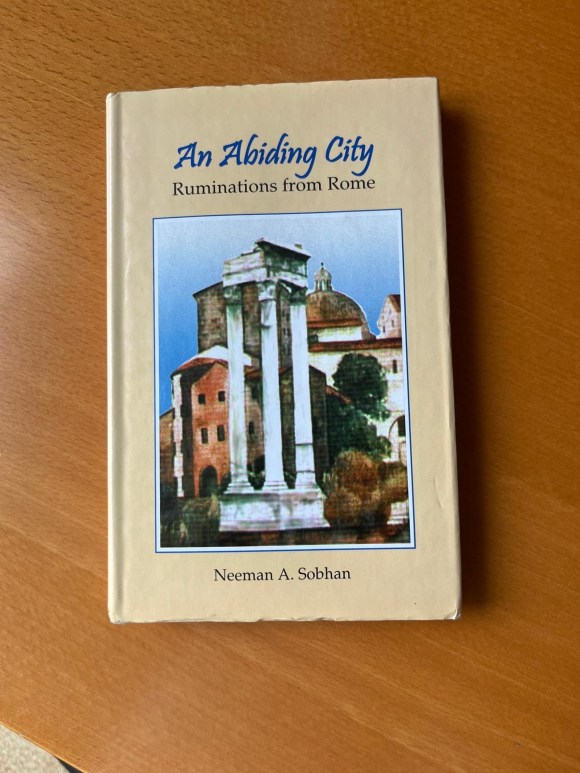
Title: An Abiding City: Ruminations from Rome

Author: Neeman Sobhan

Publisher: University Press Limited (Dhaka)

Ostia Antica

Sometimes, when my visitors to Rome, arriving in the sweltering month of July or August, voice over-zealous ambitions to ‘do’ Pompeii, I don’t have the heart to discourage them. But I beg off from accompanying them. I have nothing against Pompeii as such, but I am not sufficiently suicidal to relish the thought of trudging miles of arid ruins under a punishing sun for the twenty-third time!

It’s at this point, usually, that I try to sell what I call my ‘Lazy man’s Pompeii’: Ostia Antica. I could have called it the ‘Poor man’s Pompeii’ as well, but the riches of the ancient city can almost equal a Herculaneum to the imaginative tourist. And its biggest plus-point is that it is so much closer to Rome (as against Pompeii, about 200 kilometers away, towards Naples), and may I add, that much shadier!

Less than an hour away from Rome, Ostia Antica was founded in the fourth century B.C by King Arcus Martius (a historical persona of whom I readily admit to being shamelessly ignorant) it became Ancient Rome’s commercial and military port, and during Emperor Constantine’s time, it boasted a population of 100,000!

Ostia reminds me of another ancient city I once visited and loved: Fatehpur Sikri in India, the Mughal king Akbar’s doomed capital near Agra. The comparison to Akbar’s city is justified because, although Ostia is a remarkable example of historic Roman towns like Pompeii and Herculaneum, unlike them, it was not destroyed, rather, like Fatehpur Sikri, it was abandoned.

While the Mughal city was abandoned due to a lack of sustainable water supply, in the case of the Roman city, it was mosquitoes. Strange but true that an epidemic of malaria drove out the inhabitants of this once flourishing port city. An odd quirk of history and biology that a puny anopheline community managed to drive out a powerful anthropical one, hundred times its size!

A quick reminder here: in talking about Ostia, we must make a clear distinction between Ostia Antica, the archeological site, and the present-day beach town of Ostia, a popular seaside resort within the municipality of Rome, further down.

The excavated areas of ancient Ostia abound in numerous ruins and reminders of a thriving commercial city of times past: public and private buildings, streets, defensive walls, and harbors.

I find the residential streets most fascinating because it brings to life a real world of ordinary people. Much has been written about Roman tenement-housing and remains of these buildings abound in Ostia.

Reconstructed models apparently reveal that a typical apartment block could be five-storeys high, and that the flats were probably quite functional, mostly reached from courtyards or from the street by stairs running between shops on the ground floors.

I think of all this as I stop at a crumbled courtyard here, touch a moth-eaten wall there, step over a threadbare threshold, or mount a mysterious flight of steps that end abruptly in mid-air, leading nowhere.

For me, it’s in this residential environment that I find the faint but persistent pulse of a bygone life. Visiting it on some empty afternoon, while I might be sitting on the broken steps of a roofless room, I can surmise the life of the ordinary man or woman who once lived here: I smell the fragrance of fresh baked bread in the gutted bakery next door; I hear the sound of children playing in the silent streets, or the hum of voices in the tavern with its dusty counter; and suddenly, the entire history of the humble populace seems to be whispered and echoed by the sea-spiked breeze among the pines and cypresses.

Let the Archeologist and Historian keep their details. To me the romance of a ruined city is not necessarily in the structures themselves, in the revealed or concealed splendor of its remains, it is in the mystique of its very presence, its undefined shape as a messenger from lost times, telling us stories of the long ago.

A dead city serves to remind us that it once existed, and that the past, although it is no more, is never completely wiped out, never obliterated from the collective memory of the world. In leaving behind its footprints, the spirit of the city has defied negation and accompanies me this afternoon.

And thus, I love to sit, under the peristyle of a vanished villa, absorbing the atmosphere of this long-deserted city, contemplating the history not just of this particular Roman town, but all the nameless cities of countless civilizations in the past. I wonder at the basic story it tells of our collective and individual engagement with Life, of the heroic audacity of the human spirit attempting, again and again, to build its sandcastles against the wind, trying to carve a permanent niche on the elusive surface of Time.

Whether the crumbling habitation is in Ostia Antica or Mohenjo-Daro, in Petra or Machu-Pichu, in Moinamoti or Fatehpur Sikri; each is a monument to the Spirit of Man, the builder of cities, the creamer of dreams.

[ Extracted from An Abiding City: Ruminations from Rome. Published by UPL (University Press Limited, Dhaka), 2002 ]

ABOUT THE BOOK

An Abiding City: Ruminations from Rome is a fresh look at Italy and Rome from the perspective of a long-time resident of non-Italian origin. Neeman Sobhan, living in Italy, since 1978 wrote for two decades a personal column in the Bangladesh English language daily, The Daily Star, spinning vignettes and sketches out of her daily encounters and reflections living in Rome. Here, in vivid prose and poetic detail are selections from her work.

Among some of the myriad themes in this collection of essays and poems: the charm of everyday Rome; the romance of history; the adventure of the expatriate’s eternal quest for home; the poetry of seasonal transformations; the mysteries of relationships; the kaleidoscope of life in general, and of one woman in particular, who within her journey through the Eternal City, shares with her readers her passage through life.

The writing is enhanced by ink sketches by Italian-American artist/writer Ginda Simpson.

ABOUT THE AUTHOR

Neeman Sobhan is a Bangladeshi-Italian fiction writer, poet, columnist. She writes in English, and her fiction and poetry have appeared in many anthologies and literary journals within the sub-continent. Till recently she taught English and Bengali at the University of Roma, La Sapienza.She lives in Rome with her husband. She has a collection of short stories, Piazza Bangladesh (2014) which has been recently translated to Italian; a volume of poetry, Calligraphy of Wet Leaves (2015) and a collection of her columns, An Abiding City: Ruminations from Rome (2002). Presently, she is finishing her first novel, and lives between her home in Rome and Dhaka.

.

PLEASE NOTE: ARTICLES CAN ONLY BE REPRODUCED IN OTHER SITES WITH DUE ACKNOWLEDGEMENT TO BORDERLESS JOURNAL

Click here to access the Borderless anthology, Monalisa No Longer Smiles

Click here to access Monalisa No Longer Smiles on Kindle Amazon International

Categories
Poets, Poetry & Rhys Hughes

Two Pizza Fantasies

I can’t quite remember the first time I ate pizza. But I do remember that it came as a revelation. What a marvellous invention! The circular kind seems superior to the square or rectangular style, I don’t know why, and thin crust is better than deep pan, again I am unable to offer an explanation for this truth, though I guess mathematics definitely plays a role. But why a thin circle should be tastier than any other shape is beyond my understanding. No matter! The important thing to know about pizzas is that there are very few official variants, all vegetarian. It is a Rule of Naples that this should be so, Naples where pizza originated, and who are we to violate the ancient laws of a distant land? There is the margherita and the marinara, both simple and delicious. I don’t know if any other variations are acceptable. I am a pizza eater, not a pizza pundit. Let us be satisfied with those two types. And now allow me to present a story and a poem both themed around this most delectable of cheesy meals!

Down in the Park

There had been another report of a flying saucer over our town and this time I believed it. I saw it with my own eyes, not with anyone else’s, because I generally use my own eyes to see things. How about you? Maybe you use the eyes of your best friend, borrowed when he is sleeping, but I don’t do that. Messy and inefficient.

Anyway, I saw the flying saucer when I rose in the early hours to fetch a glass of water back to my bedside table. Flashing lights, weird flight path, eerie low drone and no sign of any trickery at all. Actually it wasn’t water in my glass. It was neat brandy and it was in a bottle, but I don’t want you to think I’m an alcoholic. I don’t want you to think I was drunk when I saw it. I wasn’t drunk.

I was as sober as an octopus. A postgraduate octopus.

The flying saucer hovered above my garden briefly, as if waiting for something, but I didn’t run out in my pyjamas; the grass was wet and I couldn’t find my slippers. I suppose you would have worn waterproof shoes made from the stitched skins of watermelons? That’s the kind of person you clearly are, but I’m not, no sir.

So I forsook the opportunity of getting a closer look. Too bad. Too bad is what you are. A scoundrel.

The next morning, I met Clive in the bakery. I was buying iced buns and so was he, but to my mild surprise he also bought a pizza, vegetarian, with a topping of extra olives.

I have to stress that my surprise really was mild. It’s not as if he was buying a machine gun made from bread or a cake in the shape of a centaur’s elbow.

“Did you hear about the—,” I began.

“Yes, Douglas, yes; I saw it myself and I stood and wondered. It hovered above many gardens, that flying saucer thing, including mine, and then it moved on. What purpose did it have? I pondered long and suddenly I realised!”

“You did what?” I croaked.

“I realised the truth about them, about the flying saucers. I know what they are and why they come here. I’m going to the park now and if you accompany me there, I’ll explain everything to you. Even though you aren’t as intelligent as me, I feel sure you will be able to understand the meaning of my words.”

The chance was too good to miss, so I followed Clive along the street that led to the nearest park. When we got there, we gravitated to the lake, as always, and watched the ducks. Some men watch women in the park, but not me. I watch ducks. That’s just the way it is.

I munched on an iced bun and cast my spare crumbs into the ripples. I often do that. I cast crumbs. I am a crumb caster. What the heck are you?

The ducks were happy to eat the morsels I offered them, but Clive held my arm in a powerful grip, most unlike him, because even though he is a strong man he is a bit of a simpering clot, and he prevented me from casting more pieces.

“Watch this!” he cried, so I did.

I often watch things when asked to do so.

Sometimes even when I’m not asked, I will watch.

I am a crumb casting watcher.

Like a discus thrower, Clive rotated on the spot and threw his pizza as far as he could. It was still warm, that pizza of his, and the olives glittered like crystals, and steam rose from the tomato paste as it soared over the waters. I know little about the aerodynamic properties of Italian cuisine, but it seemed to hang in the air for ages.

Then it dropped into the lake and sank.

“I was expecting it to float,” I remarked feebly.

But Clive was ecstatic. “Did you see? The ducks misunderstood it! They simply didn’t know what to make of it! They didn’t recognise it as food and why should they? They don’t know what a pizza is. That proves my point!”

I frowned. “You mean that—”

“Yes, Douglas, yes! Flying saucers are scraps of food that are being thrown to us by aliens from outer space. It’s so obvious! Why has no one thought of this before? We throw food for ducks; the aliens throw food for us. It’s a perfect analogy! Flying saucers are alien pizzas!”

I didn’t believe him, and I told him so. But that same night I moved my dining table and a solitary chair into my garden and sat there, expectantly, with a knife and fork.

I’m still there, waiting. And I’ve drunk all the wine.

So I’ve started on the brandy…

And I am wondering what the aliens are like.

Maybe they are like you.

In fact, I now think that you are one of them.

You cosmic rascal!

TAMPERED WITH 

The evidence
was tampered with
in Tampa.
I read about the case
in the Italian newspaper,
La Stampa.

But why was a crime
committed
in far flung Florida
considered
so newsworthy in Naples
and Rome
when there were horrider
cases much closer
to home?

It’s because of the man
suspected
of being behind the scam,
Don Avidograsso,
the celebrated mafioso.

He had defrauded a bank
of millions
one quiet morning
with a few trusty minions.
But he had made
a fatal mistake:
leaving behind the pizza
he’d baked
for his lunch, a margherita.

This delicacy was taken
and placed
in storage for forensic
examination.
Undigested, it would
provide a clue
as to who
should be arrested.

Everyone knows that Don
Avidograsso is
obsessed with margheritas.
No other pizza
is to his taste, but in haste
to flee the scene
he had abandoned it like a
discus in a dream.

Aware of the danger
he was in,
Don Avidograsso forced
entry into
the storage facility
one night
to alter the incriminating
pizza by
adding toppings regarded
as rotten
by his unforgiving culture.

Pineapple slices, no less!
And now
let me confess
that I never could assume
that a purist
such as Don Avidograsso
would ever
find room in his stomach
for the Hawaiian
variety of pizza, a travesty
to his way
of traditional thinking.

Such evidence would be
inadmissible
in court! But he was seen
and caught
by an alert guard not hard
of hearing.
Don Avidograsso’s belly
gave him away,
rumbling and grumbling
all the way
like thunder over the sea.

His pizza tampering failed
and now he waits in jail,
hungry and gaunt,
the same way
we wait in this restaurant.


Rhys Hughes has lived in many countries. He graduated as an engineer but currently works as a tutor of mathematics. Since his first book was published in 1995 he has had fifty other books published and his work has been translated into ten languages.

.

PLEASE NOTE: ARTICLES CAN ONLY BE REPRODUCED IN OTHER SITES WITH DUE ACKNOWLEDGEMENT TO BORDERLESS JOURNAL

Click here to access the Borderless anthology, Monalisa No Longer Smiles

Click here to access Monalisa No Longer Smiles on Amazon International

Categories
Interview

How Will the World look after COVID 19?

Fabrizio Verde of L’Antidiplomatico interviews Andre Vltchek

(During this exchange, both men were “locked up”. Verde in Naples, Vltchek in Santiago de Chile)

FV: How will the world be after the Covid-19?

AV: Totally different and I’d like to believe, much better.

But before it gets better, millions of people will lose their lives, and perhaps hundreds of millions will have their existence thoroughly ruined.

When I say ‘people will lose their lives’, I don’t say they will be killed by COVID-19. Instead, they will be killed by unemployment, by collapse of the social services, by psychological depression, and simply by misery.

The Western economy is crashing. The Western governments are behaving like a bunch of irrational trolls, and they are destroying, or “rearranging”, both industry and social system. Solidarity is gone; in North America, but especially in Europe. In such places like the United Kingdom, nobody is even pretending that the establishment cares about the people, anymore.

Therefore, most likely, things will get really terrible, horrific, before they get better.

The Western regime is devouring its own people, literally. Its own people, but especially people from all over the world, particularly in what could be defined as the ‘neo-colonies.’

What is new and positive is that human beings everywhere are shedding their illusions about the current arrangement of the world. They now clearly see that the gangrenous face of the Western system, of imperialism. COVID-19 is a symbol, not just a disease. After dust settles, after the epidemy is defeated, inhabitants of our Planet will never want to be governed by the European and North American “culture”.

Which means, there will be, once again, a chance for a logical development for the human race: towards socialism and democratic Communism; towards natural progress that was brutally interrupted, during the 20th century, by twisted fascist and imperialist forces with their bases in London, Paris, Berlin, Washington D.C. and New York.

FV: We are seeing two systems confronting COVID-19. Both China (we could even say Asia, in general) and the West, are fighting against the virus. Both are using all means available, but results are very different. In your opinion, is the Chinese system superior to the Western one?

AV: The Chinese system is clearly superior. For many reasons, but the most important is – because it is geared to serve and defend the Chinese people, and all human beings on this Planet. It is not a ‘perfect system’, but at this moment, it is the best system that we – our humankind – have.

It is repeatedly showing its superiority: in the social spheres, by pulling hundreds of millions of people out of poverty, and by creating a society without extreme misery. By its fight for the “ecological civilization”. And by aiming at the world without wars, free of armed conflicts. The Chinese system is bravely and effectively confronting the Western colonialism and imperialism, through many ways, one of which is the “Belt and Road Initiative” (BRI), a brainchild of President Xi.

Now, all that the West can use against China are not facts, it is the most vicious propaganda, dark sarcasm, smearing: in brief, nothing positive or progressive; no great ideas or ideals, only dirt, perverse lies, and brain manipulation of the masses through the mass media, NGOs and “education”. At a closer look, there is no logic in such propaganda. But the West uses negative indoctrination of its subjects for centuries, and it technically managed to achieve certain perfection in disseminating it all over the world. It already destroyed Soviet Union utilizing propaganda. It ruined many countries in Latin America and elsewhere. It doesn’t do it in order to improve life on our Planet. It only does it in order to keep its grip on power.

Look at the main U.S. anti-Chinese warriors: Peter Navarro and Steve Bannon: one uninformed, ignorant economist, ridiculed even by his own colleagues for knowing nothing about China; other being just an extreme right-wing wing ideologue and apparatchik.

The superiority of the Chinese system is now also clearly evident, when analyzing the struggle against COVID-19. China mobilized immediately after the first cases were detected. It behaved rationally, without excesses. Even at the most dangerous moments, it was only the hardest-hit areas, not the entire country, which were locked up. Simultaneously, the entire society went to work, enthusiastically, with great zeal, utilizing all intellectual and physical forces in the war against the novel coronavirus. It was an epic battle for the survival of the nation, and in a way, it was somehow beautiful to watch: the greatest country on Earth raising against the mortal enemy, a repulsive virus, which was, possibly, brought from abroad.

And after defeating the virus, China, together with Russia and Cuba, began helping other nations, including Italy, Serbia, but also many poor and defenseless nations, all over the world.

That is socialism, at its best. If they tell you that the great “isms” are dead, laugh at them!

Now look at the United States, United Kingdom, Italy, Spain and France! What are they doing to their people? How dare they? Inept, pathetic, ruthless approach. Why? Because these regimes cannot mobilize in the name of the people. They can only plunder, consume, and brutalize “the others.” They lost all their ability to work for the better future.

The Western civilization is dead. I have written a lot about it. And what we are experiencing now is clear proof of it. Such culture has no right to govern the world. Enough. Off the way! Let the much better systems influence the people of this Planet, instead.

FV: How do you judge the US sanctions imposed against the countries which are fighting the Covid-19?

AV: It is clear degeneracy.

The U.S. is imposing sanctions against China, Russia, Venezuela, Iran, Syria and many other places, as if it would have some moral upper hand.

You know, such countries like Venezuela ‘did not fall’. They were doing great! And the West broke their spine precisely because they were doing well. The West and their servants prevented them from changing, improving the world. First, sanctions were imposed, then huge destabilization campaigns were unleashed. Direct attempts at overthrowing legitimate governments were made. And then, when the Venezuelan economy was destroyed from abroad, massive propaganda went to work, repeating thousands of times: “You see, socialism cannot work!” And totally brainwashed and conditioned, the citizens of the West have been obediently accepting all these cheap propaganda gigs. It is shameful. Another sign that the West has no right to judge or lecture the world: its citizens are as conditioned as the ISIS fighters.

Also, just look at what is being done to Iran – a country which is, for decades, on the receiving end of the Western terror.

Recently, Venezuela and Iran asked for the assistance, so they could continue with the fight against Covid-19. And what did they get? Nothing! Sorry, they got something, obviously: the more threats, the more attacks, tightening of sanctions.

You know, in the U.S., even many doctors do not stop on the highway, when they see a car accident. So, what do you expect from their fascist government? You are down, and if you happen to be from the other end of the political spectrum, you will be kicked, robbed, violated, and perhaps, murdered. That is what they are doing to Venezuela and to Iran. It is actually not just shameful, it is twisted and inhuman.

FV: Your opinion, your thoughts, about incredible declarations of the U.S., against Maduro and Cabello of today?

AV: As mentioned above, the West is continuing to brutalize its victims, even during this tragedy. Or more precisely, especially now, when the countries like Venezuela are particularly vulnerable.

It is nothing less than a fascist, terrorist campaign against the independent-minded nations.

The United States has already managed to overthrow a socialist government in Bolivia. That was before COVID-19. Now COVID-19 is used by the “interim government” in La Paz as some justification, to ‘postpone’ the elections by several months.

Now, COVID-19 is immobilizing everybody. People cannot travel. If the U.S. decides to attack, to overthrow the socialist government in Venezuela, it can do it easily. There will be no foreign witnesses, as it is next to impossible to get to Caracas.

I am experiencing ridiculous lock-up in Santiago de Chile. I am desperately trying to get to Venezuela, but there seems to be no way. This is a political move. This fascist regime in Chile is playing the same game as its master – the West. In many ways, Santiago uses the same shameful strategy as Bolivia, where the US-backed coup broke the spine of the multi-racial socialism. The extreme right-wing government here postponed referendum on the new Constitution, by several months. It did it in the name of public health (in a country with only handful of fatalities). Ridiculous and perverse. And people, as in the West, are suddenly, obediently, accepting such lies from the president whose popularity is in only in single-digit neighborhood.

But back to Venezuela: it is possible that the West will take advantage of the situation, and try to overthrow President Nicolas Maduro, as well as the entire socialist system.

That would be detrimental to the entire Latin America and free world.

It is essential that the countries like China and Russia come to Venezuela’s rescue.

If Caracas falls, it will have huge, horrific impact on the region and the entire world. Venezuela is home to one of the most progressive internationalist philosophies on Earth. It is close to Russia, Cuba and China.

If the United States occupies it, the control of the largest oil reserves will fall into its hands, as well as the control of the access to the Panama Canal. That would have tremendously negative impact on both China and Russia.

Venezuela has to be defended, by all means.

And the entire world has to be defended against the lunatics in Washington and London, who are using COVID-19, in order to preserve their control over the Planet!

Andre Vltchek is a philosopher, novelist, filmmaker and investigative journalist. He has covered wars and conflicts in dozens of countries. Five of his latest books are “China Belt and Road Initiative”, China and Ecological Civilization” with John B. Cobb, Jr., “Revolutionary Optimism, Western Nihilism”, a revolutionary novel “Aurora” and a bestselling work of political non-fiction: “Exposing Lies Of The Empire”. View his other books here. Watch Rwanda Gambit, his groundbreaking documentary about Rwanda and DRCongo and his film/dialogue with Noam Chomsky “On Western Terrorism”. Vltchek presently resides in East Asia and Latin America, and continues to work around the world. He can be reached through his website, his Twitter and his Patreon.

First published in Countercurrents.org