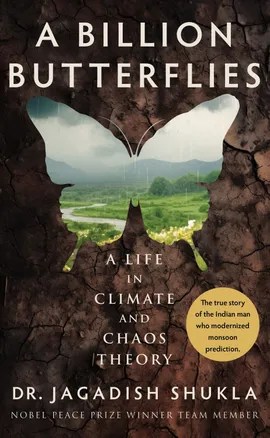
Title: A Billion Butterflies: A Life in Climate and Chaos Theory
Author:Jagadish Shukla
Publisher: Pan Macmillan India
This is a fascinating autobiography – autobiography of an Indian who revolutionised monsoon forecasting. Raised in a rural area of India devoid of electricity, plumbing, or formal educational institutions, he participated in classes conducted within a cow shed. Shukla’s upbringing was marked by erratic weather patterns, including intense monsoons and severe droughts, which resulted in unpredictable agricultural yields. His resolve led him to the Indian Institute of Tropical Meteorology, despite having limited experience. Subsequently, he embarked on an unexpected journey to MIT and Princeton, reaching the pinnacle of climate science.
His contributions have made it possible to forecast weather further into the future than was previously deemed achievable, enabling us to nourish more individuals, preserve lives, and maintain hope in an increasingly warming world.
A Billion Butterflies by Shukla offers a remarkable insider’s perspective on climate science, alongside an extraordinary memoir of his life. Grasping the concept of dynamical seasonal prediction will transform our experience of thunderstorms and our interpretation of forecasts; the incredible narrative of the individual who uncovered this will alter our perception of the world.
The fundamental concept of this heartfelt narrative revolves around envisioning a world devoid of weather forecasting. How would we determine when to evacuate populations in anticipation of fires or floods, or decide what attire to don the following day? Until four decades ago, we were unable to predict weather conditions beyond a ten-day horizon.
Writes Shukla in the Prologue: “In the past one hundred fifty years, humans chopped down many of Earth’s carbon-sucking forests and began burning fossil fuels to heat their homes, power their factories, and propel their vehicles, releasing unprecedented amounts of CO2, into the atmosphere. Like the glass walls of a greenhouse, CO2, admits energy from the sun but prohibits energy from leaving the Earth. And so pretty quickly, our nicely balanced climate became imbalanced. In the century, as the amount of CO2, in the atmosphere has increased, Earth’s global mean surface temperature has ticked up from 14 to 15 degrees Celsius.
“This is called climate change. Climate change due to human activities is now firmly established by the observed facts and the laws of physics. The consequences of the phenomenon are becoming self-evident, but so are, I’d argue, the capabilities of the new generation of scientists to find a way forward.”
Shukla says in the book, on average, the Earth expels approximately 122,000 trillion watts of energy into space annually, which is roughly equivalent to the energy it receives from the sun. This equilibrium between outgoing and incoming energy is what establishes the average climate on our planet. For nearly ten millennia, the balance between incoming and outgoing energies was so well maintained that the global annual average temperature remained a comfortable 14 degrees Celsius, allowing life to persist and humanity to flourish. On Venus, this equilibrium results in an annual average temperature of 464 degrees Celsius. This is not unexpected, considering Venus’s proximity to the sun. However, there is another significant factor, aside from the energy a planet receives from the sun that affects climate: the chemical composition of its atmosphere. On Venus, carbon dioxide constitutes 95 percent of the atmosphere. In contrast, Earth’s atmosphere contains approximately 0.04 percent carbon dioxide—or at least, it did.
The book is meticulously crafted and filled with complex details about climate events, representing a significant effort that the author labels as chaos theory. Its importance is evident in a world facing the pressing challenge of addressing the devastating impacts of climate change.
For anyone who cares about the health of our planet, this book is a must-read.
.
Bhaskar Parichha is a journalist and author of Cyclones in Odisha: Landfall, Wreckage and Resilience, Unbiased, No Strings Attached: Writings on Odisha and Biju Patnaik – A Political Biography. He lives in Bhubaneswar and writes bilingually. Besides writing for newspapers, he also reviews books on various media platforms.
PLEASE NOTE: ARTICLES CAN ONLY BE REPRODUCED IN OTHER SITES WITH DUE ACKNOWLEDGEMENT TO BORDERLESS JOURNAL
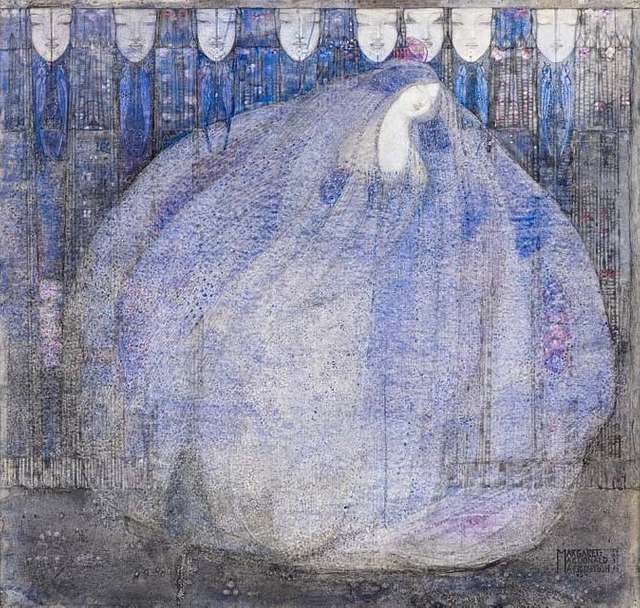
Painting by Margaret Macdonald Mackintosh (1864-1933)
Toma flopped onto the cushioned sofa in resignation and disgust. She cursed herself for being persuaded into believing that it would be a nice evening. She should have trusted her instincts. Now she regretted her decision to come to the party. Nothing to look forward to but the time when her uncle and aunt would decide to leave.
She sighed and took a sip of lemonade and noticed her uncle casting a worried glance at her. Feeling somewhat sorry for him, she smiled to assure him that nothing was amiss. It was not his fault, really. Her Latif Uncle and Rashida Aunty were doing their best to introduce Toma to the Bangladeshi community in Arlington. Back in Dhaka, Toma’s mother had lately been upset by her wayward daughter’s decision to stay on in the US to pursue a PhD after completing her Master’s. So, to appease her mother, she agreed to go to this party while visiting her maternal uncle and aunt in Virginia—a place to meet prospective bridegrooms and such. Toma herself had not been completely averse to the idea—she wouldn’t mind settling down eventually—but what she had seen so far was not very encouraging.
Early in the evening she had met Faiyaz, son of an eminent Bangladeshi doctor living in Fairfax, and himself a well-paid systems analyst with an MS from MIT. His mother had been crowing to the crowd about his recent raise. Toma could not help cringing. To her, such information was absolutely private, and she considered it as distasteful as a display of undergarments. Faiyaz, a stocky fellow of about 5 feet 4, smiled coyly at Toma, who was taller than him, poised, and very attractive. Throughout the evening, she had noticed quite a few men sizing her up and down. An elderly man even asked her if she had been in the Girl Scouts as she seemed to have an athletic body. Toma smiled politely and answered “no” before moving away feeling irritated and embarrassed.
Next came Tanvir and his parents. “Oh, how interesting! Both Toma and Tanvir begin with a T!” the father said with great mirth. Tanvir worked in a law firm in New York and was on the lookout for a prospective bride who would be smart and attractive, but not too career-oriented. He would be earning a lot, so he was more in need of a homemaker. The first question he asked Toma was what she planned to do after her master’s. When she replied that she was continuing into the PhD, he looked at her very seriously and said, “You are in physics, right?” Before Toma could reply he ploughed on. “You know, girls don’t have the right kind of aptitude for science. I don’t mean any offense. It’s just that research has shown that girls are better at languages while boys are better at mathematical and spatial cognition. In any case, with your degree and looks you can get a good job—why would you waste several years of your life on a PhD?”
Toma felt like scratching his eyes out. She took a moment before replying. “It has been my dream to become a physicist since I was in eighth grade,” she said. “Besides, I got accepted and funded at Purdue, so presumably, they didn’t find any problems with my mathematical and spatial skills.” Toma forced a smile before moving away.
After meeting Habib and his blabbering fool of a sister, Toma decided to take a break. After all, there was only so much one could take. She heaved a sigh and took another sip, no, a gulp at her drink. She could not understand why these people, who claimed to be so well-educated and cultured, acted the way they did. She looked across the room at the bevy of women in all their jewels and finery. To think that some day she might have to join their ranks made her feel nauseated. She saw a fat Mrs. Zoardar gesturing with her hands in such a way that everyone could see her emerald-studded bracelets. Another woman in a pale purple muslin saree was talking in a high-pitched voice, “Daud and I are planning to visit Europe next summer. I simply loove Paris—the Louvre is my soul. People here boast about cars and houses. You should all open your eyes and try to see the world. What is there in life, eh? Enjoy it!”
Toma grimaced and thought that the only person she could confide in about such nonsense was Mayeesha. Like Toma, Mayeesha too had been lately facing these situations. Actually, her case was worse since she lived in a city with a larger Bangladeshi community, whereas Toma had only come here to visit. Soon she would be back in the small university town in Indiana where the community would leave her largely at peace.
“Why so sad a face?” said a voice that sounded rather amused. Toma saw a woman occupying another sofa across from hers. She remembered seeing her before—a young woman who was accosted by a mother with two marriageable sons. She had deflected her by saying that she was already married and then had moved gracefully away from the vicinity. She was holding a glass in her hand, probably fruit punch, and Toma could not help noticing her fingers—the long, tapering fingers of an artist. She had an amused smile on her lips, but it was her eyes that made Toma take a second look at her. Her eyes were almost violet—a very unusual color for a Bangladeshi woman. Must be colored contacts, Toma thought. Still, there was understanding and compassion in her eyes. Unlike the other women in the room, she wore a simple vegetable-died, earth-toned cotton saree which made her all the more attractive.
“I am Urbee, I’m visiting too,” she said.
Toma smiled back. “I am Toma.”
“And you’re in the marriage mart?” said Urbee with her eyes dancing. It was more of a statement than a question.
Toma squirmed and then tried to change the topic. “I heard you say that you’re married. Is your husband around?”
“No,” replied Urbee solemnly. “I am actually separated from my husband. But I say I’m married to save myself from the old vultures. A woman here has no place unless she is under a man’s name.” She made a face and said, “Pathetic, isn’t it?”
Toma didn’t know what to say in response to this frank admission. “You’re not dressed like the other married women though,” she said.
“I’m still a student. So I can wear what I want. Besides, my husband is not here, right?” came the reply. “But there are also exceptions. See that lady over there? Urbee inclined her head and Toma followed her gaze to see a woman with a child seated on a sofa. She wore a crumpled silk shalwar-kameez, and seemed oblivious to the world. Her hair was casually tied at the back and she wore no make-up. As far as Toma could see, the only jewelry she had on was a pair of earrings, nothing gold or glittering. “Her husband is an economist, and she herself is a doctor. But she does not give a fig as to what people think of her,” murmured Urbee. “And now take a look at that decked-up camel.” Toma turned to see a tall, lanky woman in bright fuchsia pink lehenga passing by. She wore false eyelashes. The kohl eyeliner reminded Toma of Elizabeth Taylor in Cleopatra. She gave Toma and Urbee a fleeting glance as she walked by. Toma could almost see a camel in her awkward gait.
“She is a grad student at Virginia Tech—does she look like it? Her father pays for it, of course,” confided Urbee. “And there’s her sister who has come to visit from Texas.”
The sister looked normal, thought Toma. As if reading her thought Urbee said, “Wait till you see her with her son. They have a birthday bash for him once every month in anticipation of his first birthday this coming February. Oh, and they order several identical birthday cakes: one for the photos, one for the kids to smash, one for the kids to eat, one for the diabetic grandparents—you get the idea.”
Toma turned to look at her companion. “You’re kidding!” she spluttered. Urbee shook her head sadly. “No, I am not. Their father is a notorious government officer in Bangladesh. He is filthy rich. They have a ranch somewhere in Texas. The whole family spends time there every year. The decked-up camel is also in the marriage-mart, by the way.”
“She will fit in very well, I think,” answered a disgusted Toma.
Urbee smiled. Suddenly, a woman appeared from nowhere. “There you are. I’ve been looking all over for you.” Toma looked up to see a rather pretty but anxious-looking woman bending towards Urbee. “Don’t you think we should leave now?” she asked.
A flicker of annoyance crossed over Urbee’s face. But she replied in an even voice, “Come Rehnuma, I’ve just started enjoying myself. Don’t spoil it. Meet Toma. She is visiting too—like me. Toma, this is my cousin Rehnuma.”
Rehnuma glanced at Toma uncertainly and her lips stretched in a tight smile. Then she left abruptly but looked back at least twice. Toma felt somewhat uneasy. “Is there anything the matter? Your cousin does not like me, I think.”
Urbee laughed. “It’s not you. The problem is with me. I don’t fit in, you see. And she thinks I will get into trouble.”
“Do you get into trouble?” Toma was curious.
“Oh yes,” Urbee giggled. “If people bother me too much, that is. I told Mrs. Zoardar that she has a lot of similarity with the queen of pigs. And when Harun Ali’s brother came to look for a prospective bride, I told him nobody would be interested in a bald dwarf like him!”
Toma’s jaw dropped open. “What? No way! But why? Because they’re stupid?”
“Not just because they are stupid. Mrs. Zoardar has a daughter-in-law whom she treats very badly. And look at the woman—she thinks she looks like a queen. Yes, she is the Queen of Pigs.”
“And the other one?”
“That one is an absolute ass. He is a short, bald, hirsute fellow—not to mention almost middle-aged—yet he was looking for someone ‘beautiful and fair.’ Also, the bride would have to be less than twenty-five years of age. So I told him the truth. He has not found his bride yet, and that was three years back.”
A thought occurred to Toma. “You seem to know a lot of people around. How long have you been here?”
Urbee looked away. “I come here every December to visit my uncle. This is my fourth year in the US.”
“And Rehnuma is your cousin – I mean your uncle’s daughter?”
“Yes.” Urbee smiled. “She is rather cautious. Doesn’t like my ways.”
“Well,” laughed Toma. “I admire your courage. But I won’t be able to do what you do.”
“Oh, but you will,” replied Urbee with conviction, turning her shining eyes on Toma. “I, too, was polite and courteous once. But it seems a long time ago now. Sweet and enduring as my name. ‘Urbee’ means earth—did you know that?”
“I was thinking that yours is an unusual name. I have known a couple of Urmees, but no Urbee. But, seriously, you’re talking as if you’re my grandmother,” Toma laughed. “You cannot be more than three or four years older than I am.”
“I am thirty-seven, Toma. I may not look it but I am. When you reach my point in life, you too will think and feel differently.” She looked at Toma directly. “You too don’t fit in. You see things differently already.”
Toma shuffled uncomfortably. “A lot of girls feel like me. My best friend Mayeesha, for example.”
Urbee laughed. “I don’t know your friend. But you remind me of myself ten years back. I married because I thought I was in love.” She shrugged.
“I won’t get married until I find the right person,” Toma replied quietly.
Urbee peered into her face and laughed again. “And are you sure you’ll recognize the right person?” She shook her head. “You’re very romantic, just as I was,” she paused. “There’s no right person,” she shook her head. “There’s no man in this world to fit in the shoes….” Her voice trailed off. Then suddenly she got up and smiled brightly. “Best of luck in your groom hunting.”
Toma was suddenly angry. “I’m not looking for a husband,” she said firmly.
“Nooo?” Urbee looked at her wide-eyed. “What are you doing here then? Haven’t you been looking around and passing judgment too? ‘This one has a nosy mother, that one is too short, this one is too bossy’—isn’t that what you had been doing?”
Toma was too flustered to reply.
Her companion observed placidly, “We all do it, Toma. All the time. We are all in the same boat, only we think we are different.”
Toma found her tongue. “But you just said that I don’t fit in.”
“That too,” Urbee nodded. “You don’t fit into their world. You belong to another. That’s the problem. How will you survive in their world? Good luck.” Urbee walked away before Toma could stop her.
* * *
“Come dear, it’s time to leave,” Toma’s reverie was broken at the voice of her aunt. Rashida was smiling at her niece with genuine affection. Toma got up, relieved at the prospect of getting out of this place at last. Latif was already at the door, collecting their coats.
“I saw you talking to Tonima,” observed Latif when they were seated in the car. “What do you think of her?” he asked.
“Tonima?” Toma asked blankly. “Who is that?”
“The girl you were chatting with,” her aunt supplied.
“Oh! But her name is Urbee —was that her nickname, then?” Toma was a little perplexed.
Her uncle and aunt glanced at each other. “That was Tonima. What else did she say?” her aunt asked.
“I rather liked her,” Toma smiled. “She seems nice, though at the end I thought she was a bit strange. I would love to meet her again.”
“Did she say anything about herself?”
“She said she’s a grad student. But I don’t know what her discipline is, or where she studies. Why do you ask?” Then Toma added hastily, “She did mention that she is separated from her husband. . . you don’t disapprove, do you?”
Latif sighed. Toma went on, “She is a fine person, I think, even though different from most people.”
“She is not. . . er, normal,” her uncle blurted out, a little embarrassed.
“Not normal!” Toma echoed.
“She used to be a scientist, a molecular biologist doing cancer research, but then she went crazy,” Rashida said quietly. “She lost her only child in an accident. Never recovered from the blow fully. Her mother-in-law blamed her for being careless. It was not her fault though. She tried having another child but miscarried. Her in-laws interfered and poisoned her relationship with Biplob. A year later, they were divorced. Tonima and Biplob used to be a lovely couple, always the life of the party.” Rashida looked out at the lighted building they had come out from. “She was such a talented young woman—such a waste,” she sighed.
Toma fumbled for words, “But. . . uh. . . why was she . . . what was she doing in the party, then?”
“It’s her uncle’s house. She has a nurse, I think, who checks on her from time to time.”
Toma remembered Rehnuma and her anxious face. “Rehnuma,” she whispered.
“What?” Latif asked absent-mindedly. “She has this weird habit—takes on the persona of different people. And makes up strange tales.” He looked at Rashida. “Do you remember how she freaked out poor Ashraf by telling him that she is the re-incarnation of some Indian goddess?”
Rashida laughed. “Yes, Kali. I thought that was hilarious.” She looked at Toma explaining, “I don’t like Ashraf. He acts like Mr. Know-It-All. I thought Tonima gave him a good put-down.”
Toma was still struggling to grasp it all. “But she seemed quite normal to me. I mean—I mean the way she observes people.” Toma repeated some of the things she heard from her new friend. “And she has a very good sense of humour,” she added.
Latif sighed again and started the car. “That’s the problem. She seems normal—almost. But then, she has these hysterical fits when she remembers what she had and lost. Her uncle loves her very much and takes utmost care. Sometimes she is very charming, but. . .”
“And that Biplob!” Rashida grumbled. “He simply relocated. Married again—lives somewhere in California, I heard.” Then she added viciously, “The only good thing is that the new wife banished her mother-in-law from the house when she tried to meddle too much.”
Toma sat quietly, thinking of all she has heard. Urbee seemed so natural, intelligent, sane, and normal. Her observations on the people of the room were accurate and exactly as Toma thought. Suddenly, she jolted and felt a shiver run down her spine. Tonima—that name was so much like her own. And she used to be a scientist, just like she herself hoped to be. But what was she actually looking for in her prospective husband? Was she just a husband-hunter, as Tonima had said? Would she find the right person, or the right direction? Didn’t Tonima say that Toma will become like her?
As the car plunged into motion, Toma sat still and looked out into the darkness, trying to imagine what the future had in store for her.
.
Sohana Manzoor is a writer and academic from Bangladesh, with a PhD in English from Southern Illinois University Carbondale. Her works have appeared in Bellingham Review, Eclectica, Litro, Singapore Unbound, Borderless Journal, and elsewhere. She was the Literary Editor of The Daily Star from 2018- 22. Currently, she is pursuing an MFA in Creative Writing at UBC, Vancouver.
.
PLEASE NOTE: ARTICLES CAN ONLY BE REPRODUCED IN OTHER SITES WITH DUE ACKNOWLEDGEMENT TO BORDERLESS JOURNAL.
 Borderless