Categories
Excerpt

Dreiser, Melville: Birds of a Feather

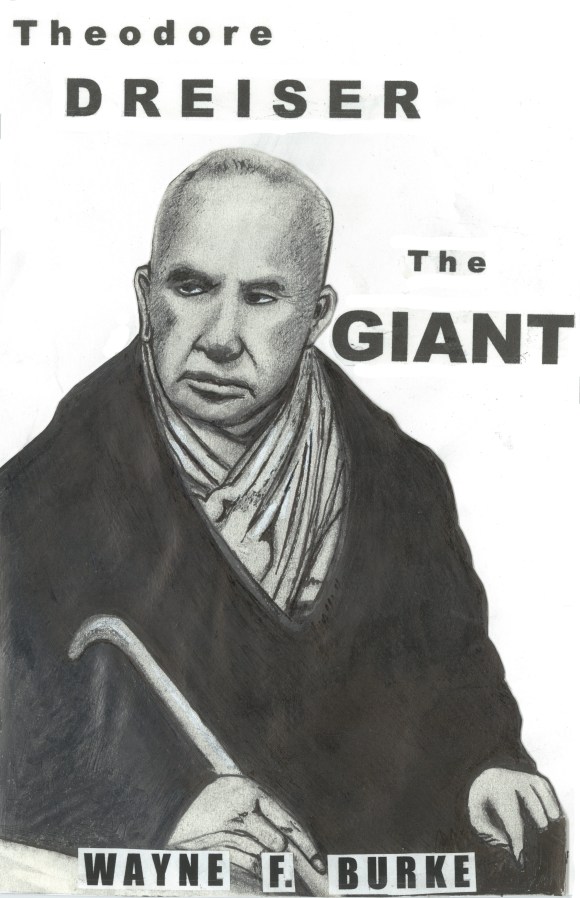
Title: Theodore Dreiser — The Giant

Author: Wayne F. Burke

Theodore Dreiser (1871-1945) reached apotheosis of his literary endeavour with his 1925 publication An American Tragedy. In the following twenty years, until completion of the The Bulwark in 1946, nothing he wrote remotely equaled the power of the tragedy. His opus plus Sister Carrie has become a classic—so too Jennie Gerhardt to a less heralded extent. Some of Dreiser’s short stories, such as “Nigger Jeff”, “St. Columba and the River”, and “The Lost Phoebe”, could stand on their own in any American or world anthology. Due to its narrative thrust and other attributes (powerful romance), The Financier was and is the best of Dreiser’s ‘Trilogy of Desire’ (including The Titan and The Stoic). The first three-quarters of the autobiography Dawn made for compelling reading, as did all of the essays in Twelve Men. The Bulwark was and is a minor classic, truncated but yanking at heart strings as adamantly if not for as long as any of Dreiser novels. Newspaper Days, the second volume of his autobiography is a baggy and verbose twin of the heavily, and unfortunately edited, A Traveler at Forty.

“The last great American writer of Melvillean dimensions,” Jerome Loving wrote of Dreiser. Dimensionality and similarity is each writer’s search to uncover and understand the phenomenon of existence. It’s a spiritual quest, though neither men have any sectarian belief (Melville nominally Unitarian). What is and to whom does the “oversoul” of Emersonian transcendentalism belong? To Dreiser, the grand protagonist life itself suggests a something else: God or gods perhaps, behind the display of natural phenomenon. Hs opus suggests that God or gods, or the “Creative Force,” used humankind for his, her, its own purpose; a purpose hidden from humankind’s limited understanding; also theorising possibilities of additional God or gods in the background making use of, let us say, “primary” God or gods, for a like inscrutable purpose.

In his last years Dreiser looked through a microscope for clues to the phenomenality of being—to unravel mysteries of life. Switching gears mid-career, he became an explorer of consciousness who preferred the company of scientists to that of literary brethren (to the detriment of his art, I must add).

 In Dawn, Dreiser theorised that humankind was an invention—a schemed-out machine, useful to a larger something. This theory marked his turn from an early mechanistic belief in universal proceedings to consideration of an oversoul, or creative intelligence, behind or causative to universal phenomenon.

But what “soul”? What cause? What intelligence? Ahab[1] tried to tear the veil that covered the quondam source; tried to expose the phenomenon of so-called “reality,” but being only a man, and mortal, failed—dying in the process. What is the symbolism of the great whale’s whiteness but a concealing veil thrown over appearances? Melville’s scientifically, scrupulously dismantled his leviathan part by part, yielding naught as to mysteries of origins and unquantifiable organic processes, while Dreiser wandered over the same dry speculative desert (as Hawthorne noted) too honest to be or do otherwise.

 Dreiser had his own mystic creed; refusing to conform to any formal doctrine—his views in later years influenced by Quakerism, Hinduism, and Christian Science (which his wife “Jug,” and his character Eugene Witla of The Genius came under spell of). In Newspaper Days, and in a sour mood, he wrote, “Religion! What a mockery! Why pray? Of whom to ask? The one who loaded the dice at the start?” Elsewhere in that same book—and in a better mood—he wrote, “There is a sower somewhere. Is it planet, gas, element, fire? It gardens and sows—what is its plan, and why?”

 Like many ex-parochial students, Dreiser had a profound dislike of Catholicism and her rituals. A dislike engendered, in Dreiser’s case, by scorn of an ineffectual father, John Paul Dreiser. In Dawn, Dreiser wrote of Catholics with ossified brains who rejected natural emotion as sinful; who spent inordinate amounts of time on their knees praying to an immense and inscrutable something which cared not for their adoration or supplication.

He denied sectarian pretense to divine authority and wrote about how little there was to the Christ legend aside from artistic spectacle. Ritual and churchly dogma infuriated him—particularly angered by the priest who at first denied Dreiser’s mother burial in the sacred grove because she was a lapsed Catholic.

Dreiser despised religion in the form of Catholicism as much as he came to despise oligarchy—though early in his career celebrated the power of the oligarch in the character of Frank Cowperwood, of the ‘The Trilogy of Desire’, apotheosis of laissez faire capitalism run amuck.

 Will Dreiser’s work survive the muddle of brave new world exigencies? I hope so. The slow relentless and inexorable pace of his stories, with their accumulation of details, are or seem anathema to the cyborg-screed of flash fiction sound bites in the blogosphere, but the stories he told—all having to do with vagaries of the human heart—though perhaps out of vogue, will never not be relevant to the human oh so human condition.

[1] From Melville’s Moby Dick

About the Book:

Theodore Dreiser – The Giant, is an explication, exegesis, of the fiction of Dreiser plus much of his nonfiction. Included are synopses of each title. Between considerations of the work is a biography of the writer. (Note: Dreiser could be, in his work, pedantic and humourless: this study is neither.)

About the Author:

Wayne F. Burke writes both poetry and prose. He is author of 12 published poetry collections–most recently Whatever Happened to Baby Wayne? Hog Press, 2025; two works of fiction–most recently No Tab For Sully, a novella, Alien Buddha Press, 2025; and six works of nonfiction–including Theodore Dreiser – The Giant, Cyberwit,net., publisher, 2025. He lives in Vermont (USA).

PLEASE NOTE: ARTICLES CAN ONLY BE REPRODUCED IN OTHER SITES WITH DUE ACKNOWLEDGEMENT TO BORDERLESS JOURNAL

Click here to access the Borderless anthology, Monalisa No Longer Smiles

Click here to access Monalisa No Longer Smiles on Kindle Amazon International

Categories
Essay

My Favourite Book by Fakrul Alam

Professor Fakrul Alam

My favourite book? Over the years, I have had many favourite books, and have been totally captivated by at least one of them at any one period of time. Indeed, once I began to take literature in English seriously, I was completely swept away by one book or the other that I came across at the University of Dhaka B. A. (Hons.) and M. A. English department syllabuses year after year. In my first year as an undergraduate, for instance, I read D. H. Lawrence’s Sons and Lovers (1913)compulsively, finding in its protagonist Paul Morel’s growing up into a young man’s storyline parallels with mine—although he was a miner’s son in Nottingham in the early twentieth century and I a boy growing up in Dhaka in the 1950s and 60s and the son of middle-class parents. A couple of years later, it was Jane Austen’s Pride and Prejudice(1813), for the story of the Bingley girls and their marriage encounters sounded familiar to me, for I too had four sisters whose marriages had become central to my parents’ thinking in all kinds of ways. And in my M. A. I read a book which harpooned me fully for many a decade—this was Melville’s Moby Dick (1851)—a whale of a book, I’m sure many of you in the virtual audience will agree. In all three cases, I read not only the novels I mentioned but almost everything by Lawrence, Austen and Melville I came across. Indeed, Melville’s fiction became the subject of my M. A. dissertation at Simon Fraser University.

But in the 1990s, I began to pay attention to Bangla writing seriously —something I had neglected for long, thanks first to an English medium education exclusively geared to the “O” levels that scanted our own literature and then my specialisation in literature in English afterwards. I began to read Bangla poetry intensively for the first time in this decade, although I had read some fiction in the language over the years. And it was sometime in the middle of the 1990s that I came across Jibanananda Das’s verse in an edition of his selected poems by the Bangladeshi poet-critic Abdul Mannan Syed. I would like to stress that this poet was born in 1899 in Borishal, a very green district crisscrossed by innumerable rivers all heading ultimately for the nearby Bay of Bengal; he died in what seemed to be an accidental death in Kolkata in the mid-1950s. Das’s verse possessed me completely, leaving me, who had till then read only some Bangla poetry but had concentrated mostly in fiction and non-fictional prose in English, with the urge to translate his verse into English. For the next three years, I kept going back to Das’s poems for their beauty, for the way they immortalised in verse the beauty of Bengal, and for the way they made me the poet’s intimate, for it is only when one translates intensely, all caught up in the source text, that one comes closest to the mind speech as well as the deep emotional life of the poet.

Having translated Jibanananda Das—surely the greatest modern Bengali poet—I felt I had to try to translate Rabindranath Tagore’s poetry—the greatest poet and literary personality Bengal has produced. Even though in the 1960s and 1970s, I had only paid sustained attention to poetry, fictional and nonfictional prose and plays in English, how could I have escaped Tagore then? He was everywhere in the Dhaka I experienced and very much part of the mindscape of us Bangladeshis as we moved towards becoming citizens of Bangladesh. His work was championed in the media; his songs were sung in events such as the Bangla new year festivities in mid-April; cultural events everywhere spurred by nationalism highlighted him in one way or the other. Besides, my father was addicted to Rabindranath’s songs and listened to him on the radio whenever he could, making us share his delight in the melodies then. My mother, for her part, quoted him all the time to give her children a sense of what we should be emulating and where we were going wrong.

In other words, Rabindranath was very much part of my consciousness, although I had occluded him till now. As I began to read him in the turn of the decade after translating Jibanananda, I felt I had to read as much of his works as I could. Inevitably, I began to translate many of his poems. By the time his sesquicentenary came up in 2011, I was invited to co-edit an anthology of his works and that led to the extensive reading of the myriad-minded writer’ work and increasing familiarity with this wonderful personality as well as writer.

And this is how I came to my favourite book of the last decade or so—Tagore’s Gitabitan. It is a book that is always on my study cum desktop computer table’s shelf over ten years now. It is something I resort to every time I listen to a Rabindranath song on YouTube in my desktop’s audio system. Sung melodiously and passionately by a favourite singer, a song by Tagore so allures me into rendering its spirit in another language that I feel I have to come as close to it as possible by translating it to the best of my ability. This means not only listening to the song again and again but also reading it on the printed page repeatedly, word by word, line by line, and stanza by stanza, time after time, till I feel I have been able to capture every aspect of it nuanced by Tagore by blending the tune and the song lyric as well as I could in the English language. In the end, of course, I fail to do so after a point, but the fascination of what is so appealing when heard, even if in the last analysis the task is an impossible one, induces me to render it into an alien language system after repeated readings and attempts to come up with a version that is close to the original in every way. I hope thereby to come to the heart of the song and am content to spend an hour or so on a few lines so that I can make its meaning clear to myself and then to others.                

Truly, there is a magical quality in the songs collected in my favorite book of this time—Tagore’s Gitabitan. It is a book that has also kindled the imagination of quite a few people—singers, musicians and translators— over eighty years now, making them represent the song-lyrics either as songs to be sung or as translations meant for foreign and even Bengal language speakers who might otherwise listen to a song swept away by the tune and opening lines without bothering with the later lines or making no attempt to understand its content.  The net result at the end of a few hours spent first reading many of the song closely, then reading my own translation again and again, is the satisfaction that I have been able to capture its essence in English through my translations. After all, and as Tagore himself has said, “the essence of a song is universal, even if its dress is local and national” (77). Why should I as a translator then not attempt to translate his songs for the world at large as well as myself even if their loveliness is uncatchable in the last analysis? He himself had led the way, and had learnt lessons along the process that were worth considering for later translators. I am hoping to bring out my own collection of translations of 350 plus songs by Tagore by the beginning of next year.

Let me point out that the title Tagore gave to the volume indicates that Gitabitan is meant to invite readers and musical devotees of the poet-composers to his “garden of songs.”  In all, the volume contains over 2,300 songs, nearly 1800 of whose tunes can be found in the musician-poet’s Swarabitan with their musical notations. In fact, there are sites now that you can google and access where you can find the Bengali words, some English translations, and notations, and even brief histories of the origins of the most commonly heard songs.

Let me point out too that Gitabitan itself is divided into six sections—songs of devotion, love, the six seasons of Bengal, patriotic songs, songs for festive and miscellaneous occasions, songs written for his plays and other publications. In their final form, the Gitabitan was published in 1941—the year the poet died. By now it has been reprinted, with new inclusions from scattered sources, innumerable times.

To conclude, why is Rabindranath Tagore’s Gitabitan my favourite book? He had himself said to Bengalis in 1939, “You can forget me, but how can you forget my songs?” Tagore’s collection of songs connects me to him endlessly, becoming a way of linking me as well with the universe and the Supreme Being and even my departed parents. They stir my patriotic side and make me one with the seasons of my country and its landscape and whatever is still romantic in me. And as I head towards the Great Unknown, they console me that there are possibilities of communion after we depart from this world as well!   

Fakrul Alam is Supernumerary Professor of English at the University of Dhaka

Click here to access the Borderless anthology, Monalisa No Longer Smiles

PLEASE NOTE: ARTICLES CAN ONLY BE REPRODUCED IN OTHER SITES WITH DUE ACKNOWLEDGEMENT TO BORDERLESS JOURNAL.