Narratives and photographs by Suzanne Kamata
Several years ago, I published a short book, A Girls’ Guide to the Islands (Gemma Open Door, 2017) about traveling amongst the islands of Japan’s Inland Sea with my daughter, who is deaf and uses a wheelchair. One of the islands that we visited was Naoshima, the site of several art museums, including the Chichu Art Museum, which houses five paintings from Claude Monet’s Water Lilies series. In addition to writing about our responses to the various artworks, I touched upon the difficulties and differences in traveling with a wheelchair user. For one thing, the ferry which conveyed us from Takamatsu City to the island, did not have an elevator to the upper decks. While others got out of their vehicles to take in the scenery from above decks, my daughter and I spent the crossing in my car.
Shortly after this trip, I received a grant from the Sustainable Arts Foundation for a longer book about traveling with my daughter, which became the award-winning Squeaky Wheels: Travels with My Daughter by Train, Plane, Metro, Tuk-tuk, and Wheelchair (Wyatt-Mackenzie Publishing, 2019). A slightly different variation of our trip to Naoshima appears in that book.
Although I loved our time on the island, and had not yet visited all the museums and installations, I had not been back since that trip with my daughter. I finally had a chance to revisit last month when I learned that the couple who had administered the grant that had made my book possible would be visiting Naoshima. I arranged to meet with them on my way back from Kyoto, where I was going to attend a book launch. Unfortunately, I wouldn’t be going with my daughter this time. She is now an adult living in Osaka, and it takes a bit of effort to coordinate our schedules. Nevertheless, I figured I could scout out the situation before planning our next mother-daughter adventure.
Although on previous visits, I had taken a ferry from Takamatsu, on the island of Shikoku, this time I took the shinkansen, Japan’s high speed bullet train, from Kyoto to Okayama, where I spent the night in a hotel. The next morning, I easily found the stop for the bus bound for the ferry terminal. Almost everyone in the queue was foreign. As far as I could tell, most of them were from Europe.
No doubt some had timed their visit with the Setouchi Trienalle, an art festival which takes place mainly in the ports and amongst eleven islands every three years. Japan, in general, has seen a huge surge in tourism over recent years due to the weak yen and governmental efforts to promote inbound tourism. While this has been good for Japan’s economy, it has driven prices up for local residents. It also means that public transportation is often crowded.
When we arrived at the ferry terminal, I purchased my ticket and joined the tail end of a very long line. Luckily, I was able to board the ferry and find a seat. I was pleasantly surprised to find the ferry had been upgraded since my last visit. Not only was it appointed with plush seats facing the water, but also there was now an elevator!


About twenty minutes later, we arrived at Minoura Port. Armies of English-speaking guides were readily available. I quickly found my way to the bus stop and onto the bus that would take me to the recently opened Naoshima New Museum of Art. I had just enough time before meeting my benefactors to check it out and have lunch.
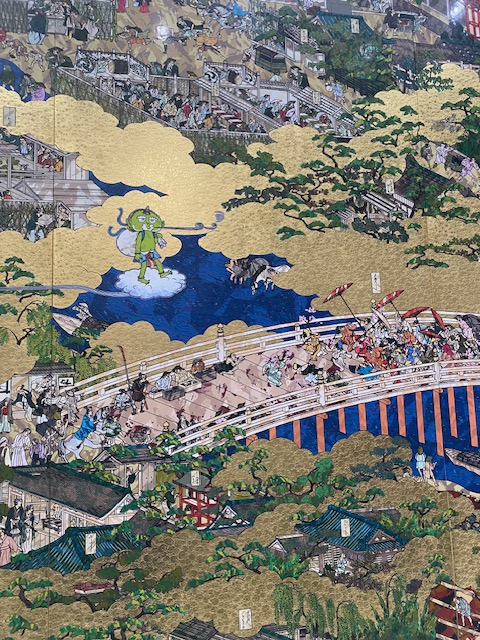
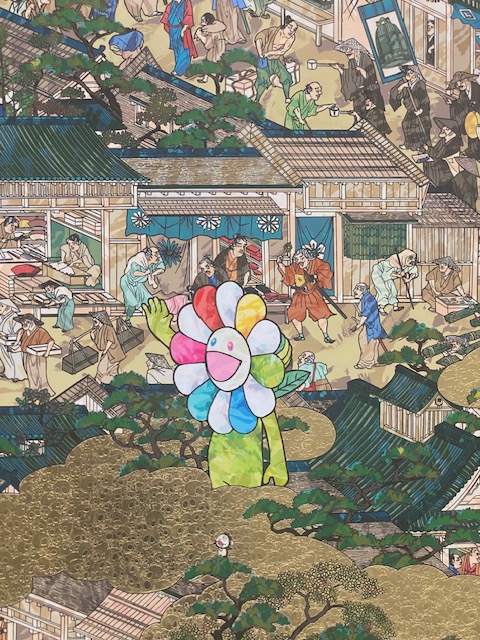
The inaugural exhibition featured the work of twelve artists and groups, including Takashi Murakami, who has achieved worldwide fame. His cartoonish characters appear on coveted Louis Vuitton bags. He also designed a special shirt, printed with cherry blossoms, for fans of the Los Angeles Dodgers. His work on display, a 13-meter-wide painting, is modeled after a 17th century folding screen titled Scenes In and Around Kyoto by Iwasa Matabei. Murakami’s rendition portrays scenes of everyday life in early modern Kyoto. But look closely, and you will find some of his iconic original characters!
Another impressive exhibit, Head On, by Cai Guo-Qiang, features lifelike wolves running toward and colliding with a glass wall. According to the exhibit brochure, the wall “symbolizes the intangible yet deeply felt ideological and cultural divisions between people and communities.”

After going through the exhibits, and vowing to return with my daughter, I popped into the museum café for a quick lunch. The dining area was in open air, with a view of the sea and the islands beyond. I ordered pumpkin toast, perhaps Naoshima’s answer to America’s ubiquitous avocado toast, and a nod to the famous Yayoi Kusama pumpkin sculptures which grace the island.
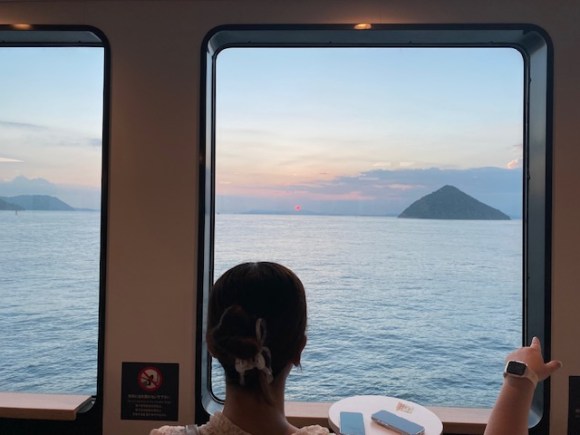
Finally, I took another bus and went to meet my friends. They are no longer awarding grants to parent artists, having shifted their focus to indigenous groups, however, I will remain forever grateful for their support. We met and had a drink near the Benesse House Park, just outside the Terrace, where my daughter and I had dined several years ago. Then it was time for me to head to the ferry terminal and back to Takamatsu, where I would catch a bus. I happened to cross at sunset – a final blast of beauty before returning home.
Suzanne Kamata was born and raised in Grand Haven, Michigan. She now lives in Japan with her husband and two children. Her short stories, essays, articles and book reviews have appeared in over 100 publications. Her work has been nominated for the Pushcart Prize five times, and received a Special Mention in 2006. She is also a two-time winner of the All Nippon Airways/Wingspan Fiction Contest, winner of the Paris Book Festival, and winner of a SCBWI Magazine Merit Award.
PLEASE NOTE: ARTICLES CAN ONLY BE REPRODUCED IN OTHER SITES WITH DUE ACKNOWLEDGEMENT TO BORDERLESS JOURNAL
Click here to access the Borderless anthology, Monalisa No Longer Smiles
Click here to access Monalisa No Longer Smiles on Amazon International
 Borderless