Narrative and photographs by Mohul Bhowmick

The palms sway as if they are reminded of a time long ago when they did not know that tectonic shifts would eventually edge them closer to the peninsular sequestration of mainland India. I bristle with the unimpeded curiosity of a man who knows that there is little to be seen apart from the reality of the here and the now. Corbyn’s Cove remains deliciously impaired by the downhill stretch of road that sees at least a hundred motor mishaps a year; I cannot help but grimace as the palms continue their little dance in immaculate rhythm with the late evening breeze.
Corbyn’s Cove seems to be a delightful aperitif before the hinging actuality imposed upon us by that of the most symbolic images of the island: the Cellular Jail. The garden near the gate of Cellular Jail boasts of petunias imported from England; I give them as much of a passing glance as the after-effects of the audio-visual show permit me.
Savarkar, hailed as a hero by the modern dispensation of our country, was perhaps the most well-known inmate of this gaol. As a reward for the valour he displayed while submitting at least three mercy petitions to the British for clemency after being sentenced here, the airport in Port Blair was named after him. On being granted that, Savarkar virtually stopped all criticism of the British Raj, as a result of which he enjoys a considerable legacy in present-day India as a freedom fighter. The museum here offers no facts about the said freedom or fighting. A young schoolboy asks questions to which his parents have no answer.
*
The convoy through which our car moves in giddying fashion on the Andaman Trunk Road leads us, after a fleeting glimpse of the indigenous people of the island — the Jarawas, to Baratang, where limestone caves await. An old, almost run-down ferry transports us to the mangrove creeks over the Middle Strait and heaves with painful aggravation before vomiting us out of its hull. The mud volcanoes watch with distaste and emit a sigh of antipathy. While the limestone caves remain apathetic to our incursions, I pay no heed to their unvoiced contempt.

But unlike many of my forays in the past, I have felt less at home in Andaman than I have anywhere else. On leaving Port Blair, it seems as if I am circumnavigating an alternate planet, where the corruption that greed unfailingly encourages is let down by the unbridled probity of the officialdom, many of whom hail from the mainland. There is little of culture to speak of, save that which is showcased by settlers from the mainland. As is usually the case when emigres outnumber natives by their sheer magnitude, the indigenous peoples of Andaman have been forced to the margins of a history that they could not claim to have created.
Repeated written requests to visit the island of Nicobar get turned down. Resigned to an expedition that matches the itinerary of other visitors from the mainland, it is not hard to find solace in Aberdeen Bazaar in downtown Port Blair when the sun goes down. The limestone caves of Baratang had been exceptionally kind during the day, decrypting my confusion between stalagmites and stalactites with ease. Listening to my questions with the uninhibited sagacity of a sixty-year-old, the caves showcased how indifference does not necessarily have to portray weakness.
*
Havelock is perhaps the best-known illustration of a one-horse or one-road-town. The ferry from Haddo twists and tumbles in the unfamiliar Bay of Bengal, infamous for its stomach-churning capabilities; it is not before the reassuring Naseeruddin Shah makes an appearance on the in-house television that I finally close my eyes. I wake to the turquoise-clear waters of the same tormentor (the Bay, not Shah) before descending into the waiting taxi, grateful for another chance at life.
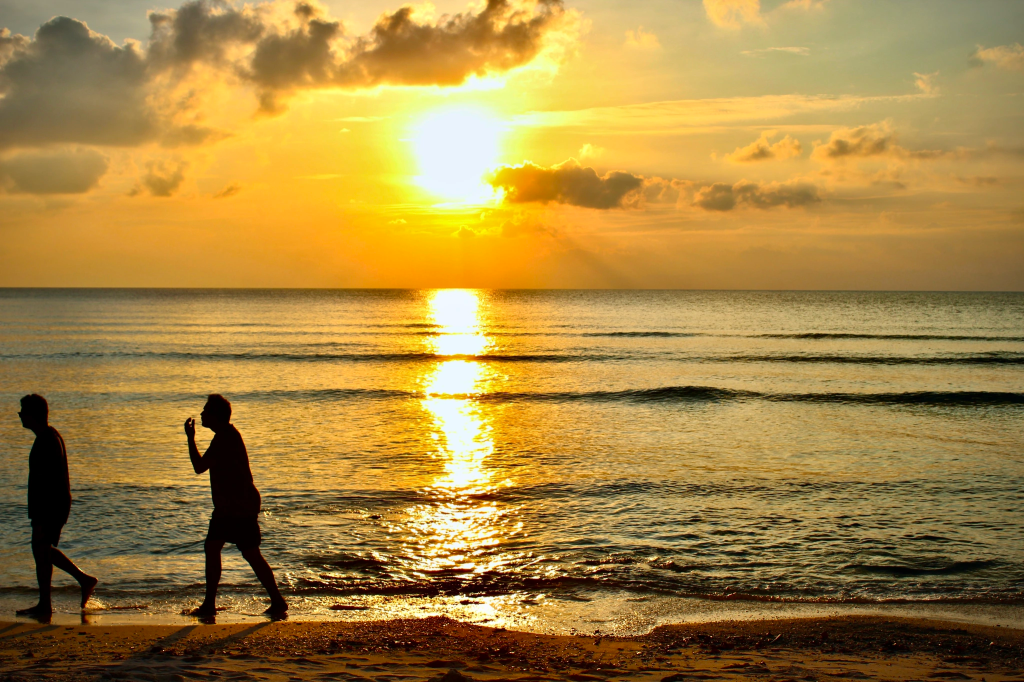
The sun sets without leaving a trace of itself at Radhanagar, and the Bengali migrants who serve up a delightful Mughlai parantha[1] talk endlessly of the overflow of tourists. Their Tamil neighbours, who sell seashells and illegal necklaces made from corals, seem happy enough to welcome the said disturbance, without whom their livelihoods would have been at stake.
The next day, the Kala Patthar beach seems astral at high noon as the sun beats gently down on the golden sand. I sit sipping on tender coconut juice and remind myself that it is too easy to seek the idea of Shangri-la in such locales, and not in the grim reality that the here and the now present. The harsh sun that burns my bare forearms to embers brings with it the missive that utopia, after all, is a state of mind.
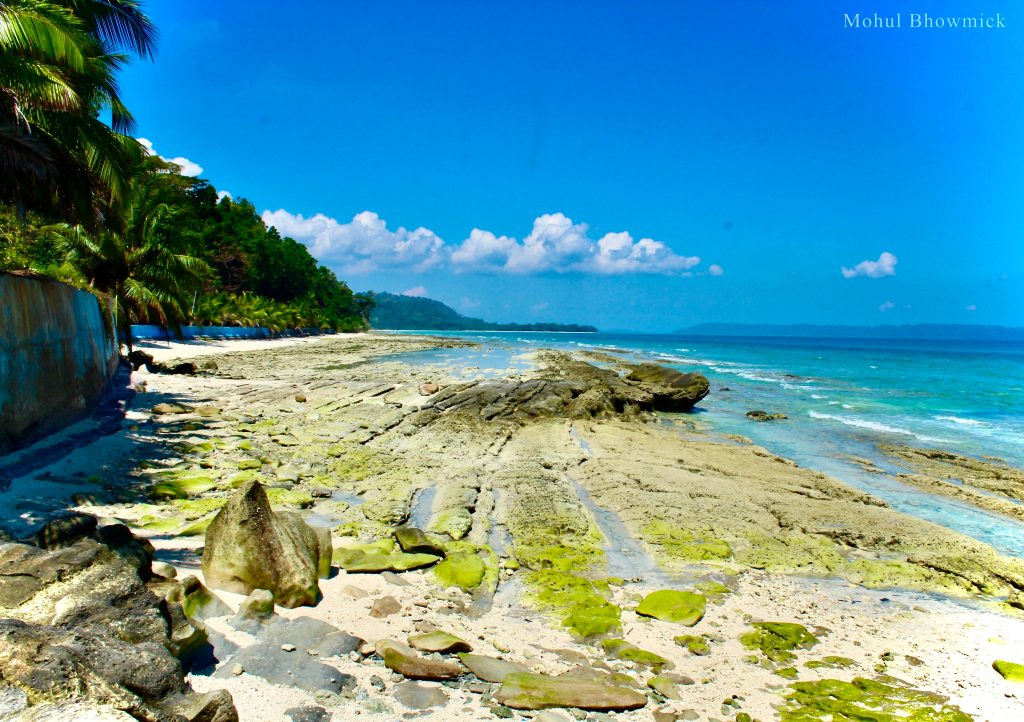
“All the way to heaven is heaven,” Saint Catherine had decreed in the fourteenth century. I found little to argue with the apostle when heading into Neil Island, recently renamed Shaheed Dweep by the central government. Bharatpur merits no mention at all, or about as much as a slap the genteel administrator at the tourist information centre would deserve for including it in one’s itinerary. Laxmanpur 1 and 2, strangely enough, overwhelm me enough to want as little to do with them as possible; it is often the untested and untried that draw a weary traveller’s mind.
*
Return to Port Blair. The droll afternoon spent at Ross takes one back a century or two, but the cacophony that the resultant evening provides is worthy enough of a Tarantino chef-d’oeuvre. At dinner, two raucous Punjabi gentlemen argue over the viscosity of the dal makhni on offer; I take second helpings of the rabri[2] keeping an ear out for the chatter. They involve the floor staff as well, who are helpless, and have no option but to get a new batch of dal tadka served. The gentlemen say that they remember having asked for dal fry… I wonder what Rasheed, our driver during the sojourn, feels when he drops his guests at the airport for their flights back home to the mainland. He has never stepped out of Port Blair and continues to seem distant from the release (or is it escape?) that the terminal offers. I imagine him looking towards me misty-eyed, hopeful for a future in which his reality mirrors that which Andaman often proffers to travellers. But he turns the car around and rushes past the incoming traffic even before we have entered the concours
[1] Mughlai Parantha is flatbread stuffed with minced meat and coated with eggs
[2] Dessert
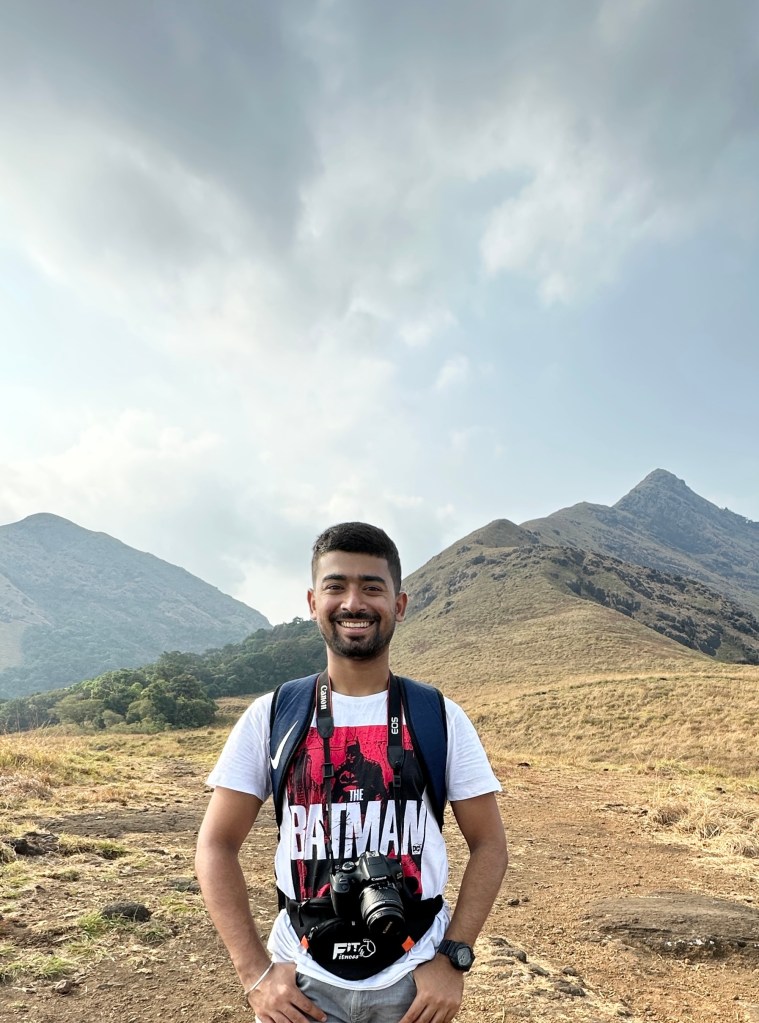
Mohul Bhowmick is a national-level cricketer, poet, sports journalist, essayist and travel writer from Hyderabad, India. He has published four collections of poems and one travelogue so far. More of his work can be discovered on his website: www.mohulbhowmick.com.
PLEASE NOTE: ARTICLES CAN ONLY BE REPRODUCED IN OTHER SITES WITH DUE ACKNOWLEDGEMENT TO BORDERLESS JOURNAL.
Click here to access the Borderless anthology, Monalisa No Longer Smiles
Click here to access Monalisa No Longer Smiles on Kindle Amazon International
 Borderless