Categories
Musings

My Forest or Your City Park?

By G Venkatesh

The tussle between the neoclassical economist [that stubborn, unyielding breed] and the ecological economist [the rebellious change-seeking breed] has been going on for several decades now, and now has reached a climax. As per the former – Robert Solow, Joseph Stiglitz and John Hartwick[1] among them –capital has to be interpreted as an aggregate of the natural and manmade varieties and as long as this sum total is constant, we are good. A decrease in the former can be made up for, by an increase in the latter – it is as simple as that, according to the neo-classicists.

Stress-free thinking? Just move on doing what you will, and the Universe will keep caring for you and protecting you. In fact, that is how a large majority of Homo Sapiens have been conducting their lives and livelihoods over the years, short-changing the conscientious ones in the process. Now this presents a disintegrated view – the adjective being important here. Disintegrated, ironically, even though the neo-classicists claim that what was not created by man can be balanced out by anthropogenic[2] assets, and one could claim that the total utility and happiness and welfare will remain unchanged.  

Let me tell you a story – fiction, yes, but may well have happened somewhere in the world, or maybe in many places in the world, on several occasions. Say there was a forest yonder a few kilometres out of the city. A forest my grandpa used to take me to, for a stroll on weekends, when I was a school-goer. Communion with Mother Nature. Feet on the soil. Glimpses of songbirds, rabbits, squirrels, gurgling streams. Shady trees under which, I and my grandpa would sit and play Ludo. He would tell me stories from the Aesop Fables and I would visualise those animals in that very forest. He would sing for me in his mellifluous singing voice and I would be enthralled and that would develop in me an interest for singing and expressing my locked-up emotions in my adulthood to vent out my grief. We would sit there, and he would teach me how to sketch the elements of Nature. I would grow up to develop an abiding interest in drawing, sketching and painting. Grandpa is no more. But thanks to those strolls, I now think I am a well-diversified individual with multiple tastes and abilities, and also a leaning towards industrial ecology, ecological economics and the like.

That was then. Now, I am a city planner in the very same city I grew up in. I have forgotten those lessons from childhood, even though I retain the said abilities – sing, sketch etc. Grandpa watching from the astral plane is surely sad. But I decide not to care. I veer towards the neoclassical, as I come under pressure from the others I am working with. I cannot stand my ground like Howard Roark did in Ayn Rand’s The Fountainhead (1943). I give my consent to the idea that miners be allowed to prospect for gold in the same forest I used to go for strolls with my grandpa in the past. I visualise a stream of royalties and taxes for the city, which could be used to set up many parks. As the neoclassical theory goes, I would be convincing city-dwellers that I am creating easily-accessible capital for them right at their doorsteps!

The city parks styled as mini-forests, come up in due course of time [money loaned out by banks, which will be repaid thanks to the said royalties and taxes which are anticipated, as the miners have struck gold, literally]. I take my sons out to the park, and while telling them about how they came about and boasting about my planning skills, I slip into memories of the past and tell them how I enjoyed my strolls with their great grandfather long ago in those natural forests yonder. My younger son looks up at me and asks, “Why have not you taken us there? We wish to see where you used to go with your grandpa.” I am dumbfounded. An epiphany!

I have stolen from them what I enjoyed as a little boy. I have deprived them of what Mother Nature had bestowed upon all of us. Surely, people of my grandpa’s generation also used to visit the forest when they were young? And possibly their own ancestors too? Obviously, that is how grandpa knew of the value of the forest for holistic development? My sons have since joined the Greta Thunberg gang and they do not spare me in their criticism. I am proud of them while I am ashamed of myself, if at all these two feelings can arise in the human heart at the very same time. But what I have done, cannot be undone.

Well, the parks and the forests can surely co-exist, so that the aggregated capital can increase a bit and then saturate, instead of having to remain constant. After all, a conscientious city planner should realise that every inhabitant in the city may not have the time, energy or the wherewithal to go to the forest a few kilometres away [especially if he/she does not own a car and there is no public transportation out to the forest]. For such people [who may perhaps account for a sizable percentage of the city population], the city parks are indeed worthwhile investments the municipality can make. A poor substitute, yes, but something good better than nothing.

We came from the forests, right? Those of you who believe that God created Adam and Eve and we all trace our lineage back to a ‘poisoned apple in the Garden of Eden’ (now was that a park or a forest?) may take a hard left. But when you have already read through the article, maybe you have no choice but to pause and ponder. Then, head to the park for a quiet walk, or if there is a forest nearby, you could go there as well for some introspection.

[1] Robert Solow, Joseph Stiglitz and John Hartwick are economists known for their theory on economic growth

[2] of, relating to, or resulting from the influence of human beings on nature

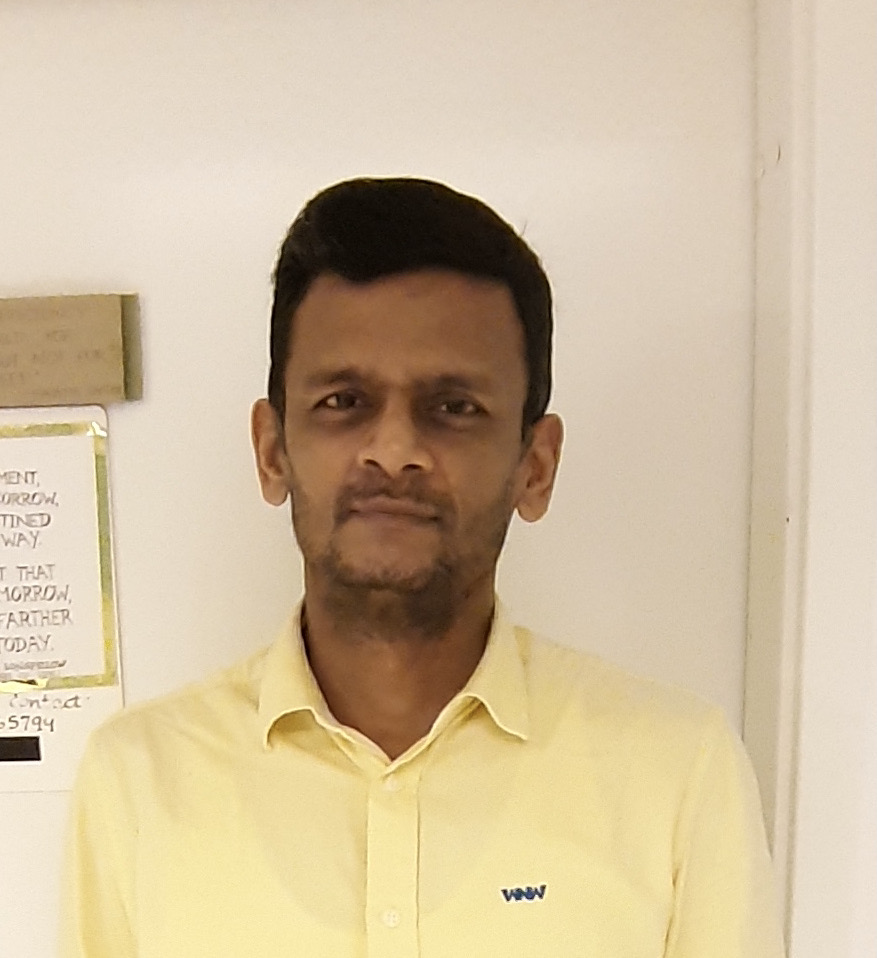
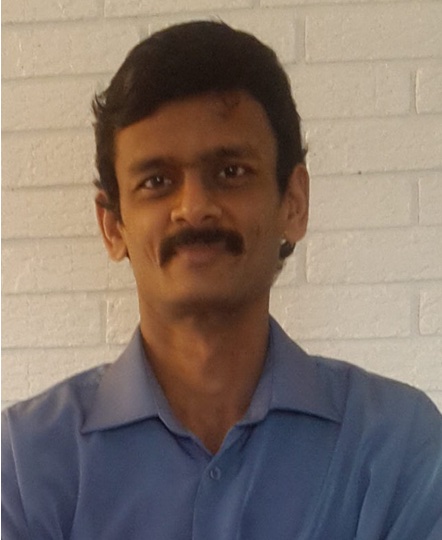
G Venkatesh is a ‘global citizen’, currently serving at The Energy and Resources Institute’s School of Advanced Studies (New Delhi, India). Prior to this, he was Associate Professor at the Karlstad University in Sweden. has published a memoir, four volumes of poetry, four e-textbooks, numerous scientific publications, crosswords, and magazine articles over time.  He is a ‘sustainabilist’ who sketches in his spare time, likes singing, and is a sports enthusiast, cricket in particular.

PLEASE NOTE: ARTICLES CAN ONLY BE REPRODUCED IN OTHER SITES WITH DUE ACKNOWLEDGEMENT TO BORDERLESS JOURNAL

Click here to access the Borderless anthology, Monalisa No Longer Smiles

Click here to access Monalisa No Longer Smiles on Amazon International
Categories
Stories

Friends

By G Venkatesh

From Public Domain
“Limitless and immortal, the waters are the beginning and end of all things on earth.”  -- Heinrich Zimmer, German Indologist and linguist

Little Varshita has an inborn affinity for proximity to water bodies. A June-born Cancerian, she eagerly looks forward to short walks along the Marina Beach in Chennai – the second-largest urban beach in the world. Five-and-a-half years old now, she is a prodigy eagerly looking forward to starting school next year. Whether her genius owes itself to nature or nurture or both, is difficult to say. It can be mentioned here that both her parents are teachers. She also possesses a very high emotional intelligence for her age. Perhaps there is a connection here to the aforementioned affinity for proximity to water bodies. Perhaps not.

Appa[1], can we go to the beach today?”

“We were there two days ago, Varshita. Can we go tomorrow instead?” Her father Ramesh who wants to watch a cricket match on television at home, smilingly attempts to dissuade her.

“Okay, no problem, Appa. Can I watch Animal Planet then this evening? If they show fish and crabs and whales and sharks and dolphins and orcas and octopuses and squids and seals and penguins….and….my-aunties?”

“Your aunties? Are Periyamma[2] and Aththai[3] going to be seen swimming, on Animal Planet?” Ramesh asks with a wink and a smile, eagerly expecting a response from Varshita.

“Noooo…M.A.N.A.T.E.E.S…” She hurls a pillow playfully at Ramesh, realising that he is pulling her leg.

“Ah, I see! Those creatures which are also called sea-cows.”

“Are they also called sea-cows, Appa? I did not know that. Now I do. But I knew sea-lions.” Ramesh is happy that he has invested in his daughter’s knowledge bank. Perhaps, his sister and sister-in-law are not going to be very happy if Varshita decides to share the joke with them. His sister especially does not have a sense of humour.

“Do not share this joke with your aunties, Varshita.”

“I promise, but in return you have to take me to the beach three times next week,” she says matter-of-factly.

“Done! Good girl!”

Varshita looks at Ramesh and knows that she has somehow gotten her way, tactfully. Little girls wiser than men; cleverer too, thinks Ramesh, recalling the Leo Tolstoy story about Akulya and Malasha[4], he had read in school in the ninth grade.

.

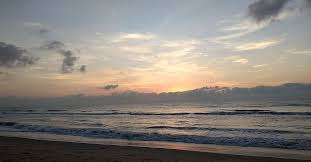
The waters of the Bay of Bengal are calm. Waves, longing for contact with the littoral sands, swoosh against the shore. Even though there are many people there on the beach, they seem to be observing silence in deference to the Sea-God. Varshita tends to speak less when out on these walks. She watches Mother Nature intently, listens carefully to Her sounds, and once in a while her curiosity leads her to ask a carefully-thought-out question. Ramesh does his best to reply, and whenever he is not able to find an answer instantly, he makes it a point to put the question on the back-burner, give it serious thought, and get back to Varshita with the answer. At times, that is even a day or two later. Once in a while, there are unanswerable questions hurled at him. Being a senior lecturer at the Indian Institute of Technology, he is used to this practice. After all, his daughter is also his student – a special one at that.

Appa, is it okay to throw a chocolate wrapper into the water?”

“No, Varshita. It is not. One must not pollute the environment.”

“But then why are there so many things lying around here? That is bad, right?”

“Yes, it is. Very much so. But maybe, people will learn not to do so, and when you are an adult, you will see that the beach is perfectly clean.”

She looks up, nods and smiles.

Appa, when the waves come and take all these things into the sea, what happens to them?”

“ A good question, Varshita. Many things which you see lying here are harmful to the animals which live in the water. All the animals you like seeing in the Animal Planet.”

“I will not throw anything, Appa, when I come here with you to walk.”

Ramesh and Varshita do a high-five, and Ramesh tells her that he is very proud of her.

The blue sky starts turning grey and some clouds float in. Precisely at that moment, Varshita sees a little girl with a sack on her back, and a stick in her hand, bending down and picking up a plastic bottle.

“Appa, what is she doing?”

“She is doing a very good thing. People throw things, and this little girl is collecting them, so that they do not get dragged into the sea to cause harm to the animals living in it. There are many people like her in our city. They are poor, yes. But we have to be thankful to them for what they do for us.”

It starts drizzling, and Ramesh tells Varshita that they have to head home. She keeps looking sideways at the little girl with the sack, as they walk away from the sea. Unanswered questions, for sure, start piling up in that four-and-a-half-year-old brain of hers.

.

Rains reign in Chennai for the next three days. Varshita knows that she cannot compel Ramesh to take her out to the beach for a walk. Ramesh however remembers the promise, and keeps checking the weather forecast every day. On Thursday, he tells Varshita that it is going to be sunny for four days at a stretch.

“So, can we go the beach tomorrow, the day after and the day after the day after?”

He chuckles, realising that his daughter remembers the promise in letter and spirit.

“Why are you laughing?”

“Because I am happy to go to the beach three evenings in a row with you. We must also ask Amma[5]to come along.” He winks, and they do a high-five.

“Yes, that will be fun. But Amma is afraid of the waves.”

“We will help her to get over her fear. But you must convince her to come with us.”

“Yes! I take on that challenge,” she says.

Ramesh’s wife Megha works as a school-teacher. She picks up Varshita daily from the kindergarten on her way back home from school. “Amma, are you interested in coming to the beach tomorrow evening with me and Appa?’

Megha looks at Varshita and studies the expression on her face. She realises that the last time she was out with Ramesh and her for a walk on Marina Beach, was over a month ago. She agrees.

“You do not seem really interested,” says Varshita.

Megha is taken aback. “How can you say that?”

“It is written all over your face,” Varshita says.

Megha bursts out laughing. “Well, whatever is written on my face, I will join you both tomorrow. That is a promise.”

“Yes!” Varshita does a V-sign this time.

.

Friday evening happens to be just the perfect time to be out on Marina Beach. Yes, there are some stray clouds, but they do not seem to be in a mood to discharge their content in Chennai. Some other place is destined to receive rainfall from them.

Megha, Ramesh and Varshita buy three ice-creams, and walk down closer to the shore. Megha spreads a large plastic sheet, and they sit down on it. Varshita remembers the little girl with the sack on her back she had seen on the previous weekend and starts looking around. Call it intuition or what you will, she spots her about 50 metres away. The girl spots a big plastic bottle floating on the water, but is a bit wary of the waves advancing to the shore.

“Appa, can I go and help her to retrieve that plastic bottle? I like getting my feet wet in the water.”

Megha glares at Ramesh and nods her head from left to right, signalling to him that he must not give in to Varshita’s request. Ramesh winks at Megha. “I will go with her. Do not worry.”

The father-daughter duo walks towards the girl, and Ramesh tells Varshita to go and talk to her. She is as tall as Varshita is, and may perhaps be a little older than her. Not more than six years old, for sure.

“You want to get that bottle?”

“Yes, but I am afraid of the waves.”

“I will get it for you. Wait here.”

Varshita looks at Ramesh, who gives her the thumbs-up sign. The little girl notices that and smiles.

Varshita takes off her slippers, and leaves them beside her father. “Take care of them, Captain, till I come back.”

Courtesy: G Venkatesh

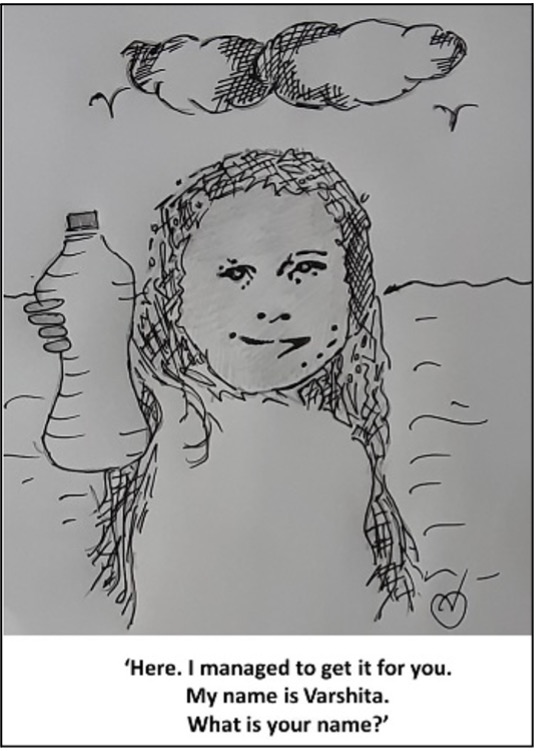
Laughing aloud, she wades two metres into the sea when the nearest incoming wave is still a few metres away.  She retrieves the bottle, turns and walks up to the girl, and says, “Here. I managed to get it for you. It was easy. My name is Varshita. What is your name?”

The girl smiles gratefully, accepts the bottle, and drops it into her sack. “My name is Mary. You are not afraid of the waves, Varshita?”

“I used to be.” She points to Ramesh and continues, “Appa told me not to be. He said that we must be careful, not afraid. But you know what, Amma is still afraid.”

“You visit the beach daily, Varshita?”

“Appa and I like to walk here sometimes. I love the sea. How about you?”

Mary looks into the distance. “I do not know if I love the sea or not. I just come here to look for things like these.”

“What do you do with them? Appa says that we must be thankful to all of you who clean up the beaches. He says that you help to stop damage being done to the fish.”

Mary smiles weakly. “You see my Amma there,” she points to a woman with a bigger sack hunting for treasures, about 100 metres away. “I will give these to Amma. Then my Amma and Appa will sell these and get money. Then we buy food and eat.”

Varshita listens intently, as she always does. “You like ice-cream, Mary?”

“Yes, I ate an ice-cream long ago. On Christmas Day.”

“Wait here,” says Varshita. She runs to where Ramesh is guarding her slippers, puts them on, and runs to her mother. “Amma, can I give my ice-cream to Mary over there? I just helped her to get that plastic bottle.”

“I saw you doing that, dear. I am so proud of you. Yes, you can give her your ice-cream. It is melting away slowly. Ask her to eat it quickly.”

Varshita grabs the ice-cream cone and runs towards Mary with a cherubic smile of her face. “Here, Mary. Your second ice-cream.”

“Have you eaten?”

“I will eat Amma’s. She usually does not eat her ice-cream and ends up giving it to me.”

“Will you be coming tomorrow, Varshita?”

“Yes, that is the plan. And the day after tomorrow also.”

“At this time?”

“Yes, and you?”

“I am not sure. I go with Amma wherever she goes. If she chooses to come here, it will be at this time.”

“What is that you are wearing around your neck?” Varshita asks, pointing to the little crucifix.

“Oh, this one. This is Jesus. Our God. I got this on the same day I ate my first ice-cream.”

Mary’s mother is calling out to her from a distance. “I am so happy that you got me the bottle and then gave me your ice-cream. You are a good person. Can we be friends?”

Varshita smiles cutely, and extends her hand for a handshake. Mary reciprocates, puts her little sack on her right shoulder, holds the stick in the right hand and the ice-cream in the left, and hurriedly walks towards her mother.

“Eat the ice-cream quickly. It will melt away,” shouts Varshita.

“Yes, I will,” Mary shouts back.

.

The next day, Mary’s mother decides to take her to a stretch of the beach further away. The day after that, Varshita feels a little unwell and the trip to the beach is called off. The two girls never meet each other again in Chennai.

But as we already know, God’s ways are mysterious. Many years pass, before they meet again in Bengaluru in a public school. One in her capacity as the mother of a girl named Sarah, and the other in her capacity as Sarah’s science teacher.

[1] Father

[2] Mother’s elder sister. In Tamil, transliterated.

[3] Father’s sister (elder or younger). In Tamil, transliterated.

[4] Leo Tolstoy’s parable Wisdom of Children was first published in 1885.

[5] Mother

G Venkatesh is an Associate Professor in Karlstad University, Sweden. E-mail: Venkatesh_cg@yahoo.com

PLEASE NOTE: ARTICLES CAN ONLY BE REPRODUCED IN OTHER SITES WITH DUE ACKNOWLEDGEMENT TO BORDERLESS JOURNAL

Click here to access the Borderless anthology, Monalisa No Longer Smiles

Click here to access Monalisa No Longer Smiles on Kindle Amazon International

Categories
Musings

That Box of Colour Pencils

By G Venkatesh

I walked down the forest path in Karlstad, Sweden, wondering how best I could ensure that a box of 36 colour pencils (used to different degrees), when given away could continue to be used so that they could fulfil the purpose they were fabricated for, as completely as possible. I recalled a tarot reader having said that ideas do not come to us when we think, but rather when we have stopped doing so. They come unbeckoned from somewhere beyond the astral realm. I stopped the train of thought in its tracks, to let the engine cool down a bit, and surrendered to the divine process of ideation and inspiration.

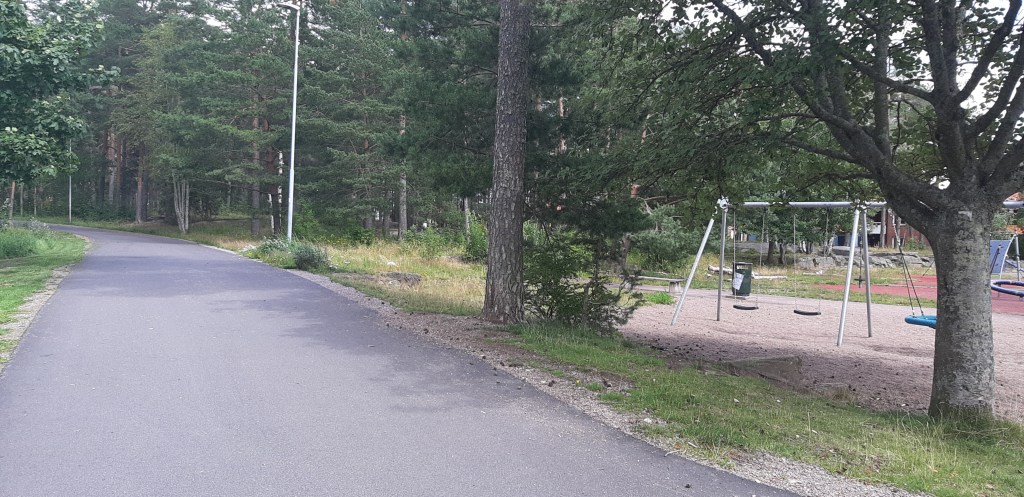
The next day, I was walking down the very same path – this was a routine after a couple of surgeries, for the purpose of recovery and regaining strength in my lower torso – when I saw two little girls (less than 6 years old, perhaps) playing in the garden to my left. An idea bubbled up. I hastened to my apartment, fetched the box of colour pencils and rushed down to the garden where I had seen the little girls. They were still there, on the swings. I walked up casually, making sure not to scare them (my bearded foreign face told me that I need to be careful here), and called out from a distance, in Swedish – “Hallo, vill ni gärna ha den? (Hello, would you like to take this?)”

The younger of the two came a bit closer, looked at the box in my hands, and asked curiously – “Vad är det? (What is it?)”

I explained that it was  a box of 36 colour pencils, some used more than the others, and that I wished to gift it away to them. As more and more questions were hurled at me, I could not help but smile and recollect Rudyard Kipling’s poem:

I keep six honest serving-men
(They taught me all I knew);
Their names are What and Why and When
And How and Where and Who.

The elder of the two girls then came down to brass-tacks, and asked, “Är det verkligen gratis? (Is it really for free?)”

I said yes, and she took it from my hands.

As I was about to turn around and walk away, I heard some murmured whispers behind me. I thought they would have opened the box, started counting and marvelling at the various shades of blue, red, green and yellow in there.

Vänta, vänta…(Wait, wait).”

I turned and they came running towards me. The younger one was now holding the box of pencils in her hand.

“Vi vill gärna betala dig (We would like to pay you for this).”

I repeated that it was a gift and one does not have to pay for gifts.

“Nej, nej…vänta (No, no, wait).”

The older one then started searching in the little pouch she had around her waist, and fished out a 2 SEK coin. Summertime in Sweden, and little kids are provided with some money by their parents, which they carry around in these mobile piggy-banks strapped around their waists. Once they have accumulated enough, they spend the money on purchasing ice-cream or chocolates or candies.

“Här, (Here),” she said proudly with a smile across her face. “Den är för dig (This is for you).”

I accepted it with a smile, which hid mixed feelings. I did not wish to deprive the little one of the feeling of pride which she was experiencing – of having put aside money to ‘buy’ this gift from a stranger.

What it was that triggered the desire to monetarily compensate me for the gift I gave them, I would never know. I would also not wish to know. Maybe because I was a stranger to them, who also looked a bit bedraggled after the surgery. Maybe it made them feel good to also give me something in return for what I had given them. That would be another thing I would surrender to the realm of ideas, which had played a part in bringing these two little girls momentarily into my life that day – the invisible hand of God, of ideas floating around in the ether ready to inspire those who are fit to receive them.

Photo Courtesy: G Venkatesh

G Venkatesh is an Associate Professor in Karlstad University, Sweden. E-mail: Venkatesh_cg@yahoo.com

PLEASE NOTE: ARTICLES CAN ONLY BE REPRODUCED IN OTHER SITES WITH DUE ACKNOWLEDGEMENT TO BORDERLESS JOURNAL

Click here to access the Borderless anthology, Monalisa No Longer Smiles

Click here to access Monalisa No Longer Smiles on Kindle Amazon International

Categories
Musings

A Taste of Bibimbap & More…

By G Venkatesh

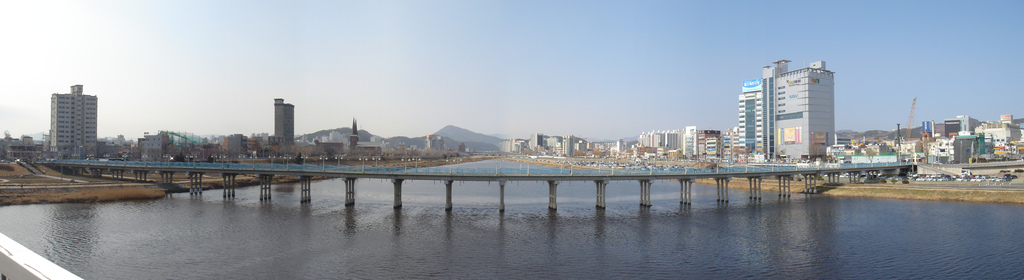
Ulsan, South Korea. Courtesy: Creative Commons

This was long ago. In the summer of 2013. Destiny brought me to South Korea for a week-long conference, the International Society of Industrial Ecology conference. I reached Ulsan, a city south of Seoul. Not having time to convert my USD to South Korean Won, before stepping onto the bus which would take me to the conference venue, and assuming that I could pay for my ticket on the bus, using my credit card, I proferred the latter to the bus driver. He shook his head. I then pulled out some USD notes and looked at him, hoping that I could pay the required amount of money in USD equivalents. He shook his head again. I said, “Okay, sorry,” and was about to turn and alight, when he turned his head and said something in Korean to the passengers on the bus. A young schoolgirl ran down the aisle towards me and said in fluent English, “You do not have to alight. I will but your ticket.”

I looked at the driver, and he smiled and nodded and beckoned me to take a seat. I looked at the girl, thanked her and asked, “Can I repay you in dollars?”

She smiled sweetly and said, “You are our guest. It is our duty to make sure that your stay in South Korea is comfortable. You do not have to repay me. You enjoy your stay here.”

I was lost in thought for the remainder of my journey, not having experienced anything similar to that before.

Bibmbap: Courtesy: Creative commons

The next day, I was guided to a restaurant about 200 metres from the conference venue, where I could eat some good-quality Bibimbap (Korean rice+vegetable dish). Being a non-experimental eater (one from whom gourmands would most certainly wish to stay away), I visited the same place for the very same meal at the very same time every evening for the next four days. Every time the elderly Korean lady who manned the counter, saw me walking in, she would intuitively know what I would be eating, and shout out ‘Bibimbap’ to the cook inside. On the 4th day, she asked me, in her broken English, ‘You here tomorrow also?’

I said, ‘No. I am going to Seoul tomorrow and then I fly to Mumbai.’

‘Oh, so last day dinner here. Then, you no pay today. Today free Bibimbap for you.’

‘But I would like to pay. I cannot eat without paying for it.’

‘No, no, free. I say free! You liked Ulsan?’

‘Okay, thank you so much. I liked the city a lot.’

I noted down the postal address of the restaurant and would send a postcard from Trondheim (Norway) – where I worked at that time in my career.

The next day, I had to take a train from Ulsan to Incheon. Time was at a premium when I reached the station. For some strange reason, my credit card ‘malfunctioned’. I had run out of Won and had foolishly forgotten to equip myself with some, as I assumed that the credit card would surely work at the ticket-vending machine at the station. I was a bit tense and started sweating profusely. I turned back and asked the young Korean boy who was next in the queue if the machine would accept USD or if there was some place nearby where I could quickly trade in my USD for some Won. He smiled, and said, “Do not bother. Where are you headed?”

When I said, Incheon, he stepped up and purchased my ticket for me. I read the price askance, did a  quick mental conversion to USD and requested him to let me repay him in that currency. He smiled again and said, ‘‘You are our guest. It is our duty to make sure that your stay in South Korea is comfortable. You do not have to repay me. Hope you enjoyed your stay here and will visit our country again.” So saying, he hastened towards the escalator on the right of the ticketing machine.

The very same words I had heard on the first day on the bus from the young girl. Perhaps this boy was her brother. Do-gooder siblings. Or perhaps they just represented the South Koreans – hospitable and helpful, doing God’s bidding on earth, smilingly and gallantly, without expecting anything in return…

.

G Venkatesh (50) is a Chennai-born, Mumbai-bred ‘global citizen’ who currently serves as Associate Professor at Karlstad University in Sweden. He has published 4 volumes of poetry and 4 e-textbooks, inter alia. 

.

PLEASE NOTE: ARTICLES CAN ONLY BE REPRODUCED IN OTHER SITES WITH DUE ACKNOWLEDGEMENT TO BORDERLESS JOURNAL

Categories
Musings

Istanbul

By G Venkatesh

Istanbul Airport. Courtesy: Creative Commons

The Schengen visa did not help much, being as it was on one of the pages of an Indian passport. I was told I could not get an on-the-spot transit visa to walk out of the airport and see the city of Istanbul, formerly Constantinople, which was one upon a time Byzantium, which in turn was known as Nova Roma when the Romans ruled it. Well, that meant spending 24 hours at the Kemal Ataturk airport – waiting for the Turkish Airlines flight to Oslo the next day in the morning. Memories of Tom Hanks in Terminal flashed past the mind’s inner eye.

Coffee and vegetable burger later, I sat down to test if a free wireless connection was available in the precincts of the airport. It was, and I could check my e-mail; not just that, I could also thereby shoot across some crosswords’ designs that I do for a magazine. Great way to spend time, I thought. Time was, is and will always be money!  My focus on the laptop screen was disturbed when a man walked past on my left, proferred his right hand and asked “Indian?”

“Yes,” said I, accepting the handshake.

“Pakistani, Shakeel,” he responded and sat down on the chair next to mine and immediately asked me if he could use my laptop for 5 minutes. I had heard about instances of threat mails being sent from cyber cafes or from laptops or desktops of totally-innocent, unsuspecting friends or acquaintances. Wariness did creep in instantly, but then I decided that I would not leap before looking… looking at the screen as he was accessing his mail. I did not wish to play into the hands of the ‘enemy’ as a noble do-gooder. There would have been nothing more disconcerting than that!

He spent more than 5 minutes and an edgy yours sincerely had to butt in with, ‘Boss, I have some urgent work to do; if you have finished.’ When I got back ‘possession’, I vowed to work on till the battery ran out, designed a crossword in the process, and then on the pretext of my fear of using unsecured wireless networks for too long, strapped the laptop back in my backpack.

After a long silence, I devised a means of dissociating myself from his company. “Okay then, I think I will just take a walk around the airport. It was nice meeting you.” I held out my hand.

He looked up and said, “I guess I shall also join you. What will I do sitting here all alone?”

I wanted to say, “That is none of my concern.” I did not. I would be saddled with Shakeel for the next 24 hours!

From my side, the ice was not broken. Hence, when he quizzed in Punjabi about what I did for a living, where I worked and how much I earned, I was a bit startled. I recalled being in the situation of the protagonist (played by amnesiac Aamir Khan) in the film Ghajini and wanted to say exactly what he says when a woman tries to get very informal with him – “I do not think I have known you so well as to be obliged to answer those questions.”

I brushed aside the questions however and decided to be as wary as wary could be. Shakeel, it turned out, had been living in Austria for seven years, managing a restaurant with his uncle. He had missed his Austrian flight in the morning, as the Emirates flight which got him into Istanbul from Dubai was delayed by 15 minutes. He had now asked his agent to rebook a seat for him on the flight to Austria next morning.

Shakeel talked of Indo-Pak business partnerships in Europe and lamented at the tension that has gripped the relations between these two neighbouring countries. I had the book, Wings of Fire with me. He pointed at Dr APJ Abdul Kalaam’s picture on the cover and commented that he is a very competent individual and wondered why he could not continue for a second term as President. During the conversation, mostly one-sided, he also said that people in India and Pakistan are more engrossed in producing babies while the rest of the world is pulling up its bootstraps and progressing fast. This statement, coming from a Muslim, took me aback a bit.

I treated him to Turkish coffee, after which he excused himself to go to the in-airport mosque, requesting me to mind his bags. “Risky undertaking,” I thought. What if…

He returned after a while though, and I scolded myself for having succumbed to paranoia and subsequent suspicion.

At around 6.30 pm, Shakeel insisted it was time for dinner and wanted to repay me for the coffee I had treated him to, by buying me dinner. I told him to carry on and said that it would be too early for me to dine. He looked at me and said, “Okay then, we will dine whenever you want to.” This was surprisingly very heartwarming and as we had known each other for just about 12 hours or so, seemed a bit too unreal. Such acts are the prerogatives of brothers and good friends.

As the day petered to a close, we decided not to sleep-starve ourselves anymore. Shakeel, still unsure of whether or not his agent would be able to confirm his booking on the next morning to Austria, dozed off and slept soundly. They say that anyone who can sleep without burdens or worries on his mind, has a clean and pure conscience. I, with a confirmed ticket, could not sleep for more than four hours – unclean and impure conscience?  I was up at 5.00 am, and at 7.30 am when I headed to board my Turkish Airlines flight to Oslo, Shakeel was still sleeping! I did not want to wake him.

Once in Norway, I sent him an e-mail. At the time of writing, it has been quite a while since I did that, and there has been no response, Maybe, he will not respond. Maybe, he is a good person who was upset with my not having the courtesy to bid him a proper ‘Khuda Hafeez’. I would never know.

Strange lessons learnt at the Kemal Ataturk Airport.

.

G Venkatesh (50) is a Chennai-born, Mumbai-bred ‘global citizen’ who currently serves as Associate Professor at Karlstad University in Sweden. He has published 4 volumes of poetry and 4 e-textbooks, inter alia. 

.

PLEASE NOTE: ARTICLES CAN ONLY BE REPRODUCED IN OTHER SITES WITH DUE ACKNOWLEDGEMENT TO BORDERLESS JOURNAL

Categories
Poetry

A Third Coming?

By G Venkatesh

KNOW THE ‘WHY’; FORGET THE REST


The ‘When’ and the ‘How’
Stimulate his mind
Towards half-baked theories
On the origin of mankind.
He talks of Crunches and Bangs,
Of black holes and dark matter,
Of infinite space and infinite time,
Endless prattle, idle chatter.

The gift of reasoning,
The power of thought
Which arrogant man
Has from somewhere got,
Is used by him
More often today
To explain the existence
Of its Giver away,
Quite as X
Would use Y’s pen
To pull him down
In the eyes of men.
The gift is taken for granted
The ‘Why’ never interests man,
As that probing would be exacting,
He would rather be Darwin’s fan.
Charlie boy, rise from your grave
And help the world to see wrong from right.
Would you rate a selfless do-gooder,
On par with a selfish and cunning sprite?

Hollow rhetoric, mere verbose
Reams and tapes for no reason
Except to pander to the basest of senses
And proclaim aloud the hegemony of Mammon.
Clamour and clutter,
Confusion and chaos,
A melange of unrest,
Erosion of ethos.
Will there be a Third Coming
Of Jesus the Christ?
Or a rebirth of Lord Vishnu
As man disguised?
For did not they say
That they would come again,
Whenever they would see
Their precepts in vain,
To tell all men around
That the mind is to be employed
To seek and understand
The pure Self, unalloyed?


Turn inward, a little will do,
The Lord is there at close quarters,
Give up your quest for the When and the How
Know the Why, obey His orders.
Shafts dug deep into diamond mines,
Spaceships launched far off into Space
Distract man and lure him away
From the near-at-hand divine grace,
Which serves to Know and not just know
Enables to Be, and not just be
And while Being, serve to launch
A veritable deluge of spirituality,
For black and white and brown and yellow
Rich and poor and fast and slow
To give and take, accept and offer
For eyes to well up at another’s woe.
Sink your shafts and get out the gold
To feed and clothe the millions
Languishing in gut-wrenching misery
Else worthless are your bullions.


The ‘Why’ of muscle and the ‘Por que’ of the brain
Not to be one-up on the less-endowed.
It is rather an unspoken divine command
Do His bidding – silently, untold

.

G Venkatesh  is a Chennai-born, Mumbai-bred ‘global citizen’ who currently serves as Associate Professor at Karlstad University in Sweden. He has published 4 volumes of poetry and 4 e-textbooks, inter alia. 

.

PLEASE NOTE: ARTICLES CAN ONLY BE REPRODUCED IN OTHER SITES WITH DUE ACKNOWLEDGEMENT TO BORDERLESS JOURNAL

Categories
Musings

Ruleman Ngwenya and Johannesburg

By G Venkatesh

Johannesberg Skyline. Courtesy: Creative Commons

Johannesburg or Jozi. This was the first city I visited outside my country at the age of thirty-two. Quite late for someone to embark on a foreign trip. Of course, my parents had never been abroad, but I was comparing myself with coevals here. And what a sojourn that was! Quite like a debut test for a cricketer where he gets into his own and looks forward to more stints at the crease or more overs to bowl. And there are many names which stand out in my mind’s eye – Rhoda (Anglicised version of Radha), Richard, Ruleman…Interestingly, the people I interacted most with during my short stay in the city, have names beginning with the letter ’R’!  

Before I embarked on my journey, and even after I arrived there, I was told that Johannesburg was notorious for the rampancy of crime – car thefts, knifings, muggings, rapes, daylight robberies and what have you. I was told:

“Never take any valuables with you when you go out.”

“Well, man, even if you do that, they will put a knife on you and ask you to give them your short and trousers and the ordinary footwear you would be wearing…these are guys who need to sell things to get money for their drugs, you see.”

“Take care, friend, your first visit to our country should not leave behind bad impressions on your mind. We want you to take back good memories and share them with your folks and friends in India.”

The Westerners and Indians in the city were concerned. I would hear these words of advice from almost every South African and Indian I would meet during my stay there. They cared and never let me venture out alone anywhere. Many offered to drive me down wherever I wished to go. I felt protected…a kind of informal Z security, unasked for. But perhaps I felt safe, perhaps imprisoned and fettered. It is hard to say.

I arrived in the city with the intention of meeting a publisher who was keen to employ me if it would be possible to obtain a work permit for me from the Government of South Africa – a gargantuan task even now. I wanted to get away from India, experience different working cultures and live a fuller life – professionally. It was at this magazine-publishing office that I met Richard and Ruleman. Richard of Dutch and English parentage, working as the editor of a mining magazine, and Ruleman of Zimbabwean origin, was employed as the office-boy.

While every minute of my stay in Jozi was memorable, considering that this was my first sojourn outside India, the last two days left a lasting impact on my mind. The dreams of obtaining a work permit were shattered, and I started making plans to wend my way back to India. I had purchased a return ticket and would have travelled back in any case – of course to return in case the work permit was granted.  On the last day but one, I was working late in the office, in order to do full justice to the project which has been assigned to me, even though I knew I had no future in the outfit or the city.

Only Ruleman was waiting, sensing that I should not be left to work alone in the office – burglars had broken into this office as well, I was told, a few months ago, and taken away some of the computers. Ruleman came into my room and assured me that he was waiting downstairs and that I could call him if I needed anything. At around 5.00 pm (work normally was wound up in Jozi at around 3.30 pm…they started work at 7.30 am) – which by Johannesburgish standards was late, I wound up, and walked down the stairs. Ruleman nodded, smiled, went around running a last-minute check of the doors and the lights and fans, and then escorted me out of the office. I used to walk back home – it was a 20 minute walk. Ruleman’s house was on the way. As we walked down, he asked me how I liked my stay here and felt sad that I would be leaving. He asked about India, and said he had always considered India as the ‘Land of Mahatma Gandhi’. I recalled that the African cabbie who had driven me down from the Jan Smuts International Airport two months ago, also told me the same thing. We reached his house.  He told me that his parents would be delighted to meet me, if I could come over for tea the next day. I smiled and said that I would love to. I thought that he would bid goodbye for the evening.

He did not. ‘I shall drop you at your doorstep. You see, this is not a safe time to be walking around in this city…I do not want anything to happen to you just when you are about to leave Jozi.’ I was thankful, though I would not really have bothered about walking down alone. ‘My father talks a lot about India. He had a lot of good Indian friends when he was working in East Africa in his younger days. You should come over tomorrow. He would be very pleased, and so would I.’ Ruleman dropped me off at the gate of the house I stayed in as a tenant and bid me goodnight.

Next day, when it was time to leave, I remembered Ruleman’s invitation. However, till the day I had walked down with Ruleman back home, Richard used to drive me down to my place of residence before turning right and heading home. This being my last day, Richard wanted to drive me down at 4.00 pm, for one last time. Ruleman said that he wanted me to visit him, as decided on the previous day. I did not know what to say or do. If I had told Richard that I would visit Ruleman, perhaps, it would not have been appropriate. Turning down Ruleman’s invitation would also not have been a very nice thing to do. And clearly there was no via media.

Richard drove me down eventually. I rued my decision. I may possibly never see that ever-smiling, do-gooder Zimbabwean again. I sent Ruleman a card from India on my return and Richard wrote to me conveying Ruleman’s thanks for the same. Small consolation perhaps. Man often talks about looking for the via media – the middle path – the path or course of action which would leave none the worse for it. There are occasions where a middle path does not exist at all.  A take it or leave it situation stares one in the face…just to remind man that no matter how hard he tries, there are many things beyond his control.

On a different note, when one sees goodness around, and care and concern for strangers who one would possibly not see again, one’s faith in God’s kindness being expressed through human agents gets reinforced. Jozi taught me a lot of lessons, which changed my perspectives towards life immensely. I was a totally different person on my return to India – calmer, spiritually aware, more respectful towards my parents, and in a nutshell – ‘grown-up’!  I realised that deep down, we are all connected to the Super Soul….and a desire to do good and a willingness to help, resides in all human hearts.

.

G Venkatesh (50) is a Chennai-born, Mumbai-bred ‘global citizen’ who currently serves as Associate Professor at Karlstad University in Sweden. He has published 4 volumes of poetry and 4 e-textbooks, inter alia. 

.

PLEASE NOTE: ARTICLES CAN ONLY BE REPRODUCED IN OTHER SITES WITH DUE ACKNOWLEDGEMENT TO BORDERLESS JOURNAL

Categories
Musings

An Existential Dilemma

By G Venkatesh

Thermodynamics’ – the word itself evokes images of entropy and chaos (heat and disorderly motion). However, it is a science which looks for the elusive order in the chaos its name evokes. There is classical thermodynamics – the macroscopic sister to statistical thermodynamics which is the bottom-up approach to understanding the behaviour of systems (studying the parts with the expectation of understanding the whole). While the classical is a mere approximation (better than not able to describe at all), the statistical is a mere prediction (something close, but not exactly).

During a period of intense and painful introspection in a coffee shop in Karlstad, Sweden, an idea perhaps floating around in the realm above the astral, settled on yours sincerely.

Picture a closed cylinder filled with ‘ideal’ gas. Students of thermodynamics often befriend the ‘ideal’ gas ideally, even though this friend is just an illusion. The gas is composed of numerous molecules, which are moving around at random, colliding with each other and with the walls of the cylinder. Indeed, over any period of time, all the molecules do not suffer the same number of collisions with others, or for that matter, do not ‘bang’ into the inner wall of the cylinder to be ricocheted back into the pack, at identical frequencies.

If the cylinder is opened for a short period of time, and then closed, some gas would leak out. Of course, while all molecules may look alike, what they experience within the cylinder is never the same for all of them. Some molecules would leak out into ‘freedom’. That seamlessly brings us to our analogy with souls on Earth.

Now, replace the small cylinder with our planet Earth. And the gas molecules with individual human souls. Pause for a minute and you would perhaps be able to visualise. Souls trapped in human bodies wander about on Earth, interacting with others (analogous to the collisions among molecules), supposedly reaping the rewards of their  karma, repeatedly. Let us assume that the law of action and reaction holds good, indisputably, the reaction in this case being from the universe or God. Just as one defines the quality of energy as ‘exergy’, if one conceives a property which represents the qualities (degrees) of good deeds, bad deeds, rewards and punishments, and labels the same as ‘exergy’ then, it must follow that:

  1. Exergy (Good deeds) = Exergy (Rewards)
  2. Exergy (Bad deeds) = Exergy (Punishments).

In other words, the higher the quality of a good deed, the better the reward, and the graver the bad deed, the more serious the punishment. Now, does this apply to every individual soul during its sojourn on earth in a specific bodily envelope? Does one find a perfect correlation? Definitely not. After all, the equations used to understand the state and behaviour of gases, do not apply to every single molecule, do they? We tend to easily tide over this impasse, just as we do in thermodynamics, by theorising that:

3. Σ Exergy (Good deeds) = Σ Exergy (Rewards)

4. Σ Exergy (Bad deeds) = Σ Exergy (Punishments)

If someone wishes to know the time period over which these summations apply, one will say that this would be the entire length of time humankind will walk on Terra Firma, and for all the reincarnations of all the souls.

Indeed, I or you will not be able to test this in any way, just as we would never be able to summarily and conclusively prove that there is life after death, while we are walking around on Earth. Further, how does one define the quality factor of good deeds and rewards, punishments and bad deeds? Who decides? So, that is that! We then turn to the Bible or the Gita or the Koran or the Zend Avesta or the Guru Granth Sahib or the Torah or any other religious text just as we refer to textbooks of thermodynamics for those equations.

For generalisations. To simplify and pretend that we understand everything, or to be humble enough to admit that we do not. To calm our minds and believe that our turn would come. We would never know where we are placed in the queue to receive rewards or accept punishments. After all, like those molecules inside the cylinder, we are tossed about here and there, and find ourselves at the wrong place, at the wrong time, with the wrong set of ‘molecules’ around us. ‘My turn would come’, implies being in the right place, at the right time, with the right people. They give this a name – divine timing. Is it random? I do not know. Neither do you.

Which souls (molecules) would ‘leave deceitful knaves for the higher and better society of gods and goddesses’ (from a play referred to by Ralph Waldo Emerson in his essay called  ‘Heroism’ in The Essential Writings of Ralph Waldo Emerson) and when, none knows. Surely, the equations (1) and (2) will never hold true for you when the time comes for you to ascend to the astral realm. You may either have been very fortunate or extremely unfortunate; may have got a fair-enough deal, or may have been scapegoated ever and anon. You would need to return to help equations (3) and (4) to manifest themselves at the fag end of the human race – perhaps at the Big Crunch or much before that….again, just as the gas molecules which are ‘freed’ may be brought down by rain again to the terrestrial hydrosphere, to cycle back and forth.   

.

G Venkatesh (50) is a Chennai-born, Mumbai-bred ‘global citizen’ who currently serves as Associate Professor at Karlstad University in Sweden. He has published 4 volumes of poetry and 4 e-textbooks, inter alia. 

.

PLEASE NOTE: ARTICLES CAN ONLY BE REPRODUCED IN OTHER SITES WITH DUE ACKNOWLEDGEMENT TO BORDERLESS JOURNAL