Categories
Slices from Life

Menaced by a Marine Heatwave

By Meredith Stephens

In an ideal world I would sleep in every morning and enjoy a leisurely breakfast, but I can indulge in no such luxury because I have a border collie. Her name is Haru. She has an elongated body, a pointy white snout scattered with black dots, one black ear and one black and white spotted ear, all-knowing brown eyes, feathered forelegs, and a bushy tail with a white tip. She looks more like a cross between a fox and a border collie than a pure border collie. As soon as she hears my voice when I wake up, she starts whining from the courtyard below, nagging me to take her for a walk. I much more looking forward to my breakfast than the walk, but Haru is the opposite.
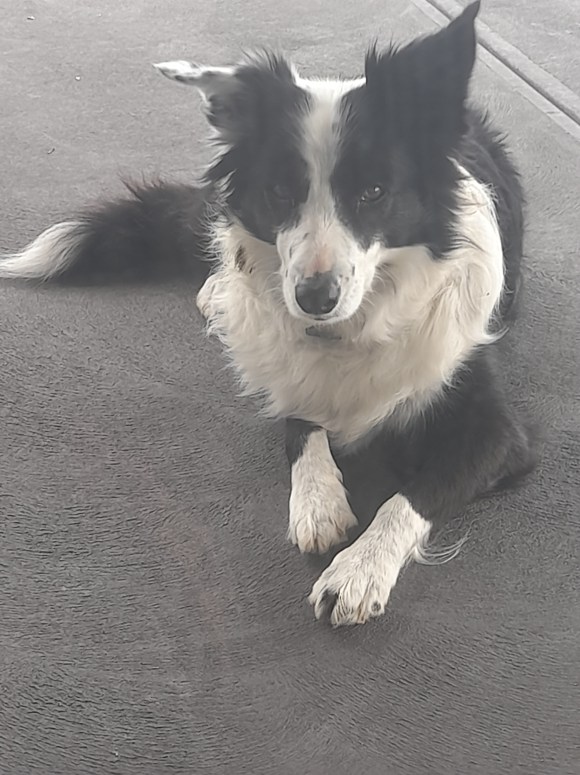
Haru. Photograph by Meredith Stephens

One Tuesday, as usual, I affixed her leash and walked her towards the esplanade. Haru has memorised the route. She strained in front of me to the point where we crossed the road and then continued to drag me towards the pedestrian crossing. Then she made a beeline for the stairs leading down to the beach. I released the leash and threw the ball down to the sand. She raced down the stairway ahead of me and ran to catch the ball. In the winter months along this coastline, dogs are allowed to run off the leash as long as they are under the owner’s control. I was joined by a throng of other dog lovers and their canines, running to catch balls. Haru is interested neither in other dogs nor other people. All she cares about is the ball. Other dogs approached her and chased her, but she’s indifferent, solely focused on the ball in my hand.

This is good for me because I get exercise when I otherwise would not, and experience vicarious pleasure in her excitement at retrieving the ball. Maybe this is more fun than breakfast after all. However, my walk last Tuesday was unlike those of previous weeks. I spotted an entire fish washed up on the shore amongst the seaweed. I had never seen this before on my daily beach walks over the last five years. Then I looked up and saw a rounded shape of a mammal a few hundred metres in the distance. I walked towards it, and once up close I realised that it was the head of a dolphin. “Sorry,” I said, feeling complicit in the damage wreaked by climate change. Haru was normally quick to sniff out a carcass and chew it, but she showed no interest.

The next day I chatted to a neighbour who told me that on her beach walk she had seen a range of species washed up on the beach that she didn’t know existed. We were witnessing the aftermath of an algae bloom, known as Karenia Mikomotoi, from September 2024. This had arisen in response to a rise in the sea surface temperatures of 2.5 degrees. The recent storms in June 2025 had washed the bodies of these sea creatures ashore. On my next beach walk I came across a small stingray, completely intact, directly in my path. I had seen stingrays before swimming in the shallows but never washed up on the beach. It was so beautifully formed that I could tell it had met an untimely death. Something untoward and unusual had happened. Again, Haru showed no interest in the stingray, despite usually being interested in decaying fish or animals.
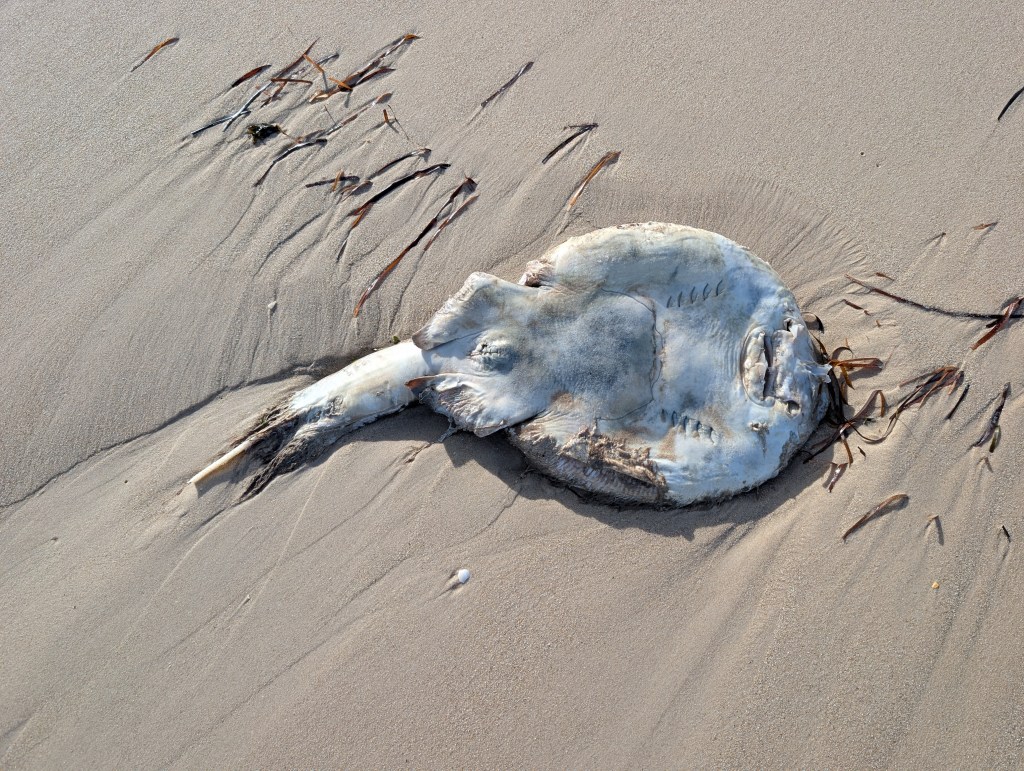
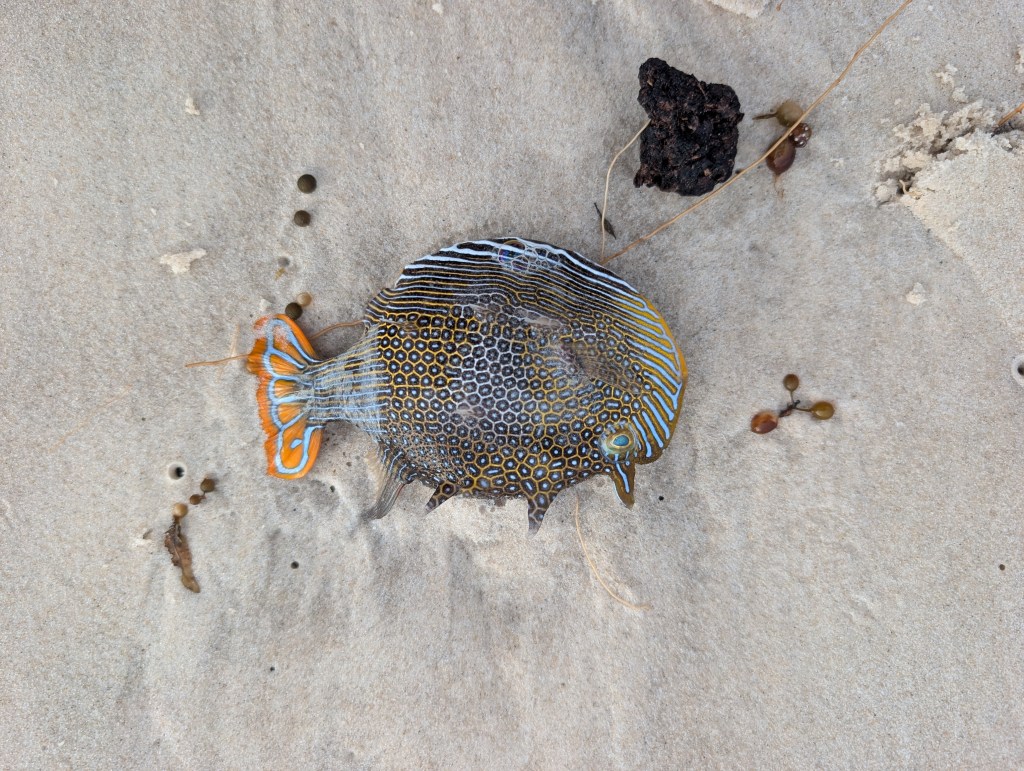
Weeks later I continued to spot fish washed up on the shore that I have never seen before. I came across much smaller fish a couple of centimetres long, some slightly larger fish, and another small stingray. These were the kind of colourful fish that I would see when snorkelling in pristine waters, not washed up on a suburban beach. Haru continued to ignore these dead creatures and skipped along the beach anticipating my ball-throwing. Or perhaps she somehow sensed they contained toxins. At least she was unlikely to be poisoned by eating them.
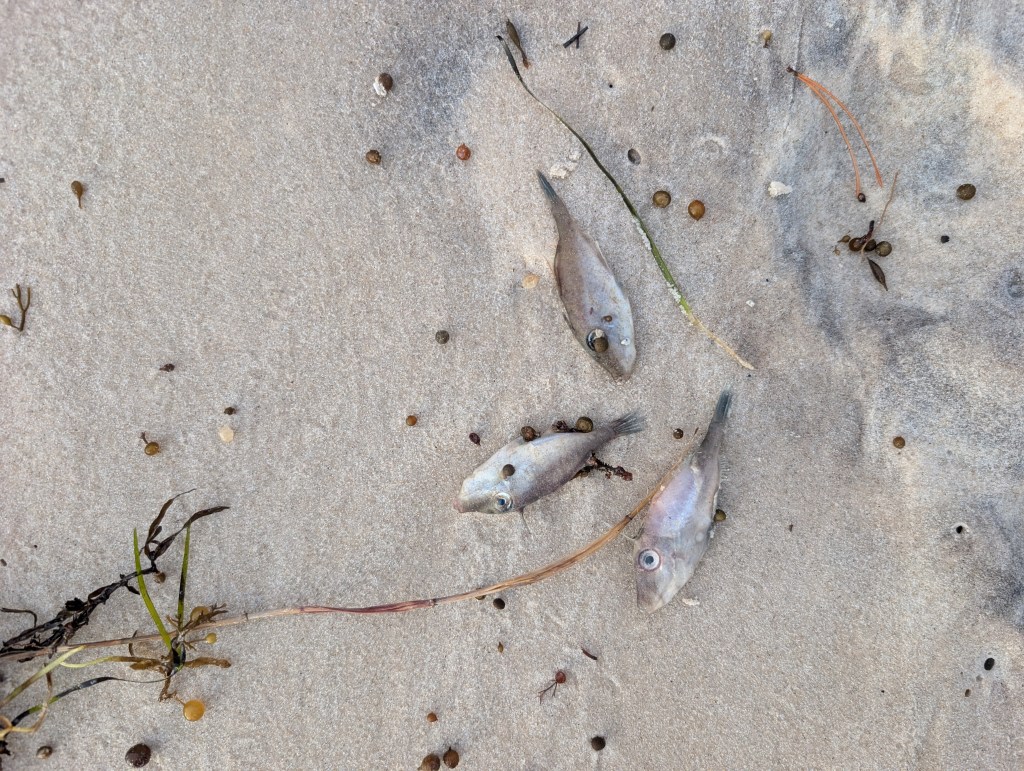
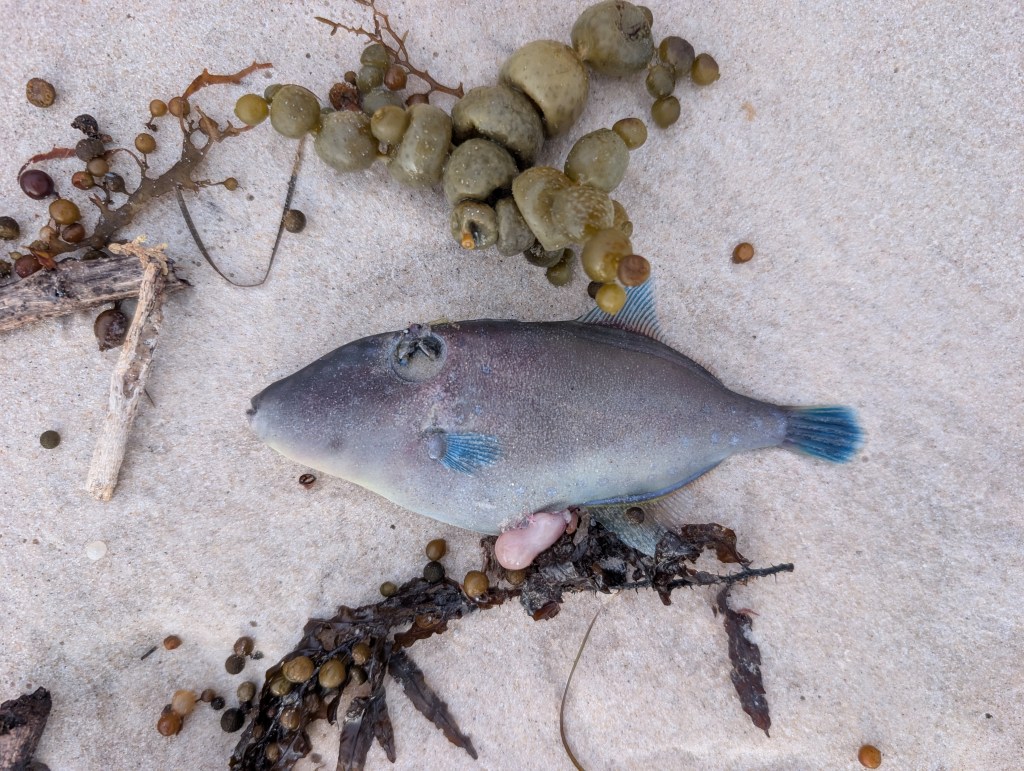
She delights in catching not only one ball that I throw her, but sometimes two. She doesn’t like to relinquish a ball, so I have another one on hand to throw her so that she can chase all the while holding the first one in her mouth. After chewing the ball down to a smaller size and squashing it, she can sometimes fit two into her mouth. Once she has managed this, she runs away from me into the wintry waters, oblivious to the cold, triumphant that she has two balls and trying to get as far away from me as she can in case, I try to take one away from her. Sometimes she skips through patches of the dirty foam left by the algal bloom.

I wish I could provide a happy ending to this story, but the algal bloom is not predicted to end soon, so my idyllic morning and evening beach walks with the oblivious Haru are likely to be punctuated with sightings of innocent marine creatures being washed ashore, victims of climate change and warming temperatures.

One consolation occurred the day my fiancé, Alex, and I left the mainland to sail across Investigator Strait to Kangaroo Island. Over the years there has never been a crossing during which we have not seen dolphins. In the back of my mind, I feared that this would be the first time. An hour into our crossing, Alex heard the familiar splash of breaking water and sighted a pod of dolphins. Not only that, once in the bay at Kangaroo Island, we spotted a sea lion. Thankfully, the marine life that can escape the algae is still undisturbed. I hope the scientists will find a way to address the marine heatwave so that life in our oceans can again thrive, and beachgoers can be spared the sight of these innocent creatures being washed up on local beaches. We can’t simply delegate to the scientists, though. Witnessing this marine carnage is a strong impetus for ordinary citizens to live more sustainably.

Meredith Stephens is an applied linguist from South Australia. Her recent work has appeared in Syncopation Literary Journal, Continue the Voice, Micking Owl Roost blog, The Font – A Literary Journal for Language Teachers, and Mind, Brain & Education Think Tank. In 2024, her story Safari was chosen as the Editor’s Choice for the June edition of All Your Stories.

PLEASE NOTE: ARTICLES CAN ONLY BE REPRODUCED IN OTHER SITES WITH DUE ACKNOWLEDGEMENT TO BORDERLESS JOURNAL

Click here to access the Borderless anthology, Monalisa No Longer Smiles

Click here to access Monalisa No Longer Smiles on Kindle Amazon International
Categories
Slices from Life

From Gatwick to Kangaroo Island

Phtographs & Narrative by Meredith Stephens

When I recently flew from Australia into Gatwick Airport, London, I was struck by the ease of passing through customs and immigration. Once I exited the plane, I was ushered to an empty lane and directed to a machine to present my passport. As I had nothing to declare I walked through the green lane. A group of four customs officers were engaged in conversation and did not notice me. I had entered the UK seamlessly in about five minutes without making eye contact with a single person.

Not so when travelling within my home state of South Australia. Alex, Verity and I were on our way from Adelaide to Kangaroo Island, situated across Investigator Strait off the southern coast of South Australia. We would have preferred to sail there, but Alex’s boat was high and dry, awaiting repairs to the mast and windows in Yaringa, eight hundred kilometres away in the state of Victoria. We had made a booking for the three o’clock ferry from Cape Jervis to Penneshaw, on Kangaroo Island. We left Adelaide at 1 pm, allowing ninety minutes for the drive and thirty minutes to board, as we always do.

Half an hour into our trip, we were stuck in a traffic jam along the arterial roadway heading south. We had never been trapped in a traffic jam in this direction before, because it was leading away from Adelaide towards sparsely populated farmland.

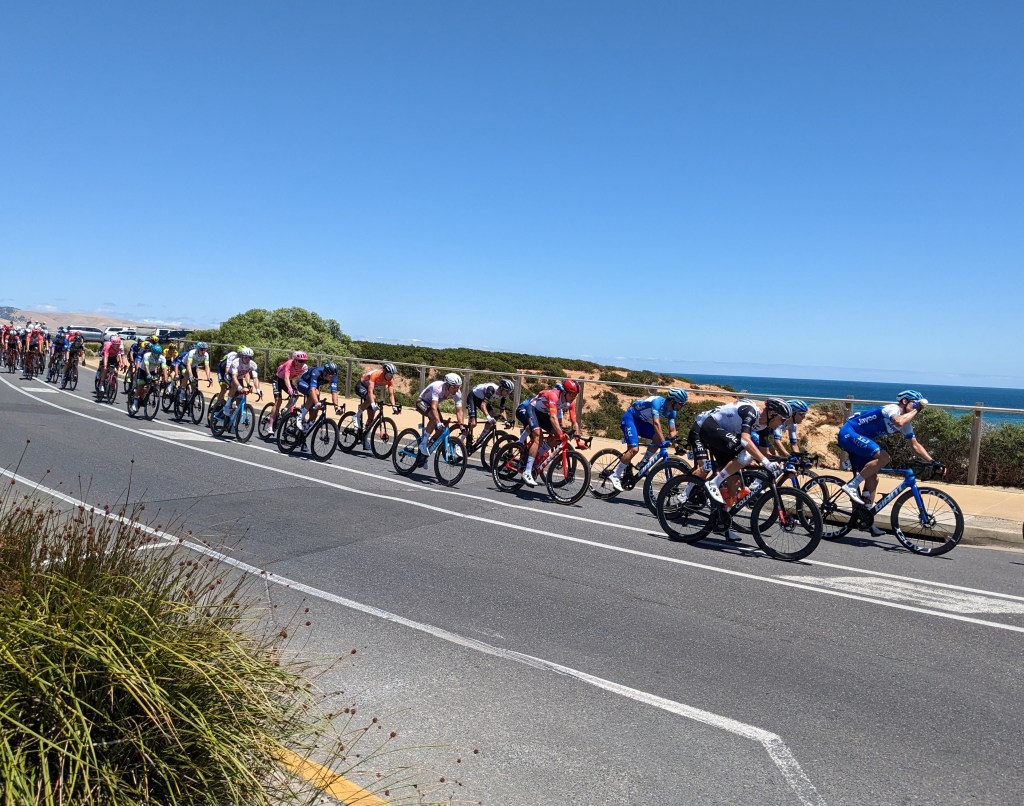
“Oh no! It’s the Tour Down Under! The road is closed for the cycling race,” lamented Alex.

He did a U-turn and headed west to the side streets in the hope of finding an alternative route along the Esplanade. After winding through the coastal suburbs, we arrived at a T junction facing the Esplanade, and were greeted by a woman in a bright orange vest holding a prominent sign saying ‘Stop!’

Onlookers lined the streets holding their cameras ready to snap the cyclists. We waited, all the while nervously checking the time on our phones, wondering whether we would miss our ferry. A few minutes later we heard an excited murmur run through the crowd, and sure enough, a group of cyclists whizzed past.

We glanced at the woman in the orange vest, hoping she would let us pass. She was on her walkie talkie and shook her head at us. Soon another group of cyclists raced past. Then the woman let us on to the Esplanade and we headed south. Soon after we were stopped by a police officer on a bicycle, who directed us away from the Esplanade. We turned east to weave our way back to our original route.

“We won’t make it to the ferry on time!” complained Alex, pressing heavily on the accelerator.

We arrived back on the highway that we had originally departed from and tried to turn right so that we could head south to Cape Jervis. A line of cars from the north were trying to turn right into our street.

“We’ll be here for hours. Best turn left and then do a U-turn,” announced Alex.

Alex turned left, accelerated, and braked when he found a gap in the oncoming traffic. He quickly did a U-turn and then headed south, passing the line of cars waiting to turn right onto the road where we had been waiting.

Would all of this be in vain? Would we get to Cape Jervis just after 3 pm to watch the ferry departing, on its way to Penneshaw? I held my phone to check the distance to Cape Jervis and noted that the estimated time of arrival was 2.54 pm. Alex tried to make up time by driving to the speed limit. A truck was labouring up the hill in front of us. Alex waited until we reached a passing lane, and then floored the accelerator. The estimated time of arrival was now 2.52 pm. Sitting next to Alex as he sped along the highway was more exciting than rides on a fairground had been when I was a child. I trusted his judgment and felt safe all the while enjoying the exhilarating speed. Next, there was a red car dawdling in front of us. Again, Alex waited until we reached a passing lane, and overtook them. The estimated time of arrival was still 2.52 pm. At least we had not been losing time as we were delayed by the slow coaches ahead of us. We entered the township of Cape Jervis, rounded the hill, and then descended to the ferry port, arriving as predicted at 2.52 pm. We expected boarding to be well underway. Instead, four lanes of cars were waiting in the line-up to board the empty ferry, which was running late. We slid into the shortest lane and turned off the engine. A biosecurity officer approached Alex’ window, his curly auburn ponytail blowing in the wind. Alex wound down the car window.

“Do you live on Kangaroo Island or are you just visiting?” he asked.

“We’re just visiting.”

“Oh, lovely! Do you have any honey?”

“No honey.”

“Do you have any bee-keeping equipment?”

“No, definitely not.”

“How about fruit?”

“We have some apples.”

“Are they from the supermarket?”

“Yes.”

“Where did you buy them?”

“In Adelaide.”

“How about potatoes?”

“No.”

“Do you have any plants?”

“We have some caper plants in the back.”

He looked at the back of our vehicle in acknowledgement.

“Oh capers! They look nice. Where did you get them?”

“From a business in Port Adelaide.”

The biosecurity officer seemed satisfied and waved us on.

“Have a lovely trip!”

Shortly after we boarded the 45-minute ferry for Penneshaw. We had been asked more biosecurity questions than at any other place on our travels, and we hadn’t even left our home state. I yearned for the ease of passing through immigration at Gatwick Airport. I had felt perversely miffed at Gatwick for having been ignored by immigration and customs officials.

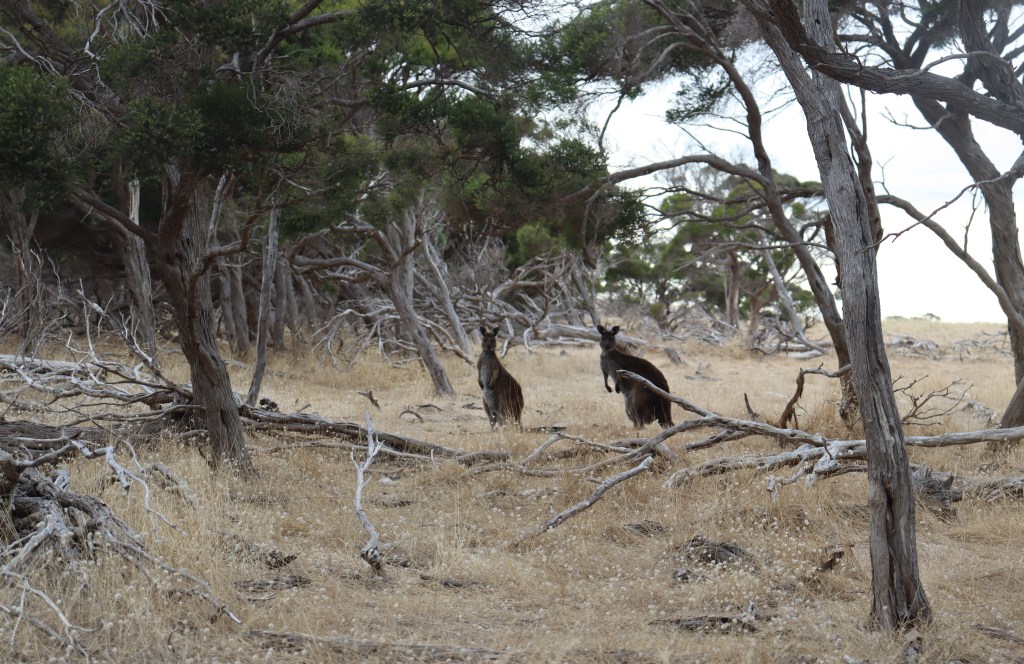
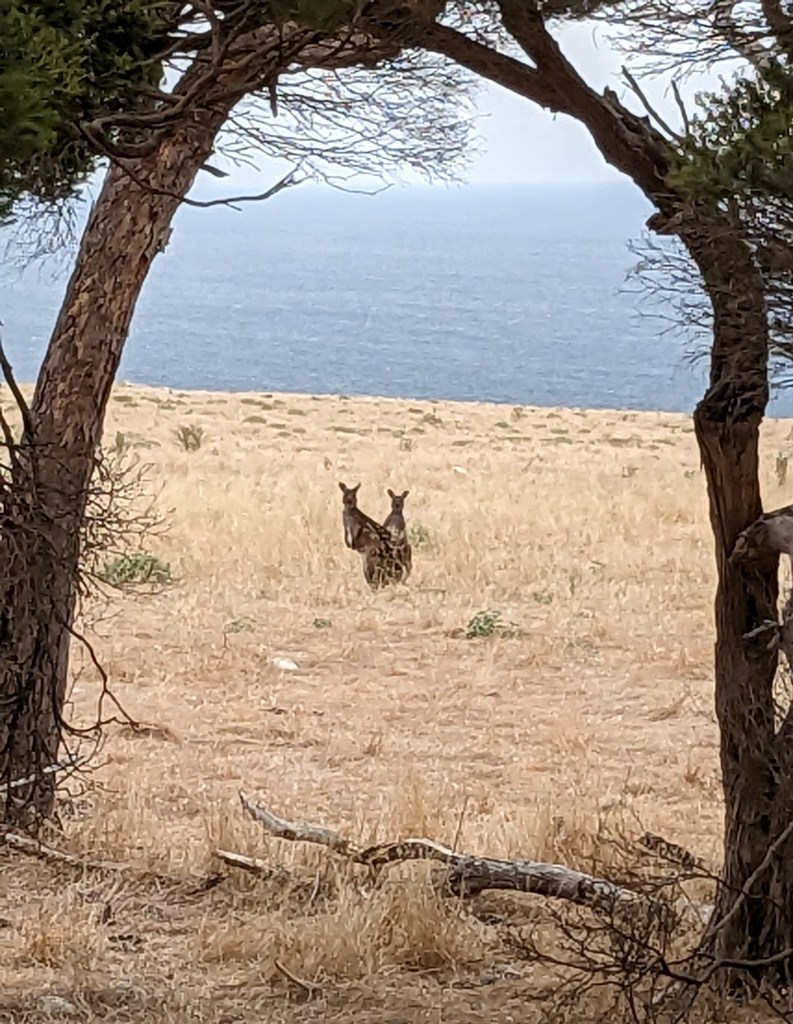
No sooner had we arrived at our destination though, did we spot a marvellous mob of kangaroos bounding across the property.

Then the following day we had a charming encounter with a Rosenberg’s Monitor looking for a drink of water – a species that is endangered on the mainland.

Rosenberg’s monitor lizard

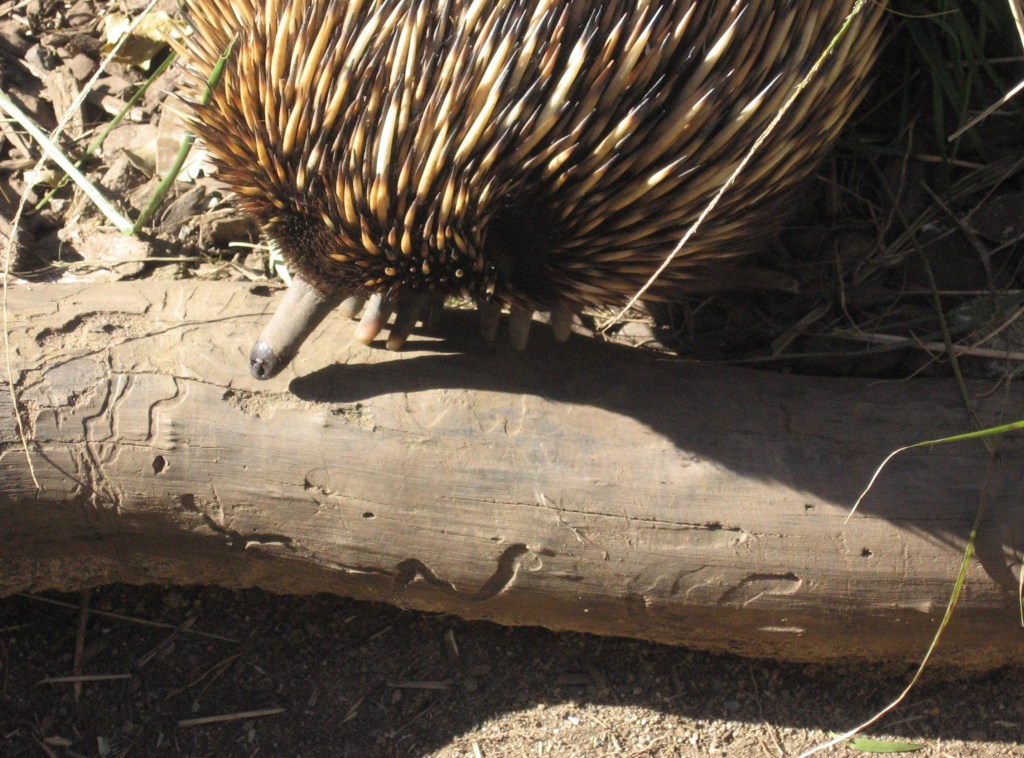
Verity later came across an elusive short-beaked echidna.

Short-beaked echidna

At last I could appreciate that protecting the fauna and flora of Kangaroo Island was important and necessary, and well worth the interrogations of a biosecurity officer.

Meredith Stephens is an applied linguist from South Australia. Her work has appeared in Transnational Literature, The Muse, The Font – A Literary Journal for Language Teachers, The Journal of Literature in Language Teaching, The Writers’ and Readers’ Magazine, Reading in a Foreign Language, and in chapters in anthologies published by Demeter Press, Canada.

PLEASE NOTE: ARTICLES CAN ONLY BE REPRODUCED IN OTHER SITES WITH DUE ACKNOWLEDGEMENT TO BORDERLESS JOURNAL

Click here to access the Borderless anthology, Monalisa No Longer Smiles