Categories
Essay

Charlie and I: My Visit to Corsier-sur-Vevey

Nirupama Kotru, a film buff renews her acquaintance with Chaplin and, in the process, learns a life lesson.

“In that dark room in the basement of Oakley Street, Mother illuminated to me the kindliest light this world has ever known, which has endowed literature and the theatre with their greatest themes: love, pity and humanity.”

— Charles Chaplin, My Autobiography

He has been called a genius by scientists, philosophers, writers, humanists, film-makers and actors. His films continue to fascinate generations. They are timeless in the true sense of the word. As children, we laughed at the slapstick and the physical humour in his films. As adults, we have learnt to appreciate the world-view that lies behind some of his funniest films. Charlie being sucked into the giant machine in Modern Times (1936) remains one of the indelible memories of childhood. Later in life, one came to appreciate the thought – the causes and consequences of the Great Depression (1929–39) – that went into the writing of the film.

Charlie Chaplin has been an important influence in Indian films. Take celebrated actor-director Raj Kapoor, for instance. Raj Kapoor absorbed the mannerisms associated with Chaplin’s Little Tramp, including the waddle. It is a tribute to Chaplin’s genius that this Indian actor came to be universally recognised as the tramp, with his film Awara (the title of the film means a vagabond or a tramp) becoming a huge hit at home and abroad. Many actors after Kapoor, among them Sridevi (Mr India,1987), Mehmood (Aulad,1968), Kamal Haasan (Punnaigai Mannan,1986), and Chiranjeevi (Chantabbai,1986), channelised their inner Charlie into their performances. But it was Noor Mohammed who first adopted the Chaplin persona, and even used the screen name “Charlie” in films like The Indian Charlie (1933), Toofan Mail (1934) and Musafir (1940).

In November 2022, when I was informed that I would have to travel to Geneva for work, my first reaction was far from enthusiastic. I thought Geneva would be bitterly cold; also I needed to start planning my forthcoming family vacation to the United States. The United Nations Conference on Trade and Development (UNCTAD), under whose aegis this program of the Intergovernmental Forum on Mining was taking place in Geneva, had asked India to send a women leader in mining.

Over the next four working days, I came to love Geneva Lake Geneve, the beautiful weather, the lovely architecture and the people. But the highlight of my trip was the last day, which I had taken off. The surprising part was that none of my colleagues, including those posted in the three Indian Missions/Consulates in Geneva, had visited the Chaplin Estate (The Manor de Bain). It was sheer luck that I remembered reading about Chaplin spending the last twenty-five years of his life in Switzerland, until his death in 1977. I discovered in the nick of time that Corsier-sur-Vevey was less than a two-hour drive from Geneva. I realised that this was a once-in-a-lifetime opportunity. A quick booking of tickets on the Chaplin World website and I was off to the Manor de Bain! I decided to combine my Vevey trip with one to Gruyere, the beautiful town which lends its name to a popular kind of cheese.

After a quick trip to Gruyere, I set off for Vevey. My heart started racing as I passed the town square in Vevey which had huge murals of Chaplin on some buildings. Finally, I entered the hallowed portals of the estate where Chaplin spent twenty-five years with his wife, Oona, and his children. Passing through his study in the main living quarters, as I entered the drawing room with its cosy sofas, I came across French windows which overlooked the massive grounds of the estate. I stopped to take a picture. Suddenly, my phone camera froze. I panicked. I tried to close the camera app and switch off my phone, but nothing worked. I thought, this was it, I won’t be able to take any more pictures to remind me of this special day. Dejected, I moved into the dining room. A lady guard came to me and asked me if I would like to write something in the visitor’s book, which I did, sitting down on a chair in the corner.

All this while I was feeling disappointed. Suddenly, I looked up to see a home video playing in a loop, of Chaplin enjoying a meal on a sunny day with family and friends. I thought to myself: Was this a sign? Was Chaplin saying, “Why are you obsessed with taking pictures? You have come so far to see my home; I want you to enjoy my estate, look at my work. Don’t let these modern gadgets rule your life. Slow down.Take it all in.”
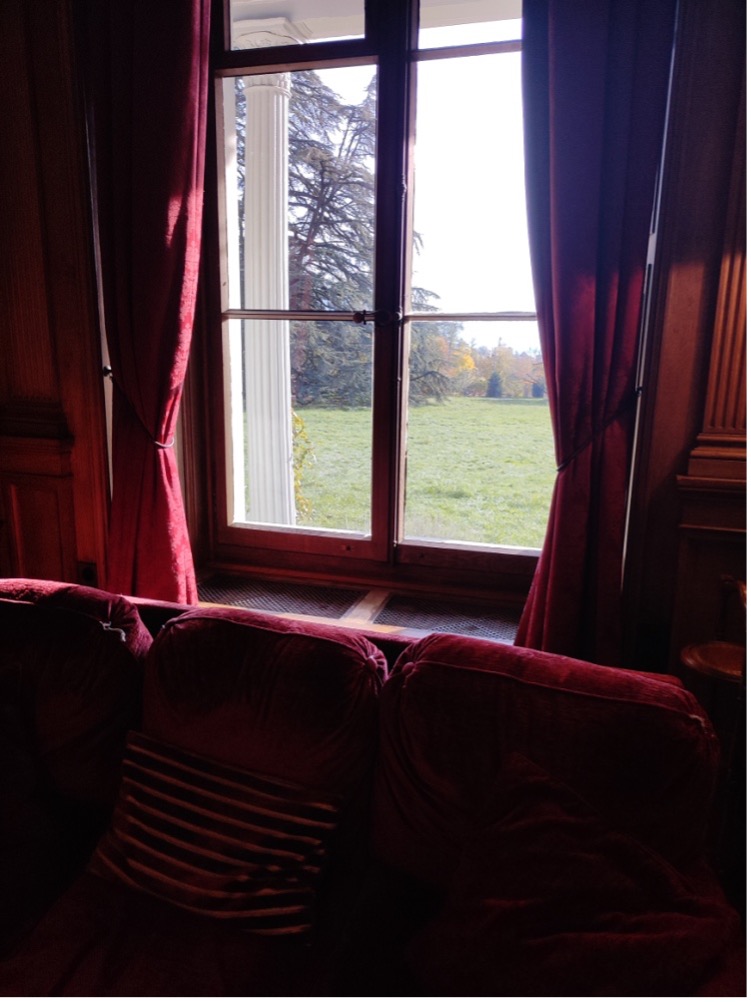
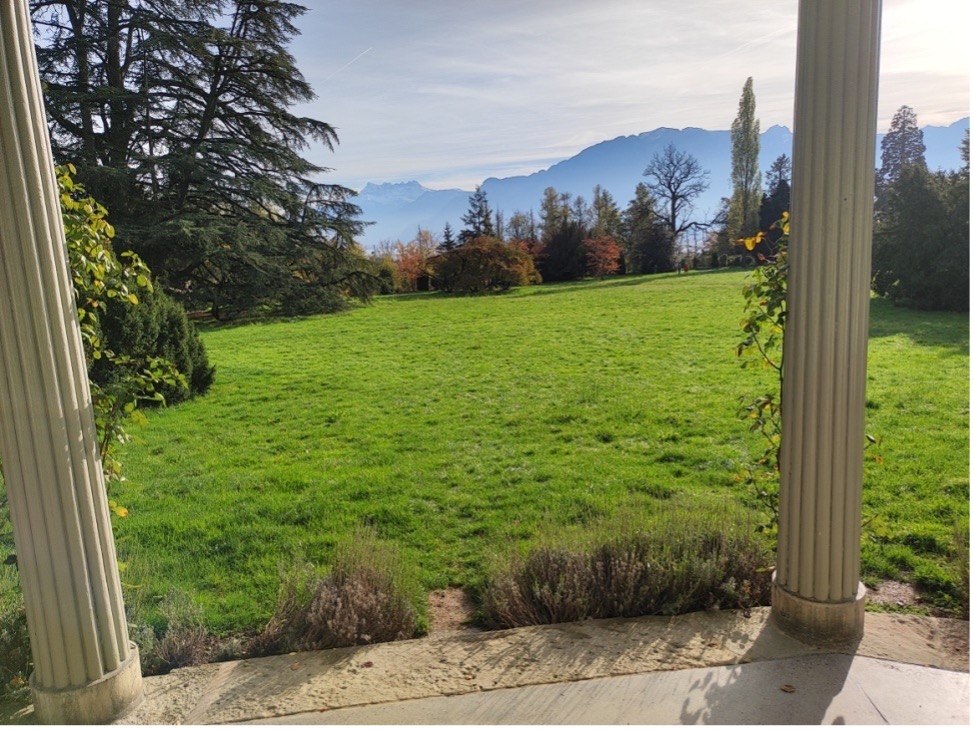
I calmed down and went back to those French windows in the drawing room to take in the magnificent view of the estate grounds. A man walked towards me. I asked him if he could help unfreeze my phone. He suggested I switch it off and then on again. I did that, and voila! It worked. Though I was relieved when my phone came back to life, I realised that in those intervening ten-fifteen minutes when my phone was frozen, I was forced to take a breather, to reflect upon the beauty I was surrounded by, and all the blessings which make life worth living. And I went back to the study and foyer of the house to spend some more time reading more about the struggles, trials and triumphs of this great artist.

As I emerged from the main building, I thought of rounding off the visit with a leisurely walk around the grounds. Suddenly I noticed a sign which said “The Studio”. I had deliberately avoided researching on what the visit had to offer, so I decided to just go with the flow and enjoy whatever was on offer. There was a screen outside “The Studio” which said that a film screening was to start in nine minutes. I waited, and finally watched the film, a moving take on Chaplin’s life and work, with ten other viewers.

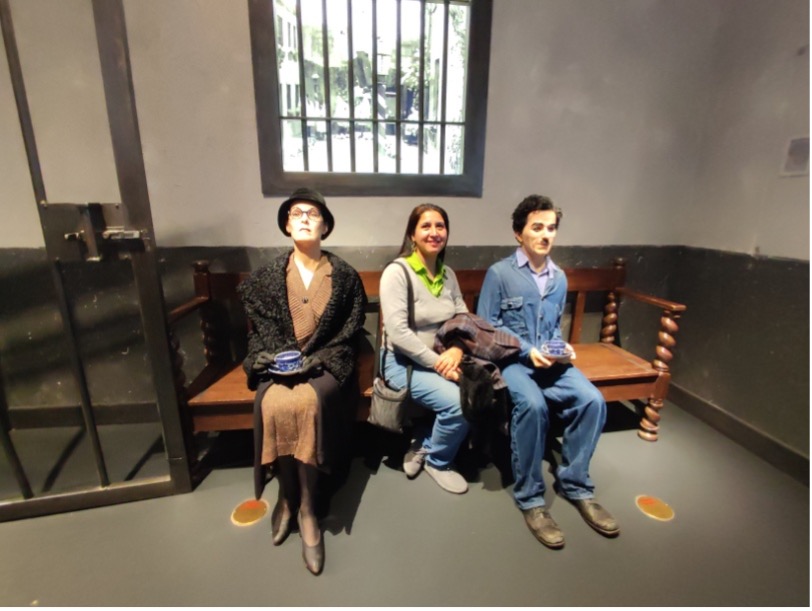
After the film ended, we were asked to move towards the screen. Suddenly, the screen disappeared and lo and behold, I found myself on a beautifully recreated set from The Kid. We were prompted to go behind the set, and to my bewilderment, what followed was one set after another – The Great Dictator, City Lights, Gold Rush, Limelight, A King in New York, whew! It was such a delight to go through those sets, to see the wax figurines, to sit on the chair from The Gold Rush with Charlie peeping from under a table, to pose next to Charlie in my own bowler’s hat, to sit on the jail bench next to him, to be swallowed by the giant machine from Modern Times. Mercifully, my camera behaved throughout the studio visit and I took many keepsake pictures. After a stroll through the beautiful grounds, I picked up some books, including Chaplin’s autobiography, and other memorabilia. I started reading the autobiography shortly after my visit and it reaffirmed my views about Charlie.

During my visit and afterwards, I got a lot of time to reflect upon how Chaplin’s films were deeply concerned with the human condition, with all the miseries and challenges brought upon it by events that the common man has no control over. Chaplin’s work includes The Gold Rush (1925), which drew from real-life events such as the Klondike Gold Rush and the Donner Party, and The Great Dictator(1940), a satire on Adolf Hitler. Limelight (1952), which depicted the frustration of a has-been comedian, can be classified as auto-fiction, as can The Kid (1921), while Modern Times has been hailed as an astute commentary on industrialisation. Levity was Chaplin’s forte, but all his films were deeply rooted in his political and social consciousness. More often than not, he had to pay a heavy price for sticking to his beliefs.

Recollecting the making of The Great Dictator, Charles says in his autobiography, “Halfway through, I began receiving alarming messages from United Artists … But I was determined to go ahead, for Hitler must be laughed at. Had I known of the actual horrors of the German concentration camps, I could not have made The Great Dictator; I could not have made fun of the homicidal insanity of the Nazis.”
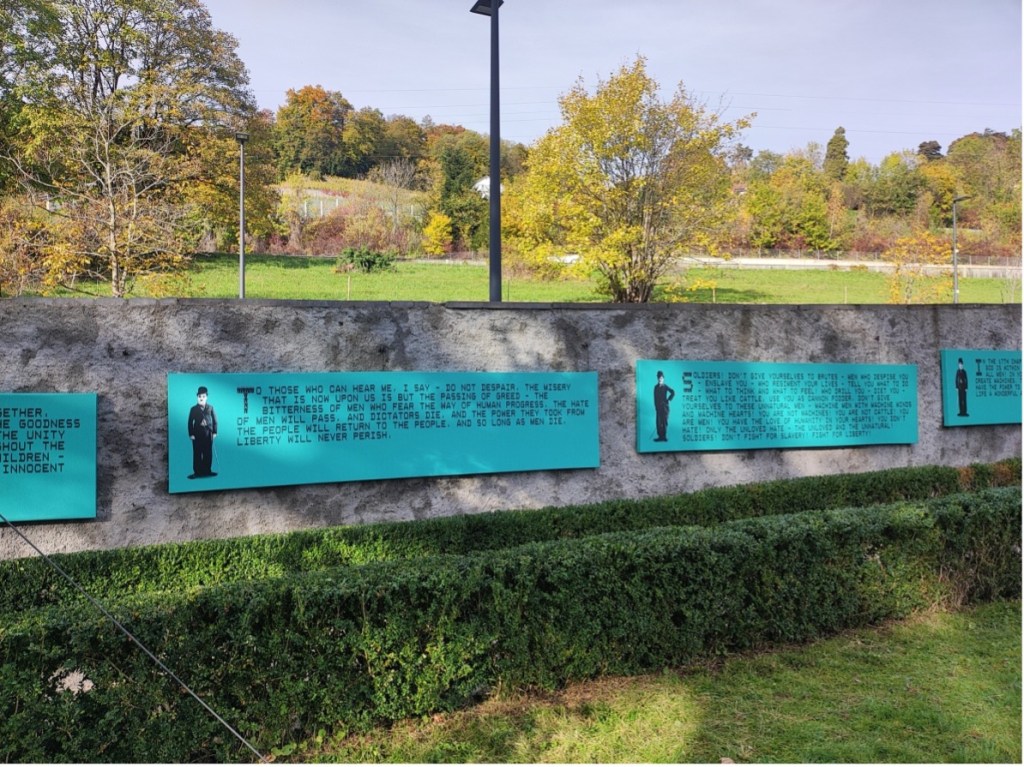
The boundary wall of the Manor de Bain. The sounds of cow bells from across the road drifted towards the estate, making for a mesmerising setting.

Chaplin was a genius who understood the power of the audio-visual medium. Since pantomime was his greatest strength, having performed bit roles in theatres during his childhood days of great hardship and penury, he used this technique to convey pathos through humour. Although he was earning quite well as a comedian-writer-director in Hollywood, by 1919, he was so frustrated with the studio system, which did not give him a free hand to write his own scripts, that he co-founded United Artists along with Douglas Fairbanks, Mary Pickford and D.W. Griffith.

His first major hit under his own banner was The Kid, which drew from his childhood experiences. So strong were his convictions about the silent film that he swam against the tide and released City Lights in 1931, well after talkies had completely taken over Hollywood. Slowly, he started warming up to the possibilities of sound in film. He used sound effects in Modern Times but no spoken dialogue. He composed and sang a charming ditty in gibberish, ‘Titine’,with some random words in French, Italian and English thrown in, for Modern Times which never fails to bring a smile to the face, even eighty-seven years after its release

Whether it was silent films or talkies, Chaplin continued to tell his stories of universal values, of hope amidst great suffering. As an artist, he never shied away from speaking truth to power. Like most great artists, he did not accept manmade boundaries. Although he was English by birth, he was criticised for not fighting in World War I. He had long arguments with Winston Churchill about Mahatma Gandhi and the struggle of the Indian people for freedom. In fact, he met Gandhi-ji shortly after meeting Churchill, during a trip to London, and questioned him at length about his abhorrence for machinery. He returned from the meeting with great admiration for Gandhi-ji’s strategies for achieving independence and his principles of non-violence and truth. His conversation with Gandhi-ji influenced his writing of Modern Times, especially the Gandhian theory about modernisation and rapid industrialisation being the cause of unemployment and rising inequality. The fearless artist once made an uncharitable remark about the English royalty, telling Churchill, “I thought socialists were opposed to a monarchy”, to which Winston Churchill replied, with a laugh, “If you were in England, we’d cut your head off for that remark.”

Being wary of the ways of Hollywood where an artist was judged by his or her success at the box office, he made few friends in the film industry. Chaplin was happy spending time visiting his childhood haunts on his trips to London, and also enjoyed wining and dining with film stars, princes and princesses, prime ministers and presidents, scientists, philosophers, poets and writers. He was friends with Mary and Douglas Fairbanks, Albert Einstein, George Bernard Shaw, H.G.Wells, Harold Laski, Aldous Huxley, Theodore Dreiser, et al. He went to Lucerne in Switzerland to meet India’s first prime minister, Jawaharlal Nehru, expressing his surprise at finding him “a small man like myself”. Chaplin invited Pt Nehru to his estate in Vevey for a meal. They had a long chat on the way, which left Chaplin impressed with the “…man of moods, austere and sensitive, with an exceedingly alert and appraising mind”.

Chaplin was a pacifist and a philosopher, and was derided for his views in America – not just mocked, but harassed by the FBI under its founding director, J. Edgar Hoover. In 1952, the country which has historically been considered the land of free speech hounded Charlie out of its borders under the mistaken impression that he was an avowed communist, and told him to never come back. Chaplin even narrowly escaped an assassination attempt in Japan.

Chaplin’s autobiography ends in 1964, on a poignant yet hopeful note, just like Charlie’s films, with Chaplin expressing his sadness at having to leave America, but also describing his happy days in Switzerland, where he befriended several artists who lived in the area. Eight years later, in 1972, Charles Spencer Chaplin was called back to America by the Academy of Motion Picture Arts & Sciences to receive an Honorary Oscar. After initial hesitation, Chaplin decided to attend the ceremony, which would end his twenty-year exile from America. He went on to receive an unprecedented standing ovation lasting twelve minutes. Cries of “Bravo!” filled the auditorium and Chaplin was clearly overwhelmed. It was an emotional homecoming for the man who had left Los Angeles in extremely unpleasant circumstances in 1952.

Chaplin was knighted by Queen Elizabeth II in 1975, but by then he was frail and had to accept the honour in a wheelchair. He passed away in 1977, but his legacy lives on. I hope cine buffs like me keep rediscovering him, for The Tramp is timeless.

(The photographs have been provided by the author, except for the book cover)

Nirupama Kotru is an officer of the Indian Revenue Service,1992 batch. Ms.Kotru has served in the Income Tax Department at Mumbai, Chennai, Delhi and Pune. On deputation, she served as Director (e Governance) in Ministry of Corporate Affairs and as Director (Films) in M/o Information & Broadcasting, where she looked after policy issues such as censorship, India’s participation in film festivals abroad, archiving, film schools and production of films.

As Joint Secretary in Ministry of Culture she has looked after prestigious national akademis such as Sahitya Akademi and National School of Drama, and national museums such as Indian Museum and Victoria Memorial Hall &Museum. She is presently posted as Joint Secretary& Financial Advisor, Ministries of Coal, Mines & Minority Affairs. She has released an album of bhajans called Upasana. She has also written around thirty articles on cinema and other topics such as parenting. She is currently co-authoring an anthology on Hindi cinema of the 1970s.

.

PLEASE NOTE: ARTICLES CAN ONLY BE REPRODUCED IN OTHER SITES WITH DUE ACKNOWLEDGEMENT TO BORDERLESS JOURNAL. 

Click here to access the Borderless anthology, Monalisa No Longer Smiles

Click here to access Monalisa No Longer Smiles on Kindle Amazon International

Categories
Poets, Poetry & Rhys Hughes

My Love for R.K. Narayan

R.K. Narayan gives me a ‘warmer’ feeling than any other novelist. This doesn’t mean that his books make life seem easy. On the contrary, his work is absolutely committed to dealing with the travails of existence, but there is a deep humanity about his style that strongly appeals to my better nature, and I love immersing myself in his world. I feel that no more genuine and sincere guide can be found to our common reality than this author.

He was an author I was aware of for a long time before I actually read him. I planned to read his books one day, but most things that are postponed until that magical ‘one day’ seem never to happen. Finally, I dipped into a very small book of his short stories when I had a bout of flu. This was a sampler volume, pocket sized and easy to race through, but I paced myself at one story a day. They were a gift to an unwell man. I loved them. Nearly all of them had a twist at the end, but the twists didn’t feel at all contrived.

There was some other quality about them that intrigued me. They seemed to display not the slightest trace of self-consciousness. They reminded me of the authors I had most enjoyed when I first discovered the joys of literature, Robert Louis Stevenson, the early H.G. Wells, some Dickens. They allowed me to be a pure reader again, rather than an aspiring writer who was always on the lookout for ways to improve his own technique.

Hot lemon tea and short stories just like these are what a man needs when the flu takes hold of him. I finished the slim volume and recovered my health. I now knew that Narayan was an author who strongly appealed to me. Therefore, it was necessary to seek out his other books. I went to the local library, a library that happens to be one of the best I have ever visited, but all the Narayan books were already on loan. However, there was another author with an Indian name on the shelf very near where Narayan should be. I decided that he might act as a temporary substitute and I took out a volume at random. It turned out to be the very first book of V.S. Naipaul, certainly an Indian writer, but one who was also a writer from Trinidad, on the opposite side of the world to India. I read it, loved it, found it very different from Narayan.

Miguel Street is a brilliant collection of linked stories. These tales are set in one street in Port of Spain, the capital of Trinidad, and written in a deceptively simple style that Naipaul claims was inspired by the author of the old picaresque novel Lazarillo de Tormes, published in 1554 and probably written by Diego Hurtado de Mendoza, a book I read a few years ago with great enjoyment. But there is a rhythmic music to Miguel Street that clearly has little to do with that earlier work. It is a funny book, but behind the comedy is a certain measure of pain, and behind that pain is more comedy, and so on. The stories are therefore multi-layered, and this concealed complexity of form works as a very satisfying contrast to the singsong language of the telling. But these tales are hard. They aren’t as warmly embracing as Narayan’s.

I came to the conclusion, one I think I still hold, that Naipaul and Narayan are opposites, that they represent two poles on one spectrum of literature, that the first is hard and cynical, the other yielding and benevolent. Naipaul always seems to be a pessimist, and even in optimistic passages he is pessimistic about the worth of optimism. Narayan always seems to be an optimist, and even when things go wrong for his characters, he is optimistic about their pessimism. More to the point, their pessimism doesn’t endure, it dissipates rapidly. I admire both authors immensely, but I would much prefer to meet Narayan and drink coffee with him than meet Naipaul over any drink.

After I finished Miguel Street I returned it to the library, and now Narayan was back on the shelves, so I helped myself to The Bachelor of Arts, a novel that flows with incredible smoothness. It tells of Chandran, who graduates from college and falls in love with Malathi, a girl he sees on the river bank one fateful evening. His yearnings for her lead to the most dramatic adventure of his youth, as he impulsively but bravely decides to reject the world when he is unable to have her as his wife. But that is only one extended incident among many. The story is delightful, charming, innocent, but it also has elements of melancholy. It is humorous and yet serious. Reading it, I fully understood why Graham Greene said that Narayan was his favourite writer in the English language. Greene also claimed that Narayan had metaphorically offered him a second home in India, and that was exactly the way I felt too.

Then I learned that The Bachelor of Arts was one volume in a loose trilogy, and I obtained the other two books linked to it. Swami and Friends turned out to be almost as engrossing and fascinating, though a little simpler in structure. The English Teacher, on the other hand, was much more sombre in tone, with a plot concerning an English teacher who loses his new wife to typhoid. Narayan lost his own wife to the same disease. The sadness and poignancy of certain scenes in this novel are thus intense, yet the author never allows his narrator to become self-indulgent and the ending of this novel is beautiful. This is a trilogy that can be regarded as authentic, and what I mean by this is that there is no sense that the truth is being operated on by the tools of the writer’s trade for effect. Truth here is unadorned and more effective as a result. It takes gentle courage to write this way and succeed so admirably.

I do feel with Narayan that he is befriending the reader as well as relating a narrative. As I have already said, Narayan gives me a warm feeling that no other writers do to the same degree. His style is perfect for the needs of readers who wish to forget about the technical aspects of literature and feel exactly the same way they did when they were young and launching themselves into the mighty universe of literature for the first time.

Narayan is able to do two contradictory things simultaneously, namely (1) show that we are all the same throughout the world, and (2) show how cultures and people around the world differ from each other. And although other authors can pull off this trick, with Narayan it doesn’t feel like a trick at all but a natural expression of his being. It is true that I have enjoyed some of his books less than others, he is far from being the perfect writer. Talkative Man, for example is one of the weaker works, a short novel, more of a novella really, set in the fictional town of Malgudi as are most of his books, and it is charming and humorous and a little bit haphazard, a semi-picaresque in which the action always seems to be episodic and wide-ranging but in fact is firmly grounded in that one small town in a sleepy backwater of Southern India.

But it lacks bite, for although Narayan’s novelistic bite is gentle, unlike the bite of Naipaul, it is a bite all the same. The Painter of Signs bites, and although there are some slapdash passages in this novel (as there are in Talkative Man) they are easy to forgive, thanks to the compelling soft force of the poignant story about two individuals who despite being on different life-paths, meet and become deeply involved with each other.

Yet there is one Narayan book that is supreme above all his others, at least in my opinion, and it is a collection of stories I took with me when I travelled to East Africa and wanted a companion light enough to carry in my small rucksack and amusing enough to make each mosquito-filled night pass smoothly. The one quality possessed by Narayan that makes him such an agreeable companion on a long journey is that he never lectures or talks down to the reader but invites him to share his world, his vision. His fictional town of Malgudi feels absolutely real to me, so much so that it is my favourite invented location in all literature, and I always accept the invitation to stroll its dusty streets.

Malgudi Days is the title of this wondrous volume. I read it in Mombasa. It is a collection that displays enormous variety within the compass of its fictional setting, the remarkable town of Malgudi, only occasionally venturing outside it, into the countryside or the jungle where tigers and angry gods cause difficulties for the people who stray into their domain. Most of the time, the people settled in Malgudi, or just passing through it, devise deeply human strategies for coping with the difficulties thrown at them by circumstance and fate, often making their own difficulties through the accretion of actions over years. Despite the warmth of Narayan’s prose style, the gentle mood he evokes, the benign ambience of the setting, there is suffering and guilt here too.

Characters are not infrequently criminals who have fled the scene of their misdoings and have relocated to Malgudi in order to start afresh. Not always can they leave behind their pasts. And yet there are no simple morality lessons here, the resolutions are often chaotic, ambiguous, the stories of some lives are left hanging. Narayan is in control of his material but not of life and life bowls balls that his characters can’t always bat…

It is difficult for me to enthuse too precisely about this collection without ending up saying things I have no wish to say. The individual stories are superb, but the sum is greater than its parts. To choose individual tales to praise seems a mild insult to the integrity of the whole, though I am aware that it is perfectly acceptable to pick out particular pieces and talk about them. The collection was not designed as a whole anyway but amalgamated from two existing collections and updated with a handful of new stories.

I am merely delighted that I discovered R.K. Narayan and I fully intend to read everything he published. And there are districts of Bangalore and Mysore that evoke some aspects of Malgudi and are there to be explored without having any specific ‘sights’ to seek out. Ambience is everything. Friendship within that ambience is a blessing. Narayan is a friend on a shelf, a genuine friend, and the black ink of his words on the white pages of his books are like reversed stars on a night sky that is as radiant as daylight.

.

Rhys Hughes has lived in many countries. He graduated as an engineer but currently works as a tutor of mathematics. Since his first book was published in 1995 he has had fifty other books published and his work has been translated into ten languages.

.

PLEASE NOTE: ARTICLES CAN ONLY BE REPRODUCED IN OTHER SITES WITH DUE ACKNOWLEDGEMENT TO BORDERLESS JOURNAL

Click here to access the Borderless anthology, Monalisa No Longer Smiles

Click here to access Monalisa No Longer Smiles on Kindle Amazon International

Categories
Poets, Poetry & Rhys Hughes

The Anthology in my Mind

Courtesy: Creative Commons

A few years after I first fell in love with literature, in my distant youth, I began putting together an imaginary anthology full of the best short stories I happened to read, and I never stopped compiling it. This anthology ought to be enormous now, unwieldy and unpublishable, but in fact it’s a perfectly manageable length and that is because it only contains stories that truly riveted me and there aren’t so many of those. It’s not good enough for them just to be good. They must be stories that make me jump up and ruffle my hair and shout: “I wish I had written that, but I didn’t, and probably I couldn’t.”

I am sure I am not the only reader who carries such an anthology around in their heads. And though my tastes might have changed over the years, the fact remains that the stories in my imaginary anthology are those that had a forceful emotional effect as well as providing a cerebral satisfaction. Having said that, I must concede that cerebral satisfaction is emotional too. We feel elated when a clever insight suddenly illuminates an opaque mystery or when an impossible puzzle proves to have an ingenious solution.

The first story in my anthology is ‘The Tell-Tale Heart’ by Edgar Allan Poe, which I read when I was 15 years old. It was the first time I encountered the device of an ‘unreliable narrator’ (or at least a narrator with a twisted view of life) and it amazed me. I became an instant Poe devotee. Other stories by Poe that can be found in my anthology are ‘The Masque of the Red Death’ and ‘The Cask of Amontillado’, both of them perfect fables, and also a few of his weird comedies (it often comes as a surprise to readers that Poe wrote comedies) such as ‘A Predicament’, which is a fine example of surrealism before the word was coined (maybe we ought to call it ‘proto-surreal’).

Poe gave me a taste for the nightmarish, which isn’t quite the same as horror, and led me to Kafka, after I was informed (I can’t remember who by) that Kafka’s work was even more nightmarish than Poe’s. Maybe it is, but in a different way. And yet neither ‘Metamorphosis’ nor ‘In the Penal Colony’ are included in the anthology, magnificent though they are. I found myself more strongly drawn to some of his less obviously allegorical stories, ‘A Country Doctor’, for example, ‘The Great Wall of China’, ‘A Hunger Artist’, and to the the very brief and brilliant ‘On Parables’.

There has to be an upper word limit to each of the stories in my anthology, of course, and this is why Voltaire’s Candide, which is a novella or short novel, finds no place in the imaginary pages. The next author to be included must thus be Ray Bradbury, my literary hero when I was seventeen or so. I have included ‘The Scythe’ and ‘Homecoming’ (the first Bradbury story I ever read) as being the most important of his stories for me. Bradbury is the true heir of Poe, for his work wanders among the genres in the same manner, and his dark humour sits side by side with his more gothic effects.

I think that Saki must be in the anthology too, and I would choose ‘Laura’ from all his tales, for its sheer ingenuity. It remains one of the best twist ending fictions I have encountered and is hilariously ironic, and twist endings are not common in Saki, who generally prefers to fulfil the uneasy expectations of the reader rather than pulling the rug from under their feet. This is why he shouldn’t be compared with O Henry, who is included for ‘The Gift of the Magi’, though it has already been anthologised hundreds of times.

Chekhov’s early stories were a big influence on me, and although his later work is considered vastly superior to the fiction of his youth, I personally regard stories such as ‘Romance with Double-Bass’, ‘The Objet d’Art’ and ‘Revenge’ with their unexpected endings as more purely enjoyable. I also received a happy shock from two quite obscure tales, ‘The Monster of Lake LaMetrie’ by Wardon Allan Curtis and ‘The Anticipator’ by Morley Roberts. Another of my favourite twist endings is found in ‘Metonymy’ by Rachel de Queiroz. But twist endings aren’t everything. My favourite H.G. Wells’ story, ‘The Country of the Blind’, has no twist at the end. It proceeds with an unstoppable momentum like a slow avalanche, the reader a helpless observer.

The finest stories of Jorge Luis Borges are among the most remarkable pieces of fiction I have read. We might all be familiar with the conceptual rigour and originality of his most famous stories, ‘Tlön, Uqbar, Orbis Tertius’, ‘The Garden of Forking Paths’ and ‘The Library of Babel’, for these texts have redefined the purpose of the short story as a cultural product, but I have always found ‘The Congress’ to be the ultimate Borges story. The matrix on which it is based is a loop that turns out to be a complex manifold akin to the mathematical shape known as a Reimann surface. It is somewhat like a reverse prose version of Escher’s lithograph ‘Print Gallery’ in which a man is viewing a picture which contains the gallery in which he stands. In ‘The Congress’ a scheme is evolved to represent and control all the variables of the real world, but as the number of variables increases due to the demands of greater precision, the scheme is seen to already exist in the form of the real world itself.

A few of Italo Calvino’s hugely inventive stories are in my anthology too, ‘The Distance of the Moon’ among them, the first of his stories to feature the character, Qfwfq, who is as old as the universe. But Calvino’s shorter fiction tends to be at its best when it comes in sequences, and it’s the entire sequence that ends up being so superb, the Marcovaldo stories, for instance. They work better as linked suites, almost novels. One of his earliest surviving stories, ‘The Man Who Shouted Teresa’, will be in my anthology, however, for its charming absurdity, its precision and ironic logic.

I still haven’t decided which stories to include by Stanislaw Lem, Roger Zelazny, John Sladek, and so many other writers, but I feel confident they will have at least one piece in the anthology. Those were all science fiction writers and I read a lot of science fiction when I was young. Fredric Brown’s ‘Answer’ must be included in my anthology as a perfect example of a one-page story that manages to deal with the biggest themes in the universe in a way that is snappy and funny but also deeply thought provoking.

Now I will mention ‘The Dead Lady of Clown Town’ by Cordwainer Smith. All literature of the imagination is ‘strange’ but most of it is created by men and women who are not particularly strange. Most tales of the far future maintain the impression that they are imagined by writers who are living in the present. But Smith’s stories give the impression they are realistic fictions written in the future. I have heard it said elsewhere that the strangeness of Smith’s style derives from Chinese methods of storytelling (Smith spent his formative years in China) but that doesn’t account for the strangeness of his visions. They are authentically strange, not forced or contrived.

‘The Incredible and Sad Tale of Innocent Eréndira and Her Heartless Grandmother’ by Gabriel García Márquez is another candidate. It is an extension of a brief scene in his renowned novel One Hundred Years of Solitude. Eréndira is a young girl who accidentally sets fire to the home of her grandmother, who forces her to work in order to repay the debt, a term of servitude that lasts years. The hallucinatory tone of the story and its incipient strangeness intensify rather than detract from the fact that this is essentially a love and revenge tragedy as bloody and passionate as any ever conceived but conveyed in language that is simultaneously moon-washed with magic, heady with tropical oppression and sharp as a machete.

‘A Manual for Sons’ by Donald Barthelme is there too. For many people ‘postmodernism’ is a suspicious word, but it never has been for me, because I discovered the work of Barthelme long before being exposed to the somewhat pretentious academic side of the ‘movement’. Barthelme’s stories are playful, wise, profound, dry, unique and funny. There is no finer stylist in the cosmos of the short story. He was an experimentalist but also had an utterly solid grasp of the fundamental rules of the craft, and ‘A Manual for Sons’ demonstrates all his strengths. It is both tragic and comedic to an extreme degree.

‘The Cloud-Sculptors of Coral D’ by J.G. Ballard. When Ballard was at his best his prose had a strange sort of clarity that was intellectual and emotional and quite heady. He was able to make geometries lyrical. The forlorn abandoned landscapes of modern civilisation were projected by him into a curious world of glacial fabulation. It often seems as if he is writing the same story again and again, refining it in an attempt to achieve some ultimate truth. In my opinion, he never bettered ‘The Cloud-Sculptors of Coral D’ in which the usual Ballardian obsessions, the overlit deserts, the elegant women, the misfits, the surreal juxtaposition of old and new, the vast silences, fuse as perfectly as grains of sand that have turned into glass. Ballard was a writer who relied almost entirely on imagery, deeply affecting sequences of mind patterns, to impress and even mesmerise the reader. After first reading this story almost twenty years ago I have never been able to forget the gliders carving clouds into giant shapes above the bizarre resort of Vermilion Sands.

‘The Four-Colour Problem’ by Barrington Bayley, a story which at first glance resembles a dissertation on geometry. There are mathematical lectures embedded in the text, but these are never too technical for digestion. To further soften their impact, Bayley adopts a darkly comic tone which owes much to William Burroughs. The plot involves the discovery that geography is wrong and that between political borders lie new countries. The explanation for this concerns a real mathematical problem. Cartographers have long known that just four colours are required to fill in a map so that no colour borders itself, but mathematics yields only a proof for five colours. Bayley’s response is that maps exist that really do require five colours and that on the surface of our globe there are missing countries existing in dimensions tangential to our own. During the course of the tale, efforts are made to probe these intersections, with unexpected and humorous consequences.

‘Five Letters From an Eastern Empire’ by Alasdair Gray. This was the first story by Gray I ever read and it burned itself into my mind so forcefully almost three decades ago that I still regard it as the zenith of what is possible in the art of the short story, or rather what I regard as ultimately desirable. It’s a political satire, a fantasy, a tragedy and a story about definitions. The changing of one word in the title of a lament written by the main character, Bohu the Court Poet, turns an act of rebellion into a perfect propaganda tool for a repressive regime ruled by an immortal puppet. This remarkable conceit has much to say about how dictatorships manipulate the masses, and the evolution of the intolerable irony of the situation in which Bohu finds himself is perfect in pacing, mood and depth of meaning.

Recently I added another story to my imaginary anthology, a piece called ‘Cul-de-Sac (Uncompleted)’ by Australian writer Murray Bail, a deeply strange, quirky, logically lateral, hugely inventive, funny and disturbing piece. I know of nobody else who has read it. It’s a story that has clearly slipped through the cracks of time and awareness. I suppose there must be hundreds of stupendous works out there similarly neglected…

The anthology in my mind is a work continually in progress. It will never be finished until I stop reading short stories and it will never be published.

.

Rhys Hughes has lived in many countries. He graduated as an engineer but currently works as a tutor of mathematics. Since his first book was published in 1995 he has had fifty other books published and his work has been translated into ten languages.

.

PLEASE NOTE: ARTICLES CAN ONLY BE REPRODUCED IN OTHER SITES WITH DUE ACKNOWLEDGEMENT TO BORDERLESS JOURNAL