Narrative by Meredith Stephens
I stretched the boat hook as far as I could towards the mooring buoy, but it slid beneath the bow.
“Go back!” I shouted to Alex back at the helm, but my voice was carried away in the wind.
I pointed at the buoy under the net, and Alex reversed. The waves were dancing in front of me and the buoy would not stay in place long enough for me to reach it. On the second attempt, I forced all of my attention on the rope attached to the buoy, and tried to pull it aboard. It was much too heavy so I screamed for Alex to come, and he raced from behind, pulled the buoy up and secured it to the bow.
How would I alight into the dinghy in these waves? Alex lowered it into the water and it lunged towards the stern and back in succession. I doubted I would be able to board in these conditions.
“How about if I move the dinghy to the side of the boat and you enter via a ladder?”
“Worth a try!” I answered.
Alex brought the dinghy to the side of the boat and slung a ladder made of strong fabric overboard. I gingerly stepped down but once I glanced at the water raging beneath me, I lost confidence and gave up.
“I think I had better hop in from the stern after all,” I told Alex.
He moved the dinghy back to the stern. As I walked towards it, I slipped and fell on my thigh. There was no time to feel sorry for myself, so I picked myself up and continued heading for the dinghy. It lunged back and forth in the waves.
“Now!” commanded Alex.
I placed one foot in the centre of the dinghy to centre myself and then sat down on the bench. As hard as it was for me it was not hard for Haru, my border collie. I called her in and tapped the dinghy behind me because I knew she was hard of hearing. She leapt behind me with alacrity. It was so much easier for her to board the dinghy, not least because of her four legs.
Alex was locking the door back on the boat. The dinghy kept lunging toward the stern, and I was scared of getting knocked off when it hit the stern. I screamed as hard as I could.
“Okay!” replied Alex and hopped in behind me. Then he turned on the engine and headed for the shore, except that the shore was unrecognisable. Instead of a sandy beach, there were rocks.
Alex headed for the most promising spot. “Hop out!” commanded Alex, and I disembarked one leg after the other and headed to climb over the rocks. As usual, Haru leapt out and ran ashore.
I thought I was clear of the rocks and the menacing water, when Alex called out to me.
“Take my backpack! The laptops are in here. They can’t get wet. I realised then that we should have put them into the dry bag.”
I walked over the slippery rocks and strained to grasp the shoulder straps of the backpack. Once they were in my hands I returned to shore over the rocks, ready for the trek up to the holiday house.
I was so longing for the warmth of the fireplace and the view of the setting sun over the bay. I walked effortlessly up the hill, with Haru trotting happily beside me. The shelter and glow of the house was just as I had imagined. It was worth the hardship of getting there.
That night the winds continued to build, but it was pleasurable to hear them passing over the house as we enjoyed the safety and warmth of being inside.
Around one in the morning, the whole house shuddered when hit by a particularly strong gust, which was violent enough to briefly wake Alex.
No sooner was it light that I heard Alex enter the room. He must have been out before the wee hours.
“The boat has drifted to shore. I had a bad feeling and got up early to check the position of the boat. From the cliffs I could see that the mast was too close to the shore. Then my fears were confirmed when I saw that it had been blown ashore.”
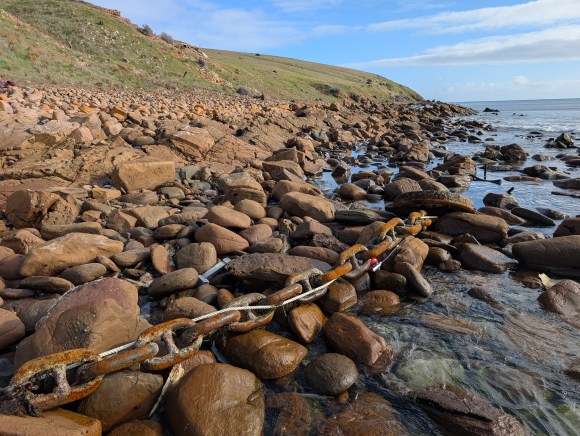
“Didn’t the mooring hold?” I asked.
“Evidently not. I’m going to check it out now. Want to come?”
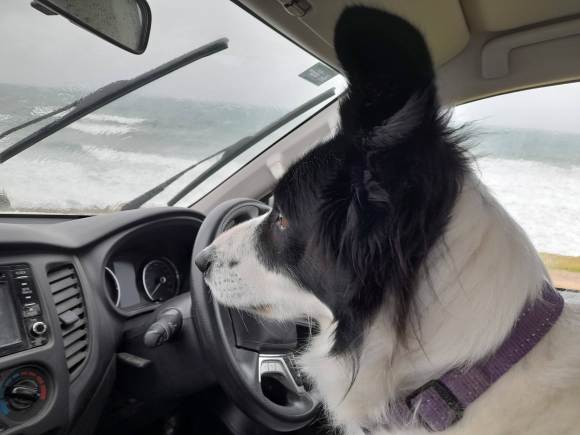
I agreed, and we drove out to the cliff with Haru in the back seat. Once at the cliff, I remained in the car because I couldn’t face the gale-force winds that were now gusting to forty knots. Meanwhile, Alex, in his wetsuit, walked down the dirt road towards the beach, entered the water, and pulled himself aboard. I kept my eyes focused on him until I saw his figure exit the boat, swim ashore, and walk up the track back toward me.
“It’s finished. There’s nothing we can do, beyond salvage.”
Alex’s boat of sixteen years and our home away from home for the last five years was no more. In years past, we had circumnavigated Tasmania, sailed to New Caledonia and back, and across the Great Australian Bight to sail north on the Indian Ocean. Exiting a marina and heading towards the waves was a symbol of leaving our troubles behind and anticipation of adventure. I could no longer take this adventure for granted.
Alex reached out to Thompson’s Marine Salvage, and they arrived at the bay within two hours. The plan was to attach one end of a heavy rope to a tractor at the top of the cliff, and the other end to the boat, and drag it onto the sand to save it from smashing on the rocks.
Alex again donned his wetsuit, descended the cliffs, and swam to the boat. I sheltered from the wind in the car at the top of the cliffs with Haru. Then I thought that I should walk towards the boat in case there was anything I could do. Just as I reached the shore, a young man in a wetsuit approached me.
“Watch out for the rope. We’re ready to begin!”
It was too late. The operation had started, and the rope was heading towards me, as the tractor started to try and haul the boat to the shore.
“Jump!” the young man urged.
I’m glad the young man thought this was a possibility, but I haven’t jumped for years. My days of jumping are decades behind me. Unable to jump, I met the full force of the rope and was knocked on my back. My head hit some rocks. I uttered an expletive “sh..!” which I reserve for extreme situations. I lay there for seconds before slowly getting back to my feet. My head was aching from the blow and my whole being was in shock. I gave up on rendering assistance and walked slowly back to the car. There I sheltered from the wind until Alex eventually returned to the boat.
“The operation has failed. The boat is still stuck on the rocks,” he explained.
Late in the day, a twenty-ton excavator arrived on the scene. I spent the day bent over holding a rubbish bag, picking up rubble from the boat. Haru trotted around me enjoying being freed from the confines of the house. The excavator approached the boat like a giant menacing dinosaur. I grabbed Haru by the collar and removed myself to a distant spot on the other side of the boat. I could not face another industrial accident. The hand of the excavator grappled the mast and moved it to a safe spot on the rocks. I watched the dinosaur make its retreat back to the road while I maintained a hold on Haru’s collar.
The following day a second twenty-ton excavator descended onto the beach. The first excavator lifted the stern while the second lifted the bow. Slowly, the airborne boat was moved off the rocks and onto land. I was invited to view it, but I couldn’t face seeing the destruction of our home. That evening, I ventured out to the paddock where the boat now rested high and dry, like a beached whale. Amongst the devastation, I retrieved the remains of my dressing gown, which had somehow become entangled in the bow.
Over the next few days, I continued to return to the beach to extract boat rubble from the shore and pull up items of clothing and bedding from the sand. Alex drove down to the beach in his off-road vehicle, and we loaded up the tray with bags of rubble. Different items washed ashore each day.
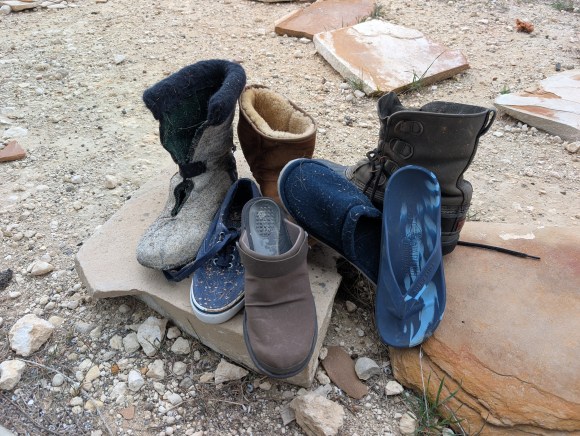
The bump on my head continued to heal, only feeling pain when touched. The bruises on my legs changed colour as they too healed. And eventually the bay would heal too. We continued daily beach clean-ups. Seven odd shoes were salvaged, an odd snorkel fin, and odd gloves. Two months later the other fin washed up, but none of the missing shoes ever made an appearance. We continued to fill our off-road vehicle, and rubbish bags, with debris. Our beloved nautical home sat out of place in a paddock awaiting salvage. We came away with a renewed appreciation and respect for the destructive power of the ever-changing sea, but it would take more than a broken boat to diminish our desire to sail again. For now, our sailing adventures were on hold, but once we had the opportunity, we would again return to the sea. This would not be our final voyage.
.
Meredith Stephens is an applied linguist from South Australia. Her recent work has appeared in Syncopation Literary Journal, Continue the Voice, Micking Owl Roost blog, The Font – A Literary Journal for Language Teachers, and Mind, Brain & Education Think Tank. In 2024, her story Safari was chosen as the Editor’s Choice for the June edition of All Your Stories.
PLEASE NOTE: ARTICLES CAN ONLY BE REPRODUCED IN OTHER SITES WITH DUE ACKNOWLEDGEMENT TO BORDERLESS JOURNAL
Click here to access the Borderless anthology, Monalisa No Longer Smiles
Click here to access Monalisa No Longer Smiles on Amazon International
 Borderless