Five poems by Pravasini Mahakuda have been translated to English from Odia by Snehaprava Das
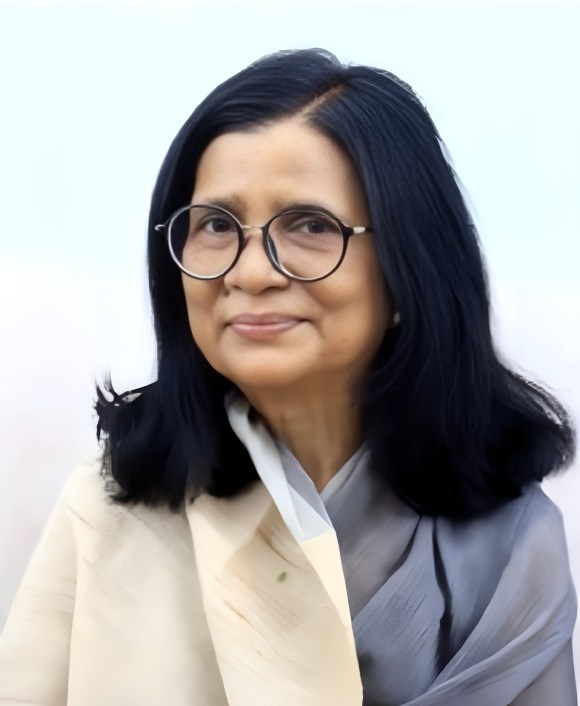
Pravasini Mahakuda
YOUR POETRY

You do not get liberated by arguments.
Liberation isn’t on your mind,
Neither is it in your fortitude or your courage,
Nor in the tricky manoeuvring of your steps.
Liberation is in the challenges
Your soul ceaselessly confronts.
Salvation is in each line of the poem you write.
Do you know or do you not?
That even after you quit this beautiful earth,
Your poetry will live.
Readers of poetry will continue to be.
Your poetry will live forever because
You hold a timeless lover inside you,
And because of your love,
Which is liberation itself.
Your poetry will thrive as a green permanence,
Even on a blazing summer noon.
You and your poetry are one,
And have never existed apart.
 You yourself are poetry --
Only poetry, and nothing else.
Because like you, Poetry, too, is a woman>
And you, like poetry itself
Are the eternal Truth.

 THE REST OF THEM

Let the rest of them
Write about revolutions
And resistances,
About rights and responsibilities.
I write about life.
I write about love,
And things that happen around me.
I write about the changing seasons,
About the prices of goods,
Of the soreness hidden in the heart.
I write about the hopes and fears that
The heart incessantly wavers between,
Of an unseen wound that never stops to hurt.
I write about the eye that cannot see
The tears trickle down the other one,
Or the drenched pillow and the sari-end.
I write about a hand
That does not care to share
The ache in the other one.
I write about the song the dead river
That flowed once between us had sung.
Let others write about
What they won and lost.
I will write about the pain emanating from
An aspired for void.
Let others write about spite and disdain,
I will sing of life and love.

SHRAVANA*

For which Shravana must the woman
Write a poem now?
What kind of a poem of Shravana
Must she write to sprinkle life
Into the desert dying inside her
To cheer herself up?
Do you think it is easy to write poetry?
You do not know perhaps,
Only a drop of rain comes down
Against millions of palmfuls of tears.
In that lone drop of rain,
 Rings a primeval tune
That perhaps lay buried under
A century old rock.
You had never been in that song
In any phase of life,
Not as friend, a husband or a neighbour
Neither as a reader, nor a critic.
The agony is because
You were never a part of that song.
The Shravana is because
You were never a part of that song.
And the rain is because of that,
And the poem too!
It’s half-hour past eight.
On this evening of a Shravana Sunday
The Shravana pours generously.
Do you believe a woman somewhere
Still sits waiting for you on this evening,
Watching her own silent tears
Mingle in the Shravana rains outside?

*Month of July-August in the Indian calendar, normally monsoons in India.

GODDESS

She is not a goddess --
The one you invoked while
Immersing,
Or immersed while
Invoking.
She is a woman.
Perhaps you have not cared to see
The tears in the eyes of that goddess.
During those performances,
You have time and again played games
With her body and her tears.
Every night,
On the freshly made beds
And in freshly written verses too.
You always know that the
Finale of the game
Will be under your control
And by your choice.
Because you have ensured the result
Would be in your favour,
You have taken the game for granted.


SAREE

The pain and pangs I have lived through
Are as many
As the threads woven
In my saree.
The end of the saree fails to hold
the profusion of
All honour and dishonour,
All joys and sorrows,
Interest and indifference,
The ache of losing things
I had won,
The ecstasy of loving
And the agony of no response.
As I set out on a journey,
The sorrow-flowers bloom in a row
Along the border of the saree,
Spring into life.
As innocent symbols of that agony,
A scene floats past my mind in a flash
Where I find the whole of my being
Standing by the loom.
I marvel at the intimate emotion
Of a beautiful loving mind
Employed at the act of weaving
Such a saree of choice.
The threads in this saree
I am clad in are as many as
The sorrows and sufferings,
Joys and elations that roll
Inside me like the gentle undulations of
The middle notes of a song.
Pravasini Mahakuda is a distinguished Odia poet and translator with 18 original books and 8 books in translation from Hindi to Odia. She has received the Odisha Sahitya Akademi award, Jhankar Award and Junior and Senior Fellowships from the Ministry of Culture, Govt. of India. Her international engagements include participation in poetry festivals in Germany presenting her work in Berlin, Munich, Hamburg, Leipzig and Frankfurt. She regularly contributes poems in national magazines and attends seminars and poetry festivals across India.
Dr.Snehaprava Das, is a noted writer and a translator from Bhubaneswar, Odisha. She has five books of poems, three of stories and thirteen collections of translated texts (from Odia to English), to her credit.
PLEASE NOTE: ARTICLES CAN ONLY BE REPRODUCED IN OTHER SITES WITH DUE ACKNOWLEDGEMENT TO BORDERLESS JOURNAL
I first learned of Therese Nagai while listening to a student presentation. I was teaching a class of first year pharmacology students at Tokushima University. Their assignment had been to make a group presentation on something related to their major. One group chose to introduce Nagayoshi Nagai [1844-1929], the Father of Pharmacology in Japan, and the founder of Tokushima University’s Pharmacology Department. My ears perked up when the student mentioned that he had married a German woman.
How was it that I had lived in Tokushima for 26 years, yet no one had ever mentioned her to me? Didn’t ordinary people know of her? I knew of the Wenceslau de Moraes, the Portuguese sailor who’d settled at the foot of Mt. Bizan and who wrote about Tokushima in Portuguese. There was a museum dedicated to him at the top of the mountain. I also knew of the German prisoners of war who’d been interred in nearby Naruto during World War I. Because of these foreign men, the prefecture had established ties with both Portugal and Germany. But what about this woman, Therese? I was determined to find out more about her.
In the photo of Therese and Nagayoshi Nagai that pops up in a cursory Internet search, she is staring off in the distance, her expression determined, resolute. Her hair is pulled back, her Victorian dress buttoned up her neck and decorated with a large cameo pin. She looks serious, sensible. He is wearing Western clothes as well — a suit, and a tie. He gazes directly at the camera, but his head is tilted toward hers. She looks as if she might be lost in thought, thinking of her native Germany, or how to improve upon her life in Japan. He seems to be thinking only of her.
Nagayoshi was born in Myodo District in Awa Province, which is now known as Tokushima Prefecture, on the island of Shikoku. His father, a physician, taught him about the medicinal properties of plants, and expected his son to follow in his footsteps. His mother died when he was a child. As a young man, he embarked for study in Nagasaki, at the Dutch Medical College. Nagasaki was the first port of call in a country newly open to foreign trade, and the influx of Western culture, after 230 years of isolation. There, Nagayoshi saw pale, big-nosed Europeans for the first time in his life. He got a job at the first photography studio in the country, where he took photos of foreigners and Japanese, such as folk hero Ryoma Sakamoto. Sakamoto, who was also originally from Shikoku, albeit further south, in Kochi, encouraged Nagayoshi to go abroad and learn from the West.[1]
From Nagasaki, Nagayoshi went on to study at Tokyo University, Japan’s equivalent to Harvard — not bad for a boy from the backwoods. Still, when he was awarded a coveted study-abroad slot at Berlin University, he felt compelled to ask his father for permission to go. His father was afraid he would never come back. “You have a responsibility to become a great doctor,” he told his son. Nagayoshi couldn’t bring himself to tell his father that his interest had turned to chemistry and pharmacology. He had no interest in becoming a doctor.
After getting the go ahead from his father to set out on this great new adventure, he sailed by boat to San Francisco, then took a train to New York, and finally sailed on another steamer to Liverpool. In Europe, everything was shiny and new – the water pipes, the gas lamps, the glass windows. He was also deeply impressed by the architecture in Berlin, declaring in a letter to his father “Everything that is built by humans is finely detailed.”[2]
Although there were several boarding houses that catered to young Japanese men, he took up residence with Frau von Holzendor, where no other Japanese student was living in order to expedite his German language learning[3]. After she passed away, he moved into a boarding house run by Frau Lagerstrom.
The young Nagayoshi was intense and single-minded, too caught up in his studies to bother with a social life. His mentor, German chemist August Wilhelm von Hofmann, suggested that if he was planning on staying in Germany, he should marry a German woman.
“That’s not as simple as you think,” Nagai allegedly replied. “Orientals are still a rarity in Germany. In Japan, foreigners are considered outsiders, and they’re called ‘Meriken’ and held at arm’s length. It will take time to get the consent of my father.”[4]
According to one biographer, Hofmann began plotting to find a German bride for Nagai. He invited his protégé along for an unveiling of a statue of his former teacher, Justus von Liebig, the founder of organic chemistry, the University of Giessen. The proprietor of the boardinghouse where Nagai was staying also accompanied them, perhaps as part of Hofmann’s plan. After the ceremony, Nagai decided to take a trip to Switzerland. On the way, he stopped at the Nassauer Hof Hotel in Frankfurt.
Looking out of his pension window, he spotted an attractive, young German woman, and asked Frau Lagerstrom how he might go about meeting her. She conspired for the two of them to have a meal with young Therese Schumacher and her mother. The Schumachers were visiting from their home in Andermach, a picturesque, medieval town on the left bank of the Rhine. Therese’s father was a local lumber and mining magnate. Nagayoshi was so tongue-tied at breakfast that he could barely manage to get a word out. When he finally spoke, he asked if she would like some honey for her bread. “Yes,” she replied.
After breakfast, Nagai and his landlady ran into the mother and daughter in town.
“Will you be going out somewhere tonight?” he asked.
“Yes, I’m going to the opera,” Therese replied.
Nagai invited himself along.
That evening they went on their first date to the Frankfurt Opera House, chaperones in tow. When asked later what the performance had been, Nagayoshi laughed and said that he didn’t remember. He’d been so mesmerised by the young woman sitting next to him, he hadn’t paid any attention to what was happening on the stage.
The next morning, Therese and her mother departed by boat to Wiesbaden. They continued on a day or two later to Schlagenbad, where the Schumchers had an exclusive contract to provide building materials for a new hotel under construction. When they returned home to Andernach, Therese was astonished to find Nagai, wearing a suit newly tailored for the occasion, waiting on the docks.
For the next three days, he was the guest of the Schumacher family. Therese gave the dapper scholar a tour of the main house, built in 1746, and the stone and lumber works.
“You’ve caught yourself a Chinaman,” Therese’s brother Mathias teased. More likely it was Therese who’d been snared by this polite, erudite Japanese visitor.
The following year, a delegation arrived from Tokyo Imperial University, inviting Nagayoshi to return to Japan head the university’s first Department of Pharmacology. In the film version of their story, Nagayoshi is torn between staying in Germany with the woman he loves and returning to the land of his birth. Of course, he was obligated to return. The university had sent him to Germany to learn for the benefit of his nation, after all.
He proposed marriage to Therese. She said “yes.” After becoming engaged, he returned to Japan alone. He worried that his bride-to-be would be discontent in backwards Japan, where country folk still clattered around in wooden geta clogs, and rickshaws were the choice mode of transportation. In the Japanese movie version of the story, his younger sister assured him that if Therese truly loved him, she would be happy to be with him no matter where they lived. It’s likely, however, that his father and sister were not quite as agreeable as they appear in the film. After all, in that era Japanese men rarely married for love, and Nagai, the only son, was eager for his father’s approval.
In 1885, Nagai experienced a breakthrough in his research, when he successfully isolated the active ingredient of Ephedrine. Later, his findings would be instrumental in the development of medication for asthma and cough suppressant. And even later, he would develop methamphetamine.
Nagayoshi and Therese were separated for months. When he finally returned to Germany, he was 40 years old. Therese was 21. They married on March 27, 1886, in a church in her hometown, Andernach, despite the fact that Nagayoshi was not Catholic. He would convert to Catholicism thirteen years later.
Once in Japan, Therese sent a flurry of letters back home to Andernach. She wrote of homesickness, but also of “standing firmly on two feet in their new life. I feel as if gradually new roots form and I become habituated to this strange way of life, to unusual manners. I’m making progress.”
Broadened by his own experiences abroad, and influenced by his sharp, young bride, Nagayoshi was a strong proponent of education for women. He co-founded Japan’s first college for women, now known as Japan Joshi Daigaku, where Therese was employed as an instructor of German. She was, reportedly, an energetic teacher, enriching her lessons with instruction on manners, customs and German cooking.
Eventually, they would have three children – Alexander, Willy, and Elsa, all brought up to be bilingual, and with an awareness of their German heritage.
In addition to being the Father of Modern Chemistry and Pharmacy in Japan, Nagayoshi served as president and founder of the Japanese-German Society. Therese is credited with introducing German food and culture to the Japanese, and, along with her husband, hosted Albert Einstein and his wife Elsa during part of their visit to Japan in 1922. Therese also helped to interpret for the couple.
Therese died in 1924.
When the eldest son, Alexander, first visited his mother’s hometown, Andernach, he claimed it as his second home. Later, during World War II, Alexander Nagai, would serve as a Japanese diplomat to Germany at the embassy in Berlin. One writer mused that his cross-cultural upbringing made him especially sensitive to the plight of the German Jews. Alexander was a member of a group that resisted intolerance toward Jews and is reported to have helped enable the issue exit visas to Jews who sought to escape Nazi Germany.[5]
In 1994, Teigi Nagai, grandson of Nagayoshi and Therese, donated an ornate chandelier to the church where his grandparents were wed in homage to their legacy and love.
[2] Hoi-Eun Kim, Doctors of Empire: Medical and Cultural Encounters between Imperial Germany and Meiji Japan (Toronto: University of Toronto Press, 2014), 91
[4] Nobuko Iinuma,Nagai Nagayoshi to Terēze : Nihon yakugaku no kaiso (Therese and Nagai Nagayoshi: Father of Japanese Pharmacology), Tokyo : Nihon Yakugakkai, 2003
Suzanne Kamatawas born and raised in Grand Haven, Michigan. She now lives in Japan with her husband and two children. Her short stories, essays, articles and book reviews have appeared in over 100 publications. Her work has been nominated for the Pushcart Prize five times, and received a Special Mention in 2006. She is also a two-time winner of the All Nippon Airways/Wingspan Fiction Contest, winner of the Paris Book Festival, and winner of a SCBWI Magazine Merit Award.
PLEASE NOTE: ARTICLES CAN ONLY BE REPRODUCED IN OTHER SITES WITH DUE ACKNOWLEDGEMENT TO BORDERLESS JOURNAL

 Borderless