Categories
Excerpt

Ostia Antica: The Fatehpur Sikri of Rome?

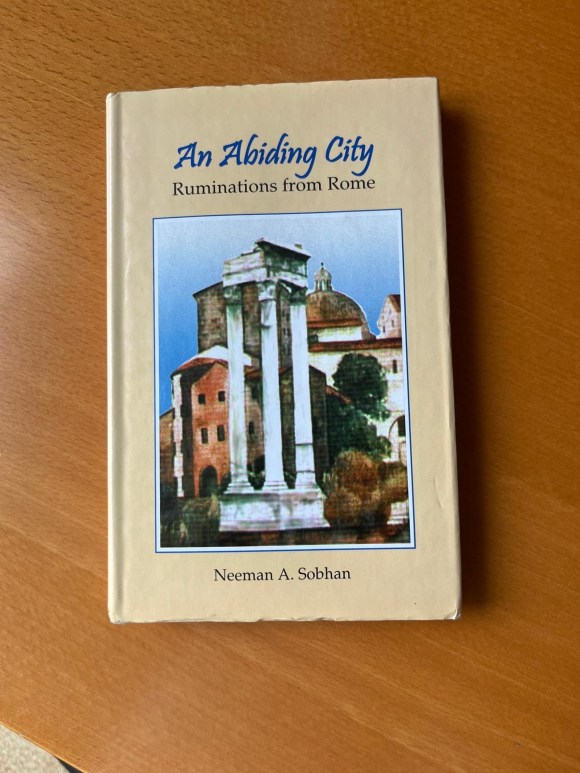
Title: An Abiding City: Ruminations from Rome

Author: Neeman Sobhan

Publisher: University Press Limited (Dhaka)

Ostia Antica

Sometimes, when my visitors to Rome, arriving in the sweltering month of July or August, voice over-zealous ambitions to ‘do’ Pompeii, I don’t have the heart to discourage them. But I beg off from accompanying them. I have nothing against Pompeii as such, but I am not sufficiently suicidal to relish the thought of trudging miles of arid ruins under a punishing sun for the twenty-third time!

It’s at this point, usually, that I try to sell what I call my ‘Lazy man’s Pompeii’: Ostia Antica. I could have called it the ‘Poor man’s Pompeii’ as well, but the riches of the ancient city can almost equal a Herculaneum to the imaginative tourist. And its biggest plus-point is that it is so much closer to Rome (as against Pompeii, about 200 kilometers away, towards Naples), and may I add, that much shadier!

Less than an hour away from Rome, Ostia Antica was founded in the fourth century B.C by King Arcus Martius (a historical persona of whom I readily admit to being shamelessly ignorant) it became Ancient Rome’s commercial and military port, and during Emperor Constantine’s time, it boasted a population of 100,000!

Ostia reminds me of another ancient city I once visited and loved: Fatehpur Sikri in India, the Mughal king Akbar’s doomed capital near Agra. The comparison to Akbar’s city is justified because, although Ostia is a remarkable example of historic Roman towns like Pompeii and Herculaneum, unlike them, it was not destroyed, rather, like Fatehpur Sikri, it was abandoned.

While the Mughal city was abandoned due to a lack of sustainable water supply, in the case of the Roman city, it was mosquitoes. Strange but true that an epidemic of malaria drove out the inhabitants of this once flourishing port city. An odd quirk of history and biology that a puny anopheline community managed to drive out a powerful anthropical one, hundred times its size!

A quick reminder here: in talking about Ostia, we must make a clear distinction between Ostia Antica, the archeological site, and the present-day beach town of Ostia, a popular seaside resort within the municipality of Rome, further down.

The excavated areas of ancient Ostia abound in numerous ruins and reminders of a thriving commercial city of times past: public and private buildings, streets, defensive walls, and harbors.

I find the residential streets most fascinating because it brings to life a real world of ordinary people. Much has been written about Roman tenement-housing and remains of these buildings abound in Ostia.

Reconstructed models apparently reveal that a typical apartment block could be five-storeys high, and that the flats were probably quite functional, mostly reached from courtyards or from the street by stairs running between shops on the ground floors.

I think of all this as I stop at a crumbled courtyard here, touch a moth-eaten wall there, step over a threadbare threshold, or mount a mysterious flight of steps that end abruptly in mid-air, leading nowhere.

For me, it’s in this residential environment that I find the faint but persistent pulse of a bygone life. Visiting it on some empty afternoon, while I might be sitting on the broken steps of a roofless room, I can surmise the life of the ordinary man or woman who once lived here: I smell the fragrance of fresh baked bread in the gutted bakery next door; I hear the sound of children playing in the silent streets, or the hum of voices in the tavern with its dusty counter; and suddenly, the entire history of the humble populace seems to be whispered and echoed by the sea-spiked breeze among the pines and cypresses.

Let the Archeologist and Historian keep their details. To me the romance of a ruined city is not necessarily in the structures themselves, in the revealed or concealed splendor of its remains, it is in the mystique of its very presence, its undefined shape as a messenger from lost times, telling us stories of the long ago.

A dead city serves to remind us that it once existed, and that the past, although it is no more, is never completely wiped out, never obliterated from the collective memory of the world. In leaving behind its footprints, the spirit of the city has defied negation and accompanies me this afternoon.

And thus, I love to sit, under the peristyle of a vanished villa, absorbing the atmosphere of this long-deserted city, contemplating the history not just of this particular Roman town, but all the nameless cities of countless civilizations in the past. I wonder at the basic story it tells of our collective and individual engagement with Life, of the heroic audacity of the human spirit attempting, again and again, to build its sandcastles against the wind, trying to carve a permanent niche on the elusive surface of Time.

Whether the crumbling habitation is in Ostia Antica or Mohenjo-Daro, in Petra or Machu-Pichu, in Moinamoti or Fatehpur Sikri; each is a monument to the Spirit of Man, the builder of cities, the creamer of dreams.

[ Extracted from An Abiding City: Ruminations from Rome. Published by UPL (University Press Limited, Dhaka), 2002 ]

ABOUT THE BOOK

An Abiding City: Ruminations from Rome is a fresh look at Italy and Rome from the perspective of a long-time resident of non-Italian origin. Neeman Sobhan, living in Italy, since 1978 wrote for two decades a personal column in the Bangladesh English language daily, The Daily Star, spinning vignettes and sketches out of her daily encounters and reflections living in Rome. Here, in vivid prose and poetic detail are selections from her work.

Among some of the myriad themes in this collection of essays and poems: the charm of everyday Rome; the romance of history; the adventure of the expatriate’s eternal quest for home; the poetry of seasonal transformations; the mysteries of relationships; the kaleidoscope of life in general, and of one woman in particular, who within her journey through the Eternal City, shares with her readers her passage through life.

The writing is enhanced by ink sketches by Italian-American artist/writer Ginda Simpson.

ABOUT THE AUTHOR

Neeman Sobhan is a Bangladeshi-Italian fiction writer, poet, columnist. She writes in English, and her fiction and poetry have appeared in many anthologies and literary journals within the sub-continent. Till recently she taught English and Bengali at the University of Roma, La Sapienza.She lives in Rome with her husband. She has a collection of short stories, Piazza Bangladesh (2014) which has been recently translated to Italian; a volume of poetry, Calligraphy of Wet Leaves (2015) and a collection of her columns, An Abiding City: Ruminations from Rome (2002). Presently, she is finishing her first novel, and lives between her home in Rome and Dhaka.

.

PLEASE NOTE: ARTICLES CAN ONLY BE REPRODUCED IN OTHER SITES WITH DUE ACKNOWLEDGEMENT TO BORDERLESS JOURNAL

Click here to access the Borderless anthology, Monalisa No Longer Smiles

Click here to access Monalisa No Longer Smiles on Kindle Amazon International
Categories
Excerpt

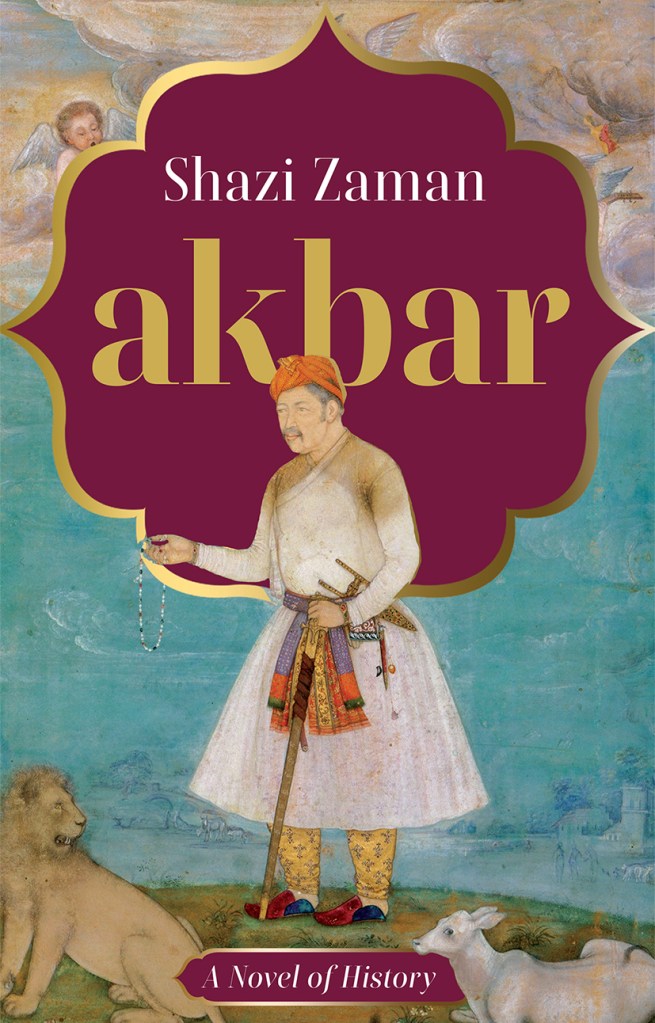
Akbar: A Novel by Shazi Zaman

Title: Akbar: A Novel of History

Author: Shazi Zaman

Publisher: Speaking Tiger, 2021

Now people began to hear of Badshah Salamat’s close links with the region of Braj. His visit was described in a dhrupad —

Shah Chhatrapati Akbar visits the Braj region,
Kings of the seven islands, nine regions and ten directions tremble.
Cavalry, infantry, elephants, and brave warriors,
With bows, arrows, swords and spears.
Not one blot on the clothes of Humayun’s son,
How formidable was the army of Jalaluddin Muhammad.

The region of Braj was not far from Fatehpur Sikri. It is said that Badshah Salamat, having listened to the poetry of Surdas, asked when he met him, ‘Surdas ji, God has made me powerful and all the talented people sing my praise. Why don’t you sing my praise too?’

Surdas sang the following words in reply: ‘No space in my heart.’

Badshah Salamat thought, ‘Why would he sing my praise? He would sing if he had the greed to seek something from me. He is a man of God.’

Finally, Surdas sang: ‘Seeing God is like nectar for the thirst that the eyes have.’

Badshah Salamat asked him, ‘Surdas ji, you can’t see. How do you know what this thirst is that the eyes have? How come this metaphor?’

When Surdas kept quiet, Badshah Salamat said, ‘His eyes are with God. He sees there and describes what they see.’

Badshah Salamat then thought, ‘He should be given something but he has been initiated into Vaishnavism. He has no desire.’

People say that when Badshah Salamat heard that the Vaishnav poet Govindswami sang very well, he went out to listen to him in disguise.

Badshah Salamat was fond of travelling incognito among people. In the sixth regnal year, corresponding to about 1560–61 ce, a large group from Agra had camped outside the city on the way to the shrine of Salar Masud Ghazi in Bahraich. Badshah Salamat went to their gathering incognito but some petty criminal recognized him and the word began to spread. To convince people otherwise,

Badshah Salamat rolled his eyes upwards. When people saw this they said, ‘Such eyes and expressions can’t be that of an emperor.’

As Govindswami sang the Raga Bhairav, Badshah Salamat was sure he would not be recognized. But suddenly, as he sat listening, these words escaped his lips, ‘Wah, wah!

Recognizing him, Govindswami said, ‘This raga has lost its value.’

At this Jalaluddin Muhammad Akbar said, ‘I am the Emperor.’

Govindswami replied, ‘If you are the Emperor, keep to it. But this raga has lost its value because you listened to it.’

Badshah Salamat then thought, ‘I am the ruler of one country. For him, the grandeur of three worlds is meaningless. Why would he obey my command?’

It is said that Badshah Salamat heard an artiste sing the poetry of the Vaishnav poet Kumbhandas and said, ‘Would there be anyone like him who sees God in this manner?’

The artiste replied, ‘Saheb, he lives even now!’

An excited Badshah Salamat asked for Kumbhandas’s whereabouts. The artiste replied, ‘There is a village near Shrigovardhan called Jamunawat. He lives there.’

When Badshah Salamat’s men reached the residence of Kumbhandas he was in Parasoli. Reaching Parasoli, these men said, ‘Badshah Salamat has asked for you.’

Kumbhandas said to them, ‘I am no servant to the Emperor. What do I have to do with him?’

Badshah Salamat’s men said, ‘How do we know what you have been called for? We are under orders from the Emperor to get Kumbhandas ji. Here is a palanquin and a horse. Please mount and come with us. We have to take you.’

Kumbhandas had no option. Wearing his shoes, he said, ‘Brother! I have never mounted a conveyance. I will go on my own.’ When Kumbhandas reached Sikri on foot, Badshah Salamat

said, ‘Kumbhandas ji, come. Please be seated.’

Badshah Salamat’s elegant tent had precious stones and frills. Even so Kumbhandas felt his home Braj was far better because Shrigovardhannath ji played there.

Badshah Salamat said, ‘Kumbhandas ji, you have written much poetry in praise of Vishnu. That is why we have called you here. Sing for me some poetry in praise of Vishnu.’

Kumbhandas thought, ‘The real patron of my voice is Shrigovardhandhar. But now that I cannot avoid it, I better sing something to ensure he does not ever ask for me. Let me say harsh words. If he minds, so be it.’

Kumbhandas remembered, ‘One who has been adopted by Lord Krishna is always safe. He would come to no harm even if the whole world turns against him.’

Then he recited —

Devotees have no need of Sikri.
One walks one’s shoes threadbare, God’s name forgotten,
And salutes those whose face brings no joy.
O Kumbhandas, without Lord Krishna, these are false destinations.

They say Badshah Salamat felt unhappy when he heard this but said to himself, ‘If he had any greed he would sing my praise. He is a true devotee of his Lord.’

Irritated with Badshah Salamat, Mullah Abdul Qadir Badayuni said, ‘… Hindu infidels, who are indispensable, and of whom half the army, and country, will soon consist and as whom there is not among the Mughals or Hindustani Muslims a tribe so powerful, he could not have enough. But to other people, whatever they might ask for, he gives nothing but kicks and blows…’

When it began to be murmured in Fatehpur Sikri that Badshah Salamat had turned Hindu, Sheikh Abul Fazl was forced to respond,

‘This rumour is spread because His Majesty, being of an open mind, would meet Hindu holy men, raise the rank of Hindus and be kind to them in the interests of the welfare of the country… There were three reasons these rumours spread by evil men gained currency. First, people following different religions gathered in the darbar, and because there was something good in every faith, everybody got some bit of praise. Secondly, because of sulh-i-kul, people of various kinds got spiritual and worldy success. Third, the crooked ways of evil people of the age.’

(Excerpted from Akbar: A Novel of History by Shazi Zaman. Published by Speaking Tiger Books, 2021)

About the book

Conventional historical accounts tend to paper over seemingly minor events related to Akbar’s life, to the detriment of a comprehensive appreciation of one of the most important figures of Indian history. Shazi Zaman fills the gap with this remarkable novel rooted in history.

Akbar’s writ ran from the Hindukush in the west to the Bay of Bengal in the east, an empire his father Humayun and grandfather Babur had only dreamed of. And his religious policy, boldly unorthodox, was as fierce a contest with the clergy, particularly Islamic, as were his military campaigns with his political opponents. Most histories give us Akbar the commander who never lost on the battlefield, and the fearlessly iconoclastic ruler. But we rarely come across the restless, questing soul who wished to reconcile a sensitive and compassionate heart to the sometimes ruthless obligations of statecraft; and the man who, in his struggle for sulh-i-kul, peace with all, could dare to treat as equal not only all faiths—Hinduism, Islam, Christianity, Jainism, Zoroastrianism and others—but all life as well—human or animal.

With a scholar’s rigour and a storyteller’s insight, Shazi Zaman, in this transcreation of his acclaimed Hindi novel, sifts through fact and many an anecdote to paint a complex yet enchanting portrait of one of the world’s great monarchs. There isn’t another book, as vast in scope and as layered, to help us fully understand the phenomenon that was Akbar: the unsparing pragmatist and benevolent ruler; the austere leader and indulgent friend; the unlettered prince and philosopher-mystic.

About the Author

Shazi Zaman started his three-decade-long career in broadcast journalism at Doordarshan and has since then worked with several media organizations. He has had a long association with the ABP News Network as a senior executive producer and as their Group Editor. He has been on the governing bodies of the Film and Television Institute of India, Pune, and the Indian Institute of Mass Communication, Delhi. Akbar is his third novel. His earlier Hindi novels are Prem Gali Ati Sankri and Jism Jism ke Log.

.

PLEASE NOTE: ARTICLES CAN ONLY BE REPRODUCED IN OTHER SITES WITH DUE ACKNOWLEDGEMENT TO BORDERLESS JOURNAL