Categories
Review

Blues, Devil and Gothic: A Fantasy that Travels Back in Time

Book Review by Andreas Giesbert
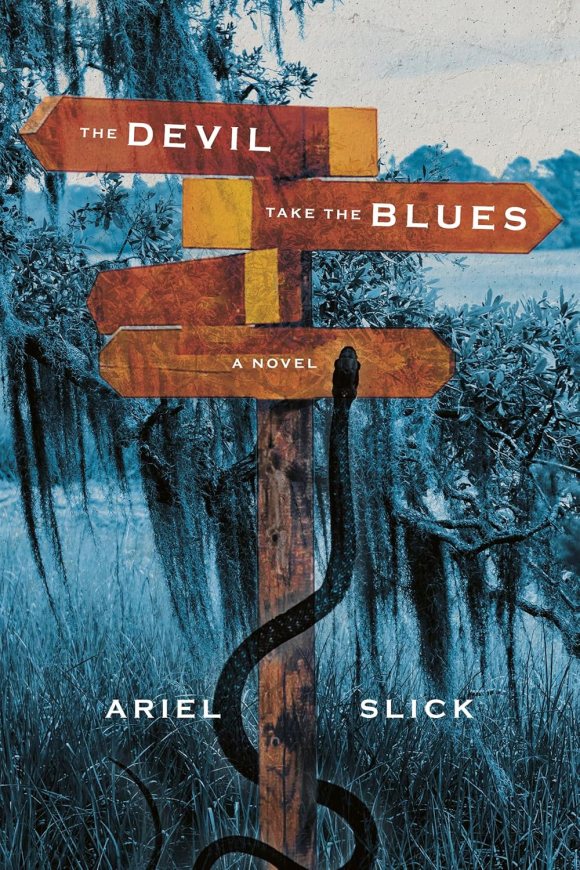
Title: The Devil Take the Blues: A Southern Gothic Novel

Author: Ariel Slick

In her newest book, The Devil Takes the Blues, the Texan novelist, Ariel Slick, takes on a journey into the deep South. Her novel is very well written and crafted. It has been substantially enriched with blues music and its mythology. 

The novel centres around Beatrice who learns of a threatening prophecy about her beloved sister, Agnes, that can only be prevented by making a pact with the Devil. The protagonists are joined by the handsome blues musician, Angelo, a mysterious voodoo practitioner, and the unlikeable husband of Agnes. The plot is superb as is the writing style. Slick is able to paint an immersive picture of the (fictional) rural town of Azoma in the 1920s. She knows how to write breathtaking action scenes as well as solemn moments and includes a lot of philosophical and ethical considerations. It is an entertaining read that also gives you food for thought.

The main reason why I picked this book was that blues is part of the title. I’m very much interested in the history of blue music, and if it is combined with (supernatural) Southern Gothic I am basically sold. Alas with many tales, blues is just some spice added into the mix and all too often reduced to a bleak cliché.

Ariel Slick approaches it differently. The novel is set in the 1920s, the period where blues was born as a popular genre of music. Victrola record players became relatively common in the US and mail delivery made the records available to the newly emerging customer group of African-Americans, even in rural regions. Slick also does not choose the obvious Mississippi Delta as the place for the story but a fictional small town in Louisiana. Slick’s book is no history class though. If you did some research on the origin of the blues you will find some errors, such as records with multiple tracks or that it’s a year too early (1924) for consumer phonographs. If you are into the history of blues music, you will also note how blues and jazz are somewhat conflated, which, by the way, is not always a problem, since genre boundaries are usually drawn in retrospect.

However, the novel tries to take on the culture that surrounded blues. The whole book is fundamentally informed by a world view apparent in pre-war blues. While there are minor flaws, Slick is able to present a much more complex picture of the blues than is usually present in fictional works. It is not about downtrodden “authentic” Black geniuses expressing their pain – a story that is too often repeated and tends to cater to expectations of a White audience – but about blues in all of its nuances. It’s about pain and racist experiences but also about love, joy and the very unique sense of humor and quick-wittedness prevalent in blues music.

What’s the deal with the devil?

As the title promises, the Devil plays a big part in this story. That comes as no surprise as the Devil is one of the core elements in the pop cultural view of the blues. Even if you don’t know a thing about the history of the blues, it’s likely that you have heard of Robert Johnson’s deal with the Devil. Fortunately, Slick doesn’t go down this path. She mentions and debunks the hurtful myth in passing and is absolutely on point in her ‘Historical Note on the Blues’ when she states, that “„[i]t’s probably a testament to racism that we’re more likely to believe a Black man sold his soul to a supernatural being rather than was a musical genius.”

Rather than solidifying the myth that the blues is the Devil’s music, she embeds it in the cultural discussion of its time. For example, she addresses the fearmongering against the alleged sins of the Devil’s music, while the actual terror was not the excess or the sexual promises of a juke joint but the lynching of human beings.

Instead of the Johnson myth and some crude idea of evil, she presents a Devil inspired by Papa Legba, that is not evil, just the guardian of the crossroads. Furthermore, this Devil is not only a concept but takes an active role in the story and even narrates parts of it. Most interesting and original is the fact that the Devil doesn’t follow a clear agenda. He is himself conflicted about his role and ethics. In some ways it’s the most human Devil I know, and for sure, more human than some of the human antagonists of the book …

Just as with the Robert Johnson myth, the book is also careful in catering to clichés when it comes to blues music. There are still some passages that put too much emphasis on a supposed immediate expressiveness and disorderliness of the genre, but the author clearly knows, that this is only a part of the blues at best. She knows that it is also an outlet to deal with hardship, by having a good time and laughing to keep from crying. Most importantly, Slick never mistakes poverty and discrimination for authenticity: “There [is] no nobility in suffering.”

Not limited to blues, the difficult topic of racism of the era is at the heart of the book. By that the book faces the particular challenge of reflecting worldviews and language from the 1920s without reproducing racist stereotypes and language itself. The book indirectly addresses this issue, when describing a situation as awkward as “a white author writing first-person perspective of a black character.” As a non-native speaker, I am not in a position to judge whether the book always succeeds in this task. There are passages where I find the choice of language problematic, but I can plainly see an anti-racist stance throughout the whole book. 

The Devil Take the Blues is a unique Southern Gothic novel that stands out by seriously involving (the history of) blues music. Even with some flaws in historic accuracy it is able to present a nuanced picture of blues music what gives the story an interesting twist. For all my focus on history and the treatment of blues music and cultural sensitivity, it should not be forgotten that the book is simply a well-crafted, entertaining read. It is compelling read from page one to the last sentence. This novel’s a good read not only for blues enthusiasts but anyone who is looking for a well-crafted story with a special twang.


Andreas Giesbert is a reviewer of speculative fiction, board games and more based in the Ruhr Valley. He mostly writes for online magazines such as www.zauberwelten-online.de, or Ginger Nuts of Horror. He is also a board member of the Mt. Zion Memorial Fund.

.

PLEASE NOTE: ARTICLES CAN ONLY BE REPRODUCED IN OTHER SITES WITH DUE ACKNOWLEDGEMENT TO BORDERLESS JOURNAL

Click here to access the Borderless anthology, Monalisa No Longer Smiles

Click here to access Monalisa No Longer Smiles on Kindle Amazon International

Categories
Poets, Poetry & Rhys Hughes

Midnight Tonight

MIDNIGHT TONIGHT

Midnight tonight
won’t be just any night.
Midnight tonight
will be just right for frights.

The shrivelled mummy
lumbers his doom
from the room in his tomb
to the outer gloom,
unwraps himself like god’s
gift to ghouls.

Vampires and werewolves
and men who are half bulls
wander the maze
of mythical days like fools
stuck in a funhouse.

As for Faust, he summons
the Devil in order
to revel with beautiful girls,
tumbling curls
and long legs included.

Denuded of armour, the hasty
knight swipes at
the hungry dragon who finds
him tasty after a lick
but later the bones will make
him sick. Heartburn!

Every day I learn something
new about the terrors
of specific midnights. Behind
the funeral parlour curtain
there is a monster certain
to pull your head off
if you draw back those drapes.

A witch doctor has arrived
in town, a wizard
in a gown made from toad
skins: he is thin
and radiates weird despair
from the stare
of his sorcerous spiral eyes.

Who among us dares ignore
the wise words
of scholarly mythographers
who caution us
to avoid minotaurs and men
with paws and claws instead
of normal hands?

There are ghosts who love to
spread themselves
thick on the toast of our sixth
sense: we shudder
inexplicably when, wickedly,
they tickle us
spookily right from the inside.

Now I want to talk about the
cobwebbed bottles of black
wine in the cellar where
ape skeletons wear dresses
decayed into tentacular nets,
fibrous, phantasmagorical.

But
let me pause for a moment
to re-read what is written
in these lines…

I think the knight and dragon
in this poem are out of place
among the entities
of gothic nightmare elsewhere
found here. On the
face of things they bring down
the eerie quotient,
ground the horrors in whimsy.

The face of things? A hideous
visage indeed
connected to a grotesque head.
And now I just need to repeat
the first stanza
and we can all go to bed.

Midnight tonight
won’t be just any night.
Midnight tonight
will be just right for frights.

Rhys Hughes has lived in many countries. He graduated as an engineer but currently works as a tutor of mathematics. Since his first book was published in 1995 he has had fifty other books published and his work has been translated into ten languages.

.

PLEASE NOTE: ARTICLES CAN ONLY BE REPRODUCED IN OTHER SITES WITH DUE ACKNOWLEDGEMENT TO BORDERLESS JOURNAL

Click here to access the Borderless anthology, Monalisa No Longer Smiles

Click here to access Monalisa No Longer Smiles on Kindle Amazon International
Categories
Stories

Viral Wisdom

By Rhys Hughes

Courtesy: Creative Commons

The Optimistic Hypochondriac

“I caught covid last week but I already had typhoid, rabies and malaria, and they all cancelled each other out.” The Optimistic Hypochondriac

I like the Optimistic Hypochondriac. I regard him as my friend, but not a close friend, oh no! I don’t want to get too close to him in case he gives me his germs. I am sure he has plenty of germs, more than he needs for himself. And he has always been a generous chap, the sort of man who would be very happy indeed to share his illnesses with anyone else.

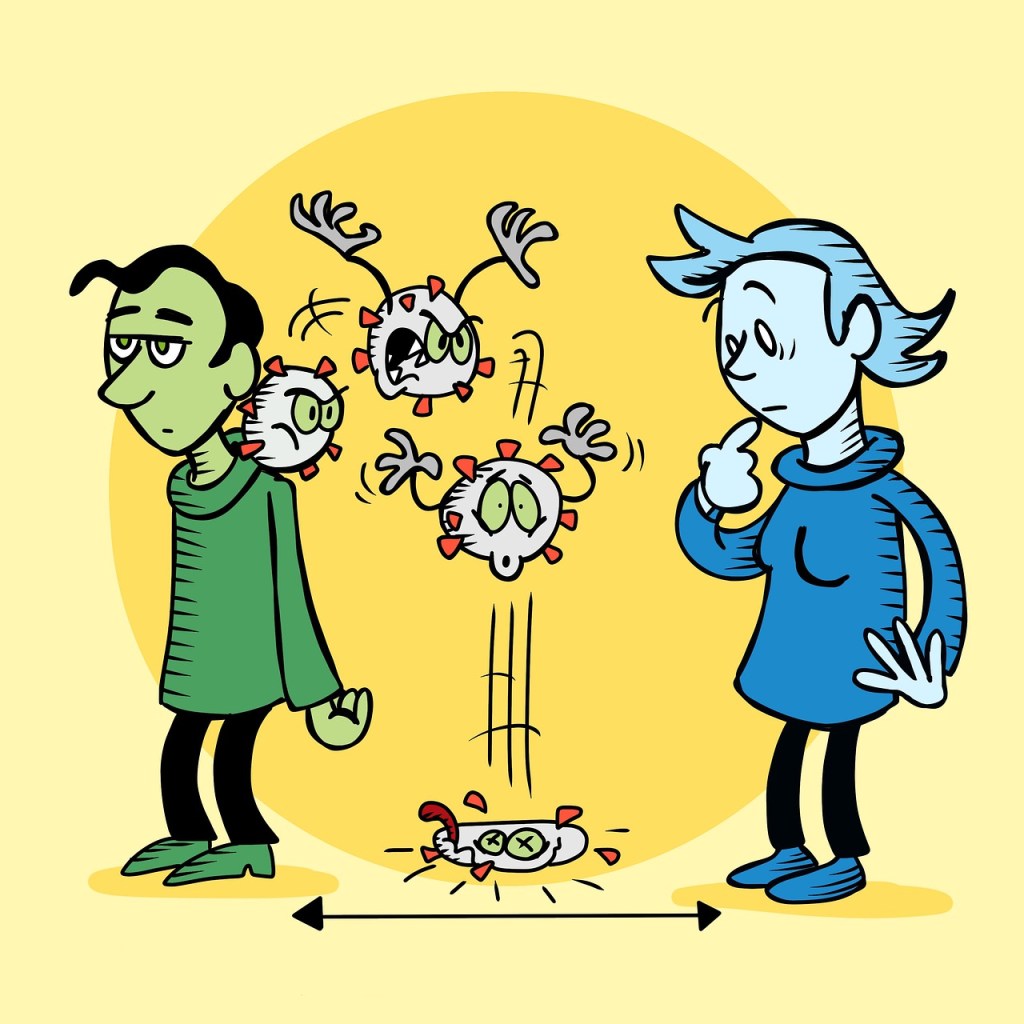
I remember in the old days how hypochondria wasn’t an infectious disease. But there is now growing evidence that the virus that causes hypochondria has undergone a mutation and is starting to spread among people who never believe they are ill. This means that hypochondria will probably become rampant in the next few years. What a dreadful notion!

I keep myself fit by going for regular runs on the beach. This morning I ran five miles on the beach. I am pleased with my performance, but my fear is that after finishing I will be stopped by the police. “Why are you out of breath? Why are you sweating? Why do you have a high temperature? You must have the virus. It’s off to quarantine with you — on Devils’ Island!”

Devils’ Island is an extremely unpleasant place. It was where all the devils in the world lived before they emigrated. The devils’ diaspora is one that hasn’t been studied in great depth yet by academics. Some of the devils went North, East and South, but most of them went West.

To “go west” can also mean to perish or disappear. The devils who went North went west, if you see what I mean, but the devils who went East didn’t, nor did the devils who went South. It gets rather confusing. But if you meet a devil, no matter where you happen to be, you can be sure that originally he was an inhabitant of Devils’ Island, which is still covered with cooling lava. People who are imprisoned there have to keep hopping.

I keep hopping too, or rather I keep hoping — hoping that I will never be sent to Devil’s Island just because I have broken the quarantine rules imposed by my government at short notice. I ought to pack a swimsuit in a suitcase just to be prepared for that horrible eventuality.

Some women pack swimsuits that are radioactive in their luggage if they think there’s a chance they might be sent to Devils’ Island. Radioactivity keeps any remaining devils away. Are there any remaining devils? Difficult to say, but not as difficult to say as “imagine an imaginary menagerie” which is a sequence of words I often have trouble with.

Better to be safe than sorry! If you are a woman in danger of being sent to Devils’ Island, be sure to pack a radioactive swimsuit. Is it bad advice to suggest the wearing of a radioactive swimsuit? No, because there’s nothing wrong with bikinis atoll. Now let’s move on —

Well, I moved on, and here I am. The Optimistic Hypochondriac has called me on the telephone to tell me that a new pandemic has started.  The singer Buster Octavius is going to give a concert to raise money, but no one knows what the money is being raised for. Buster Octavius says it is being raised because that’s better than letting it fall onto the ground.

It will be a socially distanced concert, which means that members of the audience will have to stand six feet apart. Most audience members don’t have six feet. They are human beings and only have two legs, like you and I. The six feet rule might be good for insects but for mammals it’s a disaster waiting to happen. And have you ever seen a disaster waiting to happen? They get nervous and pace up and down and growl in the wings.

The reason they wait in the wings has nothing to do with the fact that such shows as Buster Octavius is planning usually take place in a theatre. No, they wait in the wings because birds have wings and bird flu is a disease that is always a strong pandemic candidate.

Buster Octavius is a pseudonym. His real name is a closely guarded secret and the guards who guard it cannot be bribed. I have already tried. And so has the Optimistic Hypochondriac. He says, “He broke twelve semitones and that’s why he calls himself Buster Octavius.”

Quarantine regulations are coming into force and it has only been a couple of hours before the new pandemic was officially announced. My movements will be restricted once again to my home and a small area around it. I might begin to dig a tunnel in my cellar, both to pass the time and to enable me to travel further than I am allowed. The tunnel will point in the opposite direction to my office. Just to give me some illusion of freedom!

I can’t honestly say I dislike my job. When I started there last year, I was warned by my new colleagues that my new boss was a “micromanager” but when I started work at the laboratory the conditions were relaxed and no one criticised the details of anything I did.

In fact, there didn’t seem to be a manager of any sort present in the work space. Then one morning I happened to glance through a microscope and saw him jumping about on the slide and tearing his hair out. He was very angry but his voice was far too quiet to be heard.

I had never expected him to be a virus instead of a man!

The Optimistic Hypochondriac advises me to wear a mask. In fact, he tells me to wear two masks — over my ears. If the singing of Buster Octavius doesn’t kill the virus in a fifty-mile radius and help to end this new pandemic, then nothing will. It is good advice and I take it. But then, having taken it, I change my mind and put it back. But he doesn’t want it back. We argue and tussle for almost half an hour before we both admit defeat.

If the pandemic is already here, then why not just quarantine the whole world in one go, instead of sections of it? That way, we will technically be in quarantine, as all the health authorities recommend, but able to travel around freely just like we used to, and everything will continue on the surface of the planet as before. I think this is an excellent solution. A win-win!

We would only have to deal with that tiny minority who call themselves “astronauts” by refusing to let them back into the atmosphere and presto! This approach would save a lot of money and time and effort. Lots of my friends at school were interested in outer space and wanted to be astronauts but I don’t think many of them managed it. When I was little and was asked what I wanted to be when I grew up, I replied, “An adult.”

An impractical choice, I feel.

Buster Octavius is allowed to sing his doleful dirges, highly amplified, out at the captive inhabitants of the innocent city, but all the theatres have been closed and actors are out of work. This seems unfair.

To put it another way: thanks to this new pandemic, all theatre has become Japanese in style because ‘Noh Plays’ are being performed on every stage. Even Shakespeare’s Globe Theatre is about to close. But I bet they will stage one last play there… “Two Gentleman of Corona”.

The rules are being tightened. Now we aren’t allowed out of the house at all. I doubt if the Optimistic Hypochondriac will conform to this restriction. He will be arrested for breaking the law and sent to Devil’s Island instead of me. One thing I still find baffling. If people aren’t allowed out at all because of the risk of spreading the virus, why are the police allowed to approach and arrest those who do venture out? Surely the police spread the virus just the same as any other human? Oughtn’t there to be a second set of police to approach and arrest the first set, and a third set to approach and arrest the second set, and a fourth to approach and arrest the third.

And so on, forever? If not, the process isn’t logical.

As part of the fight against the virus I note that Washington DC has changed its name to Washinghands DC.  This news doesn’t concern me very much at the moment, but when I have finished tunnelling under the Atlantic Ocean I surely will sit up and take notice

It will take me at least nine months to tunnel as far as the comfortable home of the Optimistic Hypochondriac. In the meantime, Devils’ Island is rapidly filling up with arrested police officers. It will take me centuries to tunnel as far as the city of Washinghands DC. Even nine months is too long to dig tunnels. But that is how I intend to keep myself busy.

How will other people occupy their enforced leisure time? I am supposing that there will be a baby boom in nine months. And thirteen years after that, we will witness the rise of the “quaranteens”.

It turns out that the Optimistic Hypochondriac is also digging a tunnel of his own — in the direction of my house.

Therefore, we meet each other after only four and a half months of toil. He has some strange news for me. The virus responsible for this pandemic is one that hypochondriacs are immune to. But everyone else can catch it. He knows that I have never been a hypochondriac.

“I think you should change your name,” he tells me.

“To what?” I ask him.

“Virusman,” he says, and he grins.

Virusman. Unlike other superheroes he never catches criminals, they catch him instead! There is a little song that will be associated with him and it goes like this: “Virusman, Virusman / does whatever a virus can. / Can he replicate inside the cells / of all the jails in Tunbridge Wells? / You bet! / Atchoo! / Here comes the Virusman…” But I have my doubts. I have never been to Tunbridge Wells. What if it is worse than Devils’ Island?

I knew it was rash to sign the new contract sent to me by my virus provider, but I never imagined how itchy the rash would be. Fortunately, I was able to use the get-out claws to scratch myself.

Buster Octavius has been sent to Devils’ Island. Those poor remaining devils, how I feel sorry for them!

Courtesy: Creative Commons

The Polite Antibody

An antibody met a germ and said, “How do you do? I am very happy to make your acquaintance. Would you like a cup of tea? May I fetch you a cake? If you require anything to improve your comfort, please let me know and I’ll do my best to provide it. I like your colour, shape and other physical characteristics. What a fine germ you are! I admire you so much.”

 “Well, that reaction wasn’t what I was expecting!” cried the germ. “I came here to infect this bloodstream, but I don’t think I’ll do that now. I am too charmed by your kind words.”

 “It’s a new style of resistance and I’m glad it seems to work. It’s called diplomatic immunity,” said the antibody.

Courtesy: Creative Commons

Rhys Hughes has lived in many countries. He graduated as an engineer but currently works as a tutor of mathematics. Since his first book was published in 1995 he has had fifty other books published and his work has been translated into ten languages.

.

PLEASE NOTE: ARTICLES CAN ONLY BE REPRODUCED IN OTHER SITES WITH DUE ACKNOWLEDGEMENT TO BORDERLESS JOURNAL