Categories
Musings

Autumn in Hyderabad

By Mohul Bhowmick

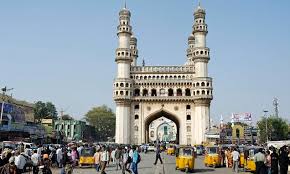
Charminar, an iconic landmark of Hyderabad. Art by Kishore Singh. From Public Domain

Had Paradise survived, the last Hyderabadi[1] would have done as well. Yet what remained of Paradise were shards of its best self-scattered around parts of the country that did not understand what it meant to carry its legacy, of what the endless cups of frothy Irani chai over a pair of lukhmis or nausea-inducing keema-roti [2]meant to the gentry of the city in general. Or, before the advent of the social media, what was the impact of the gentrification of a city better known as a town of small neighbourhoods, harassed yet equally enriched by the countless migrants from the eastern India.

Autumn had finally arrived, and the smell of the tree of sorrow permeated within the crisp, starch-lined shirts of the former politicians of a political party whose hues no one could be certain of anymore. The hijras[3] flocking the bus stop opposite the JBS[4] metro station had no intent in seeking out alms anymore. With the festive season approaching in all its vehemence, life was supposed to get better for them and the countless number of beggars — maimed or otherwise — who made a living out of the charitable pockets of officegoers.

The latter made the famous bus stand their endroit le plus important [5] and fed their starving souls with tidbits of generosity that they could only offer a pregnant prostitute or a vagrant with no feet staring up Akbar Road with a bright barrenness in his eyes. Of course, one could always count upon the Ganesh temple looming in all its gargantuan simplicity through the shards of space between the metro rail pillars and berating simple-minded Hindus for not having enriched its donation box. The last Hyderabadi often thought that this vision — more than ideas of goodwill — dictated the unusual largesse of the usually tight-lipped and parsimonious gentlefolk.

*

What could have been construed as big-heartedness among the lower classes was usually written off with disdain by those who did not have the luxury of being poor. The road that snaked down the Military Engineering Services instalments and evaded the right fork towards Secunderabad Club was sure to have ended up in the dull brown villas of Gunrock; the last Hyderabadi often wished he could spare himself the pain. To think of pain was pain itself. He forced himself off the stool next to Grill 9 where he was smoking a Charminar — a remnant of an era long gone — and joined the serpentining queue of revellers shedding their last moments of joie de vivre [6] from Tivoli, and its apostle up the road that took pride in housing respectable men these days.

Shedding the joie de vivre often took him back to the days when he could have been carefree enough to hop in and out of the multiple breweries that had sprung up like mushrooms on road number 45 in Jubilee Hills, not a million miles away from JBS as the crow flies. Had the last Hyderabadi known how to take the metro rail into the new central business district of the city, he would have reached sooner than he did when hoisting himself upon his trusted Bajaj. The latter frequently needed a pat of encouragement from its owner when it chose to get stuck on clean, wide roads that could only ferry the chief minister and his coterie. Of course, no other road would have had the gall would have had to tidy up as much as the ones here did — the lack of water, sanitation and seepage an accepted norm.

Of what need was there for him to chauffeur his thoughts in a world that had long seemed to dissolve him in a glass filled with water that no longer came from the Musi[7]? Yet, there was the odd occasion when he would find himself seeing the vast encumbrance that the cable bridge over Durgam Cheruvu had become, with the thought of jumping off it never too far from his mind.

Broadway, Prost, Forge, Fat Pigeon, Lord of the Drinks, Forefathers, Daily Rituals — of what use was it that he could reel their names as well as the oldest merlots they had from memory? Had he taken the time to look beyond the sports pages of the Deccan Chronicle, the last Hyderabadi would have found something to relish in times of the infrequent melancholy that knew him by name. Had the drink consumed him, or vice-versa, things may not have changed him for the better, or made the city — once recognisable, and now imperceptible — more hospitable towards him, but he would have known something better to do with his time than count by hand the centuries scored on the numerous pitches at the Parade Ground every Sunday.

*

Oh, how he longed to go back to Shah Ghouse and forget that a world such as the one he was forced to inhabit now existed. A world in which seasons came and went, but autumn — obstinate, stubborn autumn — always hung around far longer than it was welcome. With the lines blurring between right and wrong, it was felt that the city would not live up to its pretentions had the same happened between autumn and winter.

Of course, those settlers from the coastal belts of Andhra who made the northern neighbourhood of Kukatpally their home knew little better than to pull out their jumpers at the first smell of rain or — perish the thought — the temperature dropping below thirty. Yet, the last Hyderabadi plodded along, knowing innately that this season too was bound to leave — like the majority of his dreams — and winter would take over inevitably.

How little he trusted his words these days, delving deep inside his psyche to look for some semblance of sanity that he had held on to during his prime. Chasing another peak, the last Hyderabadi had settled down to accept the inescapable — the city would move on without him — and defy the passage of time that had once held him tightly in its grips. Oh, what he would have given to head back to Paradise, say hello to trusted old Saleem and ask for a cup of tea.

*

There were those moments of immense self-doubt in which the last Hyderabadi felt that his hands would wash away in the sickly Musi underneath Purana Pul[8], leaving him standing on his legs which were clearly giving up. The decisiveness of the issue softened the blow whenever he looked at the paunch he had developed of late — the endless runs up and down Tank Bund on Sundays when the whole world slept, being wrecked by the keema roti for which he would often turn to Garden, bypassing Paradise. (He had sought refuge at the Alfa one morning but was left ruing his choice as hordes of travellers swept past him determined to leave their footprints in the city without quite being welcomed by it.)

Whatever poetry had once risen inside him while tucking into the umpteenth samosa at Lamakaan had been disbursed by the recognition of pain in parts of his mind he seldom acknowledged. The poems were songs in celebration of life, and it was only ironic that he should have to think of these when assailed by the thoughts of an autumn long ago, when Keyes High School had been decked up for the first time, and he had finally realised what he wanted from life.

It was when Hitec City still boasted of barren boulders that one had to hike up to gain a better understanding of the panorama below. He often felt that he could understand the words, but not its meaning. That autumn seems to have flooded Manjeera — the lifeblood of the city — and neglected to pay the last Hyderabadi any tribute worth his while.

When he thought of life, his most recent memories appeared dusted with the coat of nostalgia that one often reserved for emotions felt long ago. His worries had been compounded by his mind’s reluctance to admit that he had become old, that there would not be anyone after him, that he was merely standing upon the shoulders of those who had come before — those who had experienced the greatness of this city and shed an imaginary tear at what it had eventually become.

.

[1] ’The Last Hydrabadi’ can be read by clicking here.

[2] Mince meat and roti or bread

[3] Transgender from birth

[4] Jubilee Bus Stand

[5] Most important place (translation from French)

[6] Celebrations (translation from French)

[7] River in Telengana

[8] Purana Pul, along with being a translation of ‘Old Bridge’ in Hindi and Urdu, is also a place of significance in the old city of Hyderabad.

Mohul Bhowmick is a national-level cricketer, poet, sports journalist, essayist and travel writer from Hyderabad, India. He has published four collections of poems and one travelogue so far. More of his work can be discovered on his website: www.mohulbhowmick.com.

PLEASE NOTE: ARTICLES CAN ONLY BE REPRODUCED IN OTHER SITES WITH DUE ACKNOWLEDGEMENT TO BORDERLESS JOURNAL. 

Click here to access the Borderless anthology, Monalisa No Longer Smiles

Click here to access Monalisa No Longer Smiles on Kindle Amazon International
Categories
Stories

The Last Hyderabadi

By Mohul Bhowmick

When the last Hyderabadi man walked into the last Hyderabadi Cafe in the last Hyderabadi part of the city, he winced in disapproval at what lay in front of his eyes. 

The metro rail — almost always championed as a resort of the poor but as heavy on the pocket as a plate of haleem[1] from Pista House — seemed to have overtaken the remnants of what was once the Garden Cafe. The construction workers were often seen munching on luqmi[2] before starting work in the bright sunshine of the day.

***

Had Garden survived, the last Hyderabadi would have survived too. He would have dipped his roti into the banal bowl of keema that had largely seen the innards of whatever chopping machine they used in the kitchen and digressed considerably to criticise the commercial fervour that Paradise Cafe (the World’s Finest Biryani — as it advertised itself these days), less than a mile away to the southeast, had embraced. 

Yet, the way that Paradise had fallen on its face would not have seemed agreeable to him — the pride of the city intact in this wounded yet uninjured man — and he would have argued with the horde of loafers roaming in anticipation of a few pennies near the bottom of the Clock Tower, or booed with derision at the well-dressed middle-class diners approaching Baseraa for a meal they had envisioned a month ago.

Deccan Chronicle, about a hundred metres to the east from Baseraa, would have stood in silent vigil for what it had noticed, and in muted rebuke for what it had let flow from its murky torrents. Long having divested himself of the habit of reading a newspaper, the last Hyderabadi would have turned north in search of something a bit more appetising than the statistics of bribes taken and favours disbursed. 

Wasn’t it George Bernard Shaw who said that politics was the last resort of the scoundrel? The last Hyderabadi remembered having read something of the sort during his time at the Nizam College; surrounded by biryani by the bucketful at the Grand and mutton seekh by the skewer at Cafe Bahar, his wakeful remembrances were engulfed by a sordid affair at the Public Gardens which he would much rather not recall. 

***

Much given to lewdness in his youth, which included moments of sheer discomfort riding pillion behind a pillion on a two-wheeler — effectively three on the Honda that grunted in distress. Time — often seen as slipping past him like the silky outflow of the Irani chai at Blue Sea — was the great deterrent that forced him to fight for the movement that once engulfed, and now corrupted those who had vowed to not get enamoured by the corridors of power.

The last Hyderabadi now watched the last cricket match on the last pitch at the Parade Ground and grunted in discontent while crossing the road to the Gymkhana and witnessing one of the finest cover drives ever seen on its now-remodelled track; for all his impartiality, in his eyes, the Gymkhana remained the home of cricket — the home of Indian cricket at the very least. 

***

When peppered with bouts of time — of which he had plentiful — he often dreamt of the ideal that had consumed his passions and ignited the fires that have long been dormant now. Inexcusably, he had juggled three jobs at a time when his friends were struggling to make ends meet.

The opaque waters of the Hussain Sagar at the bend around Sanjeevaiah Park had seemed inviting enough on nights when he had not had time to read the freckled Dostoyevsky acquired that Sunday from Koti. It was the timely remembrance of an embrace from a friend who ran his father’s steel bearings business in Ranigunj that finally restored the last Hyderabadi to sanity and greater aspirations than what The Idiot had suggested. Strangely enough, he had dreamt of Alexander Pushkin that night; the duel upon the Black River seemed to be disapproving of what he had evaded in life.

The last Hyderabadi was often given to understand that those of his kind were an extinct race now, those who still studied the scores on Monday morning and despaired when their Bajaj ran out of fuel in the right lane in the thoroughfare he had called ‘Kingsway’ all his life.

Rather pitifully, the memories of his childhood visited upon him infrequently, withering that which he had left behind and flowering that which he did not want to remember. Oftentimes, these recollections included little apart from the moments tiptoed from the dispensation that ruled with an iron fist and earmarked itself to the cause — perhaps too vehemently for its liking — that he believed in. 

The dilkhush[3] scarred him on more than a few occasions when he hung around the Armaan Bakery in Ferozguda. His friends had called upon him to administer the immaterial wealth he had gathered over the years and embark on the search that had bruised his ego and slighted his soul for long; it seemed to be of a lifetime ago now. The sun had set that evening beyond the railway tracks as it did today, and yet his memories conveniently lied when put on the spot.

***

Those friends to whom he had clung for stability through those years of intransigence, with whom he had set back innumerable cups of tea and luqmi at the Rio, with whom he had shared remembrances by the plentiful at the Bawarchi — they had all disappeared without a trace in a world where public memory lives long enough for the good to be remembered and the bad to be dismembered. Bawarchi had been overtaken by Shah Ghouse, and Abids by Gachibowli, the empty streets of Jubilee Hills notwithstanding.

The last Hyderabadi had known this long before they started constructing the statue of the prominent lawyer who had been responsible for drafting that which held the people of this nation liable for their values and the politicians who ruled over them accountable for the promises they made. These now loomed larger than that of the ascetic whose refuge he had sought towards the end of his life. 

Neither the ascetic nor the lawyer mattered much in the minds of the newly-minted, power-hungry class who turned their noses away from him; the ideals the former propagated had been flung into the much-insulted Osman Sagar with grandeur, with the latter swallowing them without a hint of disgust. 

The last Hyderabadi meditated upon this as he turned back from where Bade Miyan used to exist. The patthar ka gosht[4] lingered long on the tip of his tongue, but with his pockets empty and resources nullified, ice cream from one of the myriad Bihari push-cart vendors on Tank Bund would have to make do for dinner, washed down by a bottle of lemon soda made from water rarefied by the Hussain Sagar[5]‘s numerous cousins.

***

Had he taken the bus from Patny southwest to Mehdipatnam on a lazy Saturday afternoon, the last Hyderabadi would have noticed the hawker who still believed in the incorruptibility of man, who sold ball-point pens at the traffic signal without haranguing his clientele too much, or the stout hijra[6] in Rasoolpoora whose self-respect had given way to hunger, or the blind beggar in Masab Tank, who died with Hyderabad in his eyes.

Had he been flogged that day by the marching crowd demanding employment for the destitute who neither knew nor chose to care about the latest matinee flick at the Tivoli, the last Hyderabadi would have known the extent to which his boundaries lay. 

The aggrieved mob screamed in righteous indignation and discontent as he sat beside the conductor, who counted the day’s earnings with just about enough interest to murmur,

“Haibat me ye logaan kahan-kahan toh bhi fir lete rehte, kya-kya toh bhi kar lete rehte – apan khaali ye puron ku dekh lena fir gumm bol leke palat lena. Shukraan apne ku koi dam nai karte!

(With great resentment these people move about in protest, but nothing comes of it. All we have to do is look the other way when they come here. Thankfully, nobody bothers us!)”

The last Hyderabadi had cried that night.

*** 

Spring seemed to be around the corner, but the last Hyderabadi had little by way of hope, further less by way of reflection. For what he remembered seemed to hark back to the days when he could still think of himself as a man in a city that bore him, that gleefully harboured him. 

Those of his ilk had disappeared long ago, men among whose shadows he had multiplied himself and sat in the peace of knowing that there were at least some who were like him, who understood him and who, perhaps, even loved him.

.

[1] Stew originating in the Middle East and South Asia

[2] A Hyderabadi variation of the samosa with mince meat

[3] A sweet stuffed bread of coconut and tutti-fruiti

[4] A hyderabadi lamb dish

[5] A lake in Hyderabad https://tourism.telangana.gov.in/nature-discovery/HussainSagarLake

[6] A transgender from birth

Mohul Bhowmick is a national-level cricketer, poet, sports journalist, essayist and travel writer from Hyderabad, India. He has published four collections of poems and one travelogue so far. More of his work can be discovered on his website: www.mohulbhowmick.com.

PLEASE NOTE: ARTICLES CAN ONLY BE REPRODUCED IN OTHER SITES WITH DUE ACKNOWLEDGEMENT TO BORDERLESS JOURNAL. 

Click here to access the Borderless anthology, Monalisa No Longer Smiles

Click here to access Monalisa No Longer Smiles on Kindle Amazon International

Categories
Stories

        The Infallible Business


By Sangeetha G

 Courtesy: Creative Commons

“Did you apply for the job?” Somnath asked casually when they met in the evening that day. The playground adjacent to the village school had become their hangout place for the past two years. 

“I have lost hope in these applications, interviews, and jobs,” Rajesh sounded quite detached. That was a state mind he had acquired gradually over the past two years of joblessness and pandemic. It had changed his perspective about jobs, careers, city life, and life in general. Waking up early, catching the metro train during rush hours for office, slogging till late evenings, and catching the train again to get back home just for a few hours of sleep seemed a routine of a past life. In the village, they had nothing to do. The nothingness got into their heads. They found it difficult to return to their past life.

“We need to do something. But I don’t want to go back to the city,” said Somnath.

“I have a business idea. Capital-light, easily executable, infallible, and recession-proof and to top it all it has an unbelievable Return on Investment,” said Rajesh. 

“That sounds ideal, blurt it out,” Somnath looked excited.

“We can get into the business of religion and build a temple,” Rajesh said. 

Somnath was baffled. “Is that a business to do?”

“Religion is the best business and until humans continue to believe in unseen and unknown powers working upon them, the business will flourish. You can start with a very small capital and earn loyal customers, who would never question whether you deliver or not. They will keep on putting in money without applying logic. In a crisis, the business will not slacken. Instead, the loyal customers will keep on investing, hoping for a better tomorrow. What other business has these amazing deliverables?” he asked. 

“You have a point,” Somnath was on the same page. 

“What is the plan,” he asked. 

“It is simple. I have a ten-acre land that has been lying unused for years. We will set up the temple there,” Rajesh was confident.

“Just because we go ahead and build a temple, are people going to believe in the deity?”

“We will not build a temple just like that. First, a miracle should happen and then the temple will follow,” Rajesh detailed the plan. 

“As per my plan, you will fall sick…seriously sick and the doctors will not be able to diagnose your condition. As your condition starts worsening, you will announce that you had a dream. In the dream, a goddess appeared before you and asked you to dig out her idol from the nearest banyan tree. The nearest banyan tree falls in my land. As per your dream, your family and my family will dig out the idol from the soil near the banyan tree. The idol will be consecrated and you will be cured. This will be our base miracle,” Rajesh said. 

“First our families will start worshipping and slowly, by word of mouth, others will join us. As people will see that their wishes are getting fulfilled, worshippers will start flowing to our temple,” Rajesh added. 

“But, this is a farce. How will people’s real wishes come true by praying to the false idol?” Somnath was sceptical.

“Imagine, 100 people come and pray in the temple. They all will have their wishes, but at least 50 will be working towards their dreams. Simple statistics say that 30 percent are likely to achieve their dreams. Those who get their dreams fulfilled, will anyway become staunch believers. Of the remaining 70 percent, 20 percent might leave forever. But they would never complain or bad-mouth about the temple. After all, talking against God is sacrilegious,” Rajesh went on. 

“Now we have to focus on the 50 percent who are confused between belief and disbelief. We come up with propaganda that whoever did not get their wishes fulfilled in a month has some serious negative karma. They will have to do penance for nine consecutive weeks to mitigate the effect of their karma. At least 30 percent will fall for it. We will design some tough rituals as penance,” he said. 

“Why tough rituals?” Somnath was curious.

“Tougher the ritual, greater the belief,” Rajesh reasoned. 

“By then, more than 50 percent of the worshippers would have turned our believers. They will keep on pouring money into the temple and continue to do whatever we ask them to do. Further, new sets of worshippers will keep on coming to the temple. We will ask the worshippers to leave a note in a box if their wishes have been fulfilled. I am sure we will get ample notes for our marketing campaign through social media and elsewhere. Once we achieve a certain number of daily worshippers, we will touch the inflection point. Then we can relax and the system will take care of itself,” he sounded confident.

“What is the guarantee that all these worshippers will deposit money in our boxes?” Somnath asked.

“We will propagate that people who had put money saw their wealth growing multi-fold. We will get some notes substantiating this claim as well. Who does not love money? They will pour in money for the sake of more money,” Rajesh replied. 

“I liked the idea. But will people behave as we expect them to?” Somnath was critical. 

“Don’t worry. As long as humans have low levels of confidence in themselves and their efforts, they will continue to seek help from ‘above’,” Rajesh smiled. 

By then, the sun had started setting and the sky was at its crimson best. The nearest temple had started playing devotional songs and worshippers were on the way to attend the twilight veneration. They stood up and started walking back home. 

“I will get one idol from the antique dealer in the city. I will hide it in the soil near the banyan tree and you will have to come out with some convincing disease plan. We will meet tomorrow,” Rajesh said as he took the private road leading to his house.

.

Sangeetha G is a journalist in India. Her flash fiction and short stories have appeared in Down in the Dirt, Academy of the Heart and Mind, Kitaab International, Indian Review, Storizen, The Story Cabinet and Borderless Journal. Her story won Himalayan Writing Retreat Flash Fiction contest 2022. Her debut novel is in the works.

.

PLEASE NOTE: ARTICLES CAN ONLY BE REPRODUCED IN OTHER SITES WITH DUE ACKNOWLEDGEMENT TO BORDERLESS JOURNAL

Click here to access the Borderless anthology, Monalisa No Longer Smiles

Categories
Stories

The Royal Retreat

By  Sangeetha G

It was one of those harshest summer days. The simmering hot sun was sucking up the remaining moisture from the already parched soldiers. The small contingent of infantry, cavalry and elephants led by King Mahendra himself was moving at a snail’s pace. The elephants and horses kicked up the dry soil, which formed a cloud of dust. The whole unit was moving inside a red cloud of dust. 

The purpose of their mission was accomplished, but no one cared to rejoice in the victory. They did not attach much significance to the events in the battlefield. It was the eighth time they had defeated the neighbouring state. Every move of the other side was as familiar as the back of their hands. There was nothing new or exciting about the battle. King Jayavandan of the neighbouring state never wanted to accept defeat. He continued his incursions into the border areas of the princely state of Rajgarh. Eighth time, King Mahendra decided to put an end to it by finishing off the king. He had pardoned Jayavandan seven times and let him off with stern warnings. This time, he himself led the unit, asking the Commander-in-Chief of the army to stay back in the capital city. 

Soon, the flag of Rajgarh, atop the fort and the canon-mounted bastions, became visible from a distance. As they got nearer, the drawbridge over the moat was lowered and the fort gate opened with a giant creaking noise. The guards bowed their heads to pay their respects to the King. Once the King was in, the door once again creaked as it shut behind him.

The soldiers, horses and the elephants moved towards the western gate and entered the other side of the fort. The stables for horses and elephants, the ammunition storage room, jail and the soldier quarters were closer to the western gate. 

The King on horseback moved towards the large palace that stood tall at the centre of the fort. On one side, was a temple and a durbar[1] hall on the other. 

As he alighted from the horse, his younger brother Prince Upendra came out of the palace and walked towards him. Midway, he signalled to the guards on both sides. The guards moved fast with their drawn swords and circled Mahendra. It took just a second for Mahendra to realise that it was a coup.   

A large contingent led by the commander-in-chief took control of the situation. The soldiers lined up behind him. By then, the prime minister and the members of the ministerial council stood on either side of Prince Upendra. 

“Chain him,’’ Upendra ordered. Mahendra clasped his hands as the soldiers handcuffed him and clamped iron chains around his wrists. They led him towards Upendra. 

“From now on, I am the King of Rajgarh. The entire administration is under my control. Those who have objections, can raise their hands,” he said to a group of people who stood in pin-drop silence. 

Mahendra too maintained a stoic silence. He stood calm and composed. There was no sign of anger or shock on his face. He looked at the people who stood around him.

“Put him in jail. Two days later he will be executed,” Upendra announced. As a customary obligation towards a dying man, he asked: “Do you have any last wish?”

Mahendra looked around and pointed his finger towards a guard and said, “He will die with me.”

Everyone turned their heads towards the guard in dismay. The guard stood shell-shocked. 

“Take them,” Upendra ordered. As the soldiers held him and dragged him after Mahendra towards the jail, the guard kept on pleading innocence. “I have done no wrong. Please spare me. I have a family to take care of,” he cried aloud. 

Inside the jail cell, Mahendra walked up and down. His life resurfaced before his eyes — one episode after another. When he thought about his father,  he saw his 10-year-old self staring at the royal court from near the throne. His father sat on the throne exuding power and authority. When he remembered his father, his heart swelled with the same pride he had felt decades ago. 

The next scene that rushed into his mind without an invitation was not a pleasant one. People inside the palace were running out towards the gate of the fort. There was a commotion and he could hear women crying. As the fort gate opened, he saw his father’s mutilated body being brought back from the battle ground. 

He remembered the day when he moved out of the large palace along with his mother and brother, to the servants’ quarters. It was after his uncle’s ascension to the throne. The new queen’s servants came into the palace room and asked them to move out. He had never seen anybody talk rudely to his mother till that day. The servants did not even allow them to pick up their essential things. Bare-handed, they moved into a dingy room in the servants’ quarters. 

He thought about the secret meetings with the generals in the army and with King Jayavandan of the neighbouring state, promising him a few villages along the border in return for a favour. That was just before his uncle’s last battle. Then he remembered with pride the day when he walked up the steps, which took him to the throne. He sat on the throne like his  father decades ago and looked around at the royal court. It had completely changed in the intervening years. 

A soldier interrupted his chain of memories. The soldier walked up to him and announced: “The royal priest is here. He wants to meet you.” He unlocked the door of the jail cell for the royal priest. 

Mahendra stood up to show respect for the royal priest. He was an old lean man with overflowing grey hair and beard that gave him a saintly look. The priest held his hand and said, “This has been quite unfortunate. Everything happened in such a short time. I had no inkling about what was happening behind the scenes.”

“You should not worry. I have reconciled to this reality,” Mahendra said. 

“Don’t you feel betrayed by Upendra?” he asked. 

“This is the life of a king. I had a predecessor and the moment I ascended the throne, I knew I would have a successor. When you climb the steps pushing someone down, it is certain that someday someone else will push you too. That is how power works. I had visualised this scene several times in my mind. Just that, it was not clear who would replace me,”  Mahendra said.

“What about the ministers and the Commander-in-Chief?” the priest asked.

“They serve the throne and not me. They also have to look for their own personal gains. Plants grow around the tree when it falls.” Mahendra was more philosophical than what the priest had imagined him to be. 

“Why did you wish death for the guard? Everyone found it intriguing. You would have never noticed him. You don’t know him, leave alone having any enmity with him,” the priest was curious. 

“When the new king ordered death for me, I was looking around. Upendra’s face was filled with jealousy. He is still jealous of me, of my greatness and my achievements. He would have usurped the power, but he still feels that I am much mightier than him. It made me feel good.” Mahendra’s face filled with pride. 

“Then I looked at the prime minister and the other ministers. They had hung their heads in shame. They never looked up. Despite supporting Upendra, they continued to feel that I was right and what had happened to me was unjust. The Commander-in-Chief had a frigid expression on his face, revealing his helplessness towards what was happening around. I looked at the soldiers. Most of them were in a shocked state. When they looked at me, I understood that they still had immense respect for their deposed king.”

“Among them, I saw only one scornful face. This guard – he was in fact sneering at me. I accepted jealousy and treachery. They always come along with power. That will never diminish your greatness. But that sneer. It made me feel like a despicable creature. It stripped me off the pride I had carried all through my life. One day I would relinquish the throne and one day I would leave this world — that was certain and I was prepared to face them. But, I wanted to leave behind an image for posterity – that of a great ruler and a powerful king with awe-inspiring achievements. While looking back at the history of Rajgarh, I would shine as the mightiest king. I could not afford to give an opportunity to even a single person to think lowly of me,” Mahendra said. 

The guard interrupted them. “The Commander-in-Chief says your visiting time is over, Royal Priest,” he said as humbly as possible. The priest walked out of the room as the door closed behind him.


[1] Public reception area

Sangeetha G is an Assistant Editor with Deccan Chronicle newspaper in India. She writes on business-related news and has over 20 years of experience in mainstream media, including visual media, news agency and newspaper. Her short fiction has been published in the literary magazine ‘Indian Review’. 

.

PLEASE NOTE: ARTICLES CAN ONLY BE REPRODUCED IN OTHER SITES WITH DUE ACKNOWLEDGEMENT TO BORDERLESS JOURNAL