
Categories
Stories

Sleeper on the Bench

By Paul Mirabile

From Public Domain

Out on my usual morning walk. A lovely June morning, the air fresh, cool, the rising sun obscured by a belt of sleepy, moving cloudlets. The sun’s soft, mellow rays dried the dew on the large, leafy trees and blossoming flowers of Holland Park.

As always, I bent my steps towards my favourite bench where, I could sit alone and quiet, near to the ponds, yet far enough not to hear too many voices. The air smelt fragrant that particular morning. I hastened to start on my adventures with Dickens’ David Copperfield as I turned a sharp bend on the path that took me to the bench and the great, sprawling oak tree that homed the myriad rooks and scurrying squirrels. I halted. A seedy-looking man was slowly sitting up on my bench! I had never found someone occupying my bench before. He was scratching an unshaven face and an uncombed head of black, curly hair.

Snapping out of my astonishment, I boldly went up to him. “Sir, have you been sleeping on this bench?”

Hardly looking at me, he softly replied, “In fact I have, my good man. And I will add, I enjoyed a very quiet and relaxed sleep. Not a soul in the park at two in the morning, not even the squeaking of a squirrel.” He said all this with considerable aplomb.

“Well, I’m very happy to hear that. Of course you shall be leaving soon?”

“Not that soon, I’m afraid. When I sleep out, which is almost always, I arrive here in Holland Park at 2pm. and leave at three in the afternoon, sometimes a bit later.”

I bit my lip. “What do you, eye little girls with bad intent?”

“I should think not — that is very uncouth.”

“ Spit out pieces of your broken luck?”

“Hardly. My luck has remained intact, I’m proud to say.”

“Warm your feet in the sun?”

“They keep very warm in this season, even with my shoes off.”

The bench-sleeper took out a cigarette from a torn shirt pocket, lit it, then smeared his shabby clothes with greasy fingers. “Want a smoke?”

“No thank you, I don’t smoke.”

“May I ask you why you have chosen this particular bench to sleep on?” I resumed, as he puffed away, staring blankly into space. “This is my reading bench, sir. It has been for over two years. I come almost every morning to have a good read before breakfasting at the Duck or Grouse across the road.”

“Ah ! The Duck or Grouse, I know it well. The barmaid is an acquaintance of my wife.”

“You have a wife?”

“Yes, and two children. Does that shock you?” Before I could answer he pointed a slender finger at my book: “A rather dreary read in the morning, no? I mean, why not something more droll like David Lodge or Oscar Wilde?”

“I prefer Dickens if you don’t mind,” I responded, taken aback by the man’s impertinence. The impertinent man yawned, took a bright, red apple from his trouser pocket and began munching on it.

“Sorry to have disrupted your morning reading, old chap, but oftentimes in life we are confronted by unforeseen events or encounters contrary to our habits. The question is: Should we disregard the event or investigate the meaning behind it? Why on this particular morning, on this particular bench have you been confronted by someone who has hindered your daily morning ritual? Is it accidental or providential? Please, sit down.”  I did unthinkingly sit down and watched him blow blue smoke rings into the still air. I will admit that I was a bit awed by him.

He went on calmly: “Does my appearance really offend you, cause you any discomfiture? Retard your reading of Dickens, who I must say, I have never really taken a liking to?”

“Oh, so now you insult my choice of reading?” I fumed.

“I meant no insult, sir, only a reminder you that there are morning readings, afternoon readings, evening and night readings. And I’m sorry to inform you that Dickens is not a morning reading, especially David Copperfield.

“Well, I’m sorry to disappoint you, but if you are to remain seated on this, my bench, then you will be subjected to my perusal of David Copperfield; and whether it pleases you or not will not change my habit of doing so.” My bold affirmation seemed not to disturb the blighter’s rings of smoke that sailed lightly up into the broad leaves of the oak tree.

He wrinkled his nose: “Habits are terrible enemies.”

“Are they?”

“Yes, that’s why I oftentimes change a bench … even a park: St James is lovely with its lake. Richmond, Finsbury and Circus Gardens are very pleasant, too … You see, I despise habits, they instil an implacable rigor mortis.”

I ignored him and frowned: “So, you believe I’m a silly, old dolt because I read David Copperfield every morning on the same bench?”

“Of course not,” he responded quickly, tying the laces of his heelless shoes. “I simply wished to make clear to you on this lovely morning that a stranger has sat on ‘your’ bench, and that you have yet to ask him whether he is a beggar or not!”

The bench-sleeper’s remark put so point blank did indeed pique my curiosity, so I took up his defiance: “Are you not a beggar then?”

“Have I asked for money?” was his snappy reply.

“No … not yet, anyway.”

“Nor will I. So what are your deductions?” He peered at me with a mischievous gleam in his eye.

“That you are not begging for money and that you have given me the occasion to snap my habit by engaging in conversation with you.”

“You have expressed it wonderfully!” he exclaimed.

“In that case, why do you sleep out on park benches, when you said that you have a wife and children, and you have no need of money?”

He shook the dew out of his hair. “Is there anything ambiguous or incongruous about that?” he countered.

“I think there is! I have a wife and a home, and at night I sleep in my home, not on park benches.”

“And children?” 

I sat back. “No, in fact we have no children.”

He took out another cigarette. “ So?”

“So what?”

“Oh, nothing. My children often visit me in the parks when not at school, and my wife, when she’s not working.”

“I can’t believe all this!” I stuttered.

“Why not ? Have you something against a gesture so innocent, so insignificant than a man who sleeps on park benches, who is visited by his dear family, when, in fact, he could sleep in a lovely, soft bed next to his charming wife? Let us say that park benches have become my second residence.”

I gasped at that last remark mentioned so candidly. I changed the subject: “Tell me then, what do you do until two or three o’clock on this bench? You have no book to read.”

He chuckled. “My book lies outside written pages. My readings are people whom I observe, the flowers that I smell, the singing birds or gambolling squirrels that I hear. The conversations I have with many a good person, like yourself. I do read books — just the other day I found a copy of Lawrence’s The Rainbow in the trash bin. Can you imagine someone throwing away a classic of that sort?”

“Yes, that is a crime. So your days seem to pass by splendidly, a full agenda, if I may say so without irony.”

“You may say exactly that, my good man.” He stretched his limbs, took another cigarette and smoked dreamily, peering into the thick leafy foliage of the oak tree. Songbirds had been accompanying his well-stated sentences for some time now; they seemed to punctuate them, rhythmically. The manner in which he smoked his cigarette mystified me. There was a touch of delicacy, elegance, even refinement in his gestures. His speech, too, prompted me to think that he was no ordinary tramp.

He pointed to the sun: “When did you say you breakfast at the Duck or Grouse?”

“At ten o’clock.”

“Judging by the sun, it must be very close to ten.”

I glanced at my watch. “How right you are!” I said, stunned by the accurate time-telling of this unusual man.

“I’m afraid I have prevented you from reading one sentence of Dickens.”

“No bother ; I have many mornings to do so … unless …”

“Unless you find me lying or seated here every day ? Not to worry; as I said, I change benches and parks quite regularly. But who knows, we may meet again in different circumstances.” And he smiled while his eyes shone a roguishness that confounded me.

“Right!” I returned. “Perhaps we shall meet again.” I stood up to leave.

Bon appetit,” he called out as I wended my way to the front gate.

Finishing my breakfast, I hurried home eager to share that odd encounter with my wife, at that moment busy with her morning gardening. “You’ll never know how I spent my morning, dear.”

“Reading your book, I suppose, as you always do,” my wife replied tritely without looking up, pulling out the weeds from the borders of coneflowers, forget-me-nots, asters and chrysanthemums below the bay window of our newly bought duplex.

“Not at all,” I responded. “I had a very strange conversation with a man who sleeps on park benches every night, and sits on them until three in the afternoon.”

She stood and eyed me strangely. “Talking to beggars, hey? How much did he wrest from you?”

“He wasn’t a beggar Helen. He simply sleeps and sits on park benches. In fact, he had a refined way of smoking his cigarette. Very well-spoken, too.”

She continued to stare at me without a word. “He even has a wife and children who visit him in the parks.”

“Does he ? Well I’ll be damned if he wasn’t putting you on, Marvin. Do you think I’d visit you in a park, sleeping on a bloody bench?” I smiled weakly. “He’s a smooth talker, that one is. Be careful, he might put ideas in your head, ”she concluded and attended to her peonies and snapdragons.

I felt odd and asked, “How about a restaurant tonight, dear? I’ve had a handsome pay rise, you know. Let’s dine at the Galvin La Chapelle.”

Helen jumped up like a Jack-out- of-the-Box. “Are you mad? I think that beggar or bench-sleeper got the better of you. The Galvin La Chapelle is the most expensive restaurant in London … eighty or ninety quid a menu!”

“Yes, I know. But I really feel like having a wonderful meal. After all, it’s only money…”

My wife went back to her edging and weeding.

So that night, dressed in our best clothes, we stepped under the chapelled vaults of the Galvin La Chapelle in Spitalfields, whose French cuisine and romantic atmosphere knew no rival in London, perhaps even in the whole of England. We were seated at our reserved table for two in the middle of the enormous dining hall, where we could admire the polished marble pillars supporting the stone ceiling, the timbered vaults and the arched windows. We both felt so paltry surrounded by such grandiose mediaeval decor.

“Such a posh restaurant, I’ve never seen such lovely architecture and decoration. And feel this tablecloth, it wasn’t bought at Primark,” Helen remarked blissfully, passing her rough, garden-versed fingers over the silken cloth after having been seated in a red-upholstered chair by a charming young waiter.

“I knew you’d like it, darling.” I beamed, thoroughly delighted at my wife’s first impressions. “You deserve it, haven’t we’ve worked hard: first the duplex then the car?” The Maître d’Hôtel[1] greeted them in French, then with much studied decorum, lay two menus on the table in the middle of which had been placed a vase of intoxicating tuberoses whose fragrance almost caused Helen to faint in ecstasy. Marvin ordered cocktails.

Suddenly his face turned white as a ghost. Helen, snapping out of her ecstatic state, searched the sudden whiteness for a reason: “Marvin … Marvin, are you alright ? Is it the flowers or the prices on the menu that have turned your face into stone ? I told you this place was dear. We’re not at MacDonald’s, you know …”

Marvin struggled to speak: “No … no … it’s not the menu, dear.” He turned to observe the Maître d’Hôtel presently leaning on the counter of the cocktail bar. He was attired in the most striking satin canvas double-breasted tuxedo with a black, silk bow tie whose tips brushed lightly against the red-laced lining of his vest. His tailored trousers grazed daintily a pair of Crockette and Jones shoes, the dearest in London. There he leaned on his right elbow, chatting up the barmaid. With the most refined gesture, he took out a cigarette from a gold-plaited case and lit it.

Marvin gasped: “It’s him! It’s him, Helen!”

“What are you on about?”

“The head-waiter talking to the waitress at the bar…It’s the bench-sleeper in the park. I’m sure of it.”

Helen sat back, a bit ruffled at her husband’s outlandish outbursts. The young waiter brought the hors d’oeuvres[2]: duck liver royal and buffalo milk panna cotta. As soon as the waiter had served them: “Are you daft!” she whispered so as not to be heard by two couples who had just been seated near to them. “Stop this nonsense, Marvin. Control yourself. Don’t forget where we are. How can a tramp on a park bench be the head waiter of the most expensive restaurant in London?” 

“But the way he smokes his cigarette…it’s exactly like the beggar’s! And his grey eyes, those glazed, blurry, grey eyes are his. Helen I can’t believe it!”

“Then don’t believe it because it can’t be him. Calm down and eat your duck liver. Look, he’s coming to take down our main dish, which because of your foolishness, we haven’t chosen yet.”

The stately Maître d’Hôtel glided over, pad in hand. Marvin, red as a lobster, buried his face in the menu. Helen scanned hers, marvelling at the names.

“Let me suggest the crab ravioli,” His soft voice sailed in between them. A voice very familiar to Marvin.

“That sounds lovely,” Helen said, staring impatiently at her husband who was hiding his face behind the menu. “With a lot of ricotta cheese, please. I’ll also order a free range aged duck sauce à l’orange. And you darling, what will it be?” she added, barely disguising her anger.

“I shall have the Iberico pork with chimichurri sauce, please,” Marvin ordered, peering over his menu at the head waiter.

“Of course, sir, we serve the finest French cuisine in England ; une cuisine exquisite!”

“How about some wine, dear?” Helen interrupted, peevishly.

The Maître d’Hôtel suggested: “An Aloxe-Corton Latour red wine goes well with pork. As to the crab, why not a carafe of Chardonnay?”  Helen and Marvin acquiesced by simply nodding their heads. “If I’m not mistaken, this is your first time here? Perfect. Then permit me to offer you, on the house, our burnt honey custard tart for dessert. It simply melts in your mouth.” The first-comers wreathed in smiles, albeit Marvin’s somewhat withered, nodded again in ostentatious gratitude. The Mâitre d’Hôtel glided off across the stone-paved floor with velvet steps.

Marvin leaned over the table, his nose ruffling the tuberoses. “Helen, I’m telling you it’s him. I’m going over there to settle this mystery once and for all. I know he recognised me, that’s why he offered that dessert to us.”

“Don’t be rude, Marvin. I shan’t be embarrassed because of your ill-behaviour.  That beggar has got to your head. Sip your cocktail, why are you ruining such a lovely evening, especially one that will cost you over two hundred quid?” Helen bit her lip.

“But dear, I shan’t embarrass you ; I’ll just casually stroll over to the fellow and hint at David Copperfield. He’ll get the message. He’ll know I’m on to him.”

“What do you mean ‘on to him’ ? He’s not a criminal! Stop this immediately or I’ll leave you eating your two-hundred pound meal alone!” With those stern words that brooked no rebuke, the affair appeared settled …

Marvin, however, was not to be foiled …

He stood up. Gathering courage, he made a bee-line for the cocktail bar where the Maître d’Hôtel was serving himself a drink. Marvin in a low but firm voice said: “Sir, I believe we have met elsewhere.”

Being much taller than Marvin, the Maître d’Hôtel bent over him, drawing closer. He placed a comradely hand on his shoulder : “My good man, how observant you are! My disguise has not fooled you for a moment. But please, look at your lovely wife,” and he sighed. “She’s almost in tears, worrying over your stubbornness to know the truth. The truth? Of what? About a sleeper on a park bench, one who harbours a certain disdain for Dickens in the mornings? If I were to reveal the mystery of our morning’s encounter, would you please return to your table and enjoy the meal with your wife.”

Marvin remained speechless, although he did scoop out a handful of cashew nuts from a porcelain dish on the cocktail bar counter.

“You see,” the head waiter continued philosophically, “here in this restaurant I play the role of a Maître d’Hôtel. I wear the weeds and mask of social bearing, parade about this remarkable dining room with aristocratic ease. I follow the rigid rules of proper etiquette. Where we met and spoke this morning is my breath of fresh air, my dwelling of unconfined freedom. There I dispose my mask, divest my constraining costume and don the clothes and air of a bird that has flown out of its cage. Here inside, I’m an actor. There, outside, a spectator no longer on stage constrained to act, but react to those whom I observe. And that my good man is the essence of freedom. In the parks, I regain a sense of reality by observing the simplicity of Nature, the grass beneath my feet, the sun, moon and stars above my head. The trees and the songbirds. In the restaurant, albeit it be the finest in England, I merely act, opined as a social asset, as a means to cater to people’s needs for costly pleasures, and of course to my own and those of my family’s, although mine and theirs are far from costly. Look, I shouldn’t be smoking this, but it is the only pleasure, the only soupçon of outside freedom that I can afford myself here.”

Marvin, awed by this avowal, said nothing. The Maître d’Hôtel concluded: “Now hurry back to your charming wife who has been impatiently waiting for your return. I do believe your main course will be promptly served. But let me say this, please do not disclose the reason for my bench-sleeping activities. That will be our little secret, one only between us. Look, your wife appears so upset, why subject her to trivialities? Discretion, my good man. Discretion. Put her at ease and enjoy your meal.” The Maître d’Hôtel causually strolled to a nearby table, smiling.

Marvin shuffled to his table, where indeed Helen was fuming. “Well ! Has he called the ambulance to have you packed off to Bedlam?”

Marvin winced. The irony of her remark cut deep into his emotions. He appeared lost in thought: “No … We had a smashing conversation, in fact. He’s quite a decent chap, well-read on Dickens, too.”

“Good, then let us get on with this wonderful meal. Cheers darling, and thank you, the wine is heavenly and the crab, well, what can I say?” Helen raised her glass: “To us … and Dickens!”

[1]        Head-Waiter.

[2]        ‘Starters’.

Paul Mirabile is a retired professor of philology now living in France. He has published mostly academic works centred on philology, history, pedagogy and religion. He has also published stories of his travels throughout Asia, where he spent thirty years.

.

PLEASE NOTE: ARTICLES CAN ONLY BE REPRODUCED IN OTHER SITES WITH DUE ACKNOWLEDGEMENT TO BORDERLESS JOURNAL

Click here to access the Borderless anthology, Monalisa No Longer Smiles

Click here to access Monalisa No Longer Smiles on Kindle Amazon International
Categories
Stories

Hotel du Commerce

By Paul Mirabile

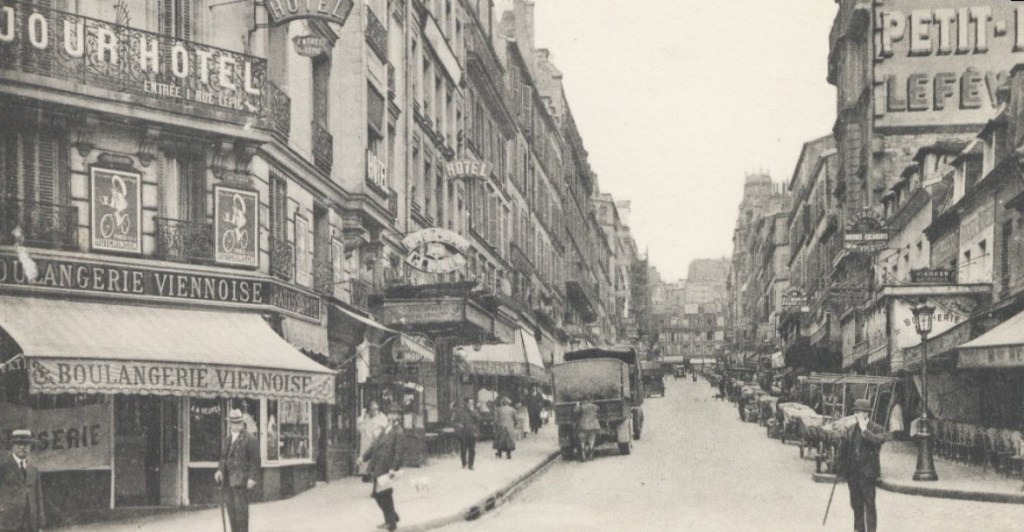
Paris 1970s. From Public Domain

In 1974, the modest, starless Hotel du Commerce, at 14, Rue[1] Sainte Geneviève, in Paris became my home for over six months, and its owner, Madame Marie, my adopted mother.

A young, aspiring journalist, I was sent to Paris by the editor of a worthless monthly magazine in Palermo, Sicily, to write an article on the monuments of Paris. I took up my long residence at the Hotel du Commerce for two reasons: it was very cheap — that is, ten francs a day — and conveniently located in the centre of the city, only a ten minute walk to the Notre-Dame Cathedral. Madame Marie, ninety kilos of joy and laughter, rented me a room on the fifth floor (without a lift) with two other residents: Caban across from me and Paco at the end of the corridor. The rooms had neither attached toilets – there was one for each floor — nor showers (none). Like all residents and tourists, we washed from the washbasin in our rooms. My little window looked out on to the red-tiled rooftop of a Russian bookshop.

To tell the truth I never wrote that article on the monuments of Paris. What a boring subject! On the other hand, my stay at Madame Marie’s hotel afforded me enough material to write a book — a sketch of her and her residents, their trades, joys and sorrows … their  uncelebrated destinies. My editor would have probably sacked me for this ‘breach of contract’, but as luck would have it, his magazine went out of business before my return to Palermo.

I shall never know why Madame Marie took such a liking to me. Everyday, she would invite me for coffee and a chat. We would even watch television in the evenings in her sitting-room which separated the tiny kitchen from the reception. From there she kept an alert eye on the comings and goings of everyone. She was a jolly old woman, and this, despite the loss of her husband at an early age, and the terrible events that occurred in her hotel during the Algerian war in the fifties and sixties[2]. She was indeed fat, but quick-witted with plenty of pluck. She had rolls of flesh rumbling under her eye-catching flower-dotted red robe.

“You know, I was a young girl during the Second World War. I hid some French Resistance fighters in my parents’ house in the Alps. The Germans who hunted down the French fighters couldn’t scare me with their rifles and threats. I sent them packing whenever they pounded at our door!” she would repeat proudly when I was alone with her. When her husband died, she was left on her own to manage the hotel, and in the 50’s that was no asset. Deserters, police informers, merciless OAS members[3] and their equally ruthless adversaries, the FNL[4]  all came and went causing rows, arrests, even murders. The plucky Madame Marie handled it all with her sang-froid and flair for compromise.

“My sixth-sense got me through that lot,” she would laugh, her jowls shaking. By the 1970’s, however, things had calmed down in Paris. The lodgers were mostly Japanese and American tourists with a sprinkling of North Europeans. No more brawls, police raids or murders. Madame Marie spoke no foreign language but she understood everything that she needed to understand. She had hired an old woman to clean the rooms. The sprightly widow had learned how to say in English, after having knocked on the lodger’s door at eight in the morning: “You stay or you go?” It was enough to get her point across.

Madame Marie disliked the police. She flared at their scent even before they stepped through the front door in incognito on the trail of someone except on one occasion. I shall let her narrate that exceptional episode: “How that flic[5] fooled me I’ll never forget. Dressed like a hippy, long hair, a torn knapsack, he took a room in the courtyard. He spent two weeks here and never said a word. He got in no later than eight o’clock at night. I thought he played the guitar on the metro[6] for money. Then one day, dozens of police stormed through the front door into the courtyard. I was in the sitting-room and rushed out the back door of the kitchen to see what all the hullabaloo was about. The door of one of my clients was wide open, a young bloke who used to play the guitar on the metro; he had been handcuffed by the ‘hippy’ and was being walked out. I couldn’t believe it. It was like a film. When everything settled down, a police officer came over to me and politely explained that my lodger was a notorious drug-dealer and had been under surveillance for weeks by the ‘hippy’. He apologised for the inconvenience and paid the rent for both the dealer (who hadn’t paid me) and the hippy-policeman.” Madame Marie sighed. “He’s the only flic who ever fooled me.” And she laughed her usual jolly laugh.

She got up to make some more coffee for at that moment Caban and Bebert came in for a chat, both a bit tipsy from their usual drinking bouts before, during and after work. Then Bebette made her appearance, the prostitute to whom Madame Marie ‘lent’ one of the courtyard rooms every now and then to exercise her profession. Madame Marie had no moral qualms about such professions. Everyone had to earn a living … Close behind sailed in an elderly woman whose name I no longer recall. Madame Marie considered the woman to be her best friend. She would sit in front of the television and shout insults at the politicians whom she disliked, much to the displeasure of the others, especially Bebert, who would shower her with mocking abuse. When things got too rowdy Madame Marie would shout them all down or threaten to turn them out if they didn’t settle down.

Madame Marie was at times brusque but fair. She liked Caban, the former butcher and now factory worker hailing from southern France, shy and lonely, drunk by mid-morning. He had been living in Hotel du Commerce since the late sixties. She was fond too, of Bebert, the chimney-sweep, a small, taciturn, melancholic chap straight out of Dicken’s David Copperfield, drunk before ten in the morning. He constantly coughed. His clothes were impregnated with soot and cigarette smoke. Bebert hardly spoke at the table, smoking like a chimney, drinking his coffee whilst Caban smiled and winced at the others’ ridiculous jokes and jibes. Day after day and night after night that sitting-room typified for me – and for the others, I suppose — a sanctuary of friendship and convivial exchange. Oftentimes, I read myself into a page of Balzac’s novel Le Père Goriot [7].

The other two residents rarely joined at that cheery table. One of them, Bolot, stayed in a room in the courtyard. He was a former German soldier who joined the French Foreign Legion after his capture during World War II. The other was called Paco, a Republican Spaniard, who escaped Franco’s persecutions after the Spanish Civil War[8].

I got to know them all, save Bebert. We had no time to get really acquainted. “Poor Bebert,” Madame Marie would sigh. One evening as we sat watching a film Bebert knocked at her kitchen door, then staggered in towards us, blood streaming from his mouth, drenching his night-shirt. His face was ghost white. He kept murmuring, “Madame Marie … Madame Marie,” through clenched, blood-filled teeth. The chimney-sweep appeared lost in a daze. Madame Marie quickly took him by the shoulders, laid him on the sofa then trotted off to get the police. They arrived quickly (the station was two doors away). An ambulance shortly followed. Bebert was placed carefully on a stretcher and carried out.

We never saw Bebert again nor had any news of him. Madame Marie presumed that he had died of a haemorrhage from too much smoking, drinking and chimney soot. She had his room cleaned and fumigated. His belongings amounted to a pair of torn slippers, two shirts and trousers and two used razor blades. On the other hand, she gasped at the hundreds of empty packs of cigarettes. Bebert’s world had been compressed into a nebulous routine of cigarette and alcohol fumes and chimney soot. A bleak, Dickensian world to say the least.

Poor Bebert. He had been living at Hotel du Commerce for eleven years. A fellow without a family, friends … known to no one. He practiced a trade that was gradually dying out. No one ever asked for him at the reception — never a phone call. He was the unknown toiler whose burial stone carries no name because he had no money for a headstone. He was probably buried in the fosse commune[9].

Caban, whom I knew much better than Bebert, fared no better. His salary flowed away upon the torrent of fumes of cigarettes and drink, or as Madame Marie put it coarsely: “He pissed it all against a wall!” Too much gambling, too. So his wife left him, after that, his sixteen-year-old daughter. They were never to be heard from again. Caban was soft-spoken, very shy. Quite frankly, I never saw Caban sober, except at six in the morning before catching the bus to work at the wine-bottling factory. He had asked the foreman, Mister Tomas, to have me hired on for the summer since many of the workers had gone off on holiday. In the café whilst waiting for the morning bus, he began his inglorious day with coffee and a few shots of cognac. He continued his indulging all through the working day on the first floor of the factory where he drank the last dregs of wine from the bottles that were to be washed. By five o’clock he was completely sloshed! Mister Tomas kept him on out of pity. Besides, Caban was inoffensive. Madame Marie even told me he had saved a girl from drowning in the Seine River in Paris. But let Madame Marie tell this very true tale: “He was walking along the banks of the Seine after work when he heard the screams and splashings below him. Caban was a strong swimmer at that time, so he took off his shoes, dived in and grabbed the girl in the water. In a few minutes he had brought her back to the banks safe and sound where a crowd of people had gathered, applauding him. The young girl cried and cried but was unhurt. And you know, her father was the owner of the France-Soir daily newspaper. So, to thank Caban, he gave him a certain sum of money and offered him the France-Soir freeeveryday for the rest of his life. All he had to do was give his name at the news-stands.”

“Does Caban read the France-Soir? I never see him reading a newspaper,” I asked naively.

She laughed. “No, Caban never reads. He never had much instruction.”

I became quite friendly with Caban since we worked together at the factory, although he would constantly upbraid me for not joining him in his ritualised morning concoction. I insisted that I never drink. He would snicker and shrug his bony shoulders. “All men drink!” he slurred. That of course was a subject of conjecture which, and this goes without saying, I never pursued with him.

One day whilst I translated for Madame Marie at the reception, I mentioned that I hadn’t seen Caban for more than a week. Neither had she. Mister Tomas had telephoned, too. Caban never missed a day at work … never. She told me to go upstairs and knock at his door. Which I did for several minutes. Silence. When I returned without news of him she immediately dawdled out to the police station. She was back in no time with two policemen. I accompanied them upstairs. They pounded at the door then kicked it open. There knelt Caban over his bed, his face black as coal. The stench in his room made us gag. I hurried down to tell Madame Marie. And as we stood in the reception, the ambulance arrived and four men, escorted by the police, placed Caban’s frail, limp body into a plastic bag and dragged it down the steps, one by one : thump … thump … thump …  Madame Marie started to cry. I covered my ears …

Poor Caban had been dead for over a week, due no doubt to a blood clot of the brain. Madame Marie never forgot those thumps on the flight of stairs. Nothing was said of his death in the newspapers, even in the tabloids. Like Bebert, he succumbed to a companionless death, without flowers or prayers. Without sorrow or tears … He too was probably buried in a fosse commune. He had no bank account. The police found six Francs in his pocket … Six more than in Bebert’s …

Paco, the Spanish refugee, had been living in Hotel du Commerce for seven years. His lack of good French isolated him from the Paris scene, so he took refuge in the clusters of Hispanic scenes that peppered the Parisian streets, especially the taverns where flamenco music could be heard on Rue Moufftard, only a fifteen-minute walk from our hotel.

Since I speak Spanish quite well, I had on many occasions accompanied Paco to these musical haunts of his, where the paella was copious, the sangria flowed like water, the music, if not excellent, loud enough to forget one’s trials and tribulations of the day. Above all, it was cheap …

Paco drank heavily, rum and coke or sangria, but never behaved uncivilly. His deep, black eyes bore into mine whenever he spoke of his luckless past: “My older brother was killed in the war against Franco. I escaped via the Pyrenees leaving behind my parents. Since 1940, I’ve been living in France, working in factories or in the fields. And you know, I still don’t have my French papers. I have no identity! I can’t go back to Spain because of Franco[10], so I must stay here unloading lorries at the Halle Market or washing dishes in grotty gargotes [11].” Paco clapped to the sound of tapping feet and to the rhythmic chords of a furious guitar. “Every now and then I repair the toilets at the hotel which are constantly clogged up.” He snapped his fingers, ordered tapas[12], spoke to his friends in the language of his parents.

The fiery Spaniard would introduce me to his Spanish artist friends, all of them sullen, sad figures whose love of Spain had evaporated into hazy fumes of sangria, nostalgia, gaudy flamenco music, tasteless tapas and brief love affairs. As to Paco, he appeared to be a loner, an ill-starred chap lost in a huge city of lost souls, of crowds so busy that their business took no heed of such a shadowy figure, fugitive and fleeting, drifting from tapas to tapas, sangria to sangria.

Paco hated Paris, but it proved the only place for a stateless refugee to avoid police roundups. For Paco, Hotel du Commerce symbolised a haven for marginals, the homeless and stateless. “Madame Marie is my guardian angel,” he would croak. “My very fat guardian angel” as he clapped and stamped to the riotous music. “The police will never find me … never!” he boasted raising his glass to Madame Marie’s health.

He was wrong. One hot September week, Paco couldn’t be found in the hotel. Madame Marie suspected foul play. Two days later the police arrived, informing her that a certain Paco Fuentes had been apprehended without papers. He had been extradited to his country of origin. His belongings? He had none, like Bebert and Caban. The little he did possess were thrown into a bag and out into a rubbish bin. Poor Paco — would he ever find his parents?

On my many jaunts through Spain, after Franco’s death, I tried to locate Paco Fuentes, but it was like finding a needle in a haystack as the expression goes. Here, however, I must thank the excellent Spaniard, for it was he who introduced me to the world of flamenco.

Bolot kept very much to himself. Unlike the other residents he never drank nor smoked. You didn’t want to muck about with Bolot — a massive fellow, indeed. But then again who would muck about with a former French Foreign Legion soldier?

Yet, Bolot’s aloofness and reserved demeanour attracted many people to him. He had that sort of winning smile, and since he spoke very good French, albeit with a heavy German accent, he befriended those who came into contact with him. Moreover, he shared a passion for stamp-collecting. That was Bolot’s raison d’être[13]! His collection had become very well known to both specialists and amateurs. I would accompany him to the Flea Market on Sundays and there he would trade stamps with the best of stamp-collectors. Stamps from the Soviet Union, China, India, Cuba, several African states, Turkey and Libya. Bolot didn’t need the money, his pension as a soldier was comfortable enough. He simply enjoyed the thrills.

One day as we strolled back to the metro as he towered above me, Bolot acknowledged his good luck: “I volunteered for the army at seventeen, an enthusiastic patriot. Was captured by the French after two days of combat and given a choice: prison or the Foreign Legion. I chose the second, changed my nationality and name.”

“What was your German name?” He smiled but left the question unanswered.

“So I fought for the French. A traitor to my homeland. Call me what you like, I couldn’t sit out the war in a prison for years and years. You know, I never went back to Germany. When I quit the Legion I received my pension and came straight to Paris, the City of Lights.”

“To do what?”

“To sell stamps!” Bolot laughed. “No, I worked as a mechanic in factories until retiring.”

I got to know Bolot as well as Caban since all three of us worked at the same wine-bottling factory in the summer of 1974. He left earlier than me because of a fight between him and an obnoxious individual who abhorred Germans, even though Bolot had acquired French nationality long ago. Bolot refused to fight him, despite the other’s punches, which the former Legionnaire dodged or blocked with considerable ease. If Bolot had really fought, he would have killed him. Mister Tomas broke up the squabble, sacked the young rowdy on the spot and apologised to Bolot. Bolot exercised the noble art of self-restraint.

When I left for grape-picking at the end of September, then on to Italy and Sicily, it was Bolot who helped me repair the broken spokes of my bicycle. Outside Hotel du Commerce, Madame Marie and Bolot wished me the best of luck, inviting me back whenever it suited me. There would always be a spare room for me she insisted. I cycled out of Paris in the direction of Burgundy. I had spent six months at Hotel du Commerce

After a month of grape-picking I returned to Palermo only to discover that the magazine had failed due to lack of interest … and funds. Relieved, I went to Madrid to begin a career as a flamenco guitarist. Time passed quickly. Or as Madame Marie would philosophically say: “It’s not time that passes but us!”  Exhausted from so much playing in studios and taverns, I decided to take a break and travel to France and visit Hotel du Commerce.

It was under new ownership. The manager, an Italian, informed me that Madame Marie had died years ago from dementia after a spell in a nursing home. How everything had changed: the reception room had been refurbished and Madame Marie’s Balzacian sitting-room had become a dining-room for guests. The once starless hotel had become a three-star hotel.

I stayed two nights and paid sixty euros a night! In the seventies, I paid the equivalent of one and a half euros! True, all the rooms had been painted in bright, cheery colours, fitted out with toilets and showers. But sixty euros? Besides, I like a hotel that is lived in, not just slept in …

With the death of Madame Marie, a whole era had come to a close. Hotel du Commerce had decidedly conformed to the standards of kitsch. There were no more residents, only tourists. All the single rooms on the fifth floor had become large rooms suitable for modern travelling couples. Gone were the days and nights round Madame Marie’s convivial table, her coffees and conversation. Those colourful figures who had imprinted their existence there, whose joys and sorrows had been shared by Madame Marie and myself, no longer painted those refurbished walls simply because the epoch ignored the very existence of such figures.

Indeed, who during those two nights reminisced the glittering epoch of Madame Marie’s Hotel du Commerce? Who even imagined her singular story and those of her likeable, touching residents? No one. No one, perhaps, except me, who vouched to safeguard those memories. Memories of the anonymous whose faces will never be seen on photos, nor names ever printed in books.

[1]        ‘Street’.

[2]        1954-1962.

[3]        ‘Secret Army Organisation’ founded in 1954 that fought against those forces who wished to prevent the independance of Algeria.

[4]        ‘The National Liberation Front’, also founded in 1954 whose militants fought for the independance of Algeria.

[5]        Jargon in French for ‘policeman.

[6]        ‘Underground’ or ‘subway’.

[7]        ‘Father Goriot’ written in 1834. Translated into English by Ellen Marriage.

[8]        1936-1939.

[9]        ‘Communal grave’.

[10]      General Francesco Franco died in 1975, and with his death, King Juan Carlos proclamed Spain a democratic nation.

[11]      French jargon for ‘cheap, unsavoury restaurants’.

[12]      Spanish appetisers.

[13] French: Reason for being

.

Paul Mirabile is a retired professor of philology now living in France. He has published mostly academic works centred on philology, history, pedagogy and religion. He has also published stories of his travels throughout Asia, where he spent thirty years.

.

PLEASE NOTE: ARTICLES CAN ONLY BE REPRODUCED IN OTHER SITES WITH DUE ACKNOWLEDGEMENT TO BORDERLESS JOURNAL

Click here to access the Borderless anthology, Monalisa No Longer Smiles

Click here to access Monalisa No Longer Smiles on Kindle Amazon International