Categories
Essay

Deconstructing Happiness

By Abdullah Rayhan

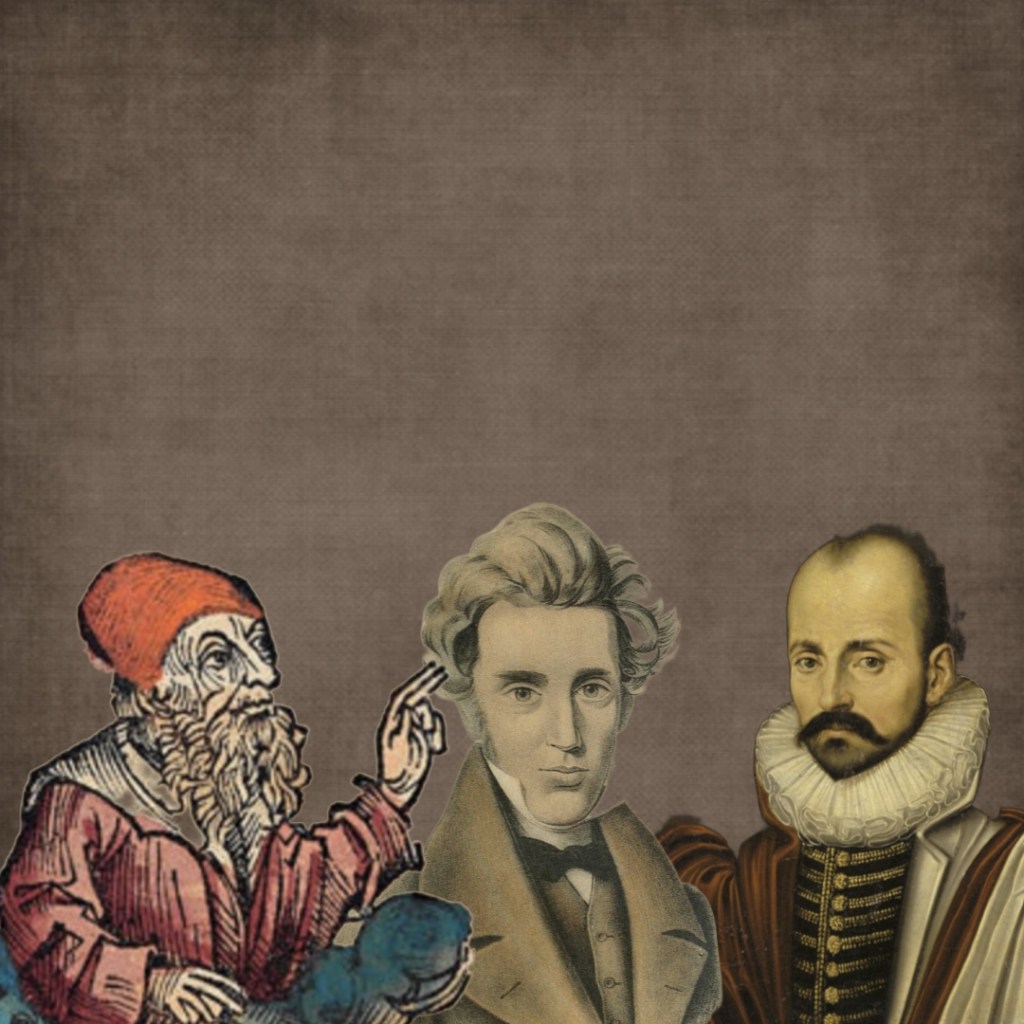
From Left to Right: Boethius, Keirkegaard and Montaigne. Courtesy: Abdullah Rayhan
“Do you hear the whisper of the shadows?
This happiness feels foreign to me.
I am accustomed to despair.”

-Forough Farrokhzad (1934-1967), Iranian Poet and Filmmaker

We seek psychotherapy to deal with the distress, sadness, depression, and psychological dimensions that are beyond our reach. Even after going through the medical procedure, we are seldom left with the satisfying sensation we deeply crave. This is where philosophy comes in.

To Socrates, philosophy was basically the way to live a life. He mainly observed how life functions and examined the influences that allocate life with certain affects. Other philosophical ideas too somewhat try to interpret the nature of existence in a similar manner. There are tons of such schools: from absurdism, to existentialism, nihilism, Hegelian, Kantian, and whatnot. But, apart from offering ideas and perspectives on existence, what else do they contribute? It can be a bit vague to trace the purpose of such philosophical ideas where the basic understanding, instead of leading toward fulfillment, can plunge us into the deepest pit of darkest despair. Existential philosophy will constantly remind you of life’s futility, ethical philosophies will keep painting idealistic portraits all to no avail. Finally, you are left with novel knowledge that does not necessarily help you deal with the struggles drowning your heart within a blurry tumult.

Fortunately, practical application of philosophy exists. Last year, when I was particularly at my lowest, estranged from everything I adored, all prospects of happiness ruined, abandoned to face monstrous adversities with a heavy bleeding heart, I found Boethius[1] comforting.

Camus, Sartre, and Nietzsche will comfort you with the assurance that you can construct optimism with your own effort. They tell your life has no inherent meaning, thus you are allowed to come up with your own sense of existence and give it any meaning you can conjure up at will. Bentham will tell you how to establish collective contentment. Kant will give you formulas to maintain peace. But none of them essentially gives a clear picture of what happiness really is. This makes Boethius unique. He doesn’t adhere to any false hopes, he rejects all things that are constructed, yet, through a transparent honesty, he shows a path that can lead toward organic satisfaction, not laced with any promises of universal fulfillment, just simple reasoning advocating for individual contentment.

Boethius basically inspires us to contemplate on our happiness. He directly questions the idea of happiness we so intimately endorse. Boethius asks you,

“Do you really hold dear that kind of happiness which is destined to pass away? Do you really value the presence of Fortune when you cannot trust her [Fortune] to stay and when her departure will plunge you in sorrow? And if it is impossible to keep her at will and if her flight exposes men to ruin, what else is such a fleeting thing except a warning of coming disaster?”

We consider ourselves lucky when we get our desired happiness. But, being lucky or ‘fortunate’ cannot be the standard that constructs happiness. In Boethius’ words, “happiness can’t consist in things governed by chance” mainly because there’s no guarantee it will last. He argues anything that is ephemeral, transient, and temporary cannot be of any value in terms of happiness as when that happiness evaporates, it is replaced by sorrow that is sometimes too much to bear. In this way, state of happiness is “a warning of coming disaster”. Happiness should not be the reason for despair and discontent. Thus, happiness brought by luck is not what it appears to be. 

He further asks if something that is temporary can really be claimed as one’s own. Boethius’s voice renders one mute when he states, “I can say with confidence that if the things whose loss you are bemoaning were really yours, you could never have lost them.”

A significant portion of Boethius’s argument is surrounding the transience of happiness. If happiness lies in what’s temporary, then isn’t misery temporary as well? Boethius puts it with much clarity. He comforts you, saying: “If you do not consider that you have been lucky because your onetime reasons for rejoicing have passed away, you cannot now think of yourself as in misery, because the very things that seem miserable are also passing away.”

Boethius inspires you to wonder about the nature of misery. We are miserable, sad, melancholic usually because we had a taste of happiness sometimes in the past, which is missing at the moment. We were happy once. But happiness is no longer part of our lives, and this absence is what’s causing our misery. Had we not had that happiness before, we wouldn’t have the misery that chokes our heart with a suffocating grip. This is the reason Boethius called happiness “a warning of coming disaster”.

Think about it. Someone who is currently living the same life as you may not be in similar misery as you because, as they haven’t had the happiness you had, they are not burdened to deal with the absence that you are compelled to plummet in. Thus, neither happiness nor misery operate based on any strict blueprint, rather it is something formed by one’s own experience and are inter-dependent. Boethius puts it very eloquently saying, “There is something in the case of each of us that escapes the notice of the man who has not experienced it, but causes horror to the man who has […] Nothing is miserable except when you think it so, and vice versa, all luck is good luck to the man who bears it with equanimity”. We lose our ability to “bear it (despair) with equanimity” because of our past interactions with pleasant experiences.

Perhaps you would relate to Boethius in terms of misery though not in an entirely literal sense. Boethius had everything. A beautiful wife, two affectionate children, popularity, respect, novelty, an amazing home, and enough money to live without any worrying. Yet, because of some false accusation, he was suddenly deprived of it all and was imprisoned. His happy life suddenly became a dark den overpouring with impenetrable despair. Many of our misery too is born because of its contrast to the time when we were happy. Now think about it for a moment. Boethius was devastated in the cell because he previously had a satisfying life. Had he lived like a homeless person with nothing of his own, the confined space of that very cell would appear satisfactory because of the roof over the head and chunks of food on the plate no matter how dim and damp the dark roof or how stale the smelly food. It shows how subjective the texture of happiness is.  

Boethius deconstructs the common perception of happiness, breaking it down to a rather ‘mundane’ prospect of life on the contrary to our belief of it being a significant one. He believes our idea of happiness itself is laced with misery. He proclaims, “how miserable the happiness of human life is; it does not remain long with those who are patient and doesn’t satisfy those who are troubled.”

So, if happiness indeed is of the nature that compulsorily leaves one unsatisfied, then does happiness deserves to be attributed with divine epithet? Boethius disagrees. He presents a compelling argument for this, saying, “[H]appiness is the highest good of rational nature and anything that can be taken away is not the highest good – since it is surpassed by what can’t be taken away …” It is the unreliability of our perceived idea of happiness that makes it a futile one with little or no value.

So, if happiness is something that is transient, unreliable, and can never offer the contentment it promises, then is happiness really something to chase after? “Happiness which depends on chance comes to an end with the death of the body,” propounds Boethius. Thus, to cling on to happiness is to cling on to a slippery rope dangling on top of a void filled to the brim with invisible abyss. You cannot do anything to make this notion of happiness fruitful in the sense you believe it to be. Boethius thinks it’s foolish to attempt to make this ineffective happiness endure and persist. He words it differently saying, “what an obvious mistake to make – to think that anything can be enhanced by decoration that does not belong to it.” Thus, again, the problem lies with the way we shape the notion of happiness.

As our immediate cognition tells us, the most apparent formula of happiness is a combination of romantic love and successful career. But is it really true? If you have understood Boethius, you probably realise that these temporary agents (romantic partner and career) cannot make you content for long. Something that is not entirely yours own cannot get you that contentment you crave. Kierkegaard too agrees how things that are not inherently one’s own are subject to loss, thus misery. Kierkegaard delivers the idea with a touch of subtle humour,

“Marry, and you will regret it; don’t marry, you will also regret it; marry or don’t marry, you will regret it either way. Laugh at the world’s foolishness, you will regret it; weep over it, you will regret that too; laugh at the world’s foolishness or weep over it, you will regret both. Believe a woman, you will regret it; believe her not, you will also regret it… Hang yourself, you will regret it; do not hang yourself, and you will regret that too; hang yourself or don’t hang yourself, you’ll regret it either way; whether you hang yourself or do not hang yourself, you will regret both.”

Kierkegaard and Boethius clearly intersect at certain points. Having happiness too, with its transience and all, is always the cause of a constant despair. Boethius very wittily points out that when we don’t have happiness, we strive and struggle to attain it. Once we have attained it, we become anxious to preserve it because no matter how much we enjoy happiness, at the back of our mind, we are aware of its temporary and fragile nature. This is why Kierkegaard says all our prospects of happiness are ultimately fated to end up in regret. Michel de Montaigne words this human tendency more concisely saying, “he who fears he shall suffer, already suffers what he fears”. In other words, as being in happiness always contains the risk of losing the happiness, this fear actually prevents one from ever fully attaining that state of mind.

Kierkegaard reaches such a conclusion because he too believed happiness as we know it is transient and fragile. The reason, as he locates, is its inorganic essence. Happiness modified with external force will never be permanent or make one content. He imagined happiness as an inswing door. He says, “the door of happiness opens inward, one should keep aside a little to open it: if one pushes, they close it more and more”. This is to say that one should not put any external force to influence happiness. That way, it’ll only cause more damage than good, or as Kierkegaard words it, the door of happiness will “close more and more”.

This overall means, our understanding of happiness, which is generally tied to external factors, can never bring within our reach the happiness we idealise with transcended romanticism. Thus, we are putting so much value in that idea of happiness in futile attempts, not knowing what it has in store for us while in reality it does not deserve to be the glorified item that sits at the epitome of human desire.

Interestingly, Boethius, Kierkegaard, and Montaigne have similar ideas on obtaining true contentment. They all agree that it’s not attainable with external properties and should be dug up from ones within. They commonly emphasise internal resources over external acquisitions.

Montaigne, for example, closely focuses on the nuanced foundation where the true happiness lies. Yes, material and metaphysical attainments can make us happy, he agrees, but not genuinely as we want it to be. He suggests, “[W]e should have wife, children, goods, and above all health, if we can, but we must not bind ourselves to them so strongly that our happiness depends on them. We must reserve a backshop wholly our own.” Similar to Boethius, Montaigne too recommends not relying our happiness on subjects that are subject to transience. Rather he advices to “reserve a backshop”. This “backshop” is the inner sanctum, a profound part of ourselves that remains untouched by the outer world, free from all kinds of external force. He designs this backshop as a space “wherein to settle our true liberty, our principal solitude and retreat”.

Kierkegaard too advocates for contentment that arises from within rather than from external influences whose essential nature is transient. In Kierkegaard’s perception, similar to Montaigne’s, it is silence, solitude, and introspection within us that can get us the contentment we idealise as happiness. He perceived all kinds of temporal gains as a reason for eventual dissatisfaction and advocated for things that remain untainted for eternity like intellect and truth.

Similar to Kierkegaard and Montaigne, Boethius agrees it is internal stability that overpowers the temporary shower of ecstatic sense of euphoria external fortune brings. Boethius advocates for this internal stability with better wording,

“If you are in possession of yourself you will possess something you would never wish to lose and something Fortune could never take away.”

This internal stability, according to Boethius, comes from one’s power of reasoning. Similar to Kierkegaard, Boethius prioritises intellectual resources because it has the ability to make one indifferent to their own fate. Intellect can make one recognise that there cannot be any prospect of contentment in things that are unstable, and everything that fortune brings is laced with this vicious instability. By fortune, Boethius does not mean a sudden stroke of good luck that potentiates all of our solvencies, but rather it’s everything good that happens to us without our own effort whether it’s a small gift from a loved one, or the smile of a baby. These make us happy, yet these are external forces. Fate intervenes in our life, leaving us with little to no control over our own selves. We can’t control a baby from smiling, and we won’t get out of our way and prevent a loved one from offering us a flower which they have invested so much thought in, but when babies do not smile at us, or when no one is left to offer even a stem of flower to us, that is when we experience a suffocation that could break our already shattered heart. Boethius asks us to realise all these with a clear conscience and allow our intellect and power of reasoning to locate what’s unstable and help us grip onto only what’s inherently ours.   

All these perspectives boil down to the fact that the reason we are not happy isn’t because we are constantly chasing it, but rather we have a wrong perception of what happiness is. Happiness is not the greatest good, nor is it anything to die for. It is, as clichéd as it may sound, something present within all of us with a very apparent eminence, and all one has to do to access it is have an open mind and reach ones within with honesty. Through this lens one doesn’t have to ‘imagine’ Sisyphus happy, rather Sisyphus is ‘happy’ for real and for eternity.

Works Cited:

On the Consolation of Philosophy by Anicius Manlius Severinus Boethius

Either/Or by Søren Kierkegaard

[1] Anicius Manlius Severinus Boethius (480-524), Roman statesman, historian and polymath

Essais by Michel de Montaigne

Abdullah Rayhan studies Literature and Cultural Studies at Jahangirnagar University.

.

PLEASE NOTE: ARTICLES CAN ONLY BE REPRODUCED IN OTHER SITES WITH DUE ACKNOWLEDGEMENT TO BORDERLESS JOURNAL

Click here to access the Borderless anthology, Monalisa No Longer Smiles

Click here to access Monalisa No Longer Smiles on Kindle Amazon International
Categories
Interview

Shantanu Ray Chaudhuri: A Seeker of Serendipity

In conversation with Shantanu Ray Chaudhuri

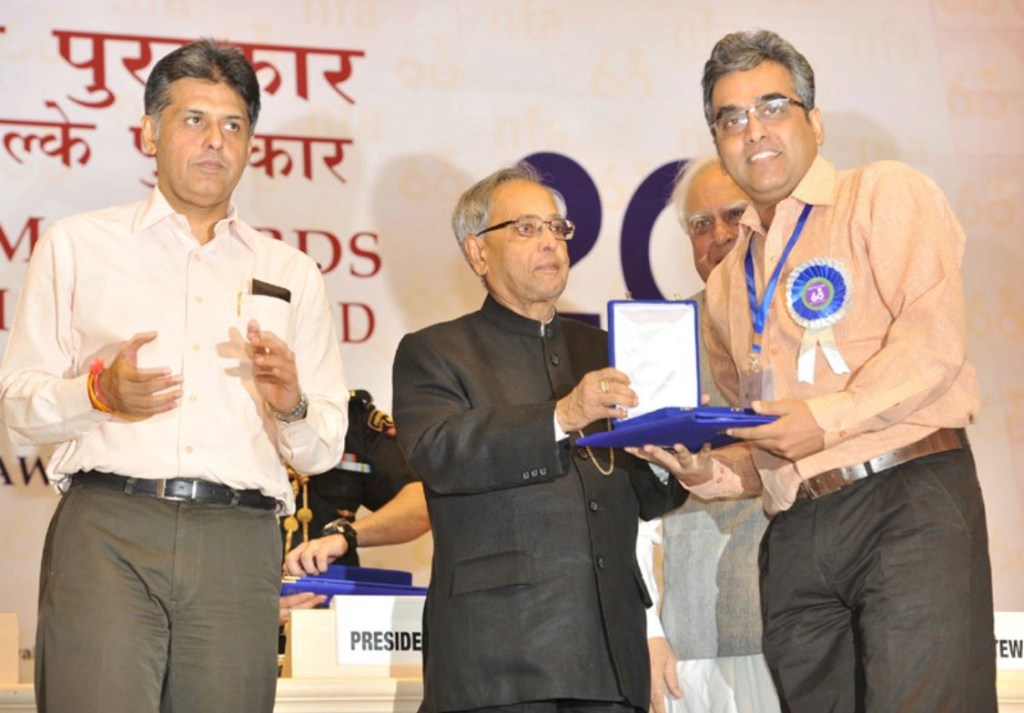
Indian President Pranab Mukherjee presents the Swarna Kamal Award to Shantanu Ray Chaudhuri at the 60th National Film Awards ceremony in New Delhi in 2013. Photo provided by Shantanu Ray Chaudhuri

Sandman, the mythical dream maker from Scandinavia, is said to sprinkle magical sand on sleeping children’s eyes to inspire beautiful dreams. What could Sandman have in common with a much-fêted editor who has worked with many celluloid stars and writers?

They both vend dreams – one makes dreams for children and the other is tries to fulfil dreams of writers attempting to create a beautiful book. Meet one such seeker of serendipity Shantanu Ray Chaudhuri, an eminent award-winning editor, who has brought out books on and by film personalities of India as well as assisted less-known writers find a footing in the tough world of traditional publishing. His magical sand is impeccable editing and an open outlook that stretches beyond the superficial glitter of fame and delves deep to look for that hidden well from which he draws out the best in a writer.

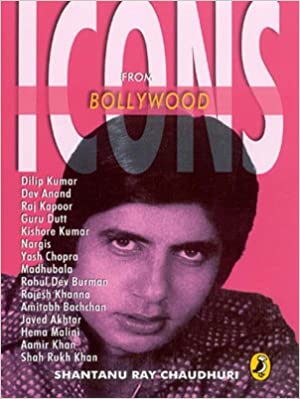
Books commissioned and edited by him have won the National Award for Best Book on Cinema twice and the inaugural MAMI (Mumbai Academy of Moving Images) Award for Best Writing on Cinema. In 2017, he was named Editor of the Year by the apex publishing body, Publishing Next. He has worked with famed writers like Gulzar and Arun Shourie as well as Bollywood stars like Rishi Kapoor and with the prestigious Satyajit Ray Archives. He has a book called Icons from Bollywood (2005) with Penguin on films, a set of fifteen essays. And he writes wonderful pieces on films for various sites like Cinemaazi, an archival film website,  and Free Press Journal regularly.

But, Ray Chaudhuri is not just a film buff as he tells the world. He has a well-kept secret like ABBA’s ‘Nina Pretty Ballerina’, who would wear dancing shoes after work and turn into a phenomenon. He emotes beautiful poetry but hesitates to publish…He does have a book of verses though called Whims brought out by the Writers’ Workshop. In this exclusive, Ray Chaudhuri, who has worked in Penguin and Harper Collins and now is the Editor-in-Chief of Om Books International, tells us how he turned from a dry accountant to a seeker of serendipity and what it takes to publish with traditional publishers.

Please tell us what started you out on your journey as an editor and writer.

I have always loved the word serendipity. It accounts for whatever good I have experienced. I loved reading of course but went on to become an accidental editor. I started very early – loved books. Went through the age-specific lists – Hardy Boys, Alfred Hitchcock and The Three Investigators, and Tintin (which I love still), then slowly to Conan Doyle and Agatha Christie and P.G. Wodehouse, Satyajit Ray, Feluda and Shonku, Somerset Maugham, Camus and others.

In fact, I remember, during summer vacations, my mashis [aunts] would often ask to pluck grey hair from their heads and would pay me at Re 1 per hair. So, if I managed 25, I would have money to buy a Tintin. Or novels that were sold in second-hand shops at Rs 10-15. I wanted to study literature and humanities but at the time the stream was looked down upon. People whose opinions we respected kept saying, ‘Will you be a schoolteacher after studying humanities?’ I wish I had said yes at the time.

Anyway… Science I was sure I wouldn’t take. And humanities I wasn’t allowed to. So, I took up commerce, graduated, did my M.Com, studied for chartered accountancy and cost accountancy. Then for years worked in accounts and finance. And hated it. I would leave jobs and go off quite regularly.

Meanwhile, I had started writing poems and on films (as a means of escaping the drudgery of accounts and finance). These were published in magazines regularly. In fact, I won the Filmfare Best Review Award that they had every month a few times. Then, Writers Workshop published my first book of poems. And by this time, nearing thirty, I had had enough of accounts. I realised that any creativity in accounts would lead to jail! And I was damned if I could put up with another day of matching debits and credits. I enrolled for a mass communication course at XIC Mumbai, then started a magazine on cinema on my own, and subsequently moved to publishing and editorial.

What pushed you into publishing others over writing yourself for we can see you are an excellent writer too?

I have often asked myself: do I have anything to say that will make a difference to someone reading? Can I ever write an opening sentence as eloquent as Camus’s The Outsider? Or create a character like Larry Darrel in Maugham’s Razor’s Edge? Or one line like Rilke’s ‘For the Sake of a Single Poem’. Or, in fact, a draft of an unpublished novel a young friend of mine, Ramona Sen, asked me to read recently to comment on editorially – it is so good … could well be the next big thing in publishing. And the answer has always been ‘no’.

I look at what goes for writing today. It dismays me that books have become all about posting your picture with the cover and getting likes – it has to be more than getting FB likes, more than announcing your book as bestseller on social media. I would be mortified about unleashing anything as mediocre as these on anyone.

And then there’s also the question of what being a ‘writer’ means for you as an individual. Some of these authors and poets I meet are so conceited … I have doubts about myself as a person … you know, as Matthew 16:26 says: For what will it profit a man if he gains the whole world and forfeits his soul? These doubts about whether my writing amounts to anything, whether it says anything about me as a person have kept me from writing and more importantly publishing my writing – barring of course my columns and features on cinema.

Editing and publishing other people’s work is more impersonal – I can keep myself out of the equation. Though when you really like a book, you do tend to get emotionally involved.

You have authored a book of poems, Whims, and Icons from Bollywood. Tell us about these.

I guess both came off just like that – I wonder if there was a case of wanting to show off at the time I had published them. Today, I would think twice. The book of poems, Whims, was published by Writers Workshop, and I was rather proud at one time that Professor Lal deemed it worthy of being published. I often told myself that some of the best Indian poets began with Writers Workshop. I just sent it off to him on a whim.

Icons from Bollywood was a more organised affair. I was working at Penguin at the time. Its children division was doing a series of books on icons – the arts, science, music, etc. Since everyone knew my interest in cinema, I had even met a few of the icons, the publisher, Sayoni Basu, asked me and I agreed. Eventually as no two people could agree on the ten names for the book – all the books in the series had ten icons – this ended up having fifteen names, the only book in the series with fifteen essays. It did rather well, got some good reviews in Dawn and Guardian and a few others.

Is authoring a book more challenging than editing and publishing for another? Or is it the other way? Please elucidate.

Of course, writing a book is more challenging. When you edit, you are working on adding some value to what a writer has already put down. You are not creating the world. At best, you help the author develop his work. It is challenging because often you are the first reader outside the author’s circle and your opinion also shapes the book. But writing is way more difficult. You are literally creating something out of nothing. Even writing a single line of good poetry is tougher than editing.

Tell us what moves your muse for poetry and prose?

That’s tough. It could be anything. For instance, in my college days DTC buses used to have a single passenger seat right at the front. I would often look at it and imagine how lonely it might feel. I eventually wrote a poem on that. Or when my folks narrated the story of Gulzar’s film Lekin to me, I was moved enough to write a poem. The sight of a battered old man, dead-drunk, lying by the roadside led to a story – what if that man had a past when there was hope and love in his life. Being in love has been a muse: I once wrote 21 poems for a beloved friend’s twenty-first birthday. The sight of my son’s sleeping face, his soft breathing, when I wake up at night and look at him. Even hate inspires you. The sense of disillusionment I felt about a ‘great’ poet’s pettiness and hypocrisy led to one of my best poems. My own frailties. The light at dusk, a tired day going to sleep. Lost friends … lost ideals. A good film. A bad film. Anything really.

We have read a lot of film pieces by you. When did your interest in writing for cinema start and how did it take off? Did it ever stray to film industries in other countries?

I think the love for cinema developed once I started studying commerce. The subjects bored me. Films offered me an escape. It helped that there were 4-5 cinema halls within walking distance of both my home and my college. I would often get away from college and make my way to a theatre. In the three years of graduation, I watched 169 films in halls. I watched the first-day-first-show, 12-3, and then would make my way to the evening one 6-9. I used to make a list and write down synopsis of what I felt. This was the 1980s, theatres were in awful shape, a really bad time for films and so most of what I watched were utter crap. But that was a lesson in itself. And I really enjoyed the escape to another world, even if a trashy one.

Slowly, with the coming of cable TV, there were more options. The VCR had come in and with that a few more options. Pirated prints from Palika Bazar. I had meanwhile written a few reviews for Filmfare and won a series of best review awards. That boosted my confidence in both my writing and my understanding of cinema. I also did a course in film and TV from the XIC, Mumbai. I started contributing to journals. I ran and wrote for the journal I started in Bombay, Lights Camera Action. But things took off after I started writing on Bengali cinema for Film Companion. And then with my association with Cinemaazi. I must thank Anupama Chopra and Sumant Batra for this. Couldn’t have happened without them.

I publish primarily on Bengali and Hindi cinema but write on a lot of international films for my own self. It’s tough finding time to watch, write, while keeping to the demands of a regular job and other freelancing assignments that one needs to do to keep the home fires burning. I envy the people who have money to spare, don’t have to worry about a job, and can keep churning out books.

Please tell us a bit about Cinemaazi – is it a website founded by you? It seems to be an archive, there is mention of an encyclopaedia?

Cinemaazi is the kind of serendipity I have been looking for as editor and film lover. It’s an initiative to document the history of Indian cinema across languages under the umbrella project Indian Cinema Heritage Foundation, a public charitable trust. The Foundation is also creating a freely accessible digital archive and encyclopaedia of Indian cinema and its people. No, I am not the founder. It’s entirely the brainchild and vision of Sumant and Asha Batra. Sumant is the kind of collector you can only be in awe of. I met him first at the Kumaon Lit Fest that he runs. And we shared a common love of cinema. In 2019, he started talking of a site to document the history of Hindi films, using his huge collection of film memorabilia. My only contribution, if you could call it that, was suggesting we make it a site on pan-Indian cinema, not just Hindi. He agreed and I worked on getting some material on Bengali and some other languages. Also kept contributing to it with articles and some video essays – we did a six-hour-long oral history project with Dhritiman Chatterjee. Cinemaazi got off to a very good start in January 2020. But by March 2020 we were all locking down. And it affected an endeavour taking its first steps. But it kept on working thanks to a small dedicated team. And now it’s poised to take off in a big way. I would have been very happy to engage in a bigger way with Cinemaazi, but as Sumant says, ‘he can’t afford me’, whatever that might mean. Sigh! I guess one ceases to be useful after a time. I am happy to have been a part of it in a small way in its first years.

You have worked with many icons of the Indian film industry like Rishi Kapoor, Satyajit Ray, Gulzar. Please share with us a few of your more interesting experiences.

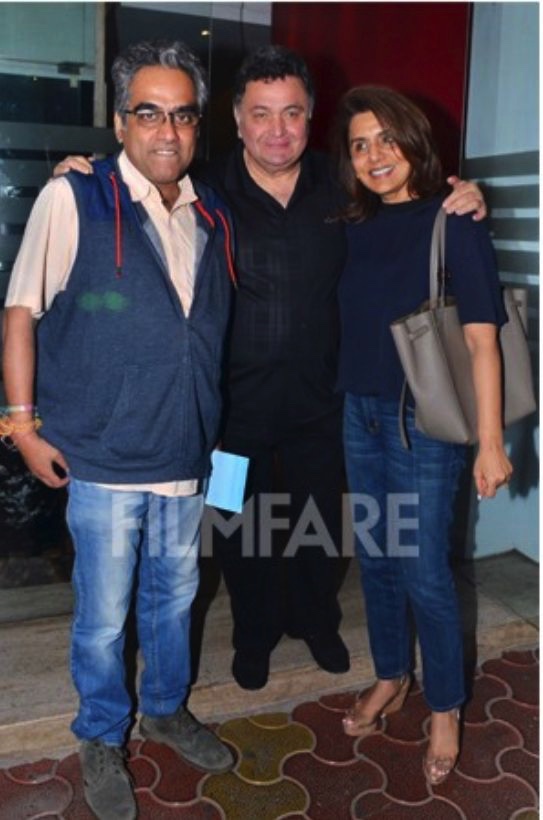
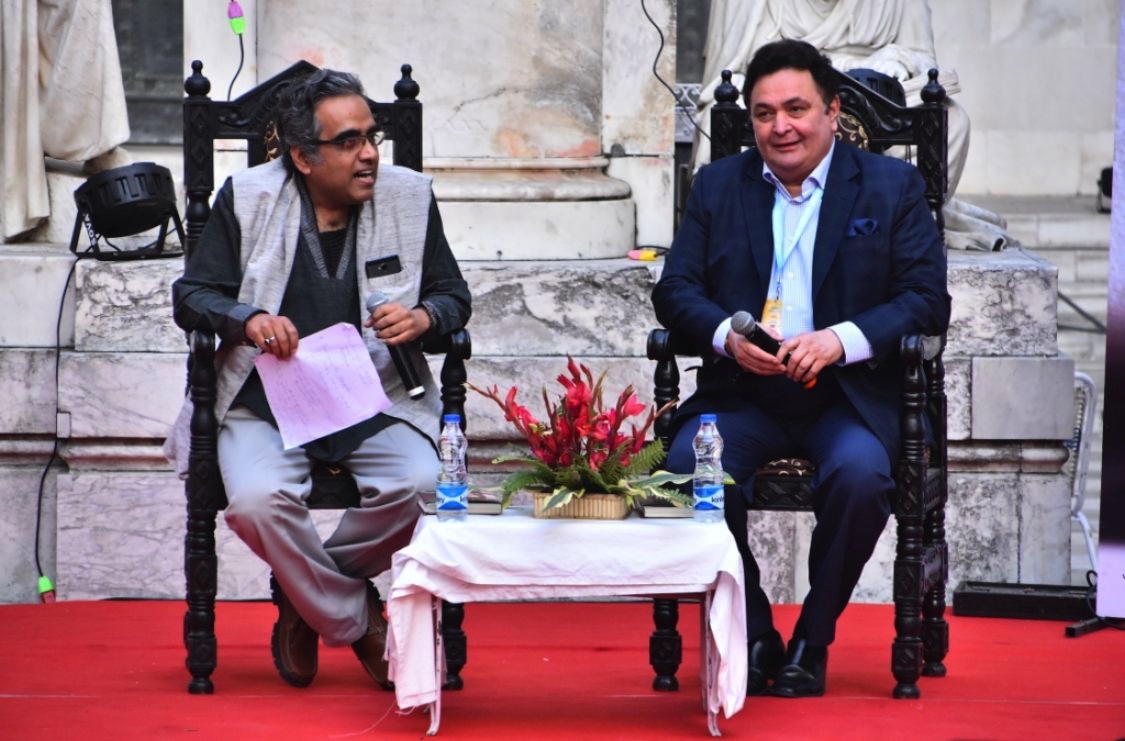
The big names I worked with like Gulzar and Rishi Kapoor and Arun Shourie were like perks of the job. Yes, they were FB like/share moments except that I seldom shared those days. I miss Rishi-ji a lot … and often go through the WhatsApp messages he sent me… With Gulzar-ji, it was all about poetry and translations. Never worked on a book of films with him, though I did commission a series of monographs on three of his films that came out after I had left the publishing house.

Shantanu Ray Chaudhuri in conversation with Gulzar and Meghna (Gulzar’s daughter) in Jaipur Literary Festival

The Satyajit Ray association was immensely satisfying. We ended up publishing five very rare books that I think not many editors would have dared to – imagine doing a book on Satyajit Ray’s unmade film on Ravi Shankar! The ones I really enjoyed were the first-time authors I was privileged to publish, people like Balaji Vittal, Anirudh Bhattacharya, Akshay Manwani, Rakesh Bakshi, Parthajit Baruah … and so many. They had no reason to trust me as editor and publisher. I have never been a big-name editor. But to have had them trust me with their books, books that did well, was quite humbling.

I was privileged to have someone like Vishal Bhardwaj trust me with his first book of poems in English. And through Vishal, I came to know Rekha and worked on a series of festival appearances with her – she has so many stories that she should do a book. With Sharmila Tagore, I worked on a book on Mansur Pataudi that did very well. Authors like Krishna Shastri, Sathya Saran and Gajra Kottary became close friends. Rakhshanda Jalil … whom I love and admire – she did a wonderful book on Shahryar with me and a couple of other translations of Gulzar and Kaifi Azmi. There was Nasreen Munni Kabir and her book on Zakir Hussain…

The more interesting encounters are the ones that ended badly. An author, who again published first with me and went on to publish 4 more, turned on me because I took on his rabid right-wing wife on the CAA and their obnoxious reference to ‘urban naxals’ … I was abused and received a lot of threatening messages and calls … I lost a friend and an author, but I am glad I could take a stand on a matter on which many of our ‘liberal’ friends and authors remain silent. Another ‘great’ poet, someone I considered God, turned out to have feet of clay and whose behaviour I find traumatic even today. But those are for my memoir! They taught me a better lesson than anything else could.

You have worked with big multinational names like Penguin and HarperCollins and even brought out collection of books on films. And now you have moved to working with one of the oldest and most iconic publishers from India. Is the experience any different?

Well, the best thing about not being with an MNC is that one is not part of the toxic environment they breed. It was killing after a point. And often they wouldn’t take on an idea just to spite you, even though some of the books that got commissioned were unbelievably bad, had me scratching my head, wondering what I had missed. And they can be very demeaning to authors. And short-sighted too. I remember signing up Rahul Rawail’s memoir of Raj Kapoor. And the publishing house actually reneged on its commitment after sending him an offer. It put me in such a bad place with him. Thankfully, I could get him another MNC publisher. And the book is now getting such rave reviews.

Yes, it’s challenging working in a smaller space. You have nothing going for marketing –  not that the biggies do anything much on this either, unless you are already a big name which makes it easy to market. Then you don’t have budgets for advances and for marketing. So, immediately your commissioning acquires a different take. But that also makes you look for good young talent. I am glad I have found quite a few, thanks to agents like Suhail Mathur and some goodwill I might have built up in the last few years. Authors I am sure I wouldn’t have been allowed to publish in the MNCs. Now, whether they sell and work in the market is a gamble.

Writers find it challenging to use traditional publishing. In an attempt to make their writing visible, many are turning to self-publishing and publishing with independent small publishers. What do you think of this trend?

I think it does take a little more time in going the traditional publishing route. Self-publishing is quicker. But then authors also need to be patient. Traditional publishing can give them benefits of a good editor. Give them more time to polish their text. However, it seems more and more authors are in too much of a rush to publish. Getting FB likes and shares is more important than working on your text. Authors don’t feel like they need good editorial intervention. Publishing is all that matters, whatever be the quality of writing.

Unfortunately, traditional publishing too has failed to give good editorial inputs. Some of the stuff I read by the MNC publishers are atrocious. I think everyone wants a book out too quick. When I started out as an editor, we had months to work on a book. These days, authors tend to ask for a marketing plan even before they have completed the first draft of the text. And publishers are only too willing to get on the treadmill. And the post-publication efforts of MNCs also operate on the 90-10 principle: 90 per cent of marketing budget is spent on 10 per cent of the biggies. So, I guess self-publishing works. Some of the most successful mass-market writers we have today started with vanity or self-publishing, then were picked up by the traditional publishers. And the writing continues to be as bad.

Can you tell us as a publisher, what do you look for when you accept or reject a piece of writing?

I don’t think any publisher has figured out what makes a book work. Most of them go by herd mentality: mythologicals are selling, let’s do them, in trilogies, since it’s fashionable these days. Short stories don’t work. Fitness/self-help, yes, let’s do. 

Basically, one looks for (i) is the content engaging (ii) is the writing interesting. Take, Akshay’s book on Sahir … I found the content wonderful. And so well done. Or Balaji-Anirudh’s book on RD Burman … the research was impeccable. And though people were sceptical, saying these people had been dead for decades, one felt that these books had that special something. Or more recently, the anthology on motherhood that Om is publishing. I was immediately interested in the theme and the variety of essays on offer – to have Kamala Das and Mannu Bhandari, Shashi Deshpande and Shabana Azmi between the same covers is…. There’s a collection of essays on the pandemic that I have commissioned, coming out soon – again, from Shashi Tharoor and Vidya Balan to an anonymous gravedigger and migrant worker – the range is incredible. The book that we are doing with Borderless Journal, for example. What a wide variety of international writing! Or the book on cybersecurity. Or for that matter, Suman Ghosh’s Soumitra Chatterjee book, which gave some fascinating insights to the director-actor relationship. I knew people would think it niche, but what if we could make it big? It has the potential.

Thank you for that. What is your vision as a publisher and writer of the future of publishing and writing?

I am too small fry to talk of the future of publishing. It’s a tough time for publishers. At the end of the day, all those 500 likes on FB won’t help if those liking don’t buy books. Social media reach is no guarantee of either good writing or good sales.

The way Westland folded says a lot about how untenable big advances are. Authors must realise that. While publishers must make efforts to sell more of the books they publish so that even if advances are small, the royalty on sales works out.

I think there’s also a lot of snobbery around English-language publishing in India. On the part of publishers, authors, translators, agents, literary festivals. I know an agent, one of India’s most successful, who doesn’t deign to pitch books to me because I am not with the top MNC publishers. Though apart from a hefty advance, there is nothing I cannot deliver that the biggies can. One of the most popular cover designers, who worked closely with me when I was at Penguin and Harper, just put me out to dry when I approached him for a cover on the Soumitra Chatterjee book. He couldn’t be bothered even to respond given that I was with a smaller publisher now. The most popular translator won’t give me time of day, though I edited his/her first book. There’s this author couple I published after both their individual books had been rejected at other publishers. But once they realised that prosperity lay in ingratiating themselves with what they perceived were other more popular and powerful editors … though none of their books have worked in terms of sales so far in the last ten years.

Most editors I have come across give off vibes like they are god’s gift to the language. I mean, not even two per cent of the population engages with the work you do. What are we so uppity about? The local cobbler attends to more people than what your average book gets as readers.

And this snobbery impacts the kind of publishing we do. We are suckers for big names, big advances. We have to move out of that. And out of this herd mentality of publishing. Give new writers, new themes a chance. At the same time, new young authors need to reflect on their work and not rush into becoming a ‘published’ author. It’s not instant noodles or coffee. Books and authors take time to develop. We need to give books that time.

Thank you for giving us your time and also taking on our anthology.

Click here to read poems by Shantanu Ray Chaudhuri

(This is an online interview conducted by Mitali Chakravarty.)

PLEASE NOTE: ARTICLES CAN ONLY BE REPRODUCED IN OTHER SITES WITH DUE ACKNOWLEDGEMENT TO BORDERLESS JOURNAL

Categories
Slices from Life

Baudelaire and Paris

By Sunil Sharma

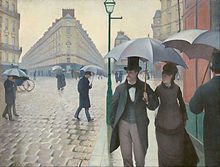
Gustave Caillebotte. Paris Street, Rainy Day, 1877. 

I

Modern Paris was discovered by Baudelaire in his avatar as the flaneur. And Walter Benjamin made this figure intellectually respectful as a field of study.

In a recent visit to Paris, I hovered between two allied states of being a flaneur and a gawking tourist. I had come as a sightseer from Mumbai, India, allured by the tales and well-crafted image of a mythic Paris, drinking in the street flavours on those May days, passively registering the wide monuments and boulevards and palaces and towers in one clean and clear sweep — almost like a wide-angle shot in a Stanley Kubrick film. Spring had set in and the Paris of May 2014 was full of eager tourists from nations as wide apart as China and the USA; Africa and Middle East and Latin America. A bouquet of the ethnicities strung together.

Then, I became a flaneur, making a neat switch, in a single instant.

I became Baudelaire.

Different terms can make you look differently at a similar set of things or a common setting.

Of course, I did not have the urge to write a new millennium version of The Flowers of Evil. At best, you can parody a sacred text but you cannot re-write it, howsoever Borges-like you might be.

I am neither of the two.

Like Mallarme and Verlaine, you can carry forward an idea by expanding it further but cannot imitate with complete fidelity to the original.

So, not in a mood for a cheap replication of a master praised by Proust so profusely, I took on the stance of a flaneur and became a connoisseur of the street-life.

Was it possible?

Assuming the role of a figure long dead or supposed to be dead? Replaced by a tourist? Solo or in a group?

Armed with a camera or a cell phone, in casuals, the modern tourist — guided by brochures and online information and a city map — looks at the urban skyline vicariously familiarized by prior research. Or, could it be at a professional polyglot guide spewing bits and pieces of history like a typical street performer or an amateur actor? A mass tourist consuming the city, architecture, culture, food, arts and clothes — public life — in a predictable way and sequence largely decided by the tourist industry. A few breaks are possible in that routine.

But to resurrect the role and agency of the classic flaneur, you have to take on a different position and way of seeing.

And what was that?

I could not become a dandy—detached, arrogant, inheritor of a small fortune, an idler walking a tortoise on a Paris street of the nineteenth century. Even if I had the means, I could get arrested for an act of animal cruelty!

Those were different times!

So what can be done?

The clues lie in The Flowers of Evil, perhaps.

Will this title be acceptable today? With changing definitions of evil? With life becoming more liberal and open?

Baudelaire was a dandy and a cultivated flaneur—the painter of modern life; a gentleman stroller of the city streets. Part of, yet apart from, the crowds.

But then, not every dandy is a flaneur and every flaneur, a dandy?

Again, dandy is a historical invention, a social-engineering, manufacturing of a social type for a particular age.

Perhaps, a metro-sexual male, now no longer fashionable.

Is he a voyeur?

Perhaps, we all are, given the nature of our society.

Or, a keen participant, an acute observer, a chronicler?

For me, the answer lies in the personality of Charles Baudelaire who in turn was influenced by Edgar Allan Poe. But that would be complicating things further.

Let us stick to our central figure Baudelaire. His genius lies in radicalizing the trope of the French flaneur. A theme that fascinated Walter Benjamin who, in the twentieth century, tried to essay the same role performed so well by Baudelaire in the industrialized Paris of the nineteenth century. The former could not capture the underlying passion of Baudelaire in this unfinished project.

In fact, by the late 1990s and start of the 21st century, author-flaneur proved an impossible figure.

Market forces, on global level, have incorporated author as a producer of kitsch or dystopia. Dissidents were slowly and subtly disenfranchised.

We are all sellers!

Baudelaire resisted this initial process in Paris. Beckett was next. Sartre and Camus too tried.

Then the flow stopped.

The Flowers of Evil mounts a challenge to the order and morality of the Second Republic.

The poems challenge the bourgeois morality and conception of order and beauty and aesthetics in a radical way. The book talks of evil and implies that the source of evil lies in its origins — capitalism.

In that simple gesture of observing, participating, recording of street life, Baudelaire liberates himself from his historical position and becomes a true artist. By talking of prostitutes and vampires, the poet shows the underbelly of capitalism. His creations provide the material basis for highlighting these themes and give credence to outcasts from the system that feed on the blood of the innocent and the gullible.

The Flowers of Evil is the greatest indictment of the French bourgeoisie by a person deeply embedded in it as a bourgeois but a radical one that unveils the brutal face of a system that once talked of revolutionary slogan of liberty, equality, fraternity!

An evil society can produce evil flowers!

Vampires are for real!

II

That Baudelaire had not died in 2014 was proven on a street near the Eiffel Tower on that memorable trip.

A Roma girl, bold and audacious, stole my son’s cell phone from his shirt pocket. She returned it after a cop intervened.

I could smell evil in the air. The disenfranchised and the ethnic Roma are still the threat — like the prostitute and the vampire, the perpetual outsiders.

The Paris of Baudelaire is not safe.

The shoot-out at the Charlie Hebdo proves that.

The vampires are out.

This time round, Baudelaire the flaneur has disappeared. There is no one to warn us of these sinister presences.

.

Sunil Sharma, an academic administrator and author-critic-poet–freelance journalist, is from suburban Mumbai, India. He has published 22 books so far, some solo and some joint, on prose, poetry and criticism. He edits the monthly, bilingual Setu: http://www.setumag.com/p/setu-home.html
For more details of publications, please visit the link below:
http://www.drsunilsharma.blogspot.in/
. This story was first published in Scarlet Leaf Review.

.

PLEASE NOTE: ARTICLES CAN ONLY BE REPRODUCED IN OTHER SITES WITH DUE ACKNOWLEDGEMENT TO BORDERLESS JOURNAL. 

.

Categories
Essay

Rebellious Thoughts At The Café de Flore

By Gaither Stewart

Whether revisionists and debunkers agree or not, the Café de Flore on Paris’ Boulevard Saint Germain is a living institution. Since its founding in 1870 it has existed as a café and a second home for French-speaking writers, artists and intellectuals of the likes of Apollinaire, Camus, Sartre and Simone de Beauvoir, and frequented by Hemingway and Truman Capote. In the 1920s and 30s, the Flore was the meeting place of the Right, after World War II of the Left. Forming a triangle with the famous but touristy Deux Magots (today taboo for the Parisian intelligentsia) and the Brasserie Lipp just across the street, the history of the Flore has always been linked with Paris, culture and political ideas. A remarkable vocation!

For purposeful urban walkers like Henry Miller certain cityscapes like Parisian coffee houses palpitate with the violent ideas that have made great cities like Moscow and St. Petersburg, Berlin, Munich and Budapest. It is impossible to pass the Café de Flore without pausing a moment to imagine Albert Camus and Jean-Paul Sartre ensconced at a back table in that left-bank citadel of thought on a rainy November day, in fervent discussion of the rage and the alienation and the revolt and the urge for revolution of their age.

In their works those existentialist intellectuals wrote the biography of European rebellion born with the French Revolution. Much of their thought was discussed or born in the Flore. Now, out on the boulevard just looking in, you might pause to wonder who is going to write the history of the great modern American Revolution, perhaps im gestation. When will it begin, some now wonder? Or has it already begun somewhere in the guts of America? The Flore stirs such thoughts in some minds.

There in the Café de Flore the two bold intellectuals, Camus and Sartre re-hashing again and again the idea of the metaphysical rebellion born in the western world after 1789, certainly evaluating also the year of 1848, the year Michael Bakunin and Friedrich Engels witnessed in a delirium of hope the second wave of revolution sweep across Europe, from Paris to Berlin and Vienna. Wave after wave of rebellion and revolution.

Sitting on the terrasse of the Flore today you can still evoke images of Paris 1968 here, right in front of you on this boulevard where many of the mobile scenes passed, an explosion only vaguely imagined by Sartre and Camus. The year that briefly, so very briefly, changed the world began here—until the tide of reaction rebounded, sweeping the eternal liberal bourgeoisie back into place in the world.

But readers of Camus will recall his conditioning in his books every Sartrean provocation with his own conviction of the Greek idea of limits. And you wonder who was right.

THE MASKS

Social masks are a threat. Yesterday, as today. In peace or war. In Fascism or in the revolution of workingmen. The bourgeoisie’s support for liberals has always been and always will be a great mystification to confuse the revolutionary. That is the reason for our mistrust of bien-pensant liberals, yesterday as today. The more liberals turn to the Right, the happier the bourgeoisie and the greater its support for “liberal” causes. And therefore the marriage of liberal democracy and market capitalism.

As it stands the gap between the people and what we call bourgeois capitalism is unbridgeable. Protest does not count a whit. Though the ultimate tremendous effect on the people of the wars in Afghanistan and Iraq and Syria is unimaginable, popular protest meanwhile still goes unheeded. Actually, the conclusion is simple: superpowers should never be confused with democracies.

Rebellion is a story of saying ‘no!’ But rebellion is not revolution. Today more than ever before rebellion against the current state of affairs and the transformation of rebellion into revolution is the task of the socially aware. With your back to the wall, in an over-loaded era, when the necessary decisions quiver and vacillate and become elusive, you nonetheless must choose.

Revolution is not only the explosion. Revolution is a long up and down period of drastic social change. Of the final reversal of everything that once was and its breath-robbing transformation into the new. Revolution is the new. Reaction to it represents the old.

REBELLION OR REVOLUTION?

Therefore the difference between rebellion and revolution is fundamental. Protest, peace marches and sit-ins are rebellious, not revolutionary. It’s a kind of either/or. However, rebellions do form a chain. In explosive ascendance. For there is no revolution without goal-conscious rebellion at the start, without saying “no!” to what was before. On the other hand, we see over and over that rebellion does not automatically produce revolution. As a rule it subsides and disappears until the next time.

So where do we stand today? Where are we in America? In Europe?  “An armed uprising anywhere is an absurd proposition”, an important person in my life recently wrote me. Those words underline the fundamental condition, the point of departure: consciousness. The consciousness, the awareness of one’s desperate situation makes rejection of that situation possible. Refusal to continue along the same old dead-end paths, refusal to accept them any longer. That awareness can lead first to rebellion, and from there it might mushroom into revolution. Might, because the three steps are not automatic and consequential. One does not necessarily lead to the next.

Unfortunately, social awareness is yet to be born in a concrete form in America. But that first basic step is in active gestation in today’s pandemic crisis. Some people are thinking. Why no public health care? Why no employment? Why the wars? You can imagine its bursting forth. To be followed then by contagious rebellion. And then, revolution can be made. Revolution is not a spontaneous affair; it is a result.

The events of 1968 on Boulevard St. Germain parading before Camus and Sartre were spontaneous and in time sputtered and extinguished amidst waves of predictable reaction. Spontaneity however helped plant the seeds of rebellion which each time splinter into a little streams and die out if minor objectives are achieved. But an overturn of everything that was and still is has to be nourished and managed.

Meanwhile, we of today have to deal with the very first step. With awareness. Without awareness of our real condition every act of rebellion is gratuitous and infantile, like. stamping one’s foot and saying “no” just to be ornery. Essential is the awareness of the real reasons for rebellion.

That is where 99% of Americans and Europeans stand today: dissatisfied but enmeshed in a cloud of unawareness of our real situation. Afraid to look into a mirror and see ourselves for what and where we are.

LIMITS

I try to imagine them today, the post-World War II intellectuals, in the Café de Flore, arguing, discussing, plotting, distinguishing. But ours are other times. New times. More complex times. They are not discussing revolution in Parisian cafés today. Maybe un petit peu of rebellion. Un petit peu of protest. Sneers and accusations against the reactionary, austerity-loving, European Union. Some lament the evaporation of the French-German-Italian Left. Staring into the Café de Flore from the street I imagine Sartre and Camus’ disappointment in the European Left, steadily losing ground to the nationalist, fascistic right everywhere.

But revolution? Non, merci! The only visible signs of even revolt against multinational Europe governed by its great banks subsidized by the taxes of the working classes are disgruntled Italy’s complaints against the European Union for its failure to help in the time of need when Italy was the only EU country infected by the coronavirus.

The French philosopher, Alain Badiou, once said in an interview with Rome’s La Repubblica that “often revolt remains entrapped in the modern world, reduced to a mere symptom of the illness. In the West, revolts are for the most nostalgic persons who aim at conserving the golden epoch of welfare in the name of an already superseded past.” The Occupy Wall Street movement, though with praiseworthy intentions, represented a handful of the endangered middle class. It was a petit bourgeois protest, in the absence of a link with the real disinherited of the planet. Few even remember it today.

DISTINCTION BETWEEN REBELLION AND REVOLUTION

In his book The Rebel, Camus deals with the Greek emphasis on “limits”. Even revolt (rebellion) has limits. In Camus’ vision “bad revolution” knows no set limits. On the contrary, so as not to degenerate into terror, the “good” revolution relies on the true sources of rebellion. Therefore, the “good revolution” must draw its inspiration from a system of thought which is faithful to its origins: thought that recognizes limits in the first place. Camus was not Robespierre.

Marx and Engels and Lenin spoke at length about this tricky topic. It’s good to refresh one’s thoughts at the source. The classical distinction is that made between a non-Marxian, spontaneous “insurrection” or “rebellion” or “uprising” and a formal revolution according to communist precepts. Of historical spontaneous insurrections, the classical case is the Spartacist revolt in post-World War I Germany, whose ill-conceived program soon met with defeat. The justicialist peasant revolts throughout the Middle Ages, which Luther denounced, shared that semi-anarchic aspect, even though at times they were led by charismatic figures, Spartacus himself being one.

One might say: My heart is with spontaneous insurrection, my reason is for eternal rebellion morphing into revolution.

This however is a false contraposition. For eternal rebellion is bound to morph into revolution, which perforce becomes “permanent revolution” or “constant revolution”. Rebelliousness without a real cause is a juvenile or neurotic disorder, a waste of human potential.

Lenin, Mao and Fidel suggested “constant revolution” or, “constant cultural-political revolution,” as the cure for the gradual corruption of a revolutionary project. Under conditions of “eternal revolution” (which the bourgeoisie caricatures as constant chaos) the masses do not retreat from the direct exercise of power as can easily happen. They do not sit back and become spectators of history, leaving all power in the hands of representatives who, with the passing of time, become a new privileged stratum, not a CLASS, as many claim!” (Milovan Djilas, The New Class)

BRUSSELS

The European Union (EU) appears today as the bourgeois restoration following the signs of rebellion that spread across the world after 1968. Some years ago the then French President Sarkozy in his role as rotating President of the EU assured his political model, George Bush, that the situation in Europe was under control. Aggressivity and rigidity were things of the past. The twenty-seven European nations had a common position. No more divisions. No more sass. Europe now spoke with one voice. Albeit a reactionary voice. And today reaction continues to sweep across Europe from Paris to Budapest, from Berlin to Rome.

This reactionary Europe is in a quiet, still subtle revolt against its brothers in the United States. This capitalist, reactionary Europe, though wounded by American hegemonic measures, wants to be heard, not however in disagreement with American capitalism. I fear it just wants more of it … a bigger piece of the cake.

The typical customers at the fashionable Café de Flore are no longer the intellectuals. Before the virus epoch began, tourists camped out on the heated veranda were looking for celebrities. Also on the terrasse and at the window tables inside the old café were the TV celebrities and the chic graduates of Paris’ elite schools like the ENA (Ecole National d’Administration) or the ESSEC business school, all dressed in their uniform, body-hugging black clothes and short black topcoats and fashionable stiletto pointed shoes. These elite school graduates—many of whom are the heirs of 1968—in our crisis situation today demand more and more lenient laws on firing and hiring. They evoke the American and British systems. Their motto is that of elite capitalism: “Fired today, a new job tomorrow.”

.

Gaither Stewart is a veteran journalist, his dispatches on politics, literature, and culture, have been published (and translated) on many leading online and print venues.

First published in Countercurrents