Categories
Stories

The Useless Idler

By Paul Mirabile

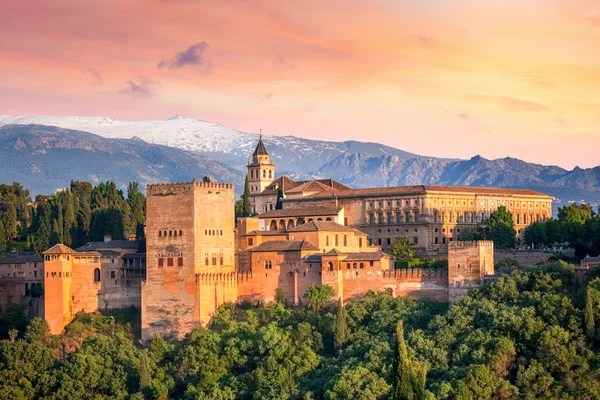
Alhambra Palace, Spain. From Public Domain

No one knew his name nor wished to know it. Only his face attracted those who came into contact with him. So it was said. A face whose huge, glowing eyes were turned both inwards and outwards, simultaneously. A face whose florid complexion, cheery and unfurrowed, bespoke a life of leisure, albeit not one of procrastination; a life of ease, but not sloth. In short, a life of early, unfought for independence.

I met my nameless stranger one fine autumn day in the Andalucian town of Granada, Spain, where he had been residing for several months, visiting the Alhambra Palace every day during those months. We had met in a small, non-distinct eatery, and he was very willing to converse with anyone who had leisure to tete a tete. We fell into lively conversation. Taken aback by his daily visits to the remarkable Palace, I enquired why he spent so many hours there.

“The Palace was built as a sign of religious, political and cultural power,” he began, munching energetically on his paella of rabbit. “But since 1492, that sign has been condemned to utter uselessness, reduced to a mere tourist attraction, however noteworthy. It has become completely useless since its mediaeval abandonment  because it’s been drained of its original value.” Here he paused, I imagine, for me to intercede. I didn’t …

“You see, this is what attracts me most to the Alhambra; its utter uselessness for our world today. I do not consider mass tourism as an instrument of usefulness.” I kept silent to goad him on, for the turn of conversation piqued my curiosity.  “The Alhambra epitomises all that I have spent my own life experiencing, consciously: the pleasures of uselessness.”

“Is uselessness a pleasure?” I nettled with a sunny smile.

“That depends upon whom it has been bestowed, sir. That depends for whom it has benefitted. The circumstances of my life and will to understand and decipher them, have conspired to draw me now into and outside of myself. My own self has become as useless as the objects that I set my eyes on each and every day as I saunter through the streets, gardens or palaces of wherever I happen to be. I have realised that such an absorption into social uselessness, and thus distance from social use, has constituted my raison d’être. And there lies the pleasure: this mode of existence is a project of life; a pure project of pleasurable uselessness to society and to myself.” His face, alit with integrity, bent low to attack the chorizos cooked in white wine sauce.

“When did you begin experimenting your project?” I asked, sipping my sangria.

“I would formulate it differently: When did uselessness experiment me!” he mumbled, his mouth full of chorizo. “It all began in Africa some thirty or forty years back, during my youthful days wandering through the Sahara desert en route to Timbucktoo. The Blue Men of the Sahara appeared absolutely useless to anyone or anything that we Europeans would call useful.”

“Such as?”

“Well, a roof over one’s head, a shower every hour, a steady, well-paid job, a car and such things … what we Europeans would term as useful, conditioned to adhere to the philosophy of infinite progress; to infinite social and political usefulness. All the Blue Men seemed to require were a few hours of sleep, food, water and the desire to procreate. Needs that all mankind need so as to account for our very presence on Earth. I lived in the desert for over a year, and little by little discovered that this lifestyle suited a possibility of existence, a life not of a desert-nomad mind you, but one of a useless idler, which as time went by, proved possible, be it in the cities of Europe and Asia or in their countryside towns and villages.”

“As I understand it, social success has no meaning for you at all?”

“Not at all. Success only invites humiliation or cruel jealousy, and the pursuit of wealth is a path marked by ruthlessness. I earn my living simply to eat, to dress according to the climate, to have a roof over my head when needed.”

“But a roof over one’s head could be expensive…” I intervened.

“I spend most of my nights out under the stars when the weather is warm. With the coming of winter, I seek refuge in Catholic missions, poor men’s shelters or in the numerous Salvation Army shelters. Any asylum that will not turn me down. As far as any permanent residence, I have taken up lodgings in the homes of generous people for a meagre fee, or have laboured on farms for my food and bed. Do not confuse uselessness with doing nothing. I’m no couch potato; I have done many things, but they do not fit into our social machine of imposed well-being. My life may appear negative to those who hold me in contempt, but my usefulness is as useful to mankind as it is to myself. Don’t forget what one Belgium writer once wrote: ‘It is thanks to a certain number of men who seem useless that there will always be a certain number of useful men.’”

“Who wrote that?”

“I forgot. But what difference does it make?” He wiped his mouth delicately, smacking his lips. He proceeded: “I imagine you probably believe me to be a social parasite or a social zero as Balzac once wrote, useless even as a human being. But read Friedrich Nietzsche on this point,” and he quoted: “’The value of a human being does not lie in his usefulnes; for it would continue to exist even if there were nobody to whom he could be useful.’”

“Quite an imposing thought,” I acknowledged, sitting back. “But you must admit that you have been useful to the kind people who hire you on or who lodge you, even for a small fee.”

He snorted: “Perhaps. But I cannot speak on their behalf, only mine.” I noted that he wiggled out of that one quite ingeniously. His face shone with a strange light. An aura of mystery gradually covered it like a gossamer veil. The light suddenly went out.

“I’m sure your effort to separate yourself from the social body must be a terrible struggle,” I pursued without irony. “I believe that to be estranged from the social body is commensurate with  being estranged from one’s own self. Am I right in assuming this?” 

“Perhaps, but not from the individuals of those societies. I am not a misantrope. This being said, solitude, fasts and meditation have prepared me for outer trials and tribulations, which I believe, without vanity, to have overcome.” He began picking his teeth with a very long fingernail.

“And God?” I rebounded, eyeing him steadily. His lips broke into an artful grin.

“He has been my only Friend since the beginning, sir. And why is that? Because we have been useless to each other since our initial communion.” He stood, evidently undesirous to develop this rather paradoxical statement. I let it drop …

We slipped outside and my nameless companion suggested that we have a quick jaunt through the ‘Arab Market’ in Zacaten. Indeed, the weather was warm, that Autumn weather which I have always found so stimulating in Granada; Granada, perched high in her mountainous refuge like an eagle in her lofty nest. My strolling companion strolled into my reverie.

“Look at the sky, a bluish turquoise which reminds me so much of the domes of the mosques in Bukhara, Uzbekistan. That turquoise which solicits silence and contemplation.”

“So you’ve visited Uzbekistan?”

“More than visited, my friend. I lived there for five years studying under the spiritual guidance of the Nakishbendi Brotherhood, a Sunna movement founded by the Shah Nakishbend, and which has survived the anti-religious crusade of the Soviet Union. With those kind and learned monks I learnt the virtues and powers of silence, contemplation, discipline, simplicity and periodical talks.”

“In what language did you speak to them?” I ventured, a bit intrigued by this singular experience.

“In Uzbek, of course!” he responded dryly. “I also learned to read Arabic.”

“But are silence and talks not contradictory?”

“Not at all, sir. Clusters of roses certainly grow silently, but good soil, air and pure water are needed for their basic growth. If accompanied by a soft, melodious voice, they grow better. Roses heed to that voice as silence heeds to constructive talks. It was during the alternating passages of silence and talks that our spiritual guides opened our eyes and senses to the uselessness of worldly matters, and since then, this uselessness has become my second nature, even my first! Mind you, this discovery has nothing to do either with self-love or atomistic individualism. As I said, I have relations with people, albeit brief; and although I keep aloof from community aggregation and national gatherings, I have never spend my life gloating in an ivory tower. No sir, I live for wanderlust not social or individual hubris! The lust for wandering … And when one wanders one cannot but converge with people, learn from them. This does not necessarily mean that I derive an extraordinary pleasure from communicating with them. To tell the truth, I prefer my own company, if I may say so …”

“But you surely feel a responsibility towards others?” I pursued, more and more fascinated by this nameless chap, who by now had led me into a marvellous little garden out of whose spouting fountain splashed tinkling sprays here and there.

“Responsibility?” he chortled, as we sat down enjoying the perfumed scents of honeysuckles and roses. “Responsibility is only towards oneself. My words or gestures will be felt by others. Would you harm or humiliate your fellow man? Uselessness does not mean selfishness or egoism. In fact, it disciplines you to an awareness of others, an awareness those who whole-heartedly believe in social relevance will never come to understand for they must belong to a community, club or ideology in order to give pride and reason to their usefulness. They discredit the experience of uselessness. Don’t get me wrong, I do not live in a fantasy world like those who tout infinite progress or community spirit. These are abstract schemas for me. My Way is to strive to overcome anger, hate and jealousy within my own sphere of existence. This entails peeling away the veils that dim the lucidity of reality; my reality of being useless to the devastating machine of the useful well-being of mankind.”

“I would then conclude that your manner of living may be called cynical or indifferent?”

He was mortified by my question. “Cynical? A cynic questions then condemns derisively the circumstances that emerge before him or her; I neither question nor condemn. I simply carry on from place to place, experimenting novel circumstances, accepting them as if they had always been mine. Indifference? Well, if you mean stepping back and out of the world’s commerce, and not to take either that commerce or oneself seriously, then I am indifferent. The crisis of many individuals today is that they take themselves much too seriously, much more seriously than the seriousness of their work or vocations. And when this self-seriousness is struck down or dethroned a dreadful sense of uselessness seizes them, causing depression, or worse, suicide. My uselessness to myself and to others is more serious than myself. I am in the world but not of it!”

As we sat in silence, I gradually felt myself transported to another dimension of time and space. Scenes of my own life flashed before my eyes, lively colourful scenes and gloomy ones. I could not resolve whether this nameless fellow fascinated or revolted me. My own life had been ensnared in a web of social irresponsibility and imposed representations. I had become one of the many cogs in the slow and steady vast social wheel that turns and churns, and I sensed that mine had become worn-out and useless. I had so yearned to be of some use to society … But now? Yes, now? How could I restore my previous enthusiasm that had long been abandoned? I had to admit, though, that this man’s experiments heightened my ardour to … to do what? Was he sent to me like some mentor? He suddenly stood and bid me a good day with a whimsical smile, as though he had been reading my thoughts.

Before leaving, however, he said: “Tomorrow I shall have a walk in the gardens of the Alhambra. Please join me, I’m sure we have much to discuss. Meanwhile, let silence be your companion until that walk.” And he disappeared into the milling crowd.

Waking early the next morning, I resolved to meet my new and somewhat eccentric companion at the beginning of the long avenue that leads to the Gate of Justice. An avenue lined with sentinels of cypress and other trees, within whose morning freshness ran a warren of narrow paths.

We met at precisely eight o’clock. With a sort of fraternal benevolence, he took my arm and we strolled upwards past the Gate of Justice, the pompous palace of King Carlos the Fifth, paid our tickets and entered the palace proper, almost religiously, under the storied vaulted corridors, by the pencilled ornaments and tiled walls of arabesque blue, over the smooth, shiny marbled floors.

“Have you read Washington Irving?” he asked in a quavering voice, as if not to disturb the mediaeval palace denizens.

“Yes, a marvellous story-teller and keen observer,” I replied softly.

“You know he led a life of ridiculous usefulness until sojourning within the walls of this soporific fairyland. Gradually Irving fell under the pleasant and industrious spell of uselessness.”

I stopped walking.

“How so? That’s contradictory!”

“Is it?” he beamed, smiling that wide, wicked, whimsical smile. “Yet so it was. He learnt through daily experience that this whole palace of enchantment lies under the layers of absolute uselessness. Layers and layers of poetry, conversation, lyrical jousts and insignificant gestures which disappeared as quickly as they were conceived. Nothing! Nothing remains of that imagined uselessness. And that is precisely why he wrote his Tales of the Alhambra[1] ; it was out of the need to express his useless life within these lyrical stones.”

My sauntering companion fell silent. Only our footfalls could be heard weaving in and out of the slender colonnades, intermingling with the chanting fountains. The blue ceramic shone on the walls like a mirror reflecting the azure …

“I see your point, I think. Before dusk, at times I watch the sun glide from East to West over the Palace walls, the dark greys slipping into ochre reds, soon to be daubed, as the sun sets, by the overglow tones of chestnut, roan and dun.”

“Yes!” he whispered excitedly. “That is perfect uselessness. It serves absolutely no purpose to anyone … even to yourself. For, unlike Irving, who snapped his experiment in uselessness,  succumbing to the desire of writing it down for all and sundry to share, I presume that in your case you have no urgency to express any posthumous glory?”

I shook my head thoughtfully, then asked: “You don’t feel the desire to keep a diary?”

“Write? A diary? What for — to satisfy my blotted ego seeking a useful outlet? These are vain insinuations, my good friend. No, it is quite enough to feast my sovereign eyes, to feed my independent emotions on this marvellous honeycomb frostwork and these fine, mullioned windows[2]. These artifices are as useless as the ephemeral poetry and conversations that rang euphoniously within the hallowed halls and courts. And indeed, why should we, mere strangers to this mediaeval marvel, impose an artificial usefulness to it all? Why should we break into lyrical extravagances of the budding rose or the flight of the owl? Into flights of phantasy poeticising upon the Towers above us where verses of love spilled forth their honied fragrances into a void of mute forgetfulness? None of that for me, sir. Within these courts and gardens I have come to the inevitable conclusion that my Destiny lies in perfect uselessness; namely, in my refusal to reanimate the beauty or the ugliness that has crossed my path for the past fifty years in Asia, Europe, the Americas and Africa. I decline to spoil the uselessness of beauty and ugliness, to encumber my spirit and soul by searching for a ‘proper use’ for such human emotions and achievements.”

We had walked through the remarkable Court of Lions and were now entering the gardens of Lindaraxa, Sultan Boadil’s[3] wife. We sat down inhaling the gay scents of roses, oranges and lemons.

He sniffed the air, then murmured: ”A vague of indescribable awe was creeping over me,” here hepaused, lifting his eyes upwards: ”Everything began to be affected by the working of my mind, the whispers of the wind among the citron-trees beneath my window had something sinister…” My companion had chanted this broken sentence in a sort of drawn-out litany. “Yes, something sinister, indeed,” he ruminated to himself. “That point of inspiration led Irving from absolute uselessness to the search for putting uselessness to use. I enjoy reading Irving, but will never convert a ‘something sinister’ to a million-copy, world-wide read book.”

The sun rose higher and higher coating the pink tongues of dawn with a purplish blue. I turned to him: “Still, I cannot see how we as humans can escape from being useful Beings!” He looked at me, his facial features had suddenly hardened, or perhaps it was due to the effects of the shadows off the sun-lit fruit trees.

“Does my speaking to you now fulfil an emotional need? Was our conversation a psychological issue to such a profound hoarding of uselessness?” I asked.

He laughed so loud that a few puffy-eyed guards turned their heads in our direction. “Dear fellow, you have hardly understood our morning jaunt. We are simply idling our time away as uselessly as possible, as useless as a leaf dropping from that citron-tree, as a person who labours all his life to survive, a hermit in his remote cave, a desert-dweller, a traveller without name or record. How many of those intrepid souls took refuge in monasteries of the East and there left no trace of their earthly footfalls? They experienced true uselessness …”

“Even to God towards whom they must have addressed their prayers?” I enquired. He raised a quizzical eyebrow.

“That is neither for you nor me to answer, my friend.” He stood, shook my hand and left the gardens back through the Palace halls.

I felt a bit put out by his prompt and unexpected departure. It were as if he had abandoned me to unravel that last enigmatic thought of his. A silly feeling of course, but one that clung to me like the scents of the roses, oranges and lemons. My mind slowly became dull, my body numb. Had the nameless wanderer put me under a magical spell? The redolence and balminess of the gardens added to my discomfiture. At the same time, however, I understood that idleness is not a state or a condition which I could bear or champion as he does. I rose, heavily. Enough of this palatial beguiling and futile jaunting. That man, whoever he is, taught me a sound lesson: a person is born into our world to accomplish a particular use, one that is his or hers alone. There is no doubt in my mind about this.

I dragged myself from the gardens back to my hotel in the Old Market at Zacatin, an effort that enlisted all my emotional and physical strength.

I must confess that during the following days, in spite of my firm resolution towards usefulness, I idled my time away seeking out that nameless idler, tramping from street to street, garden to garden, restaurant to restaurant. Every morning I rose early and scoured the halls, courts and gardens of the Alhambra.

He had vanished into thin air, as the saying goes …

*

A few years later back in Amsterdam, my eye caught sight of a book entitled The Denizen of the Underworld : The Art of Uselessness. I bought it out of some urgent curiosity that I could and still not explain rationally. The first sentences read : ”I am without shame, without guilt, without bad conscious. I truly prefer my cave swimming with mermaids, dwarves labouring at the furnaces, fairies hunting out medicinal plants. Here I breathe the air of pure uselessness, shielded against the charm and seduction of use.”

The author of the book had an odd name — Vigilius de Silentio — a name that might have fitted the face of my nameless companion whom I had met so many years ago in Granada. On second thoughts, though, that name could have fitted any face.

To tell the truth, the book bored me to death …                   

.

[1]        Washington Irving, edition Edilux, Granada, Spain.    

[2]        A vertical element made of wood or stone that divides a window in two. It is applied in Islamic and Armenian architecture.

[3]        The last Sultan of Muslim Spain, exiled to North Africa.

Paul Mirabile is a retired professor of philology now living in France. He has published mostly academic works centred on philology, history, pedagogy and religion. He has also published stories of his travels throughout Asia, where he spent thirty years.

.

PLEASE NOTE: ARTICLES CAN ONLY BE REPRODUCED IN OTHER SITES WITH DUE ACKNOWLEDGEMENT TO BORDERLESS JOURNAL

Click here to access the Borderless anthology, Monalisa No Longer Smiles

Click here to access Monalisa No Longer Smiles on Kindle Amazon International
Categories
Poetry

How (Not) to Peel an Orange

By Supriya Javalgekar

First, sit comfortably on a white sofa --
no, a darker colour simply won’t do.
It must be at the home of a friend,
who is hopelessly in love with said sofa.

Second, choose an orange, very carefully --
not green and tender, or dry and shrivelled
but just the right shade of middling,
you want to know in advance it is going to be squirty.

Next, hold it in your palms, close to your heart,
shun the use of crockery or cutlery.
Real ladies peel oranges in their laps!
Make sure you wear your daintiest top
and bandhani pants that can only be dry-cleaned.

Then, look the orange in the eye.
Trust that it will never hurt you.
forget the laws of gravity, or that action
inevitably, has an equal and opposite reaction.

Now pry it open with both hands,
mustering every force.
Watch the rinds split, seeds
tear off at their core.
Watch citrus tears soar
into in the air, slo-mo
landing on --
the white sofa,
the dainty top,
the dry-clean pants
and yes, your friend's face.

Still, eat the orange anyway.
It is very likely very tasty.
The damage is already done,
and you still need your Vitamin C.

Later, forgive the orange for the mischief.
It should have been more careful, yes.
Apologise on its behalf, of course!
Turn orange-faced in embarrassment,
blame your child-like zest for life,
blame your brain for running out of juice.
Offer a piece as a peace offering
and hope that things don’t turn sour.

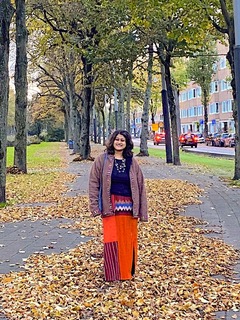
Supriya Javalgekar is an author, researcher and creative facilitator from Mumbai.  Supriya draws upon story, theatre and art to cultivate nourishing spaces for self-exploration and dialogue. She currently lives in Amsterdam and is playing hard at improvised theatre. Discover more at www.supriyarakesh.com

.

PLEASE NOTE: ARTICLES CAN ONLY BE REPRODUCED IN OTHER SITES WITH DUE ACKNOWLEDGEMENT TO BORDERLESS JOURNAL

Click here to access the Borderless anthology, Monalisa No Longer Smiles

Click here to access Monalisa No Longer Smiles on Kindle Amazon International
Categories
Stories

The Infamous Art Dealer

By Paul Mirabile

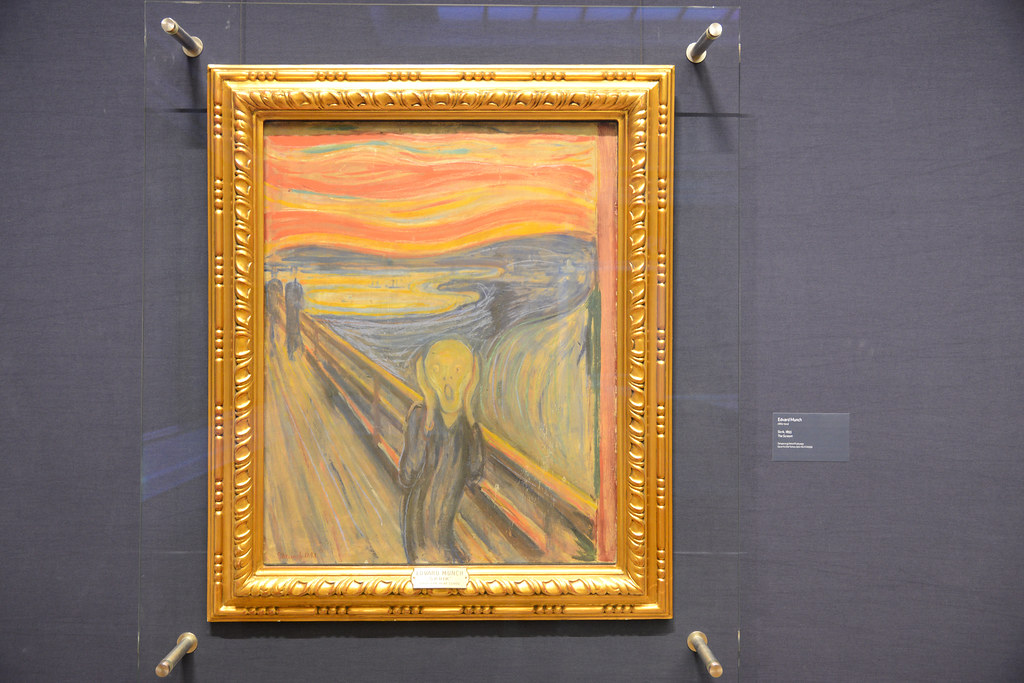
The Scream by Edvard Munch(1863-1944). Courtesy: Creative Commons

I met Gustav Beekhof twice whilst travelling in North Africa, once in Tunisia on the island of Djerba, and then in Algeria when I emerged from the desert after spending about seven months living amongst the Touregs.

Gustav was a Dutchman, tall, slender, long blond hair falling to his rounded shoulders. His blue eyes shone like scintillating mountain lakes in the morning sun. He spoke excellent English, French and German, all learned at school but polished and refined ‘on the road’ as he said in his high, nasalised voice.

Over a glass of tea, we spoke about many subjects, he emphasising that the voyager must touch Africa with his or her feet, and not ‘do’ it either in vans or in Land-Rovers as so many ‘doers of Africa do’. Gustav indeed had a whiff of smugness about him.

We split, the cocky Dutchman en route to Morocco, I back into the desert to Tamanarasset. Before leaving, however, he gave me his phone number and insisted that if I ever found myself in Amsterdam I should look him up. He threw back his long blond hair and as he got up to leave, said that he held my friendship in high regard.

Seven years later this was exactly what I did! I had been shuffling between Madrid and Burgundy France as a Flamenco guitarist at Rosario’s dance studios in the mornings and Antonio’s mesón[1] at night, and as a grape-picker at several farms between Dijon and Beaune in Burgundy. Every Autumn I would hitch to Burgundy from Madrid and for a month or so labour in the fields, in the wine-cellars, bottle wine and study oenology with the wine-growers in my spare hours.

The life of a mediocre musician and a seasonal farm labourer made no sense. I needed a change. Was not life a thick forest of possibilities ? One day as I treaded wine in one of the enormous kegs that aligned the cellar of a famous wine-grower, what the Burgundians call ‘piger‘, I suddenly thought of Gustav Beekhof. That night, back in my little room on the farm, I searched through my belongings and found his address. Yes, I would go to Amsterdam for that change.

When my work had finished on the farm I left my guitar with some friends, borrowed a bicycle and cycled up to Holland via Liechtenstein and Belgium, a strenuous journey, given the fact that the bicycle had no gears. I arrived in Amsterdam, thoroughly exhausted, but immediately set out to find my ‘friend’, if I may say so at this point in my narrative.

And indeed I did find him: having telephoned Gustav, that nasalised voice gave me directions to his home. I set off on my bike in search of him. It took me hours as I crossed bridges, turned in and out of little roads and lanes. As I struggled on, I had a strange feeling that Gustav did not know with whom he was speaking over the phone. Be that as it may, I finally found his ‘humble home’ as he merrily said, one of the many barges that float listlessly in the canals that criss-cross Amsterdam. A rather shoddy one at that, but its bohemian appearance did suit the personality of the individual I had met some seven or eight years ago in North Africa, and who was at present standing on the plank that led to the barge from the grassy pavement-bank. He was all smiles. He gestured for me to come ‘aboard’, shook my hand and led me into his ‘humble home’ …

A home that rocked and rolled ever so gently when a barge cruised by. Gustav warned me that to live in a barge one must develop sea-legs. He laughed, and the twinkle in his eye intuited that the Dutchman had no idea with whom he was speaking. I felt rather uncomfortable at first, but this loss of memory seemed not to disturb my host who spread out his long arms as if to engulf all the belongings that swam before my eyes: dozens and dozens of paintings, either framed, rolled up in clusters or on easels covered the uncarpeted ‘bottom deck’ along with hundreds of acrylic paint tubes, whilst more books and documents rose in high stacks against the unpanelled ‘starboard’, barring the grey afternoon light from penetrating two ‘portholes’. Large packages lay on a bunk bed at the ‘stern’. There were no rooms, only a very long and narrow ‘hole’ with a kitchenette at the ‘prow’. Rusting red-painted iron beams horizontally crossed the ‘hull’. Two tables had been placed in middle of this capharnaum[2], one for writing, I presumed, and one for eating ; both had seen better days. The toilet, a cubby hole, was located on ‘portside’ …

I was overwhelmed by the quantity of paintings, some of which I recognised.

“How do you like my prized collection ?” Gustav began. His tone had an undercurrent of secrecy. “I have acquired them at great pains, some are originals, others copies … and a few a result of my own genius.” Modesty was never a quality of Gustav’s personality … not even false modesty !

“But you have a Jasper Johns[3] … a Frans Van Mieris[4] and a Nicolais Astrup[5]!” I rejoined in amazement. They must have cost a fortune. My host shrugged his shoulders.

“Why do you think I live on a rubbishy barge and not in a golden palace, my dear lad ?” He threw back his long blond hair and motioned to the hackney table, where two plates, two forks and two knives had been neatly set. I sat opposite a lovely Laurits Andersen Ring painting: Road in the village of Bunderbrøde. Original or copy ? From the kitchenette Gustav sailed back gingery to the table carrying a large tray of chips ; they were dripping with oil. I put one or two in my mouth and felt sick to my stomach. From a cupboard near the toilet he brought forth a bottle of Jenever which presumedly was to wash down the chips. I looked over to his writing table and observed an open notebook.

“My Waybook,” he laughed. “I’m writing a collection of poems and stories about my voyages in India, Central Asia and Africa. Poems and stories written out ‘on the road’, but here in my barge-solitude, polished to a lacquered lustre.” My host was beaming with self-complacency.

I let Gustav make inroads on that greasy stack of chips whilst I cast cursory glances at those many paintings… “Remember those horrible mosquitoes in Africa ?” he reminisced. “They always bit me … perhaps because my blood is so sweet.” His voice had a fluty tone to it. I nodded perfunctorily.Was his blood sweeter than mine ?

I left about midnight, rather sozzled from all that Jenever.

For the next few days, my Dutch friend took me about Amsterdam, especially to the bars where we would invariably get thoroughly drunk, but also to the countryside on bicycle, gliding by the still standing windmills cranking their sails, the tulip fields in blushing bloom, over a streamlet or two, our bicycles poled over on small barques. One day we stopped near one of those streamlets to indulge in some Gouda and Edam cheese. It was there that Gustav, his mouth full of cheese and bread, made me a proposition which I was to regret for the rest of my living days …

“Listen,” he began, munching merrily, washing down his cheese and bread with a few shots of Jenever. “Since you’re out of work, how about working for me ?” I raised a quizzical eyebrow. He gave me a sly wink. “Don’t worry, it’s not hard labour. I need an itinerant salesman for my paintings. You know, I’m stuck here in Amsterdam and can’t meet the demands of all my clients. I have clients in Italy, Spain, France, England ; all over Eastern Europe, too. You’d be a perfect dealer for me, you know many languages, you have a bit of artistic talent yourself to explain certain niceties, and above all, you’re honest. I know you won’t cheat me.” His grin stretched from ear to ear. A strange grin, plastic-like. “I’ll give you ten percent of the proceeds.” And he had another spot of Jenever.

“Why ten ?”

“Why not ? It’s a number like any other. And don’t forgot, some of those paintings are going for over 8,000 Guilders, even double that in other currencies. What do you think ?” He eyed me fixedly, the deep blue of those two tarns swirling before me like turbulent whirlpools.

It took me three days to think over his proposition, and during those three days, when I visited him, we tramped about Amsterdam’s bars, drinking and conversing. Never once did he enquire about my decision. It was whilst licking off the foam of my Heineken in one of Gustav’s favourite bars, where it was his wont to reach into a drinker’s open poach of tobacco, serve himself a good pinch and roll a cigarette without ever asking permission, a rite that he alone exercised at the counter, that I decided to accept his offer. “Fifteen percent !” I added. He winced at first, but that mask slowly transformed into a broad smile. We shook hands and the deal was sealed. He ordered another round for us whilst pinching a bit more tobacco from the pouch of his displeased but stoic neighbour …

And that is how I became an itinerant dealer for Gustav Beekhof’s paintings. My wanderings took me to the most remotest of European towns, and to the most hideous suburbs of those towns. Instead of dealing with rich bourgeois families, small museum curators or private collectors, Gustav’s mailed instructions directed me to shifty-eyed men, well-dressed and well-spoken indeed, but shifty in our negotiations. Besides, we effected our transactions in the oddest of places: warehouses, depots, repositories, seedy hotel rooms. I would remove the paintings from long, plastic cylinders similar to those that the Chinese use to carry their scrolls, unroll the merchandise they were expecting, and after a thorough inspection, the head of these delegations would produce a wad of bills, and without counting them push them into the pocket of my vest. They would leave me standing there without a word, although now and then, one of them was given orders to drive me to the centre of the town and drop me off at my hotel.

Gustav had advised me to deduct my fifteen percent from the purchases, deposit the maximum amount of cash that was permitted in one of the subsidiaries of a Dutch bank, found in Greece, Norway, Belgium, France, England, Luxembourg and Germany. If a large amount of cash remained, I was to travel to another country, locate another subsidiary and deposit the rest. Gustav had absolute faith in my integrity; at any time, I could have run off with thousands of francs, liras, pounds or any currency and simply disappeared. Of course the thought never occurred to me. As to the paintings themselves, they were sent through a special mail service along with a note at one of my hotels directing to the addresses where I had my the appointments. In this way I had no need to return to Amsterdam.

These proceedings continued without respite for two years as I scurried from country to country and town to town. I must admit that over the course of time I began to question the probity of the individuals I was dealing with, for all these transactions seemed enshrouded in mystery, carried out by dubious characters, each and every one of whom bore a rank odour of unprincipled morals, although their behaviour towards me was always impeccably polite, aloof indeed, but nevertheless perfectly respectful. I, thus, disregarded these apprehensions; after all, I was earning vast amounts of money. And I wasn’t one to, as the French say, cracher dans la soupe[6] !

One fine Spring day, I received six paintings at my hotel in Thessaloniki, Greece, and a note directing me to Istanbul, where an Armenian merchant was waiting impatiently to buy the paintings at a very handsome price. However, the note warned me that the merchant was a bit of a rogue, and a clever one at that. I smiled inwardly; I had been to Istanbul several times and could negotiate quite well in Turkish. I rubbed my hands ready for the joust …

It was on the fourth day of my arrival in Istanbul by bus from Thessaloniki that our appointment had been fixed in the Armenian’s small shop near the Armenian Church of Üç Horan (Trinity) inside the Fish Market. His shop, crowded with every object that one could possibly find on the face of the earth: wooden religious statues, candelabras, thuribles, musical instruments, Ottoman-styled hanging lamps, church paintings, ikons, antique furniture, travelling chests dating from the Ottoman Empire, sabres and shields, made it difficult for me to find the merchant seated behind a long, knotty mahogany table upon which had been stacked books, paper-weights and a scruffle of yellowing documents. He had a sinister look about him, doleful, suspicious, a darkly look that matched his dark frizzy hair, thick eyebrows and beard. When he noted my arrival he sat there in frozen silence which lasted longer than I had expected of a potential buyer of Gustav’s long-sought paintings. I sensed something amiss … something which did not sit well in this Ali Baba’s cave.

The Armenian stood and cleared away the books that encumbered his table. He bade me deposit the paintings in his outstretched arms. I took them out of the cylinder and placed them gently in the crooks of his arms, where like a mother holding her child, he cradled them for a few long seconds before laying them delicately on the knotty mahogany table.

Without a word he unrolled each one, admiring the colours, the textures, the shapes, the lines.

“Very nice … lovely !” he finally said in rough Turkish. “The colour saturation of this one is marvellous. And here, the crackle paste indeed gives the village a mediaeval aura. The application of mica flake certainly highlights the effects of the tempest over the sea, whilst here, the dry brush technique impresses an eerie velatura of the Scandinavian landscape.” He looked up at me. “And what do you think of Jasper Johns’ Between the Clock and the Bed ?” The question snapped me out of my reverie; no client had ever posed a question to me concerning the contents or quality of the paintings ; all my dealings had always been conducted with the utmost taciturnity.

“I don’t know … I’m not an art specialist, only a dealer.”

He chuckled : “Are you now ?” He touched the painting ever so delicately. “Pop art ? Expressionism ? What do you think, dealer ?” I remained silent, fidgeting about, the atmosphere had become unbearably  oppressive. “Look, these fourteen colours set out like a lithograph should have been painted on Japan paper … do you follow me ?” I shook my head, ignorant of all these technical details. “Well, Mr Dealer, this is not Japan paper, consequently, the painting it not an original, which leads me to surmise that it’s a forgery !” The word forgery shot through me like a bullet. “So are those four, all falsified due to over-enthusiastic scrambling[7]. Only one is an original: The Scream, one of the eight versions by Munch, stolen this year from the Munchmusect in Oslo !” He stopped, stealing a glance at me. “How did you steal it?” he asked in a deep-toned voice, authoritative, one that does not brook rebuke. “And all the others stolen from museums, private collectors and galleries ? Just how do you do it ?” I cringed, feeling engulfed in a welter of confusion.

Mouth agape, I stammered : “I’m not a thief … I sell paintings for Gustav Beekhof, that’s all. I know nothing about where the paintings come from, except that …”

“I shall repeat the question once again,” retorted that deep-toned voice: “How do you steal them ?”

I stepped back. The whole affair was becoming a nightmare. “I told you I sell paintings for Gustav …”

My interrogator bent over the table and slapped me twice in the face. The violence sent me reeling backwards into some wooden statues. He circled round the table and stood menacingly over me. “We have been following your doings for months and months Mr Gustav Beekhof. Your repugnant affair has brought death and destruction to many innocent people.”

“Please, I don’t understand …”

“Shut up and listen !” And he punched me in the stomach, doubling me over. “Interpol shall be here in a moment or two to question you. But I would suggest you tell me everything here and now, for their methods are far from savoury.”

“Really … I’m not Gustav Beekhof … my name is Vigilius Notabene …”

“Oh really ?Vigilius Notabene ? Well now, Mr Notabene, let me inform you that you have been selling stolen paintings and forgeries to underworld criminal organisations and terrorist groups. Do you understand what that means Mr Notabene ? That means with the money they earn by selling what you have sold them for double or triple your amount, they buy arms to execute military personal and politicians, bombs to blow up train stations and aeroports. Did you think you could continue your lucrative affair with impunity ?” He grasped my collar, his face screwed up.

Suddenly, the shop door swung open. Three or four burly men dressed in civilian clothes wove their way towards us. They took me by the arms whilst the Armenian slapped me repeatedly across the face. I began to swoon. He turned to the men: “Gustav says his name is Vigilius Notabene.”

“But … I’m not Gustav !” I whimpered.

“Shall I juggle your memory ?” continued the Armenian. And that powerful fist drove into my chest. I cried out, hanging limp in the strong arms of the agents who looked on indifferently. “No, I’ll tell you your real name. Javier Fuentes, born and raised in Madrid, lover of bullfights and flamenco music. You left Spain for Holland where you changed your nationality and became Gustav Beekhof, amateur painter, counterfeiter and arch-cozen. Do you think we would never get on to your little affair ?” Again that hairy fist ploughed into my ribs.

I gasped for air. In low voices, the agents spoke to the Armenian in Dutch and in Turkish. I was amazed that I understood every word that was said. “Yes, yes Mr Beekhof, you understand everything we are saying. Polyglot, dilettante painter and musician, intrepid thief and casual traveller — it has taken us a while to corner you. And here we all are in my little shop. Cozy, eh ?”

A blow to the midriff sent me hurtling against a gaggle of porcelain geese, where I then slid squirming to the floor breaking the necks of two ! The agents violently grabbed my long, blond hair and stood me up.

“I’ll give you Gustav’s address …” I managed to gasp, my mouth filling with blood. Two agents squeezed my rounded shoulders so hard that I buckled over.

“Still on about Gustav, eh ? There is no Gustav Beekhof in Amsterdam on a barge. Gustav is right here in front of me, and there he will remain until he tells us the truth … If not …” I lifted my arms to ward off a blow, albeit none came.

“Come, come Gus, your mind has been unsettled by all these false identities ; all these wanderings in and out of cheap hotels, dealing with a bunch of thugs and killers. Fifteen percent ? Why give yourself fifteen percent when you deposit the rest in your own name in a Dutch bank account ? You must be completely daft!” I stared at my interrogator in disbelief. How did he know such precise details ?

“We know everything about you, Gussy!” as if reading my mind. “Everything except how you managed to steal these paintings from the museums. That remains a mystery to us all.”

“I’m Vigilius Notabene, born in Gotland on a farm. My parents died when I was thirteen so I left for Holland, Spain and France. In France …”

“Enough!” The Armenian began pummelling me. The agents stopped him. Then I heard the door of the shop swing open. I caught a glimpse of four men dressed in white ; tiny, white skull-caps coiffed their bald heads. They forced me into a straitjacket and hurried me into an ambulance. I was given an injection and that is all I remember until now …

I awoke in a small room, an all ghost-white room: white walls, door, window bars, curtains, bed and bedsheets, writing table. The whiteness pricked my eyes. My arms were strapped to my sides ; they had straitjacketed me. I lay helplessly surrounded by all this monochromatic melodrama.

One day a man, dressed in white whisked into the room, threw me a cursory glance, laid a notebook and pen very carefully on the white, metal table then strode to the bedside. He undid the straps of the straitjacket, pointed to the notebook on the table, and left as quickly as he came, wordlessly.

I stretched my stiff limbs and sat at the table. I had no idea where I was, and no one to turn to: no family, no friends, no lawyers … no one. I stared down at the white, lineless, notebook pages. Yes, I knew what they wanted from me. Ah, Gustav, you are a slippery sod. Here you are at last slipping out of that phantasmagoria of so many faces and places. So many existences that never existed! Take note that Vigilius Notabene will expose the truth of the past. As to Javier Fuentes, he had no future. Gustav is the true wayfarer, the ever-questing pilgrim present, here and now.

So in a renewed state of extreme excitement I now record on those very white pages :

“I met Gustav Beekhof whilst travelling in North Africa…”  

.

[1]          A small bar or tavern where people eat, drink and listen to flamenco music if there is a guitarist and a singer present.

[2]          ‘Shambles, disorder, mess’.

[3]          American painter ‘1930- ).

[4]          Dutch painter (1635-1681)

[5]          Norwegian painter (1880-1928)

[6]          To spit in the soup’.

[7]          A technique that allows to paint over areas of a painting to enhance the tone of dark-coloured areas.

Paul Mirabile is a retired professor of philology now living in France. He has published mostly academic works centred on philology, history, pedagogy and religion. He has also published stories of his travels throughout Asia, where he spent thirty years.

.

PLEASE NOTE: ARTICLES CAN ONLY BE REPRODUCED IN OTHER SITES WITH DUE ACKNOWLEDGEMENT TO BORDERLESS JOURNAL

Click here to access the Borderless anthology, Monalisa No Longer Smiles

Click here to access Monalisa No Longer Smiles on Kindle Amazon International

Categories
Poetry

Stuck

By Moonmoon Chowdhury

STUCK

For eons, I’ve been shrinking in this chamber, 
Buried under the putrid odor of mothballs.
Memories with forty tentacles and a thousand paws
Gnaw at my flaccid heart as the dirge crescendos.
The sedatives don’t palliate my elephantine pain no more.

The yesteryears trickle in  through the translucent drapery,
And hover over the crinkled bed that houses the threadbare me.
The potpourri of corroded dreams, lost friends, winding paths, 
Whirr and scatter even as my splintered spirit craves 
A break from the begrimed monochrome.

I’ve tried opening the window to trap the rays of the Sun, 
But there’s been a total eclipse, for days on end.
They prescribe self-help books, and cultivating hobbies,
And chide me for my perfect inability to invoke beauty.  
Alas! they don’t see the multiplying moulds and the dead end,
And how I circle back to square one, again and again.
  

Moonmoon Chowdhury is an aspiring poetess and writer. Her poems and stories have been published in twelve anthologies, available on Amazon. She is currently based in Amsterdam, Netherlands.