Categories
Review

A Cup that Cheers: Savouring The Coffee Rubaiyat

Book Review by Meenakshi Malhotra
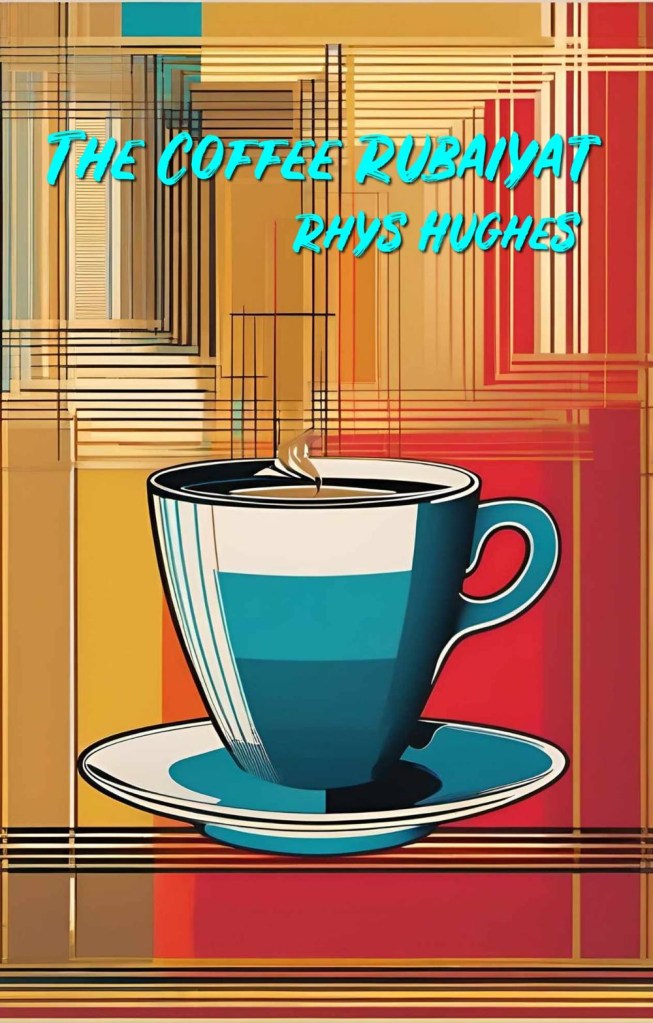
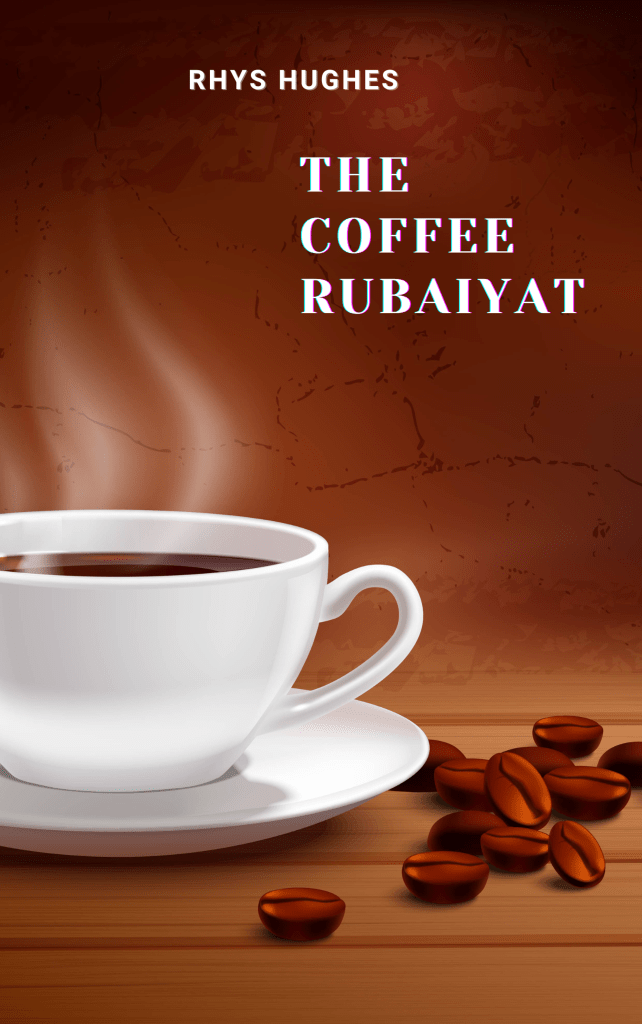
Title: The Coffee Rubaiyat

Author: Rhys Hughes

Publisher: Alien Buddha Press

 Rhys Hughes’ creative adaptation of Edward Fitzgerald’s translation of the Rubaiyat of Omar Khayyam[1] is a delightful read. Located somewhere between tribute and parody, it has recreated the tonal and prosodic rhythms of the original translation, quartet by quartet. Yet, there is a thin line between parody and subversion, and Hughes’s adaptation negotiates this with a tongue-in cheek flippancy.

To illustrate the close parallel of the original 1st quartrain of Fitzgerald’s translation and Hughes creative adaptation:

Awake! For Morning in the Bowl of Night

Has flung the Stone that puts the Stars to Flight:
And lo! the Hunter of the East has caught
The Sultan's Turret in a Noose of Light.

The original aubade is wittily recast as:  

Awake! For the alarm clock next to the bed

Is ringing the bells that can wake the dead:
And Lo! The ruby rays of the rising sun
Colour the espresso machine a pinkish red.

This paean to coffee is replete with personifications –“Dawn’s lips are coffee-smeared”(vi).

Some of Hughes odes to coffee poke fun at the metropolis and its quirky inhabitants, the poem(s) capture the rhythms of life and its frenetic pace in the urban metropolis. Thus in quatrain 18, we get a glimpse, a veritable word-picture of the tube/metro train commuter:

I sometimes think that never blows so hard,

The commuter who is late, reputation marred,
To cool his coffee so he can catch his train
Before all the doors are closed by the guard.

Literary- and other-Histories of Coffee

In a ‘Brief History of Coffee around the World’, Garrett Oden clarifies that , unlike tea and alcohol which have been around and in use for more than five thousand years, coffee has had a relatively recent history. Although it has supposedly been around for over a 1000 years, its first verifiable documented use was about 500 years ago. Accidentally discovered by a goat herder whose goats turned unusually frisky after consuming some red beans, it became popular in Yemen and the areas surrounding it, the area  we know now as the Middle East or as west Asia. The journey of coffee to Europe and beyond is replete with narratives of colonialism, plunder, pillage and scandal. This murky history was often forgotten as  the roasted magic bean  became a rage in coffee houses across the world.

The dubious antecedents of this heady brew derived from the magic bean is invoked in literary works such as Alexander Pope’s  ‘The Rape of the Lock’ where the effects of coffee are thus described:

“Coffee, (which makes the Politicians wise, And see thro’ all things with his half-shut eyes)/Sent up in vapours to the Baron’s brain new stratagems” to fulfil  his nefarious designs. Closer to our own times, we have T.S. Eliot’s line in ‘The Love Song of J. Alfred Prufrock’ where his persona declares, summing up the urban ennui of his quotidian existence, “I have measured out my life with coffee spoons”, a line which is yet another testimony to the fact that coffee has become  an inseparable and indispensable part of our everyday life.

Echoes of Fitzgerald’s Rubaiyat are interwoven into each quatrain and the poems follow the chronology of the original sequence. From the chess board (p 56-XLVIX) to the image of the “moving finger” which is replaced by the “moving tongue” (LI, p58), in poem after poem, we have many hyperboles to capture the effects of this drink which stands for a way of life. It is a way of life familiar to inhabitants of the modern metropolis where one’s life is lived under the glare of neon lights, and where sleeplessness, stress are all par for the course.  

Although the poems employs the resources of several figures of speech like metaphor, personification, hyperbole, perhaps the most apt and commonly used figure is that of bathos. It is an effect of anticlimax created by a lapse in mood from the sublime to the trivial. A typical example is Pope’s line in ‘The Rape of the Lock’ where he says, “Great Anna, whom three realms obey/ Dost sometimes counsel take — and sometimes tea”: In Hughes’s case, “the cosmos is nothing but a frappucino” ,”the inverted cup we call the sky.”

The poems are crafted in a spirit of irreverent good humour and this  book is definitely a  little nugget, worth savouring. Even if (to persist in the metaphor) one’s cup does not run over, it is definitely a cup that cheers.

Click here to read an excerpt from The Coffee Rubaiyat

[1] The translation was first published in 1859. Omar Khayyam, an astronaut, mathematician, a philosopher and a poet lived from 1048–1131 and wrote in Persian.

.

Dr Meenakshi Malhotra is Associate Professor of English Literature at Hansraj College, University of Delhi, and has been involved in teaching and curriculum development in several universities. She has edited two books on Women and Lifewriting, Representing the Self and Claiming the I, in addition  to numerous published articles on gender, literature and feminist theory.  Her most recent publication is The Gendered Body: Negotiation, Resistance, Struggle.

.

PLEASE NOTE: ARTICLES CAN ONLY BE REPRODUCED IN OTHER SITES WITH DUE ACKNOWLEDGEMENT TO BORDERLESS JOURNAL

Click here to access the Borderless anthology, Monalisa No Longer Smiles

Click here to access Monalisa No Longer Smiles on Amazon International

Categories
Excerpt

The Coffee Rubaiyat

Title: The Coffee Rubaiyat

Author: Rhys Hughes

Publisher: Alien Buddha Press

Introduction

The famous old poem called The Rubaiyat of Omar Khayyam is known to many through the translation Edward FitzGerald published in 1859. His first edition, a selection of 75 quatrains, is considered the best. He revised the quatrains several times, losing poetic force each time he did so.

His translations are regarded as highly inaccurate anyway, but they are musical, evocative and wistful, and I like them very much. They are among my favourite poems and I once resolved to learn them all by heart.

As it happens, I failed in that attempt, mainly through laziness, which is appropriate really, for FitzGerald himself was an especially lazy man, who wrote and did very little in his life.

The quatrains are all about the joys of wine. At any time of the day or night wine is good to drink. That is the essential message.

I have heard it said that Omar Khayyam’s wine is actually a metaphor, perhaps for God or enlightenment, but personally I find the idea unconvincing. Or rather, I lack the scholarly insight to feel the truth of that interpretation.

The verses seem to be about real wine, the kind that can get you drunk, though I am willing to entertain the notion that I am missing the point. At the very least they can be plausibly quoted in connection with real wine, and I have used them to justify drinking an extra glass, for yes, Omar is keen to insist that more is better than less, indulgence superior to restraint.

But although I am fond of wine, I am fonder of coffee by far. I can easily live without wine, but only with difficulty live without coffee.

Thus, I decided to write a Coffee Rubaiyat, matching FitzGerald’s first edition quatrain for quatrain but making mine all about coffee.

I daydream that copies of my slim collection will one day be found in the coffee shops of the world. If the cappuccino fits, wear it. So say I.

And now it is time for a coffee break and I shall say no more.

Rhys Hughes, June 2023

The Coffee Rubaiyat


I.

Awake! for the alarm clock next to the bed
Is ringing the bells that can wake the dead:
And Lo! The ruby rays of the rising sun
colour the espresso machine a pinkish red.

II.

Dreaming when Dawn’s Left Hand was in the Sky
I turned to Dawn with a very deep sigh,
“Crikey, dear, that’s a massive hand you’ve got.
Why not get out of bed and bring me coffee—a lot?”

III.

And, as the Cock crew, those who stood before
The coffee shop shouted—“Open then the door.
We all rather fancy a round of cappuccinos
Before grappling with our foes upon the floor.”


IV.

Now the New Year reviving caffeine desires,
The thoughtful soul to the kitchen retires,
Where the white froth on the large cappuccino
Flows out, and steam from the kettle perspires.

V.

Biscuits indeed are gone with all their crumbs,
And Sinbad is reduced to sucking his thumbs;
But still the coffee bush her lovely beans yields,
And still the waiter with our beverages comes.

VI.

And Dawn’s lips are coffee smeared; but in divine
Extra-strong roast, sighing, “The coffee’s all mine!
Cream but no sugar!”—the fox cries to the toad
But those dregs have gone cold and that’s not fine.


VII.

Come, fill the mug, and into the boiling kettle
Pour more pure water to cool the red-hot metal.
Strange folks prefer fashionable herbal teas
To sip—and Heck! They include leaves of nettle.

VIII.

And smells—a thousand aromas within one year
Wafted—and a thousand had no aroma to revere:
And this first breakfast time that brings burnt toast
Shall smear Sinbad’s ear on the sheer frontier.

IX.

Come with Coffee Khayyam and leave the lot
of juice bars and water bottles forgot:
Let gym instructors rant about overconsumption
Or doctors cry Enough—heed them not.


X.

With me at the quiet table of a terrace café
That divides the indolent from those gone astray,
Where one may slurp and dribble in peace
And pity the pedestrians who hurry on their way.

About the Book:

Settle into the enchanting rhythm of this coffee-themed adaptation of the classic Rubaiyat of Omar Khayyam, as each stanza awakens the senses with witty, humorous, and thought-provoking reflections on the joys and quirks of coffee culture.

The Coffee Rubaiyat embraces the essence of morning awakenings, midday pick-me-ups, and contemplative sips, all while exploring the comical and heart-warming encounters that revolve around this beloved brew.

This collection celebrates the endless nuances and pleasures that coffee brings. Coffee lovers, literature enthusiasts, and anyone with a penchant for the art of the bean will relish in the fusion of two worlds – the timeless verses of Omar Khayyam and the contemporary charm of Rhys Hughes.

A delightful literary adventure that will leave you yearning for another sip.

About the Author

Rhys Hughes is a writer of Fantastika and Speculative Fiction.

His earliest surviving short story dates from 1989, and since that time he has embarked on an ambitious project of writing a story cycle consisting of exactly 1000 linked tales. Recently, he decided to give this cycle the overall name of PANDORA’S BLUFF. The reference is to the box of troubles in the old myth. Each tale is a trouble, but hope can be found within them all.

His favourite fiction writers are Italo Calvino, Stanislaw Lem, Boris Vian, Flann O’Brien, Alasdair Gray and Donald Barthelme, all of whom have a well-developed sense of irony and a powerful imagination. He particularly enjoys literature that combines humour with seriousness, and that fuses the emotional with the intellectual, the profound with the light-hearted, the spontaneous with the precise.

His first book was published in 1995 and sold slowly but it seemed to strike a chord with some people. His subsequent books sold more strongly as my reputation gradually increased. He is regarded as a “cult author” by some and though pleased with that description, he obviously wants to reach out to a wider audience!

PLEASE NOTE: ARTICLES CAN ONLY BE REPRODUCED IN OTHER SITES WITH DUE ACKNOWLEDGEMENT TO BORDERLESS JOURNAL

Click here to access the Borderless anthology, Monalisa No Longer Smiles

Click here to access Monalisa No Longer Smiles on Kindle Amazon International