Reflecting on the last 12 months, Keith Lyons finds some things fade away, others reveal themselves, and mighty trees fall.
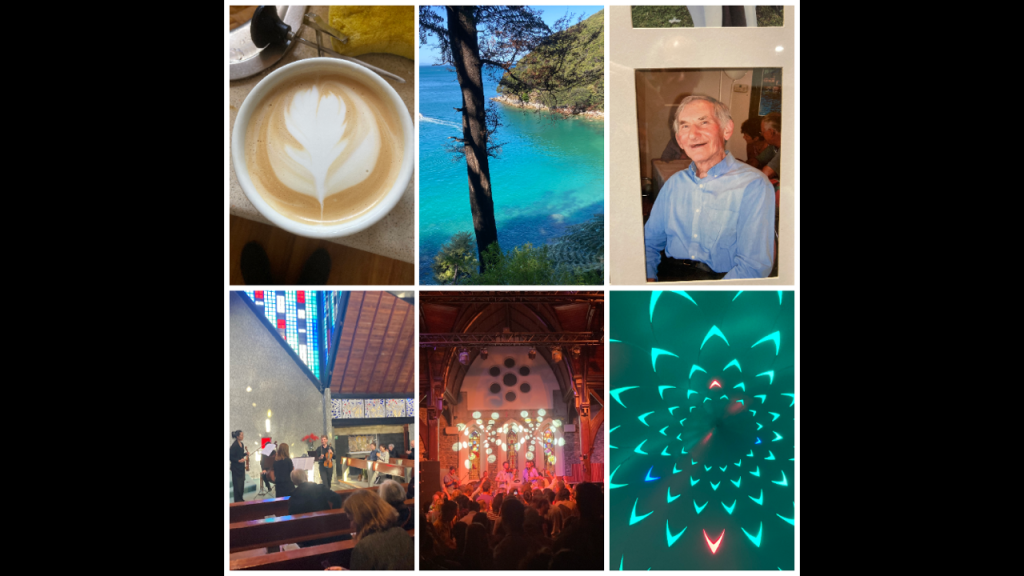
Am I over-sharing if I confess that the first photo on my iPhone of my 2024 year is a spectacle lens prescription? Or that the summary photo for 2024 — chosen by Apple and its algorithm — is of a coffee cup with the best of my efforts to create the basic latte art design: a monk’s head?
Looking back on the year, I wonder about the interplay of personal and global, a year which started with me learning how to make an origami crane, the symbol of peace, hope, longevity and good fortune, and ended with me getting ill, losing my father, without a paying job, and facing an unexpected massive bill.
The trick to making a paper crane is to have a good teacher. I was fortunate enough to connect with a semi-retired Japanese man (Mocchan) whose gift to the world is to meet strangers, have a cup of coffee, and patiently show them the dozen or so steps how to fold, flip, and unfold a piece of paper until it becomes a paper crane.
As for ill health, loss, unemployment, and debt, there are no easy tricks; you just need to go through them. “Survive til ’25” has been the mantra of bank economists and real estate pundits, recognising that 2024 has been a rough year for many sectors and most people, with inflation (and with it, rising living costs) the primary concern of citizens all around the world. Many countries are in economic recession, geopolitical threats are on the horizon, and the globe is warming faster than expected. The economic challenges were highlighted for me when earlier this year friends admitted to me they had changed their brand of coffee beans to a cheaper, no-frills variety, to cope with the cost of living squeeze. Yes, a First World problem. But who in 2024 has not examined their expenditure, put something back on the shelves, or not completed an online purchase — known as ‘cart abandonment’?
So, if I was to look back at the year in review, as a tapestry or a mosaic, what would I see? Fragments of memories, experiences, events. The days of my life, some almost the same as the previous day, others with unanticipated twists and turns. Welcome to the journey of 2024.
January
In the very centre of my city, Christchurch (New Zealand’s most English of cities), where a quake-damaged cathedral sits un-repaired, I get transported into another world, an immersive world of lights and colours in the giant inflatable sculpture Arborialis Lunminarium, made by the Architects of Air (https://www.facebook.com/watch/?v=901452564787031). Inside the labyrinth of tunnels and designs like cathedral stained-glass windows, I take time to sit in alcoves and lay in the centre of one of the domes, bathing in the natural light filtering through the installation, breathing in the tones, listening to the echoes and reverberations.
February
My next-door neighbour’s house goes on the market. I go across to an open home in the weekend. The neighbours left without saying goodbye. “Gone to Australia,” the real estate agent tells me. “Better jobs.”
Most of the prospective buyers are recent arrivals in New Zealand.
Looking across to my house, I realise, I need to do some work on my property, including having some trees cut and trimmed. I make a mental note to mention it to a friend who often meets with an arborist.
A few weeks later, the house sells at auction, for a price way beyond its valuation.
March
I go on a hiking trip with a friend in Fiordland, at one point missing a direction arrow and going off the trail, with others following us up a rocky stream-bed. After much faffing around, we retreat to the last known marked part of the trail, just as other hikers find the next marker without any problems. Lesson: sometimes the directions are up above your eyesight. Look up.
Back in internet-land, I find much merriment in watching Penn Holderness rapping in the style of Eminem wisdom found on pillows and cushions with quotes. Also, online I find a post detailing things to do for a low-dopamine morning, to sharpen mental clarity, reduce stress and anxiety, and improve long-term brain health. They include not watching Facebook reels or videos first thing in the morning (wait an hour at least), as well as drinking water, getting natural night and fresh air soon after waking, eating a high-protein breakfast, and delaying your first morning coffee for at least an hour.
April
For the first time in ages, I go out to a venue at night, listen to live music, have a few drinks, and end up dancing. The venue is a former Anglican church, built in the Gothic revival style in 1875 with an octagonal layout, and later becoming a theatre and then a Japanese wedding chapel. It is a unique setting with a micro-brewery, stained glass windows, and bouncers at the door. I am trying to recall the last time I went out to a live band and danced. My companion is also speculating that she’d also had not been out dancing since the Covid-19 pandemic. We are both in our 50s but are heartened to see others even older than us moving and grooving to the Balkan-Latin fused dub beats of Yurt Party.
May
I am late for a musical performance in the capital Wellington, and only hear half a composition that has been composed in memory of my brother. Fortunately, the performers agree to repeat the piece afterwards, to enable recording of it, and also so I can call my father so he can listen to ‘Heal’ by Salina Fisher over the phone. It is quite special. I know my father is also deeply moved by the classical composition, even without being in attendance at the Futuna Chapel, regarded as one of the outstanding pieces of 20th-century architecture in New Zealand, combining Maori and European design elements.
A day later we celebrate my father’s 88th birthday. My father is dying. A few weeks later, we are holding him and speaking with him as he takes his last breath.
June
The arborist I wanted to come cut down and trim trees on my property dies suddenly in an accident while felling a large tree on an extensive hillside property he is restoring. At a memorial service the only way through the loss is to retell stories about his character, adventures and humour.
An old friend from school days has sent a native tree to plant in memory of my father, and on the shortest day I think about where I might plant it. Winter is considered the best time to allow trees to establish in the wetter months, but it is cold outside, so I keep the tree inside in my sunroom, and ponder where it might grow best.
July
One night after visiting my mother, I come across an event that seems both crazy and appealing in the coldest time of the year. ‘Rogaining’ is a cross-country navigation sport where teams try to visit as many checkpoints as possible within a time limit. A winter series mixing strategy, adventure, orientation and the challenges of darkness. I resolve to rope in some friends to form a team. Can I offer to be the main navigator given that I’ve gotten lost in unfamiliar terrain more than once?
A pair of WWII binoculars used by my father as a naval navigator ended up in a private collection museum. It is a bittersweet part of letting go, hoping that something once connected to someone special will be put to good use, and is in good hands. When I show the photo to my mother and sister, we have a small sense of closure.
August
My work contract finishes, as our programme wraps up. The significance of the end dawns on me, as I realise the impact on many people and communities from the end of the collaborative research, including early career scientists who now may have to change professions, or go overseas in the hope of work.
In my garden, daffodils bloom bright yellow, and I bring in the flowers to spread the promise of new beginnings inside. My parents planted the bulbs when we were children.
September
Having put off appointments because of being busy at work, I get advice from a dietary nurse, fitness trainer and stress coach on improving my health, fitness, and sleep. Ultimately, I am caring for my heart. My blood pressure and cholesterol have been high in recent years. I don’t want to die ‘young’.
I go on holiday to the comforting golden sands and clear waters of Abel Tasman National Park, where I have fond memories from family trips in the 1970s. I make new memories and feel more connected to my father and brother as I gaze at night up to the vast Milky Way, with the five stars of the Southern Cross emerging over the horizon.
October
In an effort to improve my skills for employment and leisure, I start a coffee-making barista course. Each week, there is a test and challenge. I have to learn the names of the parts of the espresso machine, because at the start I only know their functions and not their exact names: group head/gasket, portafilter, basket, drip tray, steam wand.
A friend of my brother visits, bringing his partner and their child, whose first name is a composite of my brother’s name Ian, and the boy’s grandmother’s name.
November
On the barista course, we learn how to pull the perfect shot of espresso, by ensuring the best combination of freshly roasted beans, fine grind size, and how it is pressed (or tamped) to extract the full flavour of the coffee. At each one-on-one session, my tutor Masako extends my knowledge and practical skill. I have to prepare two different styles of coffee in under four minutes, from order to dispatch. I don’t make them in time. The next week, I have to make four coffees in under eight minutes — latte, long black, mocha, flat white. I am over time. Will I ever improve to be able to work in a busy cafe?
My speaking blood pressure monitor reads out my levels in mercury pilar and concludes: Result Normal. I attribute the reduction — without medication — to taking on board the advice of the Mayo Clinic around improving sleeping, reducing stress, less salt, limiting alcohol, lowering weight, and exercising frequently. After positive feedback from my health professionals on the lifestyle changes I’ve made, I felt like I undo my progress when an old school friend visits my house mid-afternoon with a carton of 18 beers and a six-pack of Guinness.
December
The day after the visit, I find the spot to plant the tree the school friend gave me in memory of my father. The tree will bloom in spring with yellow flowers to attract nectar-eating native birds. My father loved birds.
To get the temptation out of sight, I give the remaining beers away to my builder who turns up to guide an engineer through recent quake repairs to my house. The engineer, originally from China, finishes his inspection saying everything seems allright. His visit has cost me over $2,000, an unexpected extra cost due to the previous professional’s work being discredited.
I don’t even get an interview for a job I thought I was dead-certain to be shortlisted for. But another door opens, and I get a job offer for a role starting in the new year. I know I am lucky, given the tough employment market, but I know that while I might be ‘pale’ and ‘male’, I ain’t stale.
I finish my barista course, and take away the need for patience, consistency and practice.
But then, after feeling tired from a gym session, a bike ride and a hydrotherapy class, I come home and feel inertia drag me down. Will I have time to finish this piece for Borderless, I wonder? Then I test positive for Covid-19.
Best wishes to you, wherever you are.
May the past be your lesson, the present your gift, and the future your motivation.
.
Keith Lyons (keithlyons.net) is an award-winning writer and creative writing mentor originally from New Zealand who has spent a quarter of his existence living and working in Asia including southwest China, Myanmar and Bali. His Venn diagram of happiness features the aroma of freshly-roasted coffee, the negative ions of the natural world including moving water, and connecting with others in meaningful ways. A Contributing Editor on Borderless journal’sEditorial Board, his work has appeared in Borderless since its early days, and his writing featured in the anthology Monalisa No Longer Smiles.
.
PLEASE NOTE: ARTICLES CAN ONLY BE REPRODUCED IN OTHER SITES WITH DUE ACKNOWLEDGEMENT TO BORDERLESS JOURNAL.
Click here to access the Borderless anthology, Monalisa No Longer Smiles
Click here to access Monalisa No Longer Smiles on Kindle Amazon International

 Borderless