Soumik Kumar De, a teacher by profession and a poet by passion, likes to write both in Bengali and English. His creative compass includes poetry, short-story, flash-fiction etc. Adrika Ke Niye is a collection of Bengali modern creative poems . His poems have recently been published in Aulos: An Anthology of English Poetry and in Caravan. His Bengali poems has also been included in the anthology Sangshaptak . Besides he has to his credit several other academic writings. The areas of his interest include cultural studies, diaspora writings, Dalit studies etc. He also passes his leisure by playing guitar occasionally.
.
PLEASE NOTE: ARTICLES CAN ONLY BE REPRODUCED IN OTHER SITES WITH DUE ACKNOWLEDGEMENT TO BORDERLESS JOURNAL.
A skeletal man, almost half-naked, was sitting under a tree next to a charkha* reciting something from a piece of paper while tiny birds hopped around, at their twittering best.
Stand ye calm and resolute, like a forest close and mute with folded arms and looks which are Weapons in unvanquished war
And if then the tyrants dare Let them ride among you there, Slash and stab and maim and hew What they like, that let them do …….
Then they will return with shame the place from which they came And the blood thus shed will speak in hot blushes on their cheek.
One audacious one perched on his shoulder, looked around and whispered something into his ears, the other birds chirped themselves hoarse.
“Bapu, Bapu, look someone is coming to meet you, chirp – chirp – chirp.” The birds were in a frenzy of excitement.
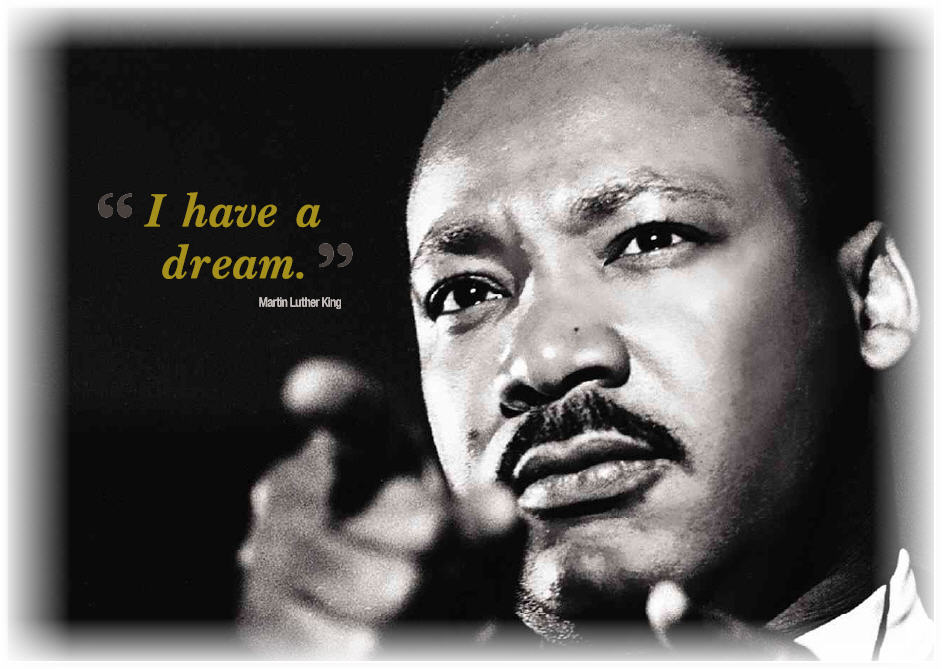
The skeletal man, contemptuously called the half- nakedfakir on Earth, who, was indeed Mahatma Gandhi; stopped spinning and sprung up, nudging away a candy floss cloud which was very keen to tickle him. Then, arms outstretched and wearing a toothless smile which brightened the surroundings, he headed towards the dapperly dressed man and remarked, happily: “Oh, you are Martin, are you not? I came up here in the year 1948, on 30 January, to be precise, and in 1955, I heard about a young man in the USA who was doing a lot for civil rights in the USA. Ah, so I get to see you finally. I remember hearing about the Montgomery Bus Boycott which was a tremendous success,” he remarked.
“Ah, that was the beginning if it all, and the Bus Boycott was inspired by you, Bapu. Initially started for a day, it lasted for 381 days and we carried on despite the stones and insults flung at us.”
“Oh, you succeeded in instilling a new sense of dignity in your brethren.”
“Yes, our community woke up after a long period of slumber. Oh, I just heard you reciting from The Mask of Anarchy by Shelley but, you know, the opponents are still slashing and stabbing, maiming and hewing – and there are no hot flushes on guilty cheeks.”
“But, mark my words, Martin, they will feel ashamed of their actions, one day, just wait and watch.”
“Yes, I am still waiting for the realisation of my elusive dream….” King remarked with a distant look in his eyes.
“I am told, down below hugging is not allowed! What a dystopian world it is turning into, unimaginable! No one is hugging or even shaking hands.” King said, inadvertently pulling away his hand which he had extended.
“Oh Martin, Don’t be funny, tactility is not taboo here, and we are at liberty to shake hands. No social distancing here. It is high time people shed their mammoth egos — look what they have reduced the world to — it is so scary.”
They hugged and shook hands warmly, their eyes twinkling merrily and the birds once again burst into a happy crescendo of chirps.
“I love this spinning wheel,” Martin said, casting appreciative glances at it. Bapu chortled in mirth, which was almost juvenile.
“You know, Martin, Gurudeb, my great friend, laughed at me for my charkha obsession, chuckled at what he thought were my idiosyncrasies, but I stuck to them – I was known for my obstinate nature, you know, and continue spinning here. It is just a symbol, actually. We need to be self-sufficient. This is what I was trying to prove.”
“Yes, you spoke the language of symbols, even your clothes symbolized the rampant poverty in your country. But no one seems to be bothered about poverty and homelessness even in the USA.”
“You know, that reminds me of an incident. It was the year 1916 and I had been invited by Annie Besant for the inauguration of Banaras Hindu University, I was shocked to see the bedecked princes sitting on the dais, giving me cold looks when I walked up to the stage, almost half- naked.” He again chuckled, looking affectionately at King. “I gave them a piece of my mind, when they started talking of India’s poverty. Feeling humiliated, some of the princes left the dais.” He added with a naughty grin. King smiled too, with a wistful look in his eyes.
“Bapu, you taught me a lot of things; it was because of you that love and forgiveness became the bedrock of my life. It was long back that I had decided that hate was too heavy a burden to carry, so I also stuck to love and tried to spread it, even when the odds were heavily loaded against us.
“You know, when the segregationists bombed my house on January 30, 1956, (Oh, it is quite uncanny – the date is also the date when they had killed you in 1948) almost killing my wife and seven-month-old Yolande, I seethed in rage and the whole night tossed and turned in bed, waiting for the morn, so that I could get a gun permit and kill the person who had tried to destroy my family. The next morning after a lot of mulling over, I had emerged from the dark night, a true Gandhian.”
“Well, you embarrass me, Martin. I did nothing, I still maintain that there is no such thing as Gandhi-ism. Love and Truth are as old as the hills. Yes, I remember hearing here that when Izola Curry tried to stab you, you forgave her too.”
“Well, she needed the healing touch, Bapu. She was unwell. And this virtue of forgiveness, I always maintain, has been your inspiration. You know, Bapu, it was in the year 1950 that I had been introduced to you — the man Gandhi — by Mordecai Johnson, I was so impressed that I immediately bought half a dozen books on you — you were responsible for removing all the confusion in my mind.”
“Well, I am really touched by your words. You know I was born in India but was made in S Africa. Pietermaritzburg was the turning point in my career. When they hurled me out of the first-class compartment on a very cold day because of my colour, I was devastated by the rampant racism. The conductor called me a coolie.”
“When I visited India in 1959, and went to a school in Kerala, the principal introduced me as fellow Dalit from the USA. For a moment I was flabbergasted, but then realized that is exactly what I was,” grinned Martin.“You know when I put the wreath at your Samadhi* in Rajghat, I had a fuzzy feeling all over.”
“Dalit lives still don’t matter in India. I am indeed devastated. You know, just the other day, I heard this gut wrenching news of a nineteen year old Dalit girl being gang-raped in Hathras, UP. I am still stunned into speechlessness. I keep hanging my head in shame — alas, this alone is what I can do.”
“This is indeed so heartbreaking. You know, Black lives still don’t matter in the USA. People are brutally kneed into breathlessness. Sitting here I can do nothing but wring my hands in rage. I cannot breathe… I cannot breathe…”
“It was on 28 August, 1963, that you gave that iconic I have a dream speech at the Lincoln memorial, pleading for an end to racism, but, alas, things still have not changed.”
“Yes, it is so sad. I can still hear the ear-splitting applause as I said, ‘I have a dream that my four little children will one day be known not by the colour of their skin but by the content of their character.’ I am still dreaming –dreaming – dreaming…Hope someday my dream will be realized.”
“I heard your twelve-year-old granddaughter, Yolande Renee King gave a very powerful speech on August 28, 2020, and many organizations joined forces to March on Washington, in a call for justice. This was indeed commendable. ”
“Well, I am indeed so proud of her, I still maintain that injustice anywhere is a threat to justice everywhere, hope this injustice and unfairness is banished from this earth.” King suddenly wiped a tear which trickled down his cheek as the words, “Papa King, we won’t forget”, fell into his ears.
“I am so proud of my granddaughter Renee. Bapu, isn’t it weird that we were killed because we talked of equality, love and forgiveness?”
“Can love ever be killed? They are deluded if they think so! Can forgiveness ever be obsolete? NEVER! Hope this vaccine of love is a success. They have no option left, they will have to stick to love, come what may.”
“I still maintain, over the bleached bones and jumbled remains of civilisations are written the words too late- too late – too late ….” Yes, if they don’t follow, love and non-violence, it will be too late …Ah, there comes Coretta*.”
“Ah, I notice she is chatting with Kasturba. What a heartwarming scene!”
Bapu and King were last seen sitting amidst a group of people singing the Ramdhun*, while King tapped his feet, time and again, raising a robust fist, saying, ‘we shall overcome’ and Kasturba and Coretta happily joined the refrain.
The birds and candy floss clouds were in throes of divine ecstasy, excitedly discussing the latest breaking news that the vaccine of love used on the humans down below had been a resounding success.
*Charkha — Spinning Wheel
*Samadhi – Memorial monument
*Ramdhun – Hymns to Rama
*Coretta King – Martin Luther King’s wife
*Kasturba – Mohandas Karamchand Gandhi’s wife
.
Dr. Santosh Bakaya is an academician, poet, essayist, novelist, biographer, Ted Speaker and creative writing mentor. She has been critically acclaimed for her poetic biography of Mahatma Gandhi [Ballad of Bapu]. Her Ted Talk on the myth of Writers’ Block is very popular in creative writing Circles . She has more than ten books to her credit , her latest books are a biography of Martin Luther King Jr. (Only in Darkness can you see the Stars) and Songs of Belligerence (poetry). She runs a very popular column Morning meanderings in Learning And Creativity.com.
.
PLEASE NOTE: ARTICLES CAN ONLY BE REPRODUCED IN OTHER SITES WITH DUE ACKNOWLEDGEMENT TO BORDERLESS JOURNAL
.
Disclaimer: The opinions expressed are solely that of the author.
I couldn’t ask Nandini if she had school education.
I only asked a foreign student excellent in Bengali about her age.

The girl, understanding only English such as brother, sister and thanks
Was the last daughter of a roti shopkeeper,
Located at the small street near the post office in Shantiniketan, West Bengal,
There was Nandini’s small shop along with fruit shops and bike shops.

Cows passing by would thrust their heads suddenly
Into the shop thatched with bamboo stems.

One Korean poet said he had seen the girl when she was seven.
Her bones had grown until now, at the age of fourteen, selling chai and roti.
In this district, goats and ducks, even dogs and cows, grow up by themselves.
They do not pierce the cow’s nose nor pull them by reins.
The only thing that hinders the cows are the chains around the trees.
The only thing hindering the sleep of dogs are so many steps and vehicle horns.

Maybe Nandini also has grown up like that,
Delivering the dishes of roti and washing the glasses of chai,
Yelling at the two babies of the older sisters,
She might learn about the world hearing the customers’ talk over their shoulders.
How long had she had bare feet? The toes pressed out from sandals looked like tree stumps.

My returning back to my country has nothing to do with Nandini.
She only smiled brightly twinkling her eyes at my small gift.
I wished she would meet a good man not wanting a dowry,
And become a nice mother of children, like her elder sister,
All together with her brothers and sisters and strong and diligent mother,
Dissolving the tragic memory of her father’s suicide.

Nandini smiled though I told her to close her mouth,
Though I didn’t ask her to say cheese to make her smile.
When did she learn to smile in front of a camera?
There lived a flower-like little girl selling chai near the old house of poet R. Tagore.
Ihlwha Choi is a South Korean poet. He has published multiple books of poetry. Until the Time When Our Love will Flourish, The Color of Time, His Song and The Last Rehearsal to name a few. E-mail: choiihlwha@hanmail.net
.
PLEASE NOTE: ARTICLES CAN ONLY BE REPRODUCED IN OTHER SITES WITH DUE ACKNOWLEDGEMENT TO BORDERLESS JOURNAL.
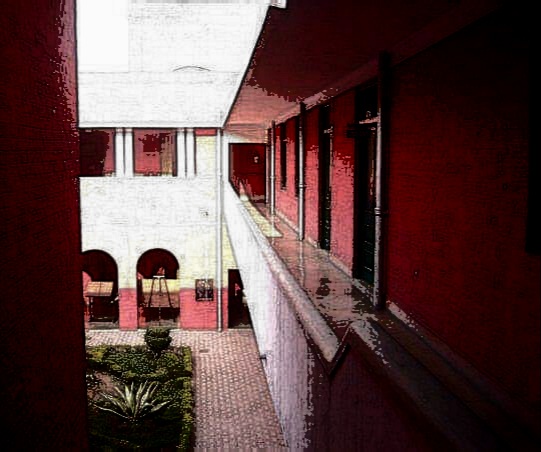
The corridors of time. The author’s school in Delhi’s Mandir Marg.
At my school, on the 30th of January, at ten minutes to eleven, a bell would ring once, like a Buddhist gong. It was a reminder to keep silence; for this was the hour and the moment when Mahatma Gandhi was gunned down. It was a time to reflect on his message and his life.
While these few minutes of silence might be common practice across India in those days, our school also had more permanent reminders of Gandhiji; there was a sculpted bust of his with a sign that said: Bapu walked here.
As young children, we had the mistaken impression that he had walked from here, and not from Birla House, to his last prayer meeting where the assassin met him; later we realised that was not so; he had merely visited earlier. Perhaps from the Harijan Basti* next door, where older students from our school went to take non-formal classes with the children of the community.
We too were sent, when a little older, to continue this form of teaching. To be frank, we did not feel much like teaching, nor did the children there like studying with newbies like us. At the time, envy was the only emotion we felt at their lack of educational fetters, a sort of Tom Sawyer meets the free-spirited Huckleberry Finn scenario. We would have to return to our classes, strict teachers and tons of homework, while those fortunate beings could fly kites and run about. After a few visits when they relaxed with us, it dissolved into fun and games and that was better than our amateur attempts to teach them.
It was years before I realised that we were the students there, learning life lessons about a world beyond the trappings of our public school life and middle class existence. In this, his birthday month, I would like to think of an old man, schooled in British law courts, yet spending a life outside, fighting both the Empire and injustice on many levels. He was probably nudging us in a puckish way, to walk in his footsteps, towards the not so privileged and to discover the symbiotic web of life in the human ecosystem.
*Harijan Basti: A low caste colony
Lina Krishnan is a poet, abstract artist and photographer in Pondicherry. She has a chapbook of nature verse, Small Places, Open Spaces, with Australian poet valli poole.
.
PLEASE NOTE: ARTICLES CAN ONLY BE REPRODUCED IN OTHER SITES WITH DUE ACKNOWLEDGEMENT TO BORDERLESS JOURNAL
Gopal Lahiriis a bilingual poet, critic, editor, writer and translator. He is the author of 22 books published including fourteen volumes of poems in English (four jointly edited anthology of poems) and eight volumes of poems and prose in Bengali, His poems have been published across various journals and anthologies worldwide. He has recently edited the book titled ‘Jaillianwala Bagh- Poetic Tributes’. He has attended various poetry festivals in India and abroad. He is published in 12 countries and in 10 languages. He lives in Kolkata, India.
.
PLEASE NOTE: ARTICLES CAN ONLY BE REPRODUCED IN OTHER SITES WITH DUE ACKNOWLEDGEMENT TO BORDERLESS JOURNAL
According to the Online Etymology Dictionary, the root of the verb protest is “to make a solemn declaration” or as a noun it refers to a pledge. Throughout The Story of My Experiments with Truth, Mohandas Gandhi notes the oaths he carried with him at various lengths. In Part One: Chapter VIII, he resolves to never steal again after he began atonement and reconciliation with his father. At a young age, he shows devout courtesy to truth. He dedicates experience of life to the pursuit of truth hence the book’s subtitle.
Later he swears an oath to his mother to not consume meat while visiting England. His Hindu faith, of which he claims ignorance, requires vegetarianism. He studies and reads on his visit to learn dietary regulations on his own that keeps his promise. When he returns home, he learns of her passing. Throughout his life he continues a strict diet without meat or milk, and his wife Kasturbabai, is also expected to abide. Even under severe threat of losing her life, Kasturbabai refused the doctor’s advice to have beef broth. Gandhi demonstrates such commitment to his ideals that he writes, “Let no one cavil at this, saying that God can never be partial, and that He has no time to meddle with the humdrum affairs of men.” His abidance to truth and oath seem to uncover God’s existence within the human sphere.
The land of India has not changed much since Gandhi’s protests and life devotions. What then is the purpose of a man of God? Gandhi notes the lack of sanitation and negligence of the poor. He is appalled that Indians would defecate in the sacred of river Ganges. He opposes the caste system and refuses to wear the sacred thread until Hinduism improves and serves the people’s well being. However he is not a bigot as he notes, “In matters of religion beliefs differ, and each one’s supreme in himself.” Gandhi’s dedication to moral improvement becomes a passion he shares with his fellow countrymen by founding schools to eradicate prejudice and ignorance so that the poor can become stronger in their self-reliance. Gandhi is not just a political activist as we understand it, but he is also a moral leader and a clear signal that God indeed exists and is concerned with human affairs.
India’s national life and character may not have improved according to Gandhi’s liking or expectations. He frequently suggests that God allows his efforts to flounder. He cannot explain why but suffers his disappointment gladly. He offers this piece of wisdom that all religions aspire to express, “The salvation of the people depends upon themselves, upon their capacity for suffering and sacrifice.” The people of India have their leader and learned to love him—however, the next important task for them is to learn to reverence each other in their habitude. It is always up to a people to secure their own blessings and reconcile with the Spirit.
Satyagraha, or passive resistance, is not a tool of destruction or self-interest. In the Autobiography, Gandhi expresses that passive resistance intends to improve the enemy’s well-being also. This is a powerful statement of political reality, that to resist you must hold the deepest compassion for the opponent and maintain moral strength and fearlessness. In the world today, such moral sacrifice and leadership appears to be absent.
In the United States, riots and violence broke out in protest of police brutality and racial injustice. The movement Antifa, a decentralised ideology and tool, wages violence with right-wing counter protests in a display of moral cowardice. Without securing blame, these street battles escalate and small businesses are ravaged. Government buildings are burned to the ground. A legal analyst on CNN requested that the viewers not focus on the destruction of property because the pain of the Black community is of greater importance. This response was in reference to the killing of Rayshard Brooks in Atlanta, Georgia. In his drunk fear of being sent back to prison, Brooks stole a taser from police and resisted arrest, eventually being shot by the officer who then tried to administer CPR.
Some scholars of literature compare Black American fiction to dalit fiction. Dalits are the untouchables of the Indian caste system. Gandhi’s social mission was to unify people of all castes, faiths, and walks of life. Frequently meeting with people of different faiths, his life effort was in understanding and showing compassion even to those with whom he disagreed. The caste system was something he wished to see overcome so that Hinduism could bear equal measure to other faiths. As mentioned earlier, he would not wear the sacred thread because he felt it was a symbol of superiority. He disavowed himself of self-righteousness.
His ideal State is one without violence, yet he maintained realistic understanding of the nature of the State. He wrote, “If national life becomes so perfect as to become self-regulated, no representation becomes necessary.” For this writer, such anarchism is the height of mature political ideals. Gandhi served this ideal of a nonviolent state with utmost clarity and dedication.
Finally I must refer to the great statement in the Autobiography on language. As a poet, I am deeply engaged with the thought presented, “Human language can but imperfectly describe God’s ways.” The devotee of Truth must recognize that our world is predicated on falsehood and deceit. Truth, it seems Gandhi suggests, is a lifelong pursuit in virtuous effort and suffering. Sincere willingness to undergo the difficult pursuit of Truth was Gandhi’s mission: however, in no way has he completed it for us. After all, it is our own choice to renounce the world and defy it’s injustices.
.
Dustin Pickering is the founder of Transcendent Zero Press and editor-in-chief of Harbinger Asylum. He has authored several poetry collections, a short story collection, and a novella. He is a Pushcart nominee and was a finalist in Adelaide Literary Journal’s short story contest in 2018. He is a former contributor to Huffington Post.
.
PLEASE NOTE: ARTICLES CAN ONLY BE REPRODUCED IN OTHER SITES WITH DUE ACKNOWLEDGEMENT TO BORDERLESS JOURNAL.
.
Disclaimer: The opinions expressed are solely that of the author.
You, light a candle in your heart . Fill your soul with the brightness of its entourage Let not this world be a selfish mirage . Let them kill your roseate dreams Ignore your poignant pleas Squash your path in mud Drench the innocent in blood . But you, light a candle in your heart . Fill your soul with the brightness of its entourage Let not this world be a selfish mirage .
Let them spill out the venom Attack the one without any weapon Destroy your precious homes Ruin your auspicious hopes
But you, light a candle in your heart . Fill your soul with the brightness of its entourage
Let not this world be a selfish mirage . Let them smudge your garments With their gratuitous comments . Let them do all the damage While they can still rampage . But you, light a candle in your heart . Fill your soul with the brightness of its entourage Let not this world be a selfish mirage . Let them create havoc in the land But this you must understand Surely you will overcome this phase For, the oppressed move closest to God’s space . Until then, light a candle in your heart . Fill your soul with the brightness of its entourage Let not this world be a selfish mirage
.
And if not a candle, a tiny spark Will definitely, drive away the darkness at large.
.
Aminath Neena is an English lecturer from the picturesque archipelago nation of the Maldives. Currently, she works at Maldives National University. An avid lover of words, poetry is a hobby closest to her heart. Her poems usually revolve around themes such as love, relationships, spirituality, society, and global issues. According to her, poetry is the gateway to spirituality because it resonates purity like no other. Among her achievements include having her poem featured in ‘Words And Music’, a programme on BBC Radio. She believes her writings to be a reflection of her thoughts, her feelings and her life.
.
PLEASE NOTE: ARTICLES CAN ONLY BE REPRODUCED IN OTHER SITES WITH DUE ACKNOWLEDGEMENT TO BORDERLESS JOURNAL.
For the love of myself, I can’t shut out the drumbeats
Reverberating in the primitive groves of ancient times
Daughter of shadows, you burn in shades of my heart.
I can’t jump over untouched spaces that
Hide under urban gloss, overlying putrid fungal stretch.
If Vemula burns and daughter of soil
Is groped with soiled nails and golden fangs
The untouchable touched with carrion lust,
For the love of self, a daughter of a sacred land
Where Shanti flows in honeyed air, and
Is enshrined in the fluttering flag,
I allow the primitive drums to roar
strange rhythms loud, and echo in blood.
For the love of myself, I strain my ear
To the silent resilience of nation’s father.
And then — I wield the reticent pen
Pregnant with the pent-up pain
And catch the helpless weeping rain
To create a song woven in weft
Of Bapu’s sublime dreams of justice
Liberty, equality, reverence, mercy-
The flowing lines an obeisance
to the power of peaceful resistance.
Against dismal discrimination,
Corruption and exploitation.
The lines take flight like the winged herald
Of peace; the rhythm echoes in groves
With the power of a lonesome figure, righteous in resistance
Marching erect with might of peace; undaunted will
That breathes new life in every faltering existence.
.
Dr. Piku Chowdhury is a teacher in a government aided post graduate college of education and an author of 8 books. She has published more than 70 articles in international journals and acted as resource person in many national and international seminars and symposia. She has published poems, acted as editor, translator and core committee member of curriculum revision in the state.
PLEASE NOTE: ARTICLES CAN ONLY BE REPRODUCED IN OTHER SITES WITH DUE ACKNOWLEDGEMENT TO BORDERLESS JOURNAL.
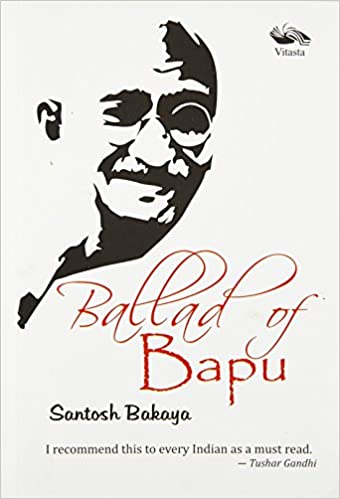
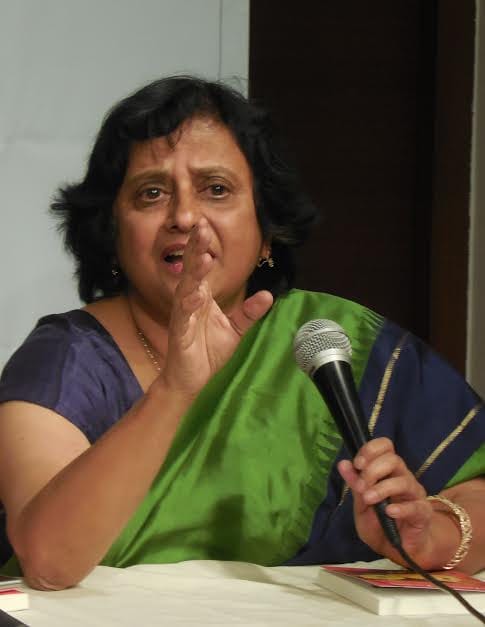
She is vivacious with what she describes as a “whacky” sense of humour and a passion for Gandhi. She has written a ballad on Bapu. You have guessed who she is – Santosh Bakaya. The thing that most impressed me about her was the way her students responded to her – students who are leading lives away from her academic umbrella even to this date. A strong influencer, who helps mould younger minds, she writes books to change her student’s lives and is a writer in her own right. Bakaya is not only an academic but a poet, essayist, novelist, biographer, editor, TEDx Speaker, and creative-writing mentor. She has been internationally acclaimed for her poetic biography of Mahatma Gandhi, (Ballad ofBapu). Her Ted Talk on The Myth of Writer’s Block, is very popular in creative writing Circles.
She has published multiple books of poetry, a novella, essays and biographies. A winner of multiple awards, her long, narrative poem, Oh Hark! which earlier figured in her book, The Significant Anthology, is now a book with illustrations by Avijit Sarkar.
Bakaya has given Borderless an extensive interview on her perception of Gandhi and Gandhism and its relevance in the current crisis filled world, punctuated with snippets of interesting vignettes from her teaching career, confirming well her characteristic of being a strong influencer in her students’ lives. Let us explore her principled, courageous and humorous outlook with her own words.
You have written a whole book and more on Gandhi. What developed your interest in Gandhi?
Gandhi, nay Bapu, was very much a part of my growing up years. My dad, (a very popular professor of English, in Rajasthan University, Jaipur), when faced by a dilemma, would invariably ask himself, what would Bapu have done in such a situation, and would go on to do what he thought Bapu would have done in that circumstance.
He never asked us to read books on Gandhi, but ignited our interest in this enigmatic man, who seemed to have an answer to everything. Was he a magician, we youngsters wondered! He would get books on Gandhi from the university library, and they would be lying at strategic points in our house; we would quietly start reading, imbibing and asking questions.
Later, it was while taking an MPhil class in the year 2012 that there was a heated discussion in the class on Bapu and his relevance. In a class of twenty students, there was just one girl who was defending the values of Bapu, the others were going all out to denigrate him.
“How much have you read on Gandhi? Can you give me the names of five books about Gandhi that you have read? Have you read his My Experiments with Truth?”
Then one student, who prided himself on being a poet, chipped in, “Madam, why don’t you write a poetic biography of Gandhi? Poetry will appeal more to us.”
This challenge hit me hard, (I am always on the lookout for challenges), but this appeared too difficult a task. Nonetheless, I took the challenge, and began by writing a few verses on the aa-bb-a rhyme scheme and got addicted, so much so that I went on to complete 300 pages of poetry on Gandhi, which was later published by Vitasta Publishers, Delhi, and is now a bestseller, critically acclaimed.
Gandhi was an ordinary man not without his fears, whims, apprehensions, a boy who was afraid of ghosts, robbers, multiplication tables, who rose above these fears to emerge as a moral icon, gaining an extraordinary status to be revered all over the world.
You wrote another book on Martin Luther King as he was influenced by Gandhi. Can you tell us what led to this book?
This book also was the result of another remark of another of my MPhil students.
Before that, while I was researching for my PhD thesis on Robert Nozick at the American Centre, Delhi. I came across the autobiography of King (edited by Clayborne Carson), I was completely fascinated by his life story and read all the books that I possibly could at the Centre — ignoring Nozick in the bargain. At that point of time, I thought maybe I’ll do my post-doctoral research on Martin Luther King, Jr. some day.
Later it was during another of my Conflict Studies’ lecture that one of my students (not a belligerent one this time) asked me to write a book on King. So that got me thinking and the book happened. It is a year since the book has been published, once again, by Vitasta Publishers, Delhi, (it has one full chapter on his India Connection) and I am happy readers have good words to say about it.
You are a fabulous teacher. Do you think your books made an impact in the way you wanted? Or was it more what you said?
I don’t know if I am a fabulous teacher, but yes, I know I am a very passionate teacher.
Yes, I think so. Let me cite an example. The MPhil student who had nudged me into writing a poetic biography of Mahatma Gandhi, and who was a great critic of Gandhi, on my insistence, read many books on Gandhi and right now, this critic of Gandhi has become a supporter of Gandhi and has become a lecturer in Political Science, specialising in Gandhian studies.
I was delighted when readers wrote saying that my book impacted them in a positive manner and since it was a poetic biography, they kept going back to it. In fact, Ballad of Bapu received more love than I had anticipated, so much so that I have given a number of talks on the book and conducted many workshops in many educational institutions followed by very fruitful and intellectually stimulating discussions.
Do you think Gandhi is pertinent in the current world? Why?
Gandhi can never be irrelevant in the world. Gandhi and Gandhism are for all times. He stood for truth and non-violence and truth and non-violence can never be irrelevant. Martin Luther King Jr. had followed his principles, time and again reiterating, that it was Gandhi who had inspired them during the Montgomery Bus Boycott and even later.
Gandhi was an ordinary man not without his fears, whims, idiosyncrasies and apprehensions, a boy who was afraid of ghosts, robbers, multiplication tables, and who rose above these fears to emerge as a moral icon, gaining an extraordinary status to be revered all over the world.
His values of Truth and Non-violence can never lose their relevance in this topsy-turvy, highly materialistic, self-centred and consumerist world. How can we ignore his supreme humanism, his overpowering love for everyone — even his enemies?
The Dalai Lama very rightly says, “He implemented the very noble philosophy of ahimsa in modern politics and he succeeded. This is a very great thing.” While the other ancient philosophers merely preached the philosophical aspects of Truth and Non-violence, his very life was a series of experiments with truth. He was a man forever evolving, trying to better himself in every way. Beleaguered humanity desperately needs to rededicate itself to the eternal values of nonviolence, truth, world peace and altruism otherwise, things will continue to be bleak.
What values of Gandhi do you think are the ones that are most relevant?
Truth, non-violence, love and compassion are values that will always be needed in this bleak world. An eye for an eye, will make the whole world blind, as he so powerfully believed. Why crave for this blindness and hurtle down an abyss?
Such peace revolutionaries like Nelson Mandela, Dalai Lama, Desmond Tutu, and Martin Luther King Jr. wouldn’t have been inspired by Gandhi had his values not been so precious. “If humanity is to progress, Gandhi is inescapable. He lived, thought, and acted, inspired by the vision of humanity evolving toward a world of peace and harmony. We may ignore him at our own risk,” Dr. Martin Luther King Jr had so eloquently said, reiterating time and again that Gandhi taught him his operational technique of fighting for civil rights.
Barack Obama, who holds Gandhi in great esteem had said:“I have always looked to Mahatma Gandhi as an inspiration because he embodies the kind of transformational change that can be made when ordinary people come together to do extraordinary things.”
The co- founder ofApple, Steve Jobs, maintained that Gandhi “showed us the way out of the destructive side of the human nature. Gandhi demonstrated that we can force change and justice through moral acts of aggression, instead of physical acts of aggression. Never has our species needed this wisdom more.”
So, we need the Gandhian wisdom and perception of love, truth, peace, moral acts of aggression and forgiveness, otherwise there is nothing but a grave new dystopian world staring at us. Has reading and writing on Gandhi impacted your life?
Yes, it definitely has. In fact, the first Gandhian that I came across was my father. My grandmother was aghast when one day the sweeper had not come, he picked up the broom and cleaned all the toilets in the house. And another day he made him have tea and breakfast with us. My granny was once again indignant, but later many interactions later, she also started subscribing to his point of view and was almost embarrassed of her earlier behaviour and developed a deep love for the underprivileged.
My father’s library was a bibliophilic treasure and I read all the books on Gandhi, later I got books from the school library too. As a collegian, I read many books on Gandhi and they had a great impact on me.
Let me cite an incident from my career. It was my first year as a college lecturer in a post-graduate government college for boys, which was known for its notorious elements. Straight from the university, I was brimming with idealism and Gandhian ideals and fired with an ardent desire to change the world (still am!). During an invigilation, I found a hulk of a boy brazenly cheating, while the senior co-invigilator looked the other way. I dashed towards him and was appalled to find a big knife stuck to his desk. I quickly pulled out the chits from under his answer sheets and raced towards the Principal’s office, his threats following me with a full- throated stridence. Tumko dekh loonga. Mera Career barbaad ker diya [I will teach you a lesson, you spoilt my career].
Later, that evening, I met him at the railway station. He was going to Mathura and I, to Delhi for the weekend. He didn’t recognise me, but I did. I walked up to him and said, you had said, that you would see me – “See me, I am right here. Do you want to beat me up? Come do it?” Dumfounded, he looked at the chit of a girl standing before him, and when he realized who I was, he fell at my feet, apologizing profusely. He now says, that was the turning point in his life.
At the risk of sounding pompous, let me say, that it has become my second nature not to nurse grudges, and I try to spread as much love around me, as possible. Yes, Gandhi and Gandhism have impacted me in a big way.
Do you think Gandhi can impact the younger generation?
Gandhi can definitely impact the younger generation if he is presented to them in a very interesting manner, through role-playing, skits, workshops etc. His values of truth and non-violence transcend all geographical boundaries and time. Bapu had fought for human rights in South Africa, achieving unprecedented success. He was indeed “a powerful current of fresh air –like a beam of light” as Nehru described him. We need this beam of light, this powerful current of fresh air as never before.
We should not forget that he was an ordinary man who rose above his ordinariness by sheer moral force, even calling off the Non-Cooperation Movement at the height of its popularity, because the violence that was unleashed at Chauri Chaura, on 4 February 1922 (a village in Gorakhpur District of Uttar Pradesh), was not in conformity with his ideology of non-violence, and he did penance for what he saw as his culpability in the bloodshed. Only a man with great moral fibre could have taken such a decision, fully aware of the criticism that would follow in its wake. Such incidents as these, need to be presented to the youngsters in a proper manner, so that their minds are cleaned of prejudices and misconceptions.
For Gandhi, cleanliness was very important, and who can deny the importance of cleanliness? There was a time when the iconic film Lagey Raho Munna Bhai had created a revolution in young mindsets, I myself being a witness to many such heart-warming scenes. When a parent who had come to drop his daughter to college, aimed tobacco spittle in the college premises, a boy picked up the broom lying nearby and swept it away, to the intense chagrin of the daughter, and the father, realizing his mistake, apologized profusely.
But things are changing fast, so are young mindsets, a sort of skepticism is setting in, so we need to present Gandhi to the younger generation with a conviction which is more robust than before.
Should we be propagating his ideals? If so, what would be the most effective way of doing so?
Of course, Gandhi’s ideals need to be propagated especially in these dark, despairing ages when the forces of fascism are wreaking havoc throughout the world. “Be the change you want to seearound you,” Bapu had said, so we should try to be that change, wherever we feel the need for change. Preachy pedagogy can only boomerang, so we should make his principles a way of life, so that the youngsters learn from them. We need to change ourselves first, if we want to spread his principles. Gandhi had said, “Power is of two kinds. One is obtained by the fear of punishment and the other by acts of love. Power based on love is a thousand times more effective and permanent than the one derived from fear of punishment.” (Young India, January 8, 1925).
To many naysayers, this might smack of naiveté, but no one can deny the fact that love and positivity are the weapons in our hands, which should be amply used to positivize the negative forces around.
As an academic, should Gandhi’s autobiography, My Experiments with Truth, be introduced as part of the school curriculum in India? Do you think that would have a good impact on young minds?
From my experience as an academic, I can say this very confidently that students prefer to crinkle their noses at course books. My Experimentswith Truth as part of the syllabus is indeed a great idea as a symbolic gesture venerating the great soul, but what I sincerely feel is that it is the need of the hour to devise such courses where My Experiments with Truth is part of supplementary reading. I believe, students should read it out of curiosity and not out of compulsion. Understanding the essence of Gandhian philosophy should not be forced on young minds. Yes, short-term courses and interestingly designed workshops can go a long way in inculcating the Gandhian spirit in youngsters.
Let me make myself clearer. Some years back, I was very happy to see youngsters at the Delhi Book Fair flocking to buy My Experiments with Truth. When asked the reason, they told me they were buying the book because in their first year of under-graduation, it was prescribed as a reference book for a course they were undergoing which, was meant for students of all disciplines. It is heartening to know that My Experimentswith Truth continues to be a bestseller. Both the supporters and the detractors, own copies of it.
What do you see as the future of Gandhism in India?
With Gandhi’s assassins being glorified with impunity, and his ideals given lip service to, only during particular days, Gandhism’s future looks bleak. But it is the responsibility of all the right-thinking individuals to pick up cudgels on behalf of this moral icon and disentangle him from the clutches of the naysayers and detractors. At a time when Gandhi’s killers are being venerated, Gandhi and what he stood for, needs to be revived. Martin Luther King Jr. had been influenced in his crusade for civil rights and non- violence by Bapu; he visited India in 1959, calling his visit a pilgrimage. During his visit he remarked that the spirit of Gandhi was very much alive in India, but alas, we are slowly forgetting the saint in beggar’s garb. Youngsters have no qualms about heaping venom at Gandhi, forwarding fake WhatsApp messages denigrating him. As I mentioned earlier and I repeat: we should not forget that he was an ordinary man who rose above his ordinariness by sheer moral force, as illustrated in his calling off the Non-Cooperation Movement at the height of its popularity, because the violence that was unleashed at Chauri Chaura, on 4 February 1922. This did exhibit his immense moral fibre.
Who can deny the importance of truth, forgiveness and non-violence in this age of crass materialism and consumerism! Gandhi had said, “Be the change you want to see in the world”, so we have to bring about the revolution within ourselves and change the world for the better, otherwise the world is doomed. In this context, allow me to quote Martin Luther King Jr, “Over the bleached bones and jumbled residue of numerous civilizations are written the pathetic words, ‘Too Late’”. Why should we wait for it to be ‘Too Late’?
As a teacher I have had the opportunity of interacting both with the millennials and the Generation Z and notice a world of difference between their mindsets.
I know of many youngsters who are running organizations, the mission of which is to create a more equitable and inclusive society. I had a very fruitful discussion with a young NRI nephew who was in India six months back and the essence of what he said boiled down to this, “The world is fighting the evils of discrimination, race, gender, and we cannot forget that Gandhi was a pioneering force in this direction. More and more people should come forward to run programmes which are consistent with his constructive programmes.” He heads one such programme which is very popular.
Then there are some from the hypercognitive Generation z who vociferously argue, “How can the oppressors rid themselves of the guilt of what the guilty have perpetrated in the past — how can they justify their oppression? We need to be proactive — and need to follow Malcom X and Not King or Gandhi. No more candlelight marches, no more offering of roses to our oppressors! We need to hurl stone for stone. You got your jobs in golden platters, our generation has no jobs, no economic security, no health security, we are surrounded by environmental hazards of all sorts, and we need to do something.”
Well, we cannot save ourselves from the guilt of the devastation that we have wrecked on the young generation but in these crosscurrents of hatred and enmity, it is humanity which is suffering, and needs to be resurrected. No matter what rampant negativities we are surrounded by, I staunchly believe, that the tenets of Gandhism will have to rise from their ashes and come to the rescue of a doddering, staggering humanity. Otherwise we are doomed.
Thanks a ton for this great opportunity, Borderless journal and Mitali Chakravarty. It was an honor answering these questions.
Thank you for giving us your valuable time, Santosh Bakaya.
This online interview was conducted by Mitali Chakravarty.
PLEASE NOTE: ARTICLES CAN ONLY BE REPRODUCED IN OTHER SITES WITH DUE ACKNOWLEDGEMENT TO BORDERLESS JOURNAL.
.
Disclaimer: The opinions expressed are solely that of the interviewee.
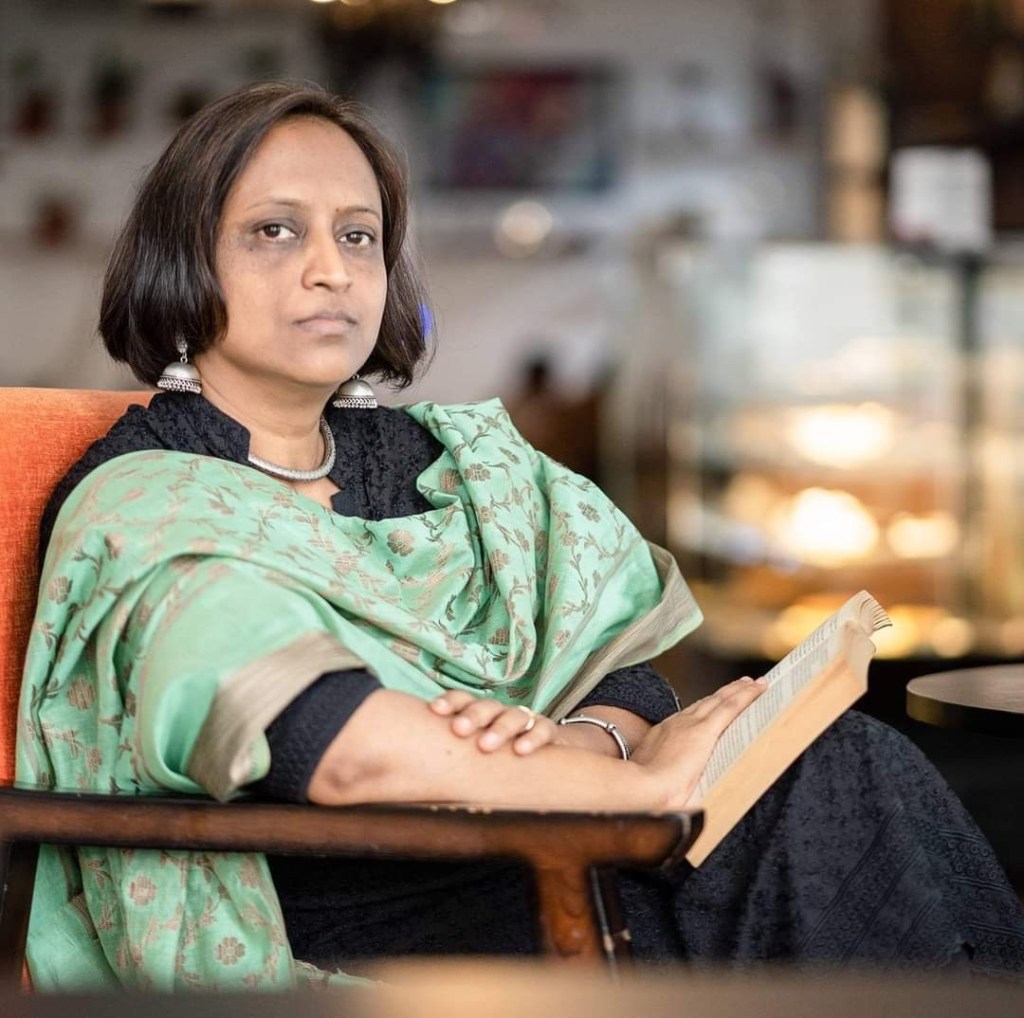
Teresa Rehman is a journalist with a difference. She is woman who feels and conquers with her pen. She does not hanker for anything more than being the spokesperson for voices in the remote areas of North-eastern India. In that spirit, she started her own magazine: The Thumb Print, and also wrote a couple of books which have found their way to even the Strand Bookstore in New York.
Rehman, an award-winning journalist based in North-east India, is known for her resolute grit and matter-of-fact approach to stories. She has worked for years toward bringing the different facets of the region, its diversity and distinct ethos into mainstream media. Rehman’s work in journalism spanned through India Today, Telegraph and Tehelka before she decided to put in all her resources into launching The Thumb Print e-magazine that she edits currently. She has managed to bring in the gender perspective to her stories.
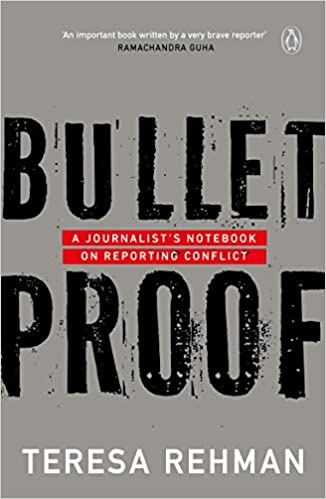
Rehman is known for her unassuming persistence on getting the details, and sensitivity. She was featured in the Power List of Femina magazine in 2012 and has written three books. The Mothers of Manipur (Zubaan Books) and Bulletproof (Penguin Random House India) are among them. Borderless in this exclusive, unravels, Rehman’s journey as a journalist.
You said in one of your Thumb Print conversations, you are a journalist and not a writer. What do you see as the difference between being a journalist and being a writer? You have written a number of books. Does that not make you a writer?
I would always prefer to call myself a journalist and a chronicler who is trying to tell the stories of the men, women and children of one of the most underreported regions of the world, i.e. Northeast India. And the books I had written are journalistic narratives without any frills, of my journey as a reporter into the nook and crannies of the region and the stories behind the stories. I am a reporter who loves her job.
How many newspapers/ magazines have you worked for?
I started off as a cub reporter for the local dailies. And after completing my studies in journalism from the Indian Institute of Mass Communication, New Delhi, I started off as a trainee journalist at the editorial desk of India Today magazine in the capital city. After that, I relocated to Guwahati and started working as a Correspondent with The Telegraph newspaper and later reported for the entire region for Tehelka magazine. Thereafter, my life took a different turn and I became a media entrepreneur by launching the webzine, The Thumb Print in 2012. I have also written about specialised issues like media analysis for The Hoot, climate change for Alertnet Reuters, the environment for The Third Pole and gender for the Women’s Feature Service.
How long have you been a journalist? Does journalism clash with family life more than other professions?
I have been a journalist for almost two decades now. I feel, once a woman steps out of the house for work or any other activity, there are changes in her family life — for some these changes are subtle and for some these changes may be earth shattering. And if a woman finds support at home, she can break any kind of glass ceiling at her workplace. A woman is exploited the most at home. And any kind of changes in her professional life begins and ends at home. I have been quite fortunate to have had a congenial atmosphere to be able to pursue my unconventional career as a journalist. I am a first-generation journalist in my family and though I had erratic working hours, I always managed to create a support system at home. However, not all women are fortunate like I am.
You have been to many places as a journalist that a common person would not visit. Are they all centred in the North- East? Is there a reason you work from this area. Tell us a bit about your experiences in such areas.
A senior journalist had once told me “your location is your disadvantage”. On the contrary, I feel that northeast India is a paradise for journalists. There are so many untold stories waiting to be told. I feel blessed that the region is my home and I chose to work from this difficult space — a region that has witnessed several decades of violent insurgency coupled with a hostile geographical terrain. My experience has been novel, vivid and interesting compared to the rat race in the journalistic circles in the metropolitan cities and the glitz and glamour of television channels. I choose to tread on the untrodden path, in the midst of virgin nature and unwritten stories. I have written about my experiences in reporting conflict in my book Bulletproof (Penguin India). I am glad that internet has opened up immense possibilities and I can work from any place in the world and get my story across to the world.
You are an award-winning journalist. Can you tell us the work that led to these awards? Did you do the work with the intent of getting the award or was that incidental?
It feels good to be recognised for your work. But I never went hankering for awards. I guess your good work speaks for itself. I had bagged some of the most prestigious awards for journalism in India that include the WASH Media Awards 2009-2010, the Ramnath Goenka Excellence in Journalism Award for two consecutive years (2008-09 and 2009-10) for the category ‘Reporting on J & K and the Northeast (Print)’, the Laadli Media Award for Gender Sensitivity 2011, Sanskriti Award 2009 for Excellence in Journalism and the Seventh Sarojini Naidu Prize 2007 for Best Reporting on Panchayati Raj by The Hunger Project. In fact, the WASH Media Award which is given for writing on water, sanitation and hygiene and is sponsored by the Water Supply and Sanitation Collaborative Council (WSSCC) and the Stockholm International Water Institute (SIWI) was given for a story I had done based on the life of my domestic help and her associates. This goes to show that in order to bag a good story, you need to keep your ears and eyes open.
Why did you feel it was important to record your experiences in books? Was writing a book different from writing for a newspaper or magazine?
A book definitely has a longer shelf life and its reach is tremendous. I was surprised to see my book on sale at the Strand Bookstore in New York. A book remains and becomes an important document for posterity as it can also be stored in the libraries of the world. A book has a life of its own compared to newspaper clippings and write-ups. It can travel far and wide.
Tell us a bit about your work in Thumb Print. What started you on Thumb Print?
The Thumb Print was a very angry reaction. When I had to struggle to find space for my stories in the so-called ‘National’ media, I decided to create my own space. This was when I had discovered the might of the internet. The Thumb Print is more like scaffold trying to reach out to the world and bring the world to our doorsteps. We proudly call ourselves an ‘international magazine with a north-eastern soul’.
You do these online interviews with writers, currently on “Why women write?” Why would you choose this topic? Did you face a lot of discrimination as a woman in journalism?
When I started doing hardcore conflict reporting, I realised that I was stepping into an old boy’s club. I was treading into masculine space and I had to manoeuvre my way all by myself. I got no support from my male colleagues. Women, all over the world, face different layers of discrimination when they step out to do something unconventional. That is why I felt that it was important to address this question of ‘Why and how women write’.
Are you planning a new book? What are your future plans?
Yes, I am working on another book on an important aspect of contemporary northeast India. And of course, I intend to dabble with different aspects of media which is trying to keep pace with the fast evolving technology.
Any message for upcoming writers/ journalists?
Yes, journalists should not forget the basic values of good old shoe-leather journalism. A value of a well-told story can never change — though the medium or external packaging might change. In trying to keep pace with technology, we should not forget the values of telling the truth that should be the primary concern of a journalist.
This interview was conducted online by Mitali Chakravarty.
.
PLEASE NOTE: ARTICLES CAN ONLY BE REPRODUCED IN OTHER SITES WITH DUE ACKNOWLEDGEMENT TO BORDERLESS JOURNAL.







 Borderless