Categories
Review

Whose Land is it Anyway?

Book Review by Nivedita Sen
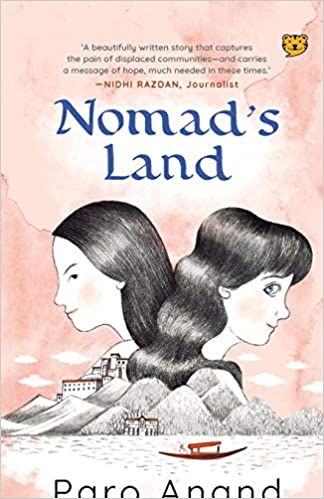
Title: Nomad’s Land.

Author: Paro Anand.

Publisher: Talking Cub (an imprint of Speaking Tiger Books), 2020

We live in times when the business of children’s literature increasingly turns towards desanitising the world around child readers to expose them to real life accounts of hatred, violence, othering and numerous other ills that are perpetuated around them in a way that they can decide for themselves who or what they want to be amidst all this. In a universe torn by war and the hostile drawing of lines, Paro Anand’s writings are sentient, sensitive and sensible exemplars of portraying the child reader’s realm as one that can subsume the world within it if s/he wants it to. In her book of stories Like Smoke, or her novels No Guns at my Son’s Funeral and now Nomad’s Land, she has let her child protagonists tread on and explore many of the concerns in the lives of adults.

Anand has talked about two ethnic groups – the Kashmiri Pandit community that had fled the valley in the eighties due to terrorist violence that often targeted them, and the imagined Qhushvaha people in the higher plateaus who had got dislodged from their homeland due to the political upheaval in which they had been ostracized by their own kinsmen, a combination of many such marginalized groups of children that the author has been interacting with. The Qhushvahans have come and resettled in what can perhaps be recognised as Majnu ka Tila, the Tibetan resettlement colony of Delhi, although Delhi has been named in the entire novel only once in relation to the Kashmiri Pandit girl Shanna’s grandparents’ residence.

The refugees have made it their camp, their home away from home, by severing their link with their own ancestral territories, reinventing the colony’s open sewer lines as the river that flowed in the lap of Mother nature back home, and reinforcing their disconnect with their own land of not so long ago. Anand claims that this group is based on a combination of children from Tibet, the North East, the Rohingyas, the Syrian child who had been left to die between shifting sands, decriminalised tribes like the Pardhis, and finally the children of the migrant labour who had to flee the cities to walk back to their villages immediately after the declaration of the lockdown with no sense of belonging to any definite region. When Anand mentioned the last group in an interview, one could sense a goosebump-raising contemporaneity about the story. The Qhushvahans represent what Anand calls the ‘Everyman of Nomad’s land’.

Amidst all messages of acrimony that children receive from their parents, Anand, who works with children of various backgrounds, says that they do not necessarily internalise those abrasions, fissures and fractures. She uses a beautiful metaphor when she says in an interview that she wants to spread the message of love and peace by teaching children addition and multiplication rather than subtraction and division. Shanna the Kashmiri girl is one such child who overcomes her diffidence in the subtle manner in which she connects with the other children of her school when Pema her friend is away and suggests to them that we could all be trees. What she means is that even if we have lost our own roots, we could grow not only branches but new roots, a message of inclusiveness that makes them rethink their inherited prejudices about the Nagas. It suggests a review of inbuilt bad blood passed on by our parents.

Pema, the Qhushvaha girl in the refugee colony, is preoccupied with something else — liberating her old grandmother or mola from her racking cough and releasing her into death through an ancient practice of ‘breathtaking’ that is performed on those who are leading vegetable lives in the twilight of their lives. It has, of course, been banned by the government because it is a kind of mercy killing. Anand points out that when laws and policies are framed in a country with a multicultural canvas like that of India, we do not take into account that one size cannot fit all. Interestingly, Shanna is included in this project. She is entrusted with the task of enabling Pema’s mola cross the bridge to death because a kinsman is not supposed to do it.

The cough becomes a motif that unites the frail and elderly across the book — Debek Dan, the only man who can teach Shanna how to perform the breathtaking ritual, Shanna’s grandfather who significantly learnt indigenous medication from a Muslim hakim friend, and Pema’s grandmother. Shanna realises that the cough that links these three people has to do with the pollution in a big city, which is where they had had to resettle after having been natives of “forever skies and endless horizons”. 

An ecological concern over the abuse of the environment comes through in the images of the open drain choked with plastic wrappers that acts as a surrogate for a river or the respiratory distress that affects the elderly across communities that were inhabitants of the mountains. That is when Shanna and Pema hit upon the idea of going back to Kashmir to procure some ingredients like roots and herbs for Nanaji’s medicines from the higher reaches of the Himalayas.

Both of them want to become doctors of indigenous medicine when they grow up, and Debek Dan’s daughter, Doyang, is willing to be an accomplice in their enterprise. The starting point of the fantasized venture would involve a reconnaissance trip to Kashmir themselves to stay with Huma and her family.  And the novel ends with Shanna and Pema undertaking a  mission that seamlessly and happily weaves together so many disparate strands in the novel — Shanna’s mother’s stops mourning to start a new life by accompanying the two girls, the reunion with Huma on whom Shanna had perpetrated communal hatred without any provocation, the understanding that Huma’s family has also been the victim of terrorist violence, the fusing together of Ayurvedic, Unani and Qhushvaha medicinal practices to solve a medical crisis in which the elderly in the novel suffer due to the hazardous air quality index in the urban pockets of the plains, and the children’s environment-friendly command over the ambience we live in. As Anand admitted herself, despite her effort to expose her child readers to sordid truths about the life around them, she ends her stories on a hopeful note so as not to leave them feeling stressed, anxious or depressed. Pema is a doer to begin with, and both the girls go up and about towards the end, therefore, to act positively on something that needs to be done to make the world a better place to live and breathe in.

Anand’s invention of the race of Qhushvahans involves not only creating a history and a geography about them, representing a protagonist, Pema as the ‘Everyman of Nomad’s Land’, but constructing a language that expresses itself in the quaint Qhushvaha deathbed rituals and chants, and making up nomenclatures (like Mola for grandmother) and facets of their culture like clothes. The English language is used by the possibly pre-teen protagonists in a way that shows real children imitate their peer group and improvise. Shanna, it is shown, feels progressively proud of being included in a group that uses adolescent colloquialisms like dude, swag, grandmom, wanna, whack, lezzies – what she calls “real TV language”.

The book deploys an anachronistic time scheme in which internet and cellphones exist in the early eighties in which the story is set. She says that this is to enable the children of the here and now to identify and feel more at home with its setting.

Paro Anand’s themes and portrayals have been such that a lot of censorship has been imposed on them by the adult gatekeepers of children’s morality. One of her books was banned from school curriculums because two adolescents of different communities share a fleeting kiss in it, and Anand justifiably calls such censorship the banning of books “for the love of hate.”

It is a work for children that is not only food for thought for children who are trying to find their feet around in a big, bad world but also makes adults pause and revisit the biases with which we inadvertently indoctrinate our children. 

Nivedita Sen is an Associate Professor in English at Hansraj College, University of Delhi. She works on Bangla children’s literature, and has translated authors like Tagore, Sukumar Ray, Asha Purna Devi, Leela Majumdar and others for Harvard University Press, Vishwabharati Press, Sahitya Akademi, Katha, Tulika and more. 

.

PLEASE NOTE: ARTICLES CAN ONLY BE REPRODUCED IN OTHER SITES WITH DUE ACKNOWLEDGEMENT TO BORDERLESS JOURNAL

Categories
Humour Poetry

Kissing Frogs

By Rhys Hughes

Kissing frogs is
sometimes a wise thing to do
but mostly no,
it’s not. They may
turn into a prince, true,
or they may turn into
something different, a thing
that will make you wince.
Who knows? I don’t.

A romantically inclined girl
with amorous curls
tumbling over her shoulders
was picking her way
one day along a narrow track
liberally strewn with
boulders. Unhappy was she
with her family and desperate
to move out of her home
and so she liked to roam
while daydreaming
of magical encounters.

On the rim of a pool
she spied a frog sitting
on a log and she said
to herself, “If I kiss his lips
maybe my wish will be granted.”
With excitement she panted
and supposed that this amphibian
had been sent by a god
slanted in her favour
so right on the meridian
of his mouth she planted a smacker
with a passionate flavour.

Oh dear! Expectations
are often thwarted and when all the
mistakes of humankind are sorted
and noted down
the assumption that a kissed frog
will always turn into a prince
must certainly be somewhere on the list.
It was the girl who changed!
Her personality remained the same, yes,
but her outer form
became perfectly frog-like
and now the frog on the log
who had long been alone
had a female to call his own
and he kissed her lips
to express his amorous nature.

But the lips of a frog
have a magical force and no sooner
had the kiss been delivered
than his bright green darling turned
into a handsome prince. He winced
if frogs can be said to wince at all
and his disappointment was evinced
by the fact he hopped away.
What use is a prince to a frog?
Let’s take this absurdity no further.
The prince turned on his heel
and went back along the difficult track
to reconcile himself with
a very surprised mother and father.

Rhys Hughes has lived in many countries. He graduated as an engineer but currently works as a tutor of mathematics. Since his first book was published in 1995 he has had fifty other books published and his work has been translated into ten languages.

.

PLEASE NOTE: ARTICLES CAN ONLY BE REPRODUCED IN OTHER SITES WITH DUE ACKNOWLEDGEMENT TO BORDERLESS JOURNAL. 

Categories
Musings

Lost in the Forest

By John Drew

Philosophers and theologians warn us about the danger of becoming distracted and misled by images. In the age of the selfies, with photography being used to sell us so many things we do not want or need and convincing us that smiling celebrities are gods and goddesses, we have reason to take their warning seriously.

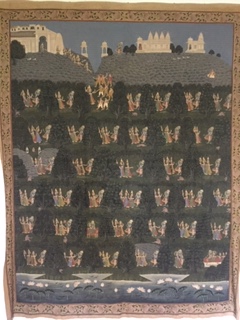
But what of images that warn us of the same danger, even while they enchant us? I ask this question while looking at a beautiful wall-hanging of the gopis seeking out Krishna in the forest of Brindaban. 

The wall-hanging is composed of 38 episodes, each framed by a woodland glade, laid out in six horizontal lines of 7,6,5,7,7 and 6 frames. At the top, Radha and seven other gopis leave the city, pots of curds on their heads, and wave farewell to their husbands as they enter the forest of Brindaban. After their many encounters with Krishna, the story concludes with Radha and Krishna haloed and seated together in a pandal beside a lotus-filled River Yamuna. 

The trouble is, when you try to follow the story of their search for love’s fulfilment line by line, top-to-bottom on the wall-hanging, the frames don’t follow one another in any recognizable sequence. Almost all the frames show three gopis confronting Krishna, apparently arguing with him and either turning away or being turned away but in no particular order.

The gopis emerge from the city in the third frame of the top line. Amid scenes otherwise always sylvan, the towers and rocks of the city are seen in the first frame of the third line and the rocks alone in the fourth frame of the final line. This phased departure from the city suggests these may be the first three frames of the story. Yet the gopis, who accompany the protagonists in each are in different-coloured saris and, apart from this glimpse, don’t appear again. We are left without a clue as to what might be the fourth frame in the sequence.

It seems it might be easier working backwards. The last frame of the last line is so obviously the culminating frame and the one before it has Krishna and Radha, both haloed, walking through the forest. But then the only other frame with the pair haloed is fully a line before this and they are seated on a rather different pandal decorated as if for a wedding and with a more ornate base. Something is not quite in order.

The colour of the saris is one obvious determinant.  Most prominently, there’s Radha in her green-and-red sari and her friend Lalita (let’s call her that) in green-and-yellow, often with a third gopi in blue-and-red  behind.  But sometimes there are suddenly gopis in brown-and-yellow and black-and-yellow instead and once or twice gopis in blue-and-yellow and  black-and-red. Sometimes the figures obscure one another and we have a glimpse of just one colour of a sari and this may belong to the eighth (otherwise missing) gopi. And why, if the colour of the saris is indicative, does Radha once appear twice in the same frame? And why, when the gopis emerge from the city, are seven of the eight figures wearing Radha’s colours? 

These concerns may appear rather silly: after all, the painter’s palette may account for such occasional discrepancies. However, the larger picture may suggest we are being deliberately misled by an artistic representation of the magic of the Ras lila. We try to make sense of what is going on in the pursuit of love’s goal and we simply get lost in the forest?

It is not totally baffling. There is some downward and, less obviously, left-to-right movement in the development of the story. Right in the very centre of the wall-hanging there is a frame where Radha steps out to engage with Krishna. This is in the third frame of the five-frame third line and given that the story culminates in the sixth frame of the sixth line, it is tempting to construct a diagonal across the matrix: Radha in the first frame of the first line engaged in a conflicting hand-to-hand pull-and-push with Krishna; in the second of the second, Lalita approaching Krishna, hand on curd pot, whether as confidante of Radha or as rival – or both – is unclear; in the fourth of the fourth, three gopis, two in Radha’s colours, turn away from Krishna; and, in the fifth of the fifth, Radha, now potless, submits herself to Krishna. This diagonal might serve as a plot for the whole story, however jumbled the frames all around.

Radha and her two main friends figure most prominently in the frames of the first line but there is no easily discernible order to the frames. The first four frames of the second line foreground different gopis and it may be that the particular story of each in turn is to be tracked, however tentatively, zig-zag down the wall-hanging before we return to the next frame as a starting-point?

The last two lines of the wall-hanging are distinct from those before in that all their frames (bar those of Radha-Krishna haloed) show a gopi approaching Krishna with a pot no longer on her head. The fifth line starts with a frame where Krishna is himself removing the pot from (if not replacing the pot on) Radha’s head (presumably as a token of his choice); in the next frame he is fanning a potless Lalita; and in the others receiving gopis who have discarded their pots.  Should we take this to be an act of collective submission following Krishna’s choice of Radha or are they the final frames of individual stories that have threaded their way down through the thickets further up the wall-hanging?

Images from nature are also tricky. Initially monkeys, one springing in from the left and another from the right, promise to show us a sequence:  in the end they at best indicate only mood. This may also be true, given their place in Indian iconography, of trees and flowers. Perhaps like the ever-shifting designs on the saris, changing from dots to dashes to crosses to ovals, they too are decorative, deceptive only in a suggestiveness that ultimately reveals nothing?

We do not know whether or not the painter is following the poet he has placed seated on the rocks in the top right-hand corner of the painting, he has wrought cunningly. Looking to piece together individual stories of the search for love, we have been baffled by their erratic course. But, however erratic, the course is perhaps common to all the gopis, however much or little we can see of each. The advantage of a closer look, however bewildering, reminds us that, instead of being distracted by a surface that leads us to a merry dance, we should discover the common pattern that underlies all and is concentrated in the composite figure of Radha, one that is ultimately subsumed in that of Radhakrishna. 

We may then tell ourselves that, even though we cannot say how we got here, we are no longer lost in the forest.

Glossary

Ras Lila: Dance of Radha, Krishna and Gopis

Gopi: Handmaidens of Radha

Pandal: An ornate tent

.

John Drew, author of India and the Romantic Imagination, was married in India, has worked in Singapore and now lives in Cambridge with his wife Rani. 

.

PLEASE NOTE: ARTICLES CAN ONLY BE REPRODUCED IN OTHER SITES WITH DUE ACKNOWLEDGEMENT TO BORDERLESS JOURNAL

Categories
Poetry

Ri-Ri’s Brushes

By Vatsala Radhakeesoon

On a faraway island,
all blue and green,
loosely tied to the colossal continents,
there lived an artist.

Her name was Ri-Ri
and in her pink pearls’ cave,
she hid a pair of brushes;
She often called them “peculiar”
but to the inhabitants they were just 
twin fan brushes glued together.

One night, three brown bats
lazing on the litchi trees
started to make fun of the painting tools;
They called them “ugly”, “grotesque”, “useless”
and threw  half-eaten fruits on  Ri-Ri’s windowsill.

The moon frowned,
The stars were startled,
Thunder tore the clouds,
The bats fidgeted on fragile branches.

Swirls of silvery, golden and  turquoise light
sparkled  around,
The fan brushes gracefully performed the circular dance,
They transformed into soft plumage of all white,
and  a confident beak all  yellow;
A pair of feet sang History to the night.

Amidst Ri-Ri’s garden,
stood a Dodo relishing the summer
of its native land,
Ri-Ri hugged it and in her local language
whispered to the bats,
“Samem mo ti sekre.”*

* Samem mo ti sekre (from Mauritian Kreol ) – That’s  my little secret.

Vatsala Radhakeesoon is an author/poet and artist from Mauritius. She has had numerous poetry books published and she is currently working on her flash fiction/short stories book. She considers poetry as her first love and visual art as a healer in all circumstances. Vatsala Radhakeesoon currently lives at Rose-Hill, Mauritius and is a freelance literary translator and an interview editor of Asian Signature journal.

.

PLEASE NOTE: ARTICLES CAN ONLY BE REPRODUCED IN OTHER SITES WITH DUE ACKNOWLEDGEMENT TO BORDERLESS JOURNAL
Categories
Stories

Pothos

By Rakhi Pande

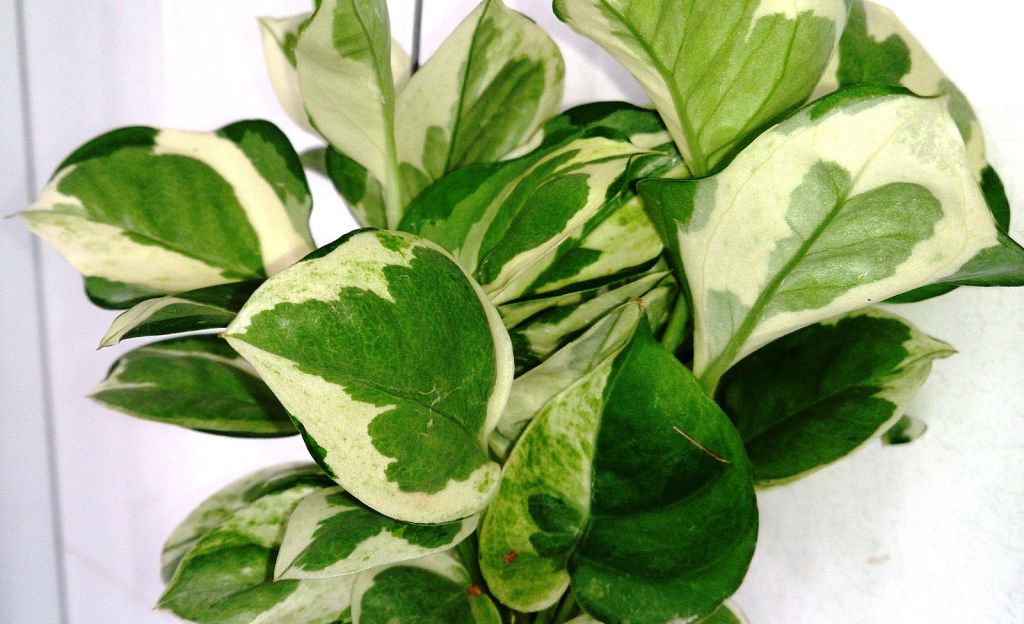
Money plant: Courtesy: Creative Commons

Shireen carefully placed the unwieldy pot on the dining table. She checked again to see if she had inadvertently damaged the lush green and tall money plant she had just bought on impulse. Her very first one, though, growing up she always had seen at least one if not more money plants at home, so, not technically her first however, her first very own money plant for her apartment. Company leased of course. 

She was fascinated and charmed by it. The plant naturally caught the eye as a new focal point in the room. Glossy emerald green leaves – darker than the emerald embedded in her ring, its marbled texture never repeated on any leaf; unique and different. The leaves looked like they had been coloured in with oil pastels.

She marvelled at the fact that a simple acquisition like that ensured that she did not immediately swipe on her phone screen to check her messages or indulge in the endless and somewhat mindless scrolling through social media posts, once home. She could stare at the plant for hours, seemingly, to observe the graceful curves of the stalks swirling upward around the moss stick.

Shireen had no idea a towering money plant with such gigantic leaves could grow out of a diminutive six-inch pot. It was possible because of the moss stick. That it could hold twenty times its weight in water, was a fact she had just learnt from the attendant at the plant shop. None of the leaves of the ubiquitous money plants she remembered from her childhood in every home been quite this size.

The little label stuck on the pot listed its scientific name – Epipremnum aureum, but the attendant at the store had called it Pothos. For a brief second, Shireen had misheard the name as Pathos. That very day she had made her high school students apply the persuasive technique of ethos, logos and pathos in their written assignments. She realised her error almost immediately. Both the scientific names didn’t sound right to her – she preferred calling it simply by its colloquially popular name — money plant.

This was purely an impulse purchase – having accompanied two of her colleagues, Min and Lena to the flower shop to select a bouquet to be sent to their dean who was hospitalised for a knee replacement surgery, she had spotted the large section containing various money plants under the enticing fifty percent off banner. That was a big deal in Singapore.

She had moved there two years ago on a work visa that included accommodation – a real coup. Her hectic work life ensured that the idea of getting a plant hadn’t even crossed her mind – until now. Min who was Singaporean Chinese, Lena from Russia  and she had struck up an easy friendship.

The informative leaflet displayed on a stand stated that the money plant would not require much watering or maintenance. It could be placed anywhere indoor, as long as it was exposed to some light. A balcony or windowsill was not a prerequisite.

“You need to steal it,” Min giggled, “for the money part of it to work.” Amused, Shireen imagined herself trying to attempt something like that in a city with probably the strictest penalties for crime. Good luck trying to explain the principles of feng shui* as a defence. Her expression made them all laugh, and Shireen spent a few careful minutes selecting one with the lushest foliage. 

Once home, she put some thought into where to place it. She decided to do some research about her new acquisition and read many interesting articles about the pothos. Some of them contradicted each other as was the norm with the internet. She had not even thought about her bedroom as an option – having absorbed the adage or warning that plants should not be kept there – a belief oft heard over the years.

However, one article strongly proclaimed that since the epipremnum emitted oxygen at night, it should be placed in the bedroom to improve sleep quality; that it was a myth that plants should not be placed there.

She tried to look for information supporting the Asian belief with some scientific reasons to back it up but couldn’t find anything online that forbade plants in the bedroom, not even on the myriad vastu shastra* sites that popped up in response to her search.

They all agreed in one aspect, that the plant should be placed in the South East direction. She decided to leave the money plant on the dining table for the time being and then, choose a spot the next day.

*

The next evening, having carried a lot of work home, she was too tired to do anything more than drop into bed early. However, remembering how the money plant’s presence had enlivened her sitting room, she forced herself to roll out of bed and bring it into the bedroom. She placed it on the dresser for the time being, vowing to figure out a better placement over the weekend.

She fell asleep almost immediately after and awoke refreshed, crediting the plant for this, even though she had no real scientific idea about the quantities of oxygen a plant that size gave out.

The weekend arrived soon enough and once Shireen had completed dusting, vacuuming and mopping her apartment, she looked around her bedroom for likely spots and found an ideal one — just below her window. It was designed to mimic a French window, with glass panels nearly all the way down to the floor. This would place the plant quite close to her bed as well, all the better to imbibe oxygen. The window was South facing, so it wouldn’t get direct sunlight but a lot of bright, indirect light.

She was determined to do all she could to ensure that the plant stayed healthy. She went to bed that night smiling over Lena’s comment that she was getting obsessive about the plant just like one does with a new pet. Just because she had bought a plant tonic for it despite its exorbitant cost.

*

She struggled awake from a deep sleep saying, “Do you need something…?” Fully awake moments later, she could have sworn it was Lena standing by her bedside to ask for a duvet.

Min and Lena occasionally slept over just like she did at theirs, especially on weekends they planned an early morning trek or outing.  Not this weekend though.

Feeling a bit uneasy, Shireen couldn’t fall asleep for quite a while.

It was probably the silhouette of the money plant that her subconscious had registered, she told herself. It was nearly four feet tall and she was not yet used to its new placement.

“I guess I did get some sleep,” she thought wryly as she awoke comfortably later than usual for a Sunday morning. In the bright light of day, she looked over at the money plant which was diagonally adjacent to her bed, not directly beside it.

She stood looking at it, thinking about that funny dream. Did the leaves look a darker green already? It had already grown, as one of the tips had curved even higher. The pointed leaf at the tip had unfurled itself, too. She couldn’t resist touching its shiny surface which resembled a plastic leaf.

She had sprayed the plant tonic just a couple of days ago – its recommended usage was once a week.

I’m just imagining this, she thought, but she secretly felt like a proud mother who’s noticed significant progress in their offspring.

*

Shireen tried to wake up, to move, to speak, but something was stopping her. She felt something flowing from the money plant – something glutinous, yet luminous, which was trying to envelop her. Some unconscious resistance that she managed did not allow that to fully occur, however.

She opened her mouth to call out, make some sound, but the words were lost in the ethereal white light that didn’t allow any sound to pass through. This sent her into a full-blown panic and she made one last concerted effort to resist whatever was happening.

Shireen awoke with a start, wide-eyed, stiff and scared. It took a few seconds for her brain to process that she had just had a bad dream.

One that seemed very real though.

In the dream, her room, her surroundings had been exactly the same. Must be from the MSG or food colouring in her takeout, she thought. She had often had vivid dreams after eating out, especially after anything which had orange food colour added to it. Like Schezwan or chicken tikka.

She found it difficult to fall sleep again – and stayed awake for what seemed like hours. Only when daylight dispersed the complete dark of the room, she fell into an exhausted sleep.

*

In the morning, for some reason, she could not bring herself to look at the money plant. “You are being ridiculous,” she admonished herself.

Had it always appeared this dark and forbidding? Weren’t most money plants a brighter green with more of a white marbled effect? Hers was mostly completely green. How had she not noticed it before? Only a few leaves had the white marble streak.

She caught herself avoiding walking by it too. The rational part of her brain mocked her for even entertaining a supposition that what she had ‘dreamt’ should impact her actions in broad daylight. “Shame on you, a supposed role model to students!” she scoffed at herself.

Shireen went online and put in a specific search request for why plants should not be placed in the bedroom. To her immense frustration, not one piece of content appeared. She couldn’t believe it. This was the internet. You could type literally anything and there were tons of articles or threads about it. Nothing in this case, though. Some posts that turned up as a result of her search warned against growing a peepal plant at home. These posts originated from Indian sites. She had some vague memories of hearing stories from her grandparents about spirits residing in the peepal tree. However, as was wont with the internet, most of the articles stated that this tree was sacred for many cultures. But this was a money plant, not even closely related to the peepal. She gave up the search.

*

Lena and Min trooped into Shireen’s place for dinner on Friday eve. They would stay the night, sleeping on the comfortable bed that appeared magically from the wall in her sitting room neatly settling itself over the couch – just by pulling on one lever.

It was only when they had all finished dessert that Min noticed. “Where’s your money plant?” Lena was astonished that she hadn’t noticed its absence. “Even you couldn’t kill a money plant!”

Shireen had already planned what to say when the topic was broached and smoothly replied that she had gifted it to her elderly neighbour downstairs, Mrs. Tan, as a gesture of goodwill when she had admired the plant. Mrs. Tan’s helper, Wei, often brought by a meal for her, sent by the kind, old lady.

Shireen didn’t want to delve into the reasons why she simply was not comfortable with the plant anymore. Not just in the bedroom; anywhere.

She had caught herself thinking about the unsettling and uncannily lucid dream and knew that she could not spend another night with the plant in the same room. She hated that she had hesitated to even touch the pot to lift it and bring it back into the sitting room in the morning. She would never ever admit the real reason for getting rid of it to anyone, not even Min and Lena, but she distinctly felt that she’d had a narrow escape.

She caught herself wondering if the reason plants should not be in the bedroom had something to do with what she had experienced in her dream. Could it be that some unknown and undiscovered interaction between plants and humans was possible? Was it a friendly, symbiotic exchange of energies she had mistaken for something sinister, a transference, or… a takeover?  

Shireen shivered and firmly blocked this line of thought.  It did, however, give her an idea for a written assignment for her students on traditional cultural beliefs impacting modern existence; ingrained spiritual beliefs or superstition, affecting day to day life – it would be interesting to read essays from over forty nationalities. She got to work on her laptop.

*

Mrs. Tan looked at her overcrowded but beautiful house. Though spacious, nearly every nook and cranny occupied with years of acquisitions.

She wondered where to put the money plant that young girl upstairs had gifted her. She was pleased as the money plant was a symbol of luck and prosperity. An auspicious gift. She called out to Wei to carry the plant.

No, her living room had no space at all.

That left only the bedroom.

As instructed, Wei placed the plant on Mrs. Tan’s broad, antique bedside table.

Glossary:

*Feng shui — A traditional practice originating from ancient China, which claims to use energy forces to harmonize individuals with their surrounding environment

*Vastu shastra — An ancient Indian system of architecture integrated with nature, incorporating traditional Hindu and Buddhist beliefs

Rakhi Pande heads the English department at a British curriculum school in Dubai, UAE. She segued into this profession after quitting her erstwhile post as General Manager in the field of brand management in India. An avid reader and award-winning educator, while dabbling with blogging and other creative pursuits, she tries to write whenever time permits.

.

PLEASE NOTE: ARTICLES CAN ONLY BE REPRODUCED IN OTHER SITES WITH DUE ACKNOWLEDGEMENT TO BORDERLESS JOURNAL

Categories
Poetry

Grandad’s Other Language

By Jenny Middleton

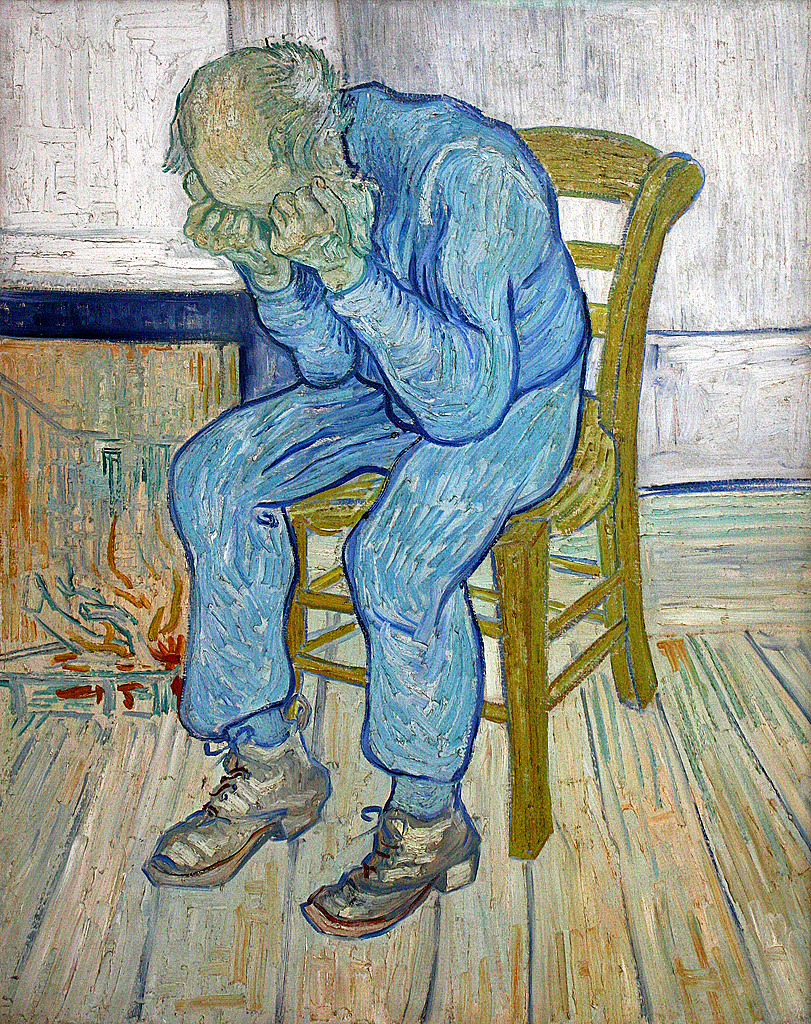
Old Man by Vincent van Gogh. Courtesy: Creative Commons
Grandad’s Other Language

My Grandad spoke Irish

not to us, but with

the soft sky thudding

piano clouds above


pulling wispy cotton vapours thin

in their gusts across the sea

unknotting rain to fall with his speech

garnered and carried with the lulling songs

of other isles rich with other airs.
 

Or else he listened, late at night,

to a radio’s report

relating today’s news with voices

from childhood’s yesteryear

new sprung
 

with lush grass, buttercups and clovers

grown long and pressing damp leaves

to whorls trapped under

the glassy, musty confines

of a London terrace and its red brick moods
 

as he murmured Latin prayers beneath

an English service to petalled oracles,

crooning untranslated lore

from the webbing undulations

of Thames Valley’s silt strewn soil

till they were a-fleck with meadowy

Ballycolgan smiles.


Jenny Middleton has written poetry throughout her life. Some of her writing has been published in hard copy anthologies or on online poetry sites, including ‘The Blue Nib’. Jenny is a working mum and writes whenever she can  amid the chaos of family life. She lives in London with her husband, two children and two very lovely, crazy cats.  You can read more of her poems at her website  https://www.jmiddletonpoems.com 

.

PLEASE NOTE: ARTICLES CAN ONLY BE REPRODUCED IN OTHER SITES WITH DUE ACKNOWLEDGEMENT TO BORDERLESS JOURNAL

Categories
The Literary Fictionist

The Dryad and I: A Confession and a Forecast

A playlet by Sunil Sharma

Cast:  A young Character as a single speaker

Chorus: A few more young actors

Venue: Any place as the stage

Total Time: Five minutes

.

(Bare stage. Only one character facing the audience. Steps forward.)

Character: Hey there! You, you…and you! Listen! (Pause) Hmm. Ready? (Pause) Well, well, here is my story…the story of a tree-man…yes, Sahiban-kadradan! A tree-man stands before you.

In the background, the chorus is only heard. It stays off stage.

Chorus: What a fiction, man! What a fiction!

Character: No, listen first!

Chorus: Fiction! Fiction!

Character: No, listen, please and then judge. Fiction often tells the truth! Listen, please!

(Silence.)

Character: Well, there was a gnarled tree in our compound in an old mohalla of Budaun, Patiali-Sarai, the street there…

Chorus: Budaun? What is that?

Character: Yes, friends, Budaun, the old and historic city of jinns and saints; of fakirs and generals; of legendary mystics and poets…

Chorus: Wow! Go on!

Character: Here it goes…

The tree was old and always whispered in mornings and evenings to those that elected to listen to its gentle song—a deep mourning…a dirge, sad and heart-rending…

Chorus: Hmm! Interesting! Your version of Harry Potter? Hmm!

Character: No Potter, here!

Chorus: Then?

Character:  It is different. Let me continue…

…Returning home from school, I would throw stones at it and it would sigh and nod its head of branches…and drop its fruits on the ground. We would eat the berries and move around its girth, playing hide-n-seek. Then…

Chorus: Then?

Character: One day, I took out a knife and shaved off pieces of its skin. The moment, the bark came off, blood oozed, and the tree cried in a wounded tone. I was not paying attention…I carved my name on the tender heart of the tree and then…

Chorus: Then? Tell us fast. Interesting tale!

Character: Then…

…a woman appeared out of nowhere, startling me, on that memorable dusk full of fading lights and shadows, in that by lane where history meets the present, memory resides dormant… to be awakened in the young ones by an unusual encounter!

Chorus (almost seems to echo): … history meets the present; memory resides dormant… to be awakened in the young ones by an unusual encounter!

 Character: Terrified! I asked her, the bleeding maiden: Who are you?

I am a dryad.

— What is a dryad?

The spirit of a tree.

I was deeply scared! I asked her, ‘Why are you here, madam dryad?’

Because you have awakened me!

— How?

By turning your knife in my heart.

I was speechless.

And casting stones at me from childhood and tearing my branches and leaves. Your wanton acts of violence have caused injuries and wounds that fester…

— I am sorry! I did not know the trees have spirits.

You mortals are fools! Now it is payback time!

— What?!

Heard me right! Payback time.

So, she said to me on that memorable dusk with light and shadows in interplay in that dusty and narrow by-lane full of memories, my dear friends and I protested but she did not listen. Then…

Chorus: Then? Tell us fast, you foolish mortal!

Character: A sad story…

…The dryad turned me into a tree-man and left me suffering for my acts of violence against trees per se…

Chorus: How? Tell us, ignorant human, ignorant of other worlds, of realms, spirits.

Character: Patience!

…I was infected by the spirit of the wounded dryad and developed strange empathy with her pain. Now, whenever children cast stones on the body of the tree, I suffer and bleed! Any scratch there is a scratch on my body-soul. Look here! Scratches all over my body! I suffer and plead…

Chorus: Plead what?

Character: Plead with the fellow humans not to hurt trees or tear the branches or leaves, carve or cut them into dead wood or…

Chorus: Or? Tell us fast, tree-man. Your wisdom as the hybrid or shape shifter? Mythological or magical creature? Half-imagined and half-real? Tell us in words so that we can understand the others.

Character:  Listen, mortals! Words of wisdom, learnt in this new avatar of twin souls, of a tree and human, residing in the human form.

Here: “The Dirge Unheard”

The more you kill others,

of the silent species and natural order,

the more of your ilk

will be killed and soon,

listen you, homo sapiens,

your species will be annihilated

forever!

Chorus on the stage now, singing:

“The Dirge Unheard”

The more you kill others,

of the silent species and natural order,

the more of your ilk

will be killed and soon,

listen you, homo sapiens,

your species will be annihilated

forever!

The choral actors appear on the bare stage facing the audience. They wear cut-outs of trees — old; wounded, stumps, and new ones, greening.

The chorus faces the audience, while the protagonist or Character remains mute and downcast, on the sides of the wings.

Chorus:

So here was this tale extraordinary

From the by-lanes of Budaun

A tale as fabulous

As the city of Budaun!

Each street—

Steeped in history and magic!

The Character steps forward and chants the remaining part of the song.

Character:

Take it or leave it, you all!

If such stories fail to change you,

You are as dead as the stumps

In a forest, once rich,

Now made barren by

The greed of the corporations

And public apathy!

Chorus:

Then it is adieu!

Few years more

And it will be all a fading memory—

Sky, seas, rivers, forests, hills and trees!

Adieu!

Exit all.

.

Glossary:

Sahiban-kadradan: Valued patrons

Mohalla: colony

.

Sunil Sharma is an Indian academic and writer with 22 books published—some solo and joint. Edits the online monthly journal Setu. Currently based in MMR (Mumbai Metropolitan Region).

.

PLEASE NOTE: ARTICLES CAN ONLY BE REPRODUCED IN OTHER SITES WITH DUE ACKNOWLEDGEMENT TO BORDERLESS JOURNAL
Categories
Poetry

Fresh Breath

By Aparna Ajith

A miniature version of myself
began to grow inside me.
A new spring will welcome my offspring.
 
Your movements give me sleepless nights.
Your invisible presence brings contentment.
You move slowly and silently within me,
I yearn to see you move around me.
 
During my monthly check-ups, you remain silent.
When I get back home, you assert your presence.
I began loving you right from the start.
I long for the joy of watching you play.
 
Counting days to my unseen one’s arrival,
Craving to hold, to see, to touch, to feel,
My whole world waits to welcome you.

Dr. Aparna Ajith serves as an Assistant Professor in English at Sree Narayana College For Women, Kollam, Kerala. Being a freelance journalist, she writes and translates articles for the Information and Public Relations Department, Government of Kerala. Her creative pieces have found space in ezines and blogs.

.

PLEASE NOTE: ARTICLES CAN ONLY BE REPRODUCED IN OTHER SITES WITH DUE ACKNOWLEDGEMENT TO BORDERLESS JOURNAL
Categories
Stories

Flash Fiction: Flight of the Falcon

by Livneet Shergill

Sitting under the banyan tree, B… was half awake, half asleep. His mind was shifting like a pendulum, thoughts of the city life he had left behind were trespassing the thoughts of his childhood and youth spent under the banyan tree in his village. As the pandemic set into its third month, B… lost his job. Without a job, heading back home was inevitable for him. This time it took him three days to get back home. Earlier it would take him only one day. The journey was even longer than those three days. The journey didn’t end when he reached his home — it just started. Although his village was five hundred kilometers away from the capital city, it’s stark isolation belied this reality.

Suddenly, out of nowhere black clouds engulfed the burning summer sun that had been shining brightly. Then began a game of hide and seek between the mighty sun and the black clouds. B…, like a silent hidden spectator, was watching the game and wondering whether life is more predictable or the weather. Probably there was an uncanny resemblance between the two.

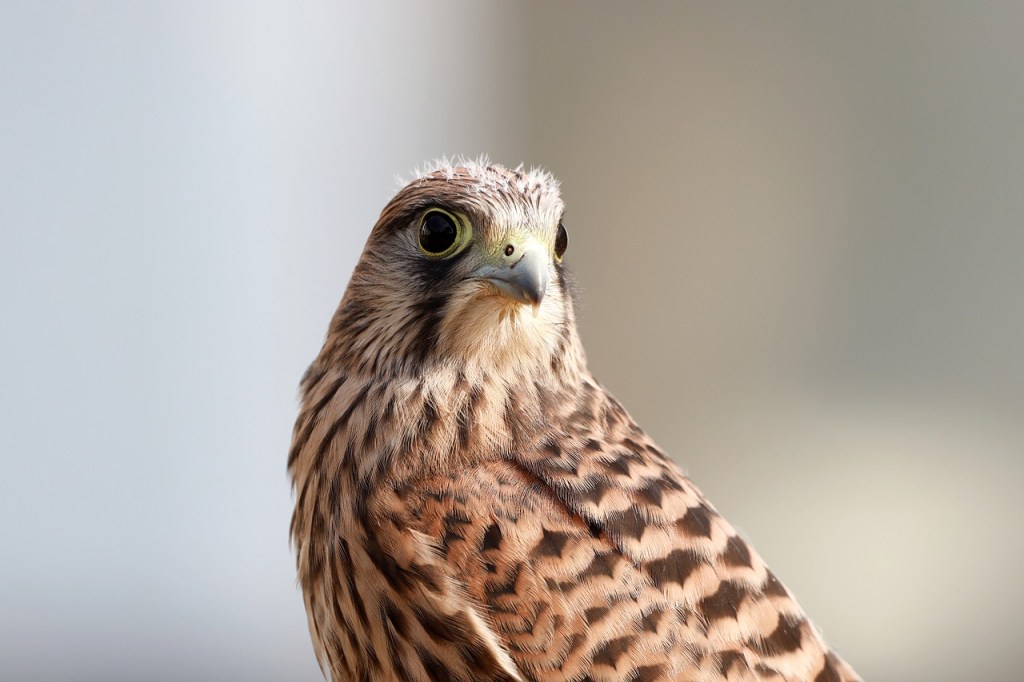
Someone was gazing at him from a far distance, the gaze made him uncomfortable. A pair of dark brown eyes ringed with yellow penetrated his being as if every part of him was up for an examination. Unknowingly he began to walk in the direction of those eyes. The sun was again visible and also moving in that direction. It seemed as though he was following the sun, he walked for about an hour. In all, he had walked four kilometers. But he was exhausted.

The residential area of his village was behind him. He was standing on the dusty pathway between two fields and on the tree before him the pair of mesmerising eyes were still continuously staring at him without blinking. To B…’s immense amazement, it was a falcon sitting on Gulmohar branch, hidden between the red flowers, with only its eyes visible. The falcon and B… gazed at each other as if they were long lost friends who had met after many years. Tears began to roll down his eyes.

The falcon took flight. B… followed. One, two, three and within five minutes there were six falcons flying in the sky in a triangular formation.  The falcons in the sky and B… on the ground matched their rhythm. Sometimes, they hurried and at times they were steady. It started to drizzle. That didn’t disturb their synchronization. After six hours of this rhythmic exercise, B… collapsed.

The sun had set, and it was beginning to get dark. He was lying unconscious in the fields with falcons circling him — rather unusual a sight. Lightning struck the village. Some of the homes were set ablaze. The blaze from the burning houses was visible from a distance. It had started to rain heavily now. The falcons had disappeared and B… was lying prostrate in rain. Heavy rain had put off the fire.

Next morning, the villagers found him in the fields, burning with fever and still unconscious. The village was too remote for a doctor. The village elders took on themselves to heal B…. After twenty-four hours, he regained consciousness and he was a new man.

In the past two days, his entire life had unfolded before him.

The city lights that once bedazzled him had lost their glitter. He realised lights that do not illuminate were pointless. They only tired the mind and the eyes. The earthen lamp dimly lighting the room was to be his guiding light. The dusty by-lanes of his village were to be his high streets.

It had taken ten years and a pandemic for him to understand that the village life he had left for a better life in the city was the same off-grid life many city dwellers aspire for. The peace and tranquility he was experiencing could not be found anywhere else.

The way a storm with high winds blows down a tree and reveals the tree’s hollowness; the barrenness of the city life was uncovered by the pandemic.

The branches of the banyan tree had grown long enough to reclaim the Earth beneath. The branches were one with the roots again. B… had finally found his footing, on his own land.

B… was sitting under the banyan tree, dark brown eyes ringed with yellow were gazing at him from the treetop. A group of children encircled him, engrossed in the story he is telling.

At long last, he is home.

Livneet Shergill is a PhD in Economics. She works as an independent researcher and writing gives her unmitigated happiness. The childhood literary bug has never quite left her.

.

PLEASE NOTE: ARTICLES CAN ONLY BE REPRODUCED IN OTHER SITES WITH DUE ACKNOWLEDGEMENT TO BORDERLESS JOURNAL

Categories
Poetry

Legends in Verse

By Jared Carter

Sarcophagus with the myth of Protesilaus and Laodamia. Here, Laodamia grieves for the loss of her husband Protesilaus in the Trojan War. From a tomb along the Via Appia Nuova, ca. 160-170 CE: Creative Commons
Laodamia to Protesilaus

If you were lost, how would I find you,
what path take along dark streets, through
damp vaults, how untangle those choices
far underground, those myriad voices?

If I were gone, you could no longer follow
through great spillways, or deep hollows
in that world. My footsteps would fade,
there would be no echo, no light or shade.

Still, somewhere your presence ahead
would call, through realms of the dead,
through time imploded and turned back,
platform deserted, abandoned track.

No pause in this long pursuit, this seeking
that has no end. Neither of us speaking,
or able to break the spell – neither chase
nor surrender. Only the lost, familiar face.

(First published in The Raintown Review.)


Resurrection

The body rises up at last,
          it cannot keep
Its distance from what comes to pass,
          when more than sleep

Is beckoning. To bid adieu
          and still to bless,
Savonarola reached out through
          the flames; and pressed

Against them, Frida Kahlo sat
          upright, as though
Awakening at last from what
          is merely show.

(First published in Clementine Unbound.)


Jared Carter’s most recent collection, The Land Itself, is from Monongahela Books in West Virginia. His Darkened Rooms of Summer: New and Selected Poems, with an introduction by Ted Kooser, was published by the University of Nebraska Press in 2014. A recipient of several literary awards and fellowships, Carter is from the state of Indiana in the U.S.

.

PLEASE NOTE: ARTICLES CAN ONLY BE REPRODUCED IN OTHER SITES WITH DUE ACKNOWLEDGEMENT TO BORDERLESS JOURNAL