Categories
Review

Gandhi & Aesthetics

A review by Bhaskar Parichha
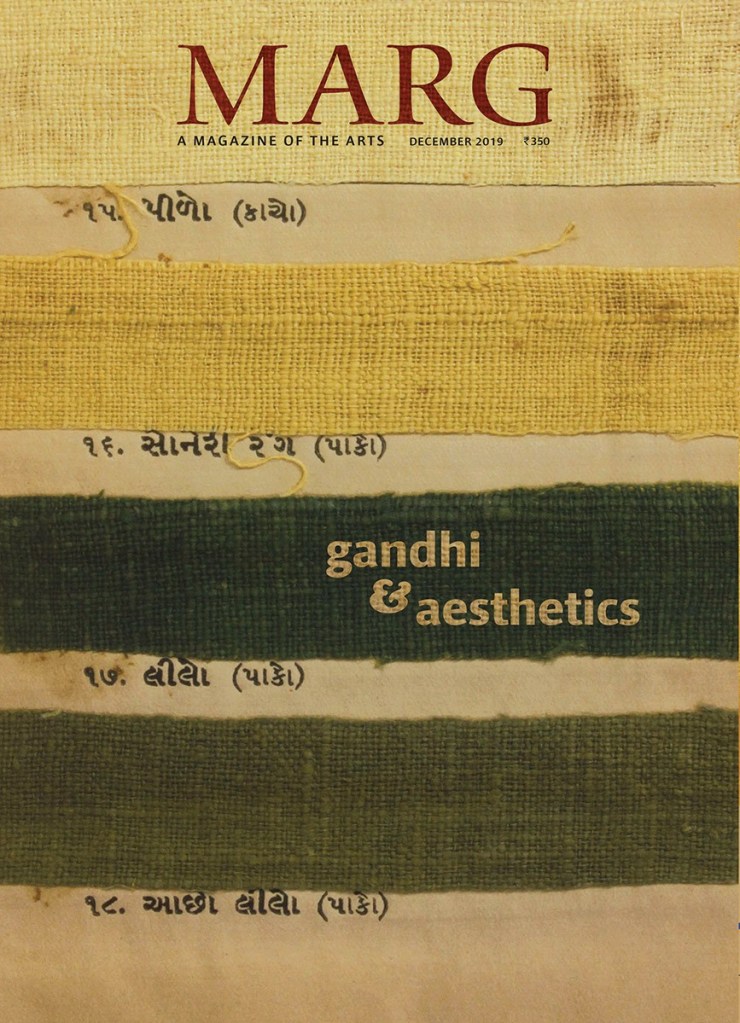
As India celebrated the sesquicentennial of MK Gandhi last year, Marg had come out with a special issue on the lesser-known aspects of Gandhi’s engagement with aesthetics.

Gandhiji’s aesthetics was two-fold: one, it was a quest for exquisiteness and two; it was a set of principles fundamental to the personal practice. Edited by Tridip Suhrud, the nine essays are a fitting tribute to the inventive beauty of Gandhiji and its wide-ranging applicability in present-day society.

In an art project organised by Sahmat in 1994–95 as a continuation of a program called Artists Against Communalism that emerged in response to the Babri Masjid demolition in Ayodhya and as a part of a year-long series of events, artists — from KG Subramanyan to Atul Dodiya, from NS Harsha to Nilima Sheikh, A Ramachandran to Vivan Sundaram, Nalini Malani, PT Reddy, Nand Katyal, Shamshad Hussain, Orijit Sen, Parthiv Shah — were invited to create postcards that could later be displayed as artworks in galleries and also be circulated among the general public as boxed sets. Ram Rahman’s essay   ‘Thematic Ad-Portfolio: Postcards for Gandhi’ deals with these postcards.

In the editorial note, associate editor, Latika Gupta, gives an overview of the underlying themes of this volume and how they explore Gandhi’s conceptual understanding of art which combined the ideas of truth, beauty, and utility. The Mahatma is also placed in the context of the current times when his legacy is being put to different political uses.

It is a widely held belief that the Mahatma had no place for art, music, and literature in his ascetic life and ideas about national regeneration. In the introductory essay ‘Art as Namasmaran: The Aesthetics of Gandhi’, Tridip Suhrud unravels the various human and natural artistic elements that moved and influenced Gandhi, the concepts and patterns that guided and came to be reflected in his choice of attire, living spaces, and discipline.

‘In the Footsteps of Spectres: The Aesthetics of Gandhi’s Walks’ by Harmony Siganporia, we get to see how walking was an integral part of Gandhi’s private and public engagements with politics and truth. Gandhi embarked on several important walks throughout his life. They served as forms of pilgrimage, mass agitation, and individual protest. This essay explores various aspects of Gandhi’s walks by revisiting his writings and the photographs of these historic events.

Sudhir Chandra in his article ‘Gandhi’s Hindi and His Aesthetics of Poverty’ dissects Gandhi’s appreciation of minimalism and purity, which is evident not just in his sartorial style but also in his use of language. Convinced that Hindi alone could be India’s national language, Gandhi attempted to transform it into a more inclusive language, incorporating certain words from regional languages and others of Urdu-Persian origins.

‘Music for the Congregation: Assembling an Aesthetic for Prayer’ by Lakshmi Subramanian explores Gandhi’s adoption of musical prayer as an important tool for shaping ashram life and community at Sabarmati. For Gandhi, music was a useful prop to make prayer a joyful experience and prayer was crucial for character-building among satyagrahis. His taste for music was shaped by his exposure to the church choirs of England, and the larger repertoire of devotional recitation and music that had been popularized by V.D. Paluskar and the Gita Press. These influences eventually guided his choices as he approached Pandit N.M. Khare to lead the prayer sessions and public meetings at his ashram and created a collection of songs — Ashram Bhajanavali.

In ‘Architecture as Weak Thought: Gandhi Inhabits Nothingness’. Venugopal Maddipati looks at two houses inhabited by Gandhi in Segaon (Sevagram), Wardha —Adi Niwas and Bapu Kuti. While the former is very simple and minimalist, the latter is more elaborate in design with clearly partitioned rooms. Though it would seem that architecture played a secondary role in Gandhi’s life and was relegated to the marginal spaces of domesticity and interiority, Maddipati has an alternative viewpoint.

‘The Long Walk to Freedom’ by Jutta Jain-Neubauer brings into focus a lesser-known aspect of Gandhi’s personality as a designer and maker of chappals. Gandhi saw in handmade sandals an aesthetic route to eradicate the stigma that had been associated with the communities of skinners, tanners and leather workers. Inspired by the Trappist Roman Catholic monastic order who were staunch believers in austerity and manual labor, Gandhi set up a shoemaking unit at the Tolstoy Farm and later replicated the model at Sabarmati Ashram in Ahmedabad. Made from the skin of animals that had died a natural death, this iconic ashram Patti Chappals also came to be known as ahimsa slippers.

‘A Biography in Prints: Gandhi and the Visual Imaginary’ by Vinay Lal studies the evolution of the representations through a range of prints that offer a chronological rendering of his life, charting his transformation from a law student in England to a satyagrahi in South Africa and finally the architect of India’s independence. Lal discusses the subtler meanings and politics conveyed in the compositions.

Throughout his long political and spiritual career, Mahatma Gandhi frequently stated that his life goal was to reduce himself to zero. This was a goal that he variously pursued by shedding worldly attachments, declaring celibacy, adopting abstinence, and periodically undertaking to punish bodily fasts, all for the sake of meeting his ideal of aparigraha or “non-possession”. ‘Reducing Myself to Zero: The Art of Aparigraha’ by Sumathi Ramaswamy reflects on the aesthetic dimension of this key Gandhian aspiration.

‘Ark, Saint, City, Cipher: The Gandhi of Gulam Mohammed Sheikh’ by Ananya Vajpeyi focuses on the Baroda-based artist’s engagement with the Mahatma and his ideals. Looking at a series of paintings made by the artist from 2000 to 2019, the writer analyses how Sheikh draws on references from various older texts and images and places Gandhi as an interlocutor across different periods and philosophies.

A fitting tribute by the Marg foundation to the father of the nation.

.

Bhaskar Parichha is a Bhubaneswar-based  journalist and author. He writes on a broad spectrum of  subjects , but more focused on art ,culture and biographies. His recent book ‘No Strings Attached’ has been published by Dhauli Books. 

.

PLEASE NOTE: ARTICLES CAN ONLY BE REPRODUCED IN OTHER SITES WITH DUE ACKNOWLEDGEMENT TO BORDERLESS JOURNAL.

Categories
Poetry

Gandhi at Crossroads

By Professor Dr Laksmisree Banerjee

He grew and grew like a huge banyan

with knotted roots

and a leafy shade

for us to sit under

and introspect.

.

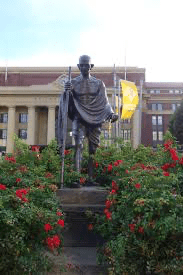
He now stands at the crossroads

spectacled in stone,

piercing through the dimness

of truth

in iconic distance

in the labyrinths of history.

.

The vendor still fights

under the sun,

under the load

of his wares,

the slum dweller

still droops in death

inebriate in poverty,

the capitalist still

swoons in exultant vulgarity

bought from the sweat and blood

of the down-and-outs.

.

The Mahatma

in his statuesque immobility

carved in rocky apathy

at the traffic signal

remains forever forgotten

in the quagmire of life.

.

(First published in Dr Banerjee’s book, Peahen-Passions)

  *Prof. Dr. Laksmisree Banerjee is an established Sr. Poet, Writer, Educationist, Scholar, Rotarian & practicing Classical Vocalist, with many National and International Awards, Accolades & Publications to her credit. She is a Senior Fulbright Scholar (USA), Commonwealth Scholar (UK,) and a National Scholar & Gold Medalist in English of Calcutta University, India. A University Professor of English & Culture Studies, she is a recipient of the coveted UGC Post-Doctoral Research Award (Govt. of India), which she was awarded for her Path-Breaking Post-Doctoral Research Work & Global Lectures on the Comparative Studies and Transformative Vision of World Women Poets. She has also been felicitated by the Sahitya Akademi with the “Avishkar” Award/ Honour for her dual expertise as a “Scholar- Musician and a Poet- Artiste”. Prof. Banerjee has been the Founder Pro- Vice Chancellor & Ex Vice Chancellor of Kolhan University, the largest in Jharkhand India. She has lectured, taught, performed and recited in premier Universities and Literary Festivals across continents. Widely published and anthologized, she has Five published Books of Poetry, One Hundred and Twenty Research Publications with Several Academic Books to her credit. Prof. Banerjee also has the rare Honour of being The Indian President’s/ Rashtrapati’s Nominee on Boards of Central Universities. Her pivotal areas of specialization include Women’s Global Writings, Tagore’s Poetry (Studies) with her English Transcreations of Tagore, Oriental Mysticism & Sufism, English Romantic Poetry, American Transcendental Poetry & Eco-Feminism. Dr. Banerjee is also a Sr. Rotarian & a Multiple Paul Harris Fellow. Through her Poetic, Academic & Other Writings as well as her Vocal Music & Poetry Recitals and Socio- Cultural Activism, she practices the avid Promotion of Peace, Freedom, Good Will, Equality and Universal Brotherhood for a Better World—- through Trans-Cultural Understanding which shines through every facet of her work.

.

PLEASE NOTE: ARTICLES CAN ONLY BE REPRODUCED IN OTHER SITES WITH DUE ACKNOWLEDGEMENT TO BORDERLESS JOURNAL. 
Categories
Essay

Gandhi – an enduring universal vision – and those spectacles

He’s regarded as ‘The Father of the Nation’ and the man who brought down the mightiest global empire without firing a single bullet, yet Gandhi’s ideals and vision go beyond India’s borders and the last century to offer us inspiration and hope. Keith Lyons applauds the Mahatma from New Zealand.

I’ve seen Gandhi everywhere. Not just on my recent trips to India, but also in my native New Zealand, and on television.

Throughout the state of Kerala, during my two-month stint last December and January this year, it seemed that every town featured a prominent tall monument to the pioneering leader, the larger-than-life man who stood just 1.64m tall.

In my New Zealand birthplace, the capital Wellington, a bronze statue of Mahatma Gandhi was unveiled in 2007 in recognition of his non-violent approach to end injustice and free the Indian sub-continent from British colonial rule, as well as the influential man’s simplicity, purity and tolerance.

Gandhi has also featured several times in my favourite television show, the long-running American animated sitcom The Simpsons. In one episode, Gandhi appears next to Homer, protecting him from the murderous intent of Mr Burns, while in another, Bart says he is using non-violent resistance, much to the disgust of his sister Lisa who can’t believe Bart is comparing himself to Mahatma Gandhi.

Also, in The Simpsons Gandhi is wrongly listed as a recipient of the Nobel Peace Prize — he was nominated five times, and the awards committee later regretted never awarding it to the campaigner. To give you an idea of how Gandhi is internationally regarded, in 1999 he was runner up to Albert Einstein as Man of the Century — Gandhi had been named Man of the Year by Time magazine in 1930. There’s another vague approximation moment in ‘The Simpsons’ when Marge declares, “If Gandhi could go without eating for a whole three-hour movie, I can do this.”

While Gandhi is universally acclaimed, and something of an icon for peace and civil disobedience, in India there’s both much admiration and respect for his accomplishments, as well as some criticism for his views on race (and sex), along with the complaint that he was hopelessly unrealistic. Gandhi is still revered as a hero, but it seems regard for the man is more nuanced, reconciling the Westernised lawyer with his frugal lifestyle adopting the clothing style of the poor and khadi.

I attempted to read the hefty 738-page book Gandhi by his grandson Rajmohan Gandhi, pulling it out of the shelves of my local library and holding the substantial tome with both hands hoping not to strain the muscles of my forearms.

However, after reading inside the cover, and admiring the photos of the bespectacled Gandhi, I skipped to the end, to his assassination. One of the conclusions of the book is that the bullets of a Hindu fanatic didn’t kill him. Supporting evidence might include you reading this piece about Gandhi, the longest-running American scripted primetime television series, and some pretty cool spectacles.

During my last trip to India, it was revealed to me just how ubiquitous Gandhi is. At Cochin International Airport, the world’s first airport fully powered by solar energy, I exchange my US dollars for fresh 2,000 and 500 rupees notes, each with a smiling image of Gandhiji.

Gandhi is literally put on a pedestal in Kochi city, frozen in time calmly striding out with his walking stick, while all around the traffic swirls around one of the main roundabouts of the commercial port city. It took me a while, but then I realised why many of the cities I’d visited across India had an ‘M.G. Road’ as its main thoroughfare — and it wasn’t because they were named after M.G., the British sports car.

The other obvious Gandhi-related iconography was the omnipresent image of Gandhi spectacles. Initially, I thought this was something to do with helping poor-sighted people, perhaps some kind of campaign to donating your old reading glasses so someone less fortunate might be able to read.

My misconception was cleared  when I listened to the then Union Minister of State for Culture and Tourism, the very approachable Kerala-born Alphons Joseph Kannanthanam, who addressed the 2019 Jaipur Literature Festival (the world’s largest free literary event) outlining the progress of the Swachh Bharat Mission, an ambitious plan to achieve an ‘open-defecation free’ India by the 150th anniversary of Gandhi’s birth. Oh, that was on 2 October last year.

The effort to clean up the streets as well as build millions of toilets flows on from the revolutionary dream of Gandhi, who once declared ‘I want clean India first and independence later’. Officially around 110 million public, community and household toilets have been built across India, though some are not used, and there’s still a long way to go to ease the sanitation woes of a nation of 1,380,004,385 souls, and the social stigma attached to cleaning latrine pits.

I wonder if Gandhi were alive today how he would view the progress towards better sanitation and hygiene, the plight of those urban sewer workers, and the use of his trademark spectacles for the ambitious ‘built-it-and-they-will-come (or dump)’ campaign.

The world’s largest toilet-building and behavioural change initiatives feature just the glasses, not the face of Gandhi. The bridge on the round-frame spectacles of the Swachh Bharat Mission has India’s flag tricolours, reinforcing the patriotic duty to play one’s part — and not to lay a cable outdoors.

Gandhi himself first acquired those steel-frame specs while in London in the 1890s — that style was popular around the turn of the century. Some pairs of his glasses have recently turned up, including a pair from South Africa which fetched over $340,000 at auction in the UK.

For most people outside India, Gandhi’s spectacles have other associations. Seeking to emulate the visionary and pacifist was John Lennon of The Beatles, who wore similar-styled spectacles, and also wanted to have Gandhi on the album cover of Sgt. Pepper’s Lonely Hearts Club Band.

Apple co-founder Steve Jobs wore similar spectacles in tribute to Gandhi. Jobs said that Gandhi was his choice for ‘Person of the Century’ because “he showed us the way out of the destructive side of our human nature”. Gandhi used moral acts of aggression instead of physical acts of aggression to force change and justice. Jobs said, “Never has our species needed this wisdom more”.

For me, Gandhi is an example of what can be achieved in making the world a better place, without the use of force or violence. He believed in creating an ideal society, with full democracy, and freedom. Gandhi ‘walked the talk’ on living a simple life and showed the virtue of patience. More than a century and a half after he was born, his message about the need for religious and political tolerance is just as relevant today. What a man. What a message.

.

Keith Lyons (keithlyons.net) is an award-winning writer, author and creative writing mentor, with a background in psychology and social sciences. He has been published in newspapers, magazines, websites and journals around the world, and his work was nominated for the Pushcart prize. Keith was featured as one of the top 10 travel journalists in Roy Stevenson’s ‘Rock Star Travel Writers’ (2018). He has undertaken writer residencies in Antarctica and on an isolated Australian island, and in 2020 plans to finally work out how to add posts to his site Wandering in the World (http://wanderingintheworld.com).

.

PLEASE NOTE: ARTICLES CAN ONLY BE REPRODUCED IN OTHER SITES WITH DUE ACKNOWLEDGEMENT TO BORDERLESS JOURNAL. 
Categories
Poetry

And Then Came Gandhi…

 By Navneet K Maun

Let there be peace

in each household,

in every community,

indispensible, in the present scenario

of animosity, egoism, narrow-mindedness.

The dark period of Colonialism

unified the countrymen

afflicted by unemployment, poverty, atrocities

in their daily struggle for survival.

The Jallianwala Bagh Massacre

stirred up a hornet’s nest.

The great bard renouncing his knighthood,

a turning point in history.

And then came Gandhi

an apostle of truth,

a beacon of hope,

dispelling the darkness

of untouchability and casteism.

His holy grail acknowledged

by Einstein, Thoreau, Martin Luther King, Tagore.

Gandhi’s Satyagraha

paved the way for Emancipation

a herculean task.

The altar of freedom

cleansed with the blood of the martyrs

tears of the kin.

Their heroism making them immortal.

Let Gandhi’s India be a harbinger of peace and ahimsa

for the world at large.

.

Mrs. Navneet K Maun was born in West Bengal. Did her initial schooling from Oak Grove School, Jharipani, Mussoorie. She furthered her education from Regional College of Education, Bhubaneshwar. She did her Graduation and BEd from there. She did her Masters in English Literature from Banaras Hindu University, Varanasi. She has vast experience in teaching and has retired as a Senior Teacher from a Public School in Delhi. Her hobbies include reading, travelling, writing and cooking.”

.

PLEASE NOTE: ARTICLES CAN ONLY BE REPRODUCED IN OTHER SITES WITH DUE ACKNOWLEDGEMENT TO BORDERLESS JOURNAL. 
Categories
Musings

Travels with Gandhi

Dr. Nishi Pulugurtha meanders through the passages of Aga Khan Palace…

Places have always fascinated me. They say so much, about lived experience, about people and about culture. There is so much of history and life in places, known unknown and little known. Some waiting to be discovered, some familiar. Tucked in the familiar lanes and by lanes of the city I live and places that I have been to are moments of history, of lives, of stories that need to be heard, places and buildings that need to be discovered. Even familiar places throw up new stories and new histories.

Living in times such as these when COVID_19 has kept us locked in, at times I see some picture, a news item, a small story somewhere that takes me back to a place, a memory,  a slice of history and the past. Travel writing has taken up quite a bit of my time in the past few months as I sat editing my manuscript, an edited volume, a collection of travel essays. So, even though I was physically in one place, at home, I was able, at least, for some time to visit and re-visit places as I read the essays that my wonderful contributors had crafted.

 I thought of going back in time too, to speak of a place, a city that I had visited some years ago. Of a monument, a building that stood majestic, of a hot summer day when I decided to put to use a couple of hours that I had at hand before I had to catch my flight and head home. Those were times when travel was not a big issue and we travelled for various reasons. Moreover, we could travel when we felt like it, or wanted to. The pandemic has pulled the plugs on that, life has now become restrictive and as I try to make the most of it,   I decided to scribble some thoughts that came to mind. Especially, as October was knocking around the corner and being imprisoned was something that Mohandas Karamchand Gandhi often experienced. I refer to him as the monument that I speak about has a connection to him and to an important aspect of his life.

On a trip to Pune I encountered a small part of history. This was my first trip to the city and a very short trip at that. I was hoping to make the best of the few hours of leisure I had. A city that had been growing at a fast pace for some years due to the software industry, Pune seemed at first sight very much a modern city that is ever growing and expanding. The older part of the city is crowded with a lot of traffic. The dirty Mutha river, mostly dry, the Shaniwar Wada close by and the very popular Dadushth Ganesh temple are crowded with tourists and locals. I did check them out too. I did write about my visit to Shaniwar Wada some years ago too.  In this essay I will write of my experiences of my visit to the Aga Khan Palace. One of the reasons for my choice of it is its connection with Mohandas Karamchand Gandhi whose birthday falls in this month.

A short auto ride took me to the Aga Khan Palace that is located in Samrat Ashok Road on a scorching day in May.  Built by Sultan Muhammed Shah Aga Khan III, the spiritual leader of the Nizari Ismaili Muslim, this palace was built to help the poor in the region badly affected by famine in 1892. According to popular lore, the Sultan built the palace to provide employment to villagers of the surrounding region. About a thousand people worked on it and it was constructed in five years at a cost of about twelve lakh rupees. For many years the palace housed a school till it was handed over by Prince Karim Aga Khan to the Gandhi Smarak Samiti in 1972 as a mark of respect to the memory of Gandhi.

As one enters the compound one notices a plaque at the entrance that announces that this building is a monument of national importance. It is in this building that Gandhi was imprisoned along with his wife, Kasturba Gandhi, his secretary, Mahadev Desai and political activist and poet, Sarojini Naidu after he began the Quit India Movement, from August 1942 to May 1944. This monument is also important as it is here that both Kasturba Gandhi (February 22, 1944) and Mahadev Desai (August 15, 1942) died. In a corner of the premises of this monument is a Samadhi, a memorial to both of them, marking the place where they were cremated. Two tulsi plants mark the spots. A calmness pervades the whole place. A lone gardener cleans the dry leaves as I stand there for a while transported to another time.

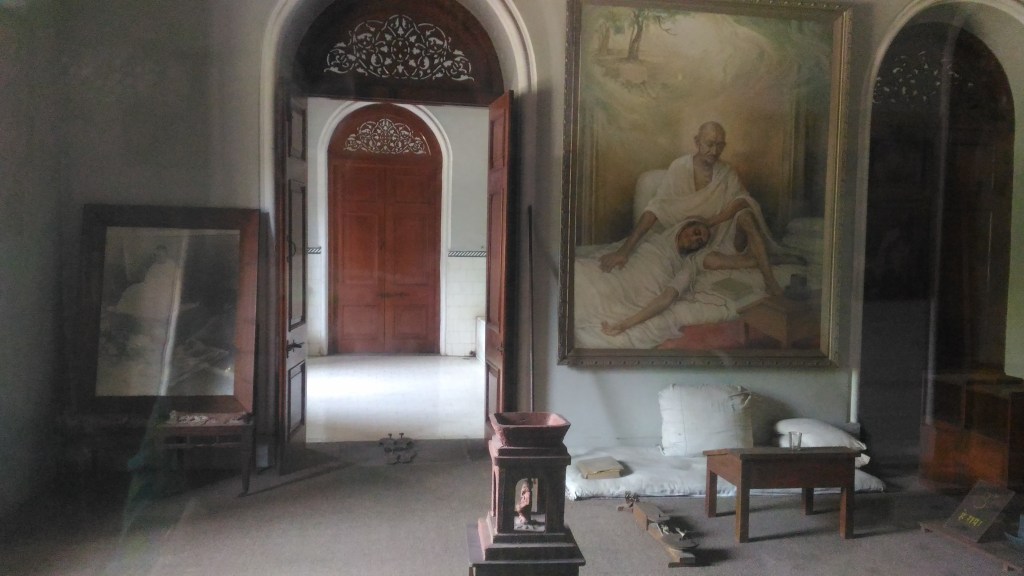
The palace is now a museum with the rooms used by Gandhi, Kasturba and Mahadev open to the public. The rooms are spartan revealing the simple life that its inhabitants lived. A few personal items of Gandhi are on display too – utensils, slippers, clothes and letters. As one enters into the big hall at the entrance there is a large statue of Gandhi. The museum has large paintings which present various aspects of him during the struggle for freedom. There is one that has Gandhi with a begging bowl in front of a big crowd. One image is that of Kasturba lying in Gandhi’s lap, a canvas that presents an intimacy in their relationship. A painting titled “New Hope for Rural India” reveals Gandhi’s engagement with the “Constructive Programme”- a programme that envisaged an agenda for a revolution that would bring about a change in the individual and in society, a programme that Gandhi undertook to prepare the people for a post-independence India. Another painting is titled “A Crusader for Humanity.

The imposing palace has Italian arches and lawns and has five halls. With a magnificent structure, the two storied building has a corridor that encircles the entire building. This building is now the headquarters of the Gandhi National Memorial Society. I recall walking through the building taking in every aspect of it, pausing to observe and note as I move through the rooms and corridor. I remember sitting under one of the large trees and gazing at this building that had been witness to a major part of Indian history. As I revisit the place with words and emotions, in times that are so different, I am reminded of the relevance of Gandhi’s ideals of non-violence in a world that is increasingly becoming violent — in action, in deeds, in words. It is time, to ponder about his ideals that are needed now more than ever.

.

Dr. Nishi Pulugurtha is Associate Professor in the department of English, Brahmananda Keshab Chandra College and has taught postgraduate courses at West Bengal State University, Rabindra Bharati University and the University of Calcutta. She is the Secretary of the Intercultural Poetry and Performance Library, Kolkata (IPPL). She writes on travel, film, short stories, poetry and on Alzheimer’s Disease. Her work has been published in The Statesman, Kolkata, in Prosopisia, in the anthology Tranquil Muse and online – Kitaab, Café Dissensus, Coldnoon, Queen Mob’s Tea House, The World Literature Blog and Setu. She guest edited the June 2018 Issue of Café Dissensus on Travel. She has a monograph on Derozio (2010) and a collection of essays on travel, Out in the Open (2019). She is now working on her first volume of poems and is editing a collection of essays on travel.

.

PLEASE NOTE: ARTICLES CAN ONLY BE REPRODUCED IN OTHER SITES WITH DUE ACKNOWLEDGEMENT TO BORDERLESS JOURNAL. 

Categories
Poetry

Khadi: A Threat to the Dictator

    By Milan Mondal

Khadi: A Threat to the Dictator

The sun was at the zenith,

Because the dictator had gun.

He never thought of the setting sun.

The dictator cared a fig

And the charcoal was burning behind the white ash.

Tolerance was the stick to kindle the flame,

And truth was the only tool for the silent blast.

From South Africa to Jallianwala Bagh

Or from Champaran to Dandi

The dictator realized the charisma of khadi.

.

Status Quo

Three years more passed

After the platinum jubilee

My cheeks are now no better than dry-grapes.

No distinctive line is visible

In between two of my breasts.

The beasts are still treading,

‘Wire’ cannot protect cleavages

From the ‘Oracle’.

Breaking the ‘riddle’,

Oedipus does sow the seed

To stigmatize Jocasta.

.

Milan Mondal, Assistant Professor in English at Narajole Raj College (Narajole, Paschim Medinipur, West Bengal, India) is a young bilingual (English and Bengali) writer of poetry and short stories. The major themes of his creative writings include ‘partition’, ‘diaspora’, ‘psychoanalysis’ ‘existentialism’ etc. Some of his poems have been published in reputed magazine.

.

PLEASE NOTE: ARTICLES CAN ONLY BE REPRODUCED IN OTHER SITES WITH DUE ACKNOWLEDGEMENT TO BORDERLESS JOURNAL. 
Categories
Review

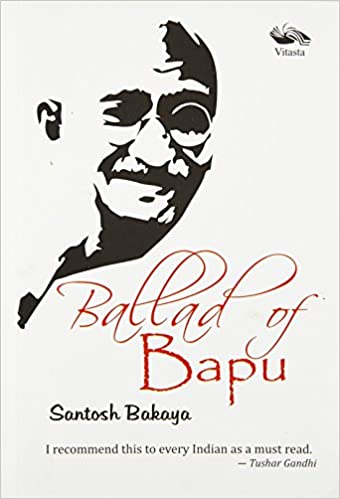
Ballad of Bapu

Book Review by Moinak Dutta

Book : Ballad of Bapu

Author: Santosh Bakaya

My first impression of M.K. Gandhi is a simple drawing of a drooping figure of a frail man with a stick in hand. It was drawn by one of my cousin brothers, when we were studying in primary school. That drawing then appealed to me as a simple thing to do without much artistic skill. From that pictorial knowledge of Bapu, I graduated to something celluloid, when my father one beautiful spring evening brought home a videotape cassette ( at that time VCP was in rage) titled ‘Gandhi’ I was told that the movie was the first one to get American Motion Pictures Award for India.

After watching the film for many days, I thought of Ben Kingsley as the real Gandhi. That got rectified later when I was made to read an interesting article on Gandhi (this time by my mother). Several research books with razor sharp debates and deliberations can be easily found on Gandhi. Afterall, Bapu had remained one of the most ‘loved and hated’ man all through his life. Reading Ballad of Bapu is like having a dream on Bapu — colourful, smooth and enchanting, for it is not a mere research work on Gandhi’s life and his doctrines, it is a ballad, a lyrical one, sustained from page one to the last. Divided into several short chapters and decorated with rare photographs of Bapu’s life, the book is a poetic analysis of Gandhi and his works. I might have said that it is a poetic biography, but if even by mistake should I say that for once about the book, I will be committing a great blunder. I will be completely overlooking the deft touch of analysis of Gandhi’s works as done with meticulous ease by the author-poet. The author is not merely writing a biography. She has mined out several incidents apparently small and insignificant of Bapu’s life, only to indicate a larger pattern.

For any student of history, the book will amply provide details which are astoundingly well researched. But that is probably not the focal point of the book. The author has found how by different actions and deeds, Gandhi laid a foundation of non-violence as a principle which is undoubtedly Godly and because it is Godly, it had to face severe challenges, the final challenge being the assassination of Bapu. By sacrificing his life, Bapu had, with finality, proved the Godliness of his principle. Chapter by chapter, events by events, the author has shown how Gandhi became Mahatma. Of all the chapters , the ‘Centrestage’ , ‘ Phoenix farm’ ‘Tolstoy and Gandhi’ ‘Tolstoy farm’ ‘Gandhi in India’ ‘Annie Besant and Gandhi’, ‘Jallianwala Bagh’ , ‘Chauri Chaura’ and ‘Imprisonment’ appeared to be the most engaging for in these chapters we not only find different anecdotes on Bapu’s life but also the valuable authorial commentary on Bapu. For example, ‘Phoenix farm’ explores Gandhiji’s reading habit:

At dawn Gandhi read The Gita, the Koran at noon”

 In ‘Tolstoy and Gandhi’, we find how voraciously Bapu read Tolstoy while in jail at South Africa.

 “In jail, in Tolstoy’s books he found a soulmate

Greatly inspired by this man born in 1828”

 To write history is difficult, to write personal history is more difficult, but to write personal history of a man like Bapu and that too in ballad form maintaining ‘ a-a-b-b-a ‘ rhyme scheme all through is simply superhuman a work and that Santosh Bakaya has performed with ease, as if she were a musician or a pianist running her practiced fingers on words to make them sing. And they sing in tune with Gandhian philosophy, his unwavering faith on non-violence and peace. A testimony to the author’s assertion on Gandhian philosophy can be found in the chapters like ‘Jallianwala Bagh’ where she has written:

“Towards a self-disciplined Bardoli his eyes turned

 A policy of senseless gore he had always spurned”

The same assertion comes to the fore in the (in)famous ‘Chauri-Chaura’ incident. Bapu with all resilience stood for non-violence and went to prison again, blaming himself for the crime which was not his doing, truely like a father, who can go any distance, to any extreme, for his sons and daughters.

No provocation can justify murder, he exclaimed

For the protestors’ crime, himself he blamed”

The unshakeable faith in non-violence, however, never posed any hindrance for Bapu, who always stood for what is right. While he was imprisoned, he wrote to the British Government why he felt sedition was the creed that he followed. In fact, Bapu was imprisoned more on charges of sedition than any leader in that period, yet how wrongly his non-violent acts were judged. The author has rightly pointed out: “Sedition was their creed, said the man with integrity

 In his first article ‘Tampering with Loyalty’”

 In similar vein Bakaya has carried on in the chapter ‘Imprisonment’ when she explained:

“On 19 September 1921

Fearlessly wrote this son

The government was shocked at his sheer audacity”

But Gandhiji probably had been too much for both the British and those who could not comprehend his philosophy, as the author has pointed out:

“He started Harijan, a weekly new

Which, with his rapier touch he did imbue…

… But for the Sanatanists an unpalatable brew”

This outer struggle led eventually to an inner struggle in Bapu. So, even after independence he could not be happy. He had remained restless with agony, hurt by pains.

“2nd October 1947 did not dawn like any day

Though it was the Mahatma’s 78th birthday

He was restless

The fury relentless

Dampened his spirits he could smell decay”

 And that decay took him to the point of being challenged. He responded by sacrificing his life.

“Was he a mad man or a coward?

He whipped out a pistol, with no compunction?”

 The author has left that rhetorical question beautifully, almost theatrically poised towards the end of the concluding chapter.

If we are to rediscover and relearn Gandhi, if we are to trace the path between Gandhi and Mahatma, this book is a must read.

.

Moiank Dutta is a teacher by profession and published fiction writer and poet with two literary & romance fictions to his credit. His third fiction is going to be published soon. Many of his poems and short stories have been published in dailies, magazines, journals, ezines.

.

PLEASE NOTE: ARTICLES CAN ONLY BE REPRODUCED IN OTHER SITES WITH DUE ACKNOWLEDGEMENT TO BORDERLESS JOURNAL.

Categories
Poetry

To Thee O Gandhi

By Soumik De

Round glasses and a cane stick

A loin cloth and a pair of clogs

Mark thee O mark thee!

.

Truth and triumph

Struggle and stride

Shape thee O shape thee!

.

Bold and bald

Bend but strict

From thee O from thee!

.

Wheels and whiffs

Text and textiles

Spins thee O spin thee!

.

Glamour and Glory

Great yet gentle

Merge into thee O merge into thee!

.

Thou art the other name

Of India

Salute thee O salute thee!

Soumik Kumar De, a teacher   by profession and a poet by passion, likes to write both in Bengali and English. His creative compass includes poetry, short-story, flash-fiction etc. Adrika Ke Niye is a collection of Bengali modern creative poems . His poems have recently been published in Aulos: An Anthology of English Poetry and in Caravan. His Bengali poems has also been included in the anthology Sangshaptak . Besides he has to his credit several other academic writings. The areas of his interest include cultural studies, diaspora writings, Dalit studies etc. He also passes his leisure by playing guitar occasionally.   


.

PLEASE NOTE: ARTICLES CAN ONLY BE REPRODUCED IN OTHER SITES WITH DUE ACKNOWLEDGEMENT TO BORDERLESS JOURNAL. 

 

Categories
Stories

When Bapu met MLK Jr…


By Santosh Bakaya

A skeletal man, almost half-naked, was sitting under a tree next to a charkha* reciting something from a piece of paper while tiny birds hopped around, at their twittering best.

Stand ye calm and resolute,
like a forest close and mute
with folded arms and looks which are
 Weapons in unvanquished war 

And if then the tyrants dare
Let them ride among you there,
Slash and stab and maim and hew
What they like, that let them do …….

Then they will return with shame
the place from which they came
And the blood thus shed will speak
in hot blushes on their cheek. 

One audacious one perched on his shoulder, looked around and whispered something into his ears, the other birds chirped themselves hoarse.

“Bapu, Bapu, look someone is coming to meet you, chirp – chirp – chirp.” The birds were in a frenzy of excitement.

The skeletal man, contemptuously called the half- naked fakir on Earth, who, was indeed Mahatma Gandhi; stopped spinning and sprung up, nudging away a candy floss cloud which was very keen to tickle him. Then, arms outstretched and wearing a toothless smile which brightened the surroundings, he headed towards the dapperly dressed man and remarked, happily: “Oh, you are Martin, are you not? I came up here in the year 1948, on 30 January, to be precise, and in 1955, I heard about a young man in the USA who was doing a lot for civil rights in the USA.   Ah, so I get to see you finally. I remember hearing about the Montgomery Bus Boycott which was a tremendous success,” he remarked.

 “Ah, that was the beginning if it all, and the Bus Boycott was inspired by you, Bapu. Initially started for a day, it lasted for 381 days and we carried on despite the stones and insults flung at us.”

“Oh, you succeeded in instilling a new sense of dignity in your brethren.”

“Yes, our community woke up after a long period of slumber. Oh, I just heard you reciting from The Mask of Anarchy by Shelley but, you know, the opponents are still slashing and stabbing, maiming and hewing – and there are no hot flushes on guilty cheeks.”

“But, mark my words, Martin, they will feel ashamed of their actions, one day, just wait and watch.”

“Yes, I am still waiting for the realisation of my elusive dream….” King remarked with a distant look in his eyes.

“I am told, down below hugging is not allowed! What a dystopian world it is turning into, unimaginable! No one is hugging or even shaking hands.” King said, inadvertently pulling away his hand which he had extended.

“Oh Martin, Don’t be funny, tactility is not taboo here, and we are at liberty to shake hands. No social distancing here. It is high time people shed their mammoth egos — look what they have reduced the world to — it is so scary.”

They hugged and shook hands warmly, their eyes twinkling merrily and the birds once again burst into a happy crescendo of chirps.  

“I love this spinning wheel,” Martin said, casting appreciative glances at it. Bapu chortled in mirth, which was almost juvenile.

“You know, Martin, Gurudeb, my great friend, laughed at me for my charkha obsession, chuckled at what he thought were my idiosyncrasies, but I stuck to them – I was known for my obstinate nature, you know, and continue spinning here. It is just a symbol, actually. We need to be self-sufficient. This is what I was trying to prove.”

“Yes, you spoke the language of symbols, even your clothes symbolized the rampant poverty in your country. But no one seems to be bothered about poverty and homelessness even in the USA.”

“You know, that reminds me of an incident. It was the year 1916 and I had been invited by Annie Besant for the inauguration of Banaras Hindu University, I was shocked to see the bedecked princes sitting on the dais, giving me cold looks when I walked up to the stage, almost half- naked.” He again chuckled, looking affectionately at King.
“I gave them a piece of my mind, when they started talking of India’s poverty. Feeling humiliated, some of the princes left the dais.” He added with a naughty grin. King smiled too, with a wistful look in his eyes.
 
“Bapu, you taught me a lot of things; it was because of you that love and forgiveness became the bedrock of my life. It was long back that I had decided that hate was too heavy a burden to carry, so I also stuck to love and tried to spread it, even when the odds were heavily loaded against us.

“You know, when the segregationists bombed my house on January 30, 1956, (Oh, it is quite uncanny – the date is also the date when they had killed you in 1948) almost killing my wife and seven-month-old Yolande, I seethed in rage and the whole night tossed and turned in bed, waiting for the morn, so that I could get a gun permit and kill the person who had tried to destroy my family. The next morning after a lot of mulling over, I had emerged from the dark night, a true Gandhian.”

“Well, you embarrass me, Martin. I did nothing, I still maintain that there is no such thing as Gandhi-ism. Love and Truth are as old as the hills.  Yes, I remember hearing here that when Izola Curry tried to stab you, you forgave her too.”

“Well, she needed the healing touch, Bapu. She was unwell. And this virtue of forgiveness, I always maintain, has been your inspiration. You know, Bapu, it was in the year 1950 that I had been introduced to you — the man Gandhi — by Mordecai Johnson, I was so impressed that I immediately bought half a dozen books on you — you were responsible for removing all the confusion in my mind.”

“Well, I am really touched by your words. You know I was born in India but was made in S Africa. Pietermaritzburg was the turning point in my career. When they hurled me out of the first-class compartment on a very cold day because of my colour, I was devastated by the rampant racism. The conductor called me a coolie.”   

 “When I visited India in 1959, and went to a school in Kerala, the principal introduced me as fellow Dalit from the USA.  For a moment I was flabbergasted, but then realized that is exactly what I was,” grinned Martin.“You know when I put the wreath at your Samadhi* in Rajghat, I had a fuzzy feeling all over.”

“Dalit lives still don’t matter in India. I am indeed devastated.
You know, just the other day, I heard this gut wrenching news of a nineteen year old Dalit girl being gang-raped in Hathras, UP. I am still stunned into speechlessness. I keep hanging my head in shame — alas, this alone is what I can do.”

“This is indeed so heartbreaking. You know, Black lives still don’t matter in the USA. People are brutally kneed into breathlessness. Sitting here I can do nothing but wring my hands in rage. I cannot breathe… I cannot breathe…”

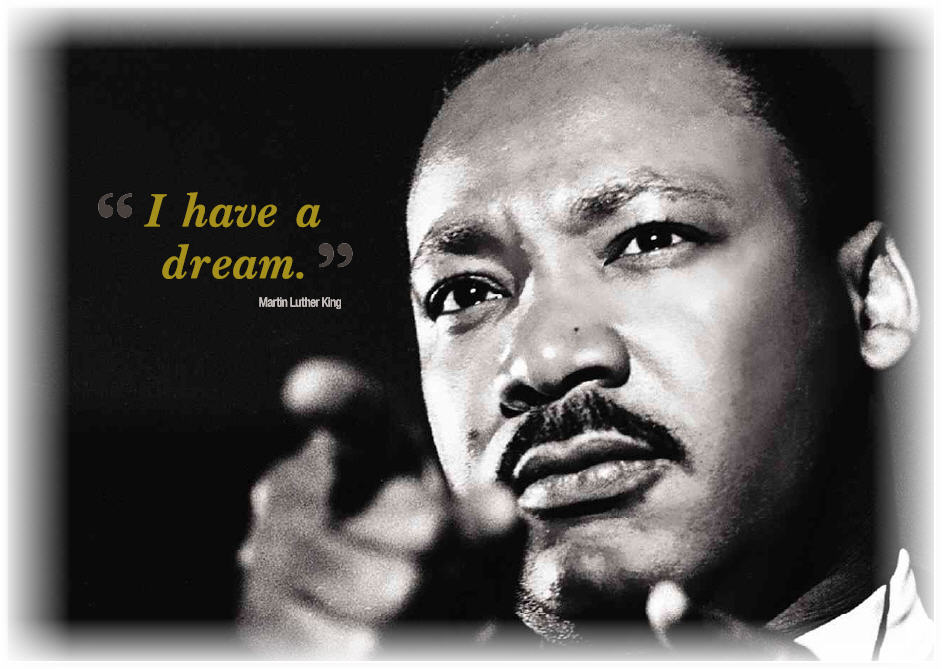
 “It was on 28 August, 1963, that you gave that iconic I have a dream speech at the Lincoln memorial, pleading for an end to racism, but, alas, things still have not changed.”

“Yes, it is so sad. I can still hear the ear-splitting applause as I said, ‘I have a dream that my four little children will one day be known not by the colour of their skin but by the content of their character.’ I am still dreaming –dreaming – dreamingHope someday my dream will be realized.”

“I heard your twelve-year-old granddaughter, Yolande Renee King gave a very powerful speech on August 28, 2020, and many organizations joined forces to March on Washington, in a call for justice. This was indeed commendable. ”

“Well, I am indeed so proud of her, I still maintain that injustice anywhere is a threat to justice everywhere, hope this injustice and unfairness is banished from this earth.” King suddenly wiped a tear which trickled down his cheek as the words, “Papa King, we won’t forget”, fell into his ears.

“I am so proud of my granddaughter Renee. Bapu, isn’t it weird that we were killed because we talked of equality, love and forgiveness?”

“Can love ever be killed? They are deluded if they think so!  Can forgiveness ever be obsolete? NEVER! Hope this vaccine of love is a success. They have no option left, they will have to stick to love, come what may.” 

“I still maintain, over the bleached bones and jumbled remains of civilisations
 are written the words too late- too late – too late
….” Yes, if they don’t follow, love and non-violence, it will be too late …Ah, there comes Coretta*.”

“Ah, I notice she is chatting with Kasturba. What a heartwarming scene!”

Bapu and King were last seen sitting amidst a group of people singing the Ramdhun*, while King tapped his feet, time and again, raising a robust fist, saying, ‘we shall overcome’ and Kasturba and Coretta happily joined the refrain.

The birds and candy floss clouds were in throes of divine ecstasy, excitedly discussing the latest breaking news that the vaccine of love used on the humans down below had been a resounding success.

*Charkha — Spinning Wheel

*Samadhi – Memorial monument

*Ramdhun – Hymns to Rama

*Coretta King – Martin Luther King’s wife

*Kasturba – Mohandas Karamchand Gandhi’s wife

.

Dr. Santosh Bakaya is an academician, poet, essayist, novelist, biographer, Ted Speaker and creative writing mentor. She has been critically acclaimed for her poetic biography of Mahatma Gandhi [Ballad of Bapu]. Her Ted Talk on the myth of Writers’ Block is very popular in creative writing Circles . She has more than ten books to her credit , her latest books are a biography of Martin Luther King Jr. (Only in Darkness can you see the Stars) and Songs of Belligerence (poetry). She runs a very popular column Morning meanderings in Learning And Creativity.com.

.

PLEASE NOTE: ARTICLES CAN ONLY BE REPRODUCED IN OTHER SITES WITH DUE ACKNOWLEDGEMENT TO BORDERLESS JOURNAL

.

Disclaimer: The opinions expressed are solely that of the author.

Categories
Poetry

Nandini

Written and translated from Korean by Ihlwha Choi

I couldn’t ask Nandini if she had school education. 
I only asked a foreign student excellent in Bengali about her age.

The girl, understanding only English such as brother, sister and thanks 
Was the last daughter of a roti shopkeeper,
Located at the small street near the post office in Shantiniketan, West Bengal,
There was Nandini’s small shop along with fruit shops and bike shops.

Cows passing by would thrust their heads suddenly
Into the shop thatched with bamboo stems.

One Korean poet said he had seen the girl when she was seven.
Her bones had grown until now, at the age of fourteen, selling chai and roti.
In this district, goats and ducks, even dogs and cows, grow up by themselves.
They do not pierce the cow’s nose nor pull them by reins.
The only thing that hinders the cows are the chains around the trees.
The only thing hindering the sleep of dogs are so many steps and vehicle horns.

Maybe Nandini also has grown up like that,
Delivering the dishes of roti and washing the glasses of chai,
Yelling at the two babies of the older sisters,
She might learn about the world hearing the customers’ talk over their shoulders.
How long had she had bare feet? The toes pressed out from sandals looked like tree stumps.

My returning back to my country has nothing to do with Nandini.
She only smiled brightly twinkling her eyes at my small gift.
I wished she would meet a good man not wanting a dowry,
And become a nice mother of children, like her elder sister,
All together with her brothers and sisters and strong and diligent mother,
Dissolving the tragic memory of her father’s suicide.

Nandini smiled though I told her to close her mouth,
Though I didn’t ask her to say cheese to make her smile.
When did she learn to smile in front of a camera?
There lived a flower-like little girl selling chai near the old house of poet R. Tagore.

Ihlwha Choi is a South Korean poet. He has published multiple books of poetry. Until the Time When Our Love will Flourish, The Color of Time, His Song and The Last Rehearsal to name a few. E-mail: choiihlwha@hanmail.net

.

PLEASE NOTE: ARTICLES CAN ONLY BE REPRODUCED IN OTHER SITES WITH DUE ACKNOWLEDGEMENT TO BORDERLESS JOURNAL.