By Hamiruddin Middya: Translated from Bengali by V. Ramaswamy
Babu, I am merely a poor Santhal. Please don’t take offence at anything I say. After all, we people who belong to the forest have always been losing. We are day labourers. We neither have nice houses nor do we possess any cultivable land.
Rangakul, Kusumkanali, Nabindanga and Mohulboni were all small Adivasi villages in the forest. Nearby were farmers, and people of the Ghosh, Mahato and Sinha communities. All the land belongs to them. We gaze at the sky in the hope of rain and cultivate a single crop. Some people have taken up the timber business and become rich and arrogant overnight. Why would they care about farming! It’s us who want to farm the land. A one-third share to the landlord, or else a monetary arrangement. We are poor folk, where will we get so much money! So, we cultivate the land on a crop sharing crop basis. But can one survive the whole year with that? The moment there’s no more rice for the cooking pot, we queue up beside the metalled road, wave out to any bus going eastward and get on board. After all, there’s no shortage of jobs there. With water from the canal available there, the fields yield golden paddy twice a year. By the grace of Marang Buru, all we want is to work our bodies so that we can feed our bellies.
When water is scarce at the edge of the forest where we live, famine looms. What’s new about that!
Singh babu is the big warehouse keeper here. He’s in the timber business. His house is at the fringe of the forest, across the railway line. It’s not a house but a fortress. He has done well in business with the help of his sons. Our men and women carry dry wood gathered from the forest to the babu’s warehouse across the railway bridge. He weighs our bundles and buys them. Even if the price is higher in the marketplace, who wants to go there if you have someone close by!
I cultivate a bigha-and-a-half of the babu’s land. It’s his warehouse that Lokha’s Ma carries wood to. There was a terrible drought this year. Fields, pastures and ponds were all parched, gasping for water. The paddy harvest was not good. The stalks were not tall. Just like a mother’s milk dries up if she is unable to eat, it’s the same with the ears of paddy. What will we eat the whole year? An unpared bamboo in the arse! How will I go to the babu and tell him?
I got the opportunity. Lokha set a trap somewhere and caught a waterhen. I told him, “Give me the bird, son. Let me give it to the babu.”
But Lokha did not want to part with it. “Why should I give it just like that?”
I said, “It’s not just like that, son. I have to make the babu happy, he’s very fond of bird meat. After all, we survive by cultivating his land.”
Who knows what Lokha thought but he did not argue any more.
I went with the bird at dusk. Singh babu was sitting with his son on a platform under the mango tree in front of the warehouse, he was doing some calculations. As soon as he saw me, he exclaimed, “Arey[1] it’s Hansda! What’s that in your hand?”
I went close to the babu. The babu studied the bird and exclaimed, “Wow! You’ve brought a waterhen!”
The babu never called me Sanatan Hansda, only Hansda. I could see that he was very happy to get the waterhen. His middle son, Haru, took the bird from me and left. Their house, surrounded by walls, was just behind the warehouse. I sat down below the platform.
The babu asked, “Has the paddy been threshed?”
“Babu, that’s what I came to tell you about. All the paddy has been destroyed in the drought! After threshing the remaining stalks, I could only get six sacks of paddy.”
The babu’s face turned grave. He blurted out angrily, “What the hell are you saying, bastard! Six sacks? I went to the field and saw for myself, it was full of swaying stalks.”
“Yes, babu, it was like that then. But there was no rain in Magh[2]. The plants began to droop after that!” I pleaded with the babu.
“Enough of your nonsense! Haru will go tomorrow and see how it’s only six sacks. Don’t try to be cunning!”
“Sure, send him then, babu. I am not telling you lies.”
Haru didn’t come. The next day, Singh babu himself arrived in haste. He came in the middle of our festivities. I was anxious wondering where I would ask him to sit, and what I would feed him. All of us, men and women, drink hanriya [3]and dance. Ours is a small village. We can’t afford to buy a dhamsa or a madol. We had everything earlier, but they broke long ago. When the boys and girls of the village grow up and it’s time for them to get married, we get those drums on rent. During our festivals, the boys in the youth club play music on the mic. We dance to that. Seeing our song and dance, Singh babu later whispered to me, “Give me a glass of hanriya too. Let me try it. But mind it, don’t tell Haru!”
“Oh no, babu. Don’t worry about that. Have as much as you want.” I thought it was funny. The father drinks out of his son’s sight. After all, we have none of all that. Father and son drink together to their heart’s content.
Why were Singh babu’s eyes so bloodshot today? I was scared. I said to him, “Come, come babu. Come inside and sit comfortably.”
The babu said angrily, “I haven’t come to sit, Hansda. Show me the paddy quickly.”
So, I showed the babu the paddy. He looked at me sternly and asked, “You haven’t hidden it somewhere, have you?”
“No, no babu. I would never do something like that in my life,” I said, holding my ears with my hands. “Why don’t you ask someone?”
“Chandmani and Gona Murmu got a good harvest. What kind of farming are you doing?”
“They got a pump-set from somewhere and irrigated their fields twice. There’s a shallow tubewell in the field there.”
The babu was about to leave with a sullen face. I said to him, “Let us keep the crop this time, babu. It’s a meagre harvest. My family can survive for a few days with that. I’ll repay you next time.”
The babu came to a halt with a start. He lowered his voice, and said, “Why should you go without food – am I not there! You have a young wife at home. Send her to the warehouse in the evening. After all, you can’t send her when people are around!” And saying so, the babu left. There was a strange smile on his face. Seeing that smile, my chest heaved. What on earth did the babu say before he left! How could I send Lokha’s Ma to the warehouse with wood now?
2
There was a fair in the nearby village of Mohulbani. As the Shalui festival is not celebrated with much fanfare in our village, it’s to the fair in Mohulbani that everyone dresses up and goes. There’s a cockfight every year during this time. This year, I too was a hauchi. Someone who participates in a cockfight is called a hauchi. I had never put a cock to fight. But the idea of doing that during this year’s festival caught my fancy.
Lokha’s Ma had brought the rooster as a tiny chick from her father’s house. I saved it so many times from the jaws of wretched mongooses and civets. It was big now, and sparkling red in colour. It crowed, konk konkkor konk, in the semi-darkness of dawn. Hearing its crow, the birds on the trees then began chirping. It hovered around every hen in the village, all by itself. It walked with its chest puffed out, as if it was the king of the forest. If such a rooster could not fight, then why on earth was it born?
Lokha tugged at my lungi and demanded, “I’ll go too, Baba. Take me along with you to see the fair.”
Lokha’s Ma said, “Take him along. He’s my little boy. On a festival day, he’ll go to see the fair, he’ll eat jilapi[4], but no – what kind of a father are you!”
“All right. Come along then.”
Mustard flowers were in bloom in the fields. It was yellow everywhere, both on the lowlands and the uplands. After all, it was a festival of flowers now. Men and women, old and young, were walking to the fair along the narrow boundary ridge. Some raced along on bicycles on the red laterite road, ringing their bells, kring kring. Close to the forest was the field known as Bhangatila Maath, which was where the fair took place. Shops with captivating wares, flutes for children, toy drums. Such a variety of food items, telebhaja[5], jilapi. Earthen pots and utensils were selling somewhere under a tree canopy. Rows of bicycles and pick-up vans were elsewhere. An old Santhal man was going around selling bamboo flutes. He himself was rapt in the melody he was playing. There was a cloud of red dust. Girls and young men were walking around holding hands, disregarding the dust. The crowd at the fair was made up of people from all the nearby villages.
Was it only Santhals? No, babu folk too had come to have fun. Everyone was dressed in new clothes, looking their best. Girls had applied mahua oil on their hair and parted their hair, with wildflowers adorning their coiffure.
Hidden away from the fair, in a clearing inside the forest, there was a crowd of people. That’s where the cockfights took place. It used to take place in the fair ground itself earlier. But a few times, police vans had arrived and pulled down everything. It has moved its venue into the forest ever since. I went there with Lokha. Sal-wood poles had been planted, and the spot had been encircled with a rope. Everyone was standing around the rope, Some of them were hauchis, with roosters in their hands. Others had come only to watch.
I asked Lokha to stand under a tendu tree, and told him, “Don’t go anywhere, son. Just stand here and watch the cockfights. I have to find us an opponent.”
I was going around with my rooster, looking for an opponent, when a suited and booted babu with a camera on his shoulder pushed his way through the crowd. Everyone gaped at the man.
A few kaatkaars, those who tied blades to the roosters’ feet, had gone into the enclosure through the boundary rope. Seeing the babu, they said, “Hey babu, what business do you have here? You want to publicise the cockfight? Stop taking pictures, we warn you!”
The babu put his camera into his bag following the threat.
As I went around searching, who should I encounterbut Singh babu — a pleasure-seeking man indeed! He frequently participated in cockfights to indulge his fancy. From time to time, he also wagered money on the days of the weekly market. There was a spirited rooster in the babu’s hands. Seeing me, he said, “What’s up, Hansda, have you brought one too?”
I nodded my head, and said, “Yes, babu. I did it for fun.”
“But you’re in bad times! So how come you’re indulging your fancy?”
Seeing the rooster in my hand, the babu’s rooster stretched its neck, fluffed the feathers on its neck, and glared agitatedly. When I had told the babu about the six sacks of paddy, the babu had glared at me in the same way. My rooster’s eyes too emitted fire. They were a fine pair, but how could I tell the babu that! He was a well-known man, why would he agree to a cockfight with me?
The kaatkar Hiralal, from Panchal was nearby, tying blades toa rooster’stoes. Seeing our two roosters, he burst out, “The two make a fine pair! Why don’t you get them to fight?”
Had Hiralal lost his head or what! What’s this he was saying! Would someone like Singh babu agree to a cockfight with my rooster! I was a poor Santhal. I survived by farming the babu’s land. But I was astonished to hear the babu’s response.
“Hey Hansda! Are you willing?”
I replied hesitantly, “Whatever you wish, babu.”
Hiralal began tying blades to the two roosters’ toes. We didn’t call them blades. The blades were known as heter. Kaatkars had arrived to tie the heter to the toes of all the fighting roosters. After all, there were so many roosters for the cockfight! If there had been only one kaatkaar, it would be night by the time the contests were over.
The rooster belonging to Budhon Ghosh, the ration-dealer from Harindanga village, was fighting now with the one belonging to Fatik Ghosh from Panchal. There was a circle made with lime powder within the roped-in enclosure. The two roosters were made to face each other within the circle. The roosters in the hands of other cockfighters in the crowd raised their necks and crowed. The cockfight was going to be a lively one.
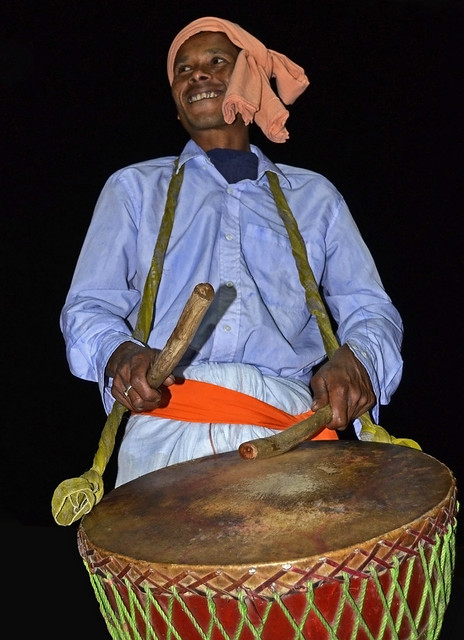
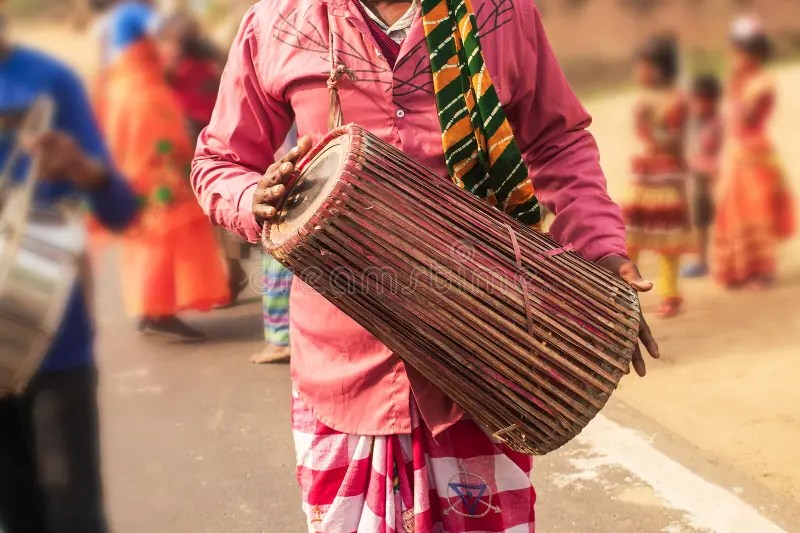
Meanwhile, the beats of the dhamsa and madol came wafting from the fairground. Intoxicated with mahua [6]and hanriya, our young men and women were dancing in a circle, hand in hand. A tide of joy washed over the hills. The whole forest was in a state of intoxication with the drim drima drim beat.
Budhon Ghosh won the cockfight. The spectators clapped and whistled to congratulate him. Fatik’s defeated rooster was his now.
It was our turn next. Singh babu and I entered the roped enclosure. We held the tails of the two roosters and stood them face to face in the middle of the lime circle. Singh babu and I too were face to face. These weren’t roosters! They were like magnets drawn to iron. They could not be restrained, they kept pulling forward. As soon as the whistle blew, fweeeet, we released the roosters. The fight began. They flapped their wings, torn feathers flew into the air. Neither of them spared the other.
When the babu’s rooster was overcoming mine, the spectators applauded, and cried out, “Singh babu! Singh babu!” Again, when my rooster was beating the babu’s rooster, a few spectators behind me excitedly burst out, “Hansda! Hansda!”
I was witnessing another battle. After all, the two roosters weren’t roosters. They were Singh babu and me. We were down on our hands and knees, both of us had become roosters. We were in an unflinching face-off. Behind me were rows and rows of Santhal men and women, mothers, brothers and sisters, standing with bows and arrows, battle axes, and spears in their hands. And behind the babu were row upon row of diku, as outsiders were known.
I suddenly heard the Santhals cry out excitedly, ‘Sanatan! Sanatan!’ I realised I had lost my concentration. I saw that my brave rooster had pierced his blade into the breast of the babu’s rooster and felled it. I had won!
I rushed and picked up the babu’s rooster. It was mine according to the regulations. The kaatkaar too had to be paid for fixing the blades. There was no end to Lokha’s joy! The next fight had already begun.
Lokha’s Ma had forbidden me again and again. “Hey, what if this fully grown rooster loses? How about indulging yourself with food only at the festival instead?” But I paid her no heed. How happy Lokha’s Ma would be now!
But as soon as I glanced at Singh babu, I had a strange feeling. Why had his face turned so ashen? After all it was merely a battle between two roosters…
I felt no joy despite having won. What had I done, oh dear! I had beaten the babu. How could I take his rooster home and eat it?
I said to Lokha, “Go, my son. Go and give the rooster to the babu.”
Lokha asked me, “Are you very angry? We won! So why should I give it?”
What was Lokha saying! That we won? After all, we had never been able to win! We had been beaten time and again, my dear! Ever since some distant time. What had I done now, oh dear, by beating the babu! My eyes turned moist. I went with the rooster to the babu.
The babu did not say a single word to me.
I said, “Hey babu! Take this. Let your boys have a feast. I have one already!”
The babu said, “No, Hansda. I won’t take a beaten rooster home.”
Hearing that, I shook my head. The babu patted my shoulder and said, “Let’s see what happens next year.”
[1] Oh!
[2] Bengali month starting mid-January and ending mid-February
[3] Local liquor
[4] A fried sweet
[5] Deep fried snacks
[6] Local liquor
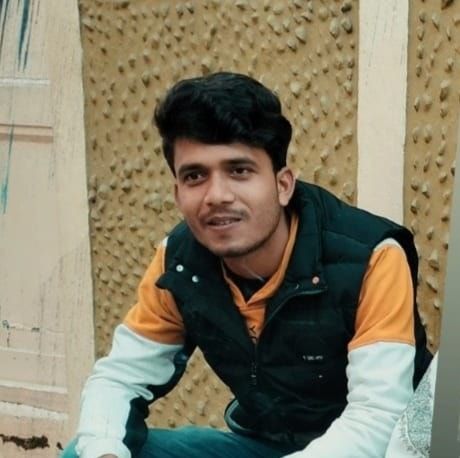
Hamiruddin Middya was born in 1997 in Ruppal, a remote village in Bankura district in West Bengal. Born in a marginal farmer’s family, he has been in agricultural fields and farming from his childhood. His passion for writing started from his school days. He has worked as a domestic helper, a migrant construction mason, and travelled to rural fairs to sell wares. Hamiruddin’s first story was published in the magazine Lagnausha in 2016. Since then, three collections of his short stories have been published, Azraeler Daak (2019), Mathrakha (2022), and Ponchisti Golpo (2025). The story collection, Mathrakha, received the Yuva Puraskar for 2023 from the Sahitya Akademi, India.
V. Ramaswamy took up translation following two decades of engagement in social activism for the rights of the labouring poor of Kolkata. Beginning with the iconic and experimental writer Subimal Misra, he then devoted himself to translating “voices from the margins”, both in fiction and nonfiction. Besides translating four volumes of Misra’s short fiction, Ramaswamy has translated Manoranjan Byapari, Adhir Biswas, Swati Guha, Mashiul Alam, Shahidul Zahir, Shahaduz Zaman and Ismail Darbesh, among others.
PLEASE NOTE: ARTICLES CAN ONLY BE REPRODUCED IN OTHER SITES WITH DUE ACKNOWLEDGEMENT TO BORDERLESS JOURNAL
Click here to access the Borderless anthology, Monalisa No Longer Smiles
Click here to access Monalisa No Longer Smiles on Amazon International
 Borderless