By Naramsetti Umamaheswararao
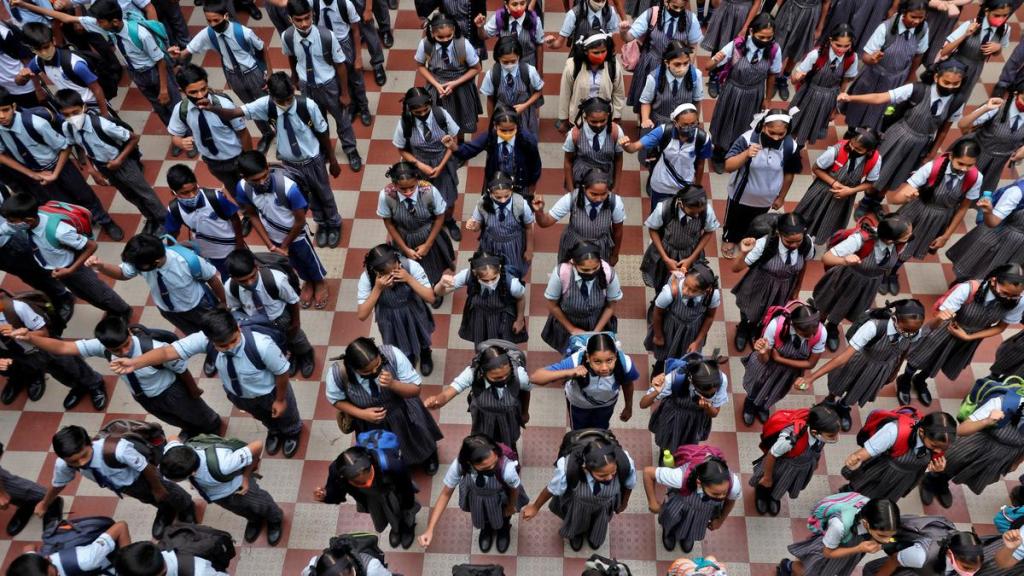
All the students of Seethanagaram High School stood in the playground for the morning prayer. The headmaster, along with the other teachers, was also present.
After the prayer, the headmaster addressed the students: “A new academic year began yesterday. Many new students will be joining us today. We will start lessons from tomorrow. For today, let’s spend the day playing games. Are you all ready?”
The mention of games excited the children. They enthusiastically replied, “Yes, Sir!”
“Alright! From where you are standing, try to reach the other end of the playground by hopping on one leg,” the headmaster instructed.
The students replied, “We can’t do that, Sir.”
“Don’t say that. You shouldn’t give up without trying. All of you, give it a shot,” he encouraged.
Some students stepped forward and tried to hop on one leg. A few managed to go a little distance before falling, while others gave up after a short while. The headmaster praised their efforts and asked them to return.
Next, the headmaster said, “Now, close your eyes and walk to the end of the playground.”
Just like before, the students shook their heads and said, “We can’t do that, Sir.”
“Don’t worry. We will be right behind you. No one should open their eyes or cheat,” the headmaster assured them.
Trusting his words, the students attempted the task. They walked slowly, but it was very difficult to walk with their eyes closed. They didn’t know what lay ahead—there could be stones or pits. They took each step with great fear. About three-quarters of the students gave up halfway, saying it was impossible. A few, with great difficulty, made it to the end of the playground. The headmaster praised their efforts and asked all the students to gather in the assembly hall.
Once all the teachers arrived in the assembly hall, the headmaster selected twenty students and paired them up to face each other. He tore some chits and wrote on them. Placing the chits in some of the students’ hands, he instructed them to convey the words in the torn scrap of paper to their partners using gestures. The students tried as instructed.
When asked if they understood what their partners were trying to convey, everyone said they did not.
Ravi, who had just started the tenth grade and was known for his courage, watched these games and asked, “Why did you have us do these activities, Sir? Do these games have anything to do with our studies? Walking on one leg, walking with eyes closed, and conveying messages through gestures were all very difficult. We struggled a lot, and some even fell. Why did you make us do this?”
The headmaster responded, “Ravi mentioned that walking on one leg, walking with eyes closed, and communicating through gestures were difficult. Do the rest of you agree?”
All the students nodded in agreement.
The headmaster then said, “You’re right. I agree with you. These tasks were indeed difficult. But due to the disabilities given to them by God, some people with physical impairments, like blindness or deafness, have to live their entire lives like this. Can we agree that their lives are more challenging than ours?”
The students remained silent, unable to answer. When the headmaster repeated the question, Ravi replied, “How would we know, Sir?”
“Didn’t you just experience what it feels like to be lame, blind, or deaf while playing those games? That should have given you some understanding. That’s why I asked,” the headmaster explained to Ravi, who nodded in agreement.
“Another question for all of you. If someone is in trouble, what should we do as fellow human beings?” the headmaster asked.
“We should help them,” the students replied.
“Good job! That’s the right answer,” the headmaster praised them, and the students responded loudly, “That’s right, Sir!”
The headmaster then asked, “We shouldn’t make fun of people like that, right?”
“No, Sir,” the students replied in unison.
At that moment, the headmaster called an attendant and had three students brought before the assembly.One student walked with the help of a stick. Another was visually impaired, and the third student’s disability was not visible but had a hearing impairment.
The headmaster showed these three students to the others and said, “These students joined our school yesterday. Two of their disabilities are visible, and the third has a hearing problem. They are already suffering from these disabilities. We should show compassion and offer our help to them. I have seen with my own eyes some students mocking and making them cry. That’s why I made you experience how difficult life is for those with such impairments through these games. These three students need your support and assistance. Not just these three, but anyone with disabilities, wherever they may be, should be helped. We should give them the assurance that we are here for them and give them moral support.”
The students responded loudly, “Yes Sir!”
At that moment, three students stood up and walked to the front of the assembly.
They said, “Sir, we were the ones who mocked them yesterday. We behaved wrongly because we didn’t understand their difficulties. Please forgive us.”
The headmaster advised them to help those in need and behave well in the future, and then he dismissed all the students to their classrooms.
Naramsetti Umamaheswararao has written more than a thousand stories, songs, and novels for children over 42 years. he has published 32 books. His novel, Anandalokam, received the Central Sahitya Akademi Award for children’s literature. He has received numerous awards and honours, including the Andhra Pradesh Government’s Distinguished Telugu Language Award and the Pratibha Award from Potti Sreeramulu Telugu University. He established the Naramshetty Children’s Literature Foundation and has been actively promoting children’s literature as its president.
.
PLEASE NOTE: ARTICLES CAN ONLY BE REPRODUCED IN OTHER SITES WITH DUE ACKNOWLEDGEMENT TO BORDERLESS JOURNAL
Click here to access the Borderless anthology, Monalisa No Longer Smiles
Click here to access Monalisa No Longer Smiles on Amazon International
 Borderless