Story by Sharaf Shad, translated from Balochi by Fazal Baloch
The moment he stepped into his home, he sensed that something was wrong. A strange desolation and silence crept down the walls and doors. His wife, upon seeing him, stood up. Her voice trembled overwhelmed with anxiety. She whispered: “The snow is melting.”
“What?” At the mention of snow, his eyes flared with alarm. He rushed to the room where the snow statue was kept. As usual, it stood there like an impregnable mountain. But now, a tiny teardrop was trickling down its right cheek. The line of the rolling tear seemed to slice the statue into two, like the slash of a sword. He knew that if the melting continued, the statue wouldn’t last much longer. The mere thought of this brought tears to his eyes.
A few years ago, the sea had gifted him that very statue. In those days, he used to visit the sea every evening. He adored the sea and its rising tides, drawn to the depths and the vastness that made him feel immortal. It was that very sense of immortality that pulled him to the shore night after night. Despite the violence of the waves rising and crashing, he continued captivated by them.
One day, as he was lost in watching the rise and fall of tides, he noticed the statue gleaming amidst the water, like a giant pearl. He picked it up, marveling at nature’s artistry. He wondered how such a beautiful statue could exist in the midst of such chaos. Then, a voice echoed from the tides, addressing him: “It’s a gift for you, from me. Every evening you came here and shared my grief. Take this statue home. It will bring you peace, health, and prosperity.”
The wind, tracing lines upon the surface of the ocean, was impressed by the sea’s generosity. It told him that, to help preserve the statue, it would maintain constant climate. When everything becomes kind to someone, time will surely follow suit. Thus, time assured him that it would never bring decay or harm to the statue.
He took the statue and placed it in the finest spot in his home. As the sea and the wind had promised, the statue became a symbol of prosperity and success. Under its shade, his life flourished. But that day, the snow had started to melt!
He knew that this was a sign that his life would soon be stormed with worries and torments. He quickly stepped out of the room. The wind was swirling dust in the courtyard. Like a man who finds comfort in a familiar face during a calamity, he tearfully told the wind that his snow statue was melting.
“Everything perishes in its due time,” the wind replied indifferently.
“But you promised to protect the statue and keep the climate unchanged.”
“I still stand by what I said. It is man who claims the climate is changing. Everything—the sky, the earth, the sea, the wind, the stars, and the moon—remains as it always has. It is only man who changes.”
“I don’t understand what you mean,” he blurted out in frustration. “Just tell me how to escape this curse!”
“Everyone must find their own way forward,” the wind replied.
“All roads seem closed to me,” he lamented.
“When all roads appear closed, that’s where a new one opens,” the wind whispered as it blew away, filling the lanes with dust.
To remind time of its promise, he turned to it for answers. The time listened patiently, as if it already knew the situation. After a brief silence, it gently spoke, “In this world, everything changes its shape sooner or later. Even things that seem unchanged eventually undergo some transformation. Your statue has fulfilled its purpose, and this is the law of nature. Everything new will turn old, and when it does, it changes. Your statue may have taken on a new form—one that may not be as appealing to you as it once was—but it will never truly decay.”
“My life now depends on this statue,” he said desperately. “By its virtue, my family has lived in prosperity. Since it arrived in our home, worries and sorrows of life have forgotten our door. Who knows what curse might fall upon us once it’s gone? Its new shape could bring harm and loss to me.”
“Who knows?” the time replied indifferently.
“If this statue continues to melt, my entire house will be ruined. That’s why I don’t want it to change its form.”
“It cannot be stopped from changing now,” the time said firmly.
Feeling disheartened by the time’s response, he wandered, lost in thought, searching for a way out of his dilemma. While he wandered absent mindedly, he felt a hand on his shoulder. Startled, he turned to find a tall man dressed in white, standing beside him.
“Hey man, I’ve seen you wandering these lanes for a while now. Is everything okay?”
Like a drowning man catching at a straw, he poured out the entire story. After listening, the tall man said, “You’ve pleaded with the wind and the time, and now you’ve told me, a mere wayfarer, your troubles. But you never approached the one who gifted you the snow statue.”
Startled by the realisation, he sprang to his feet, as if pulled up by ten men, and hurried away without thanking the tall man.
He rushed to the sea and bowed before it, pleading, “My snow statue is melting— please, do something to help me.”
“I cannot do anything,” the sea replied indifferently. “Your statue has run its course. Everything has its lifespan and eventually decays. It is an illness without a cure.”
“The fate of my house depends on this statue. There must be a way to escape this curse!” he cried, his voice filled with frustration and despair.
“The sea doesn’t find a way out for anyone,” the sea responded, its voice now filled with arrogance.
“Then no one should find a way for the sea either,” a voice echoed behind him. He turned and saw the same tall man standing there. The sea seemed embarrassed, lowering its head in shame. After a brief silence, its lips trembled as it muttered: “Go home. The blessing of snow will shower upon everything in your house.”
Overjoyed by these words, he grasped the tall man’s hand gratefully, thanking him. The fire that had been consuming his soul was suddenly soothed by the sea’s promise. He hurried home and rushed straight to the room where the statue stood. The teardrop that had once fallen from the statue had dried. Relieved, he smiled, content that the statue had been spared from decay.
Eager to share the joyful news, he went to find his wife and children. But as he stepped into each room, a strange, eerie air of grief and sorrow greeted him. Everything in his house had turned to snow—the windows, the doors, the curtains, and even his wife and children had transformed into frozen statues of snow. The sea’s words echoed hauntingly in his mind: “Go home. The blessing of snow will shower upon everything in your house.”
His heart shattered. Madness and despair took hold of him as he raced back to the sea. But when he arrived, his worst fears were realised. The sea was gone. In its place stretched a vast, dark desert.
He turned back and wandered through the streets, searching every lane and alley for the man in white. He needed to tell him how the sea had deceived and betrayed him. But after scouring every corner of the city, he found no trace of the man. Overcome with disappointment, he returned to the road leading to the sea, holding on to a faint hope that it might have returned.
When he arrived, there was no sea—only the endless desert stretched out in its place. His body, weak and exhausted, could go no further. He stood there, frozen, like a lifeless piece of wood.
He remained in that spot for years, unmoving. The changing seasons, the winds, and the harsh climates left their marks on him. Over time, his form withered into a blackened log, lying forgotten by the roadside. His body had turned dark — black as a stone, disconnected from the people, the sea, and the snow.
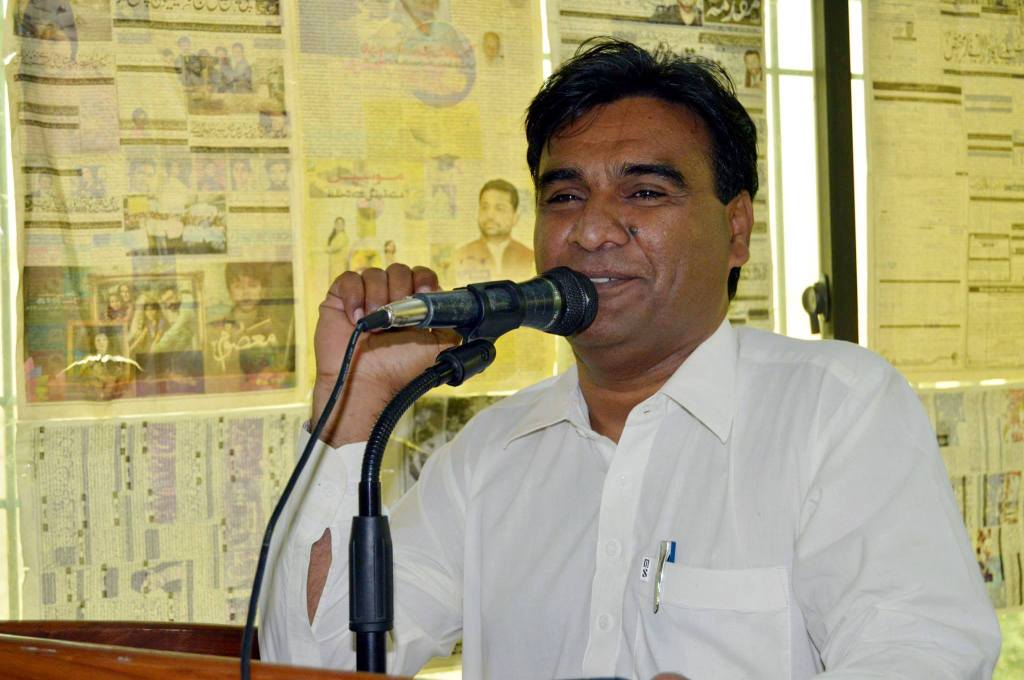
Sharaf Shad is simultaneously a short story writer, poet, translator, and critic. The richness of narrative is one of the defining features of his short stories. Death and identity crises are recurring themes in his works. A collection of his short stories, titled “Safara Dambortagen Rahan” (Journeying Down the Weary Roads), was published by the Institute of Balochistan, Gwadar, in 2020. The story presented here is taken from that collection and is being published with the author’s permission.
Fazal Baloch is a Balochi writer and translator. He has translated many Balochi poems and short stories into English. His translations have been featured in Pakistani Literature published by Pakistan Academy of Letters and in the form of books and anthologies.
PLEASE NOTE: ARTICLES CAN ONLY BE REPRODUCED IN OTHER SITES WITH DUE ACKNOWLEDGEMENT TO BORDERLESS JOURNAL
Click here to access the Borderless anthology, Monalisa No Longer Smiles
Click here to access Monalisa No Longer Smiles on Amazon International
 Borderless