By Naramsetti Uma Maheswara Rao
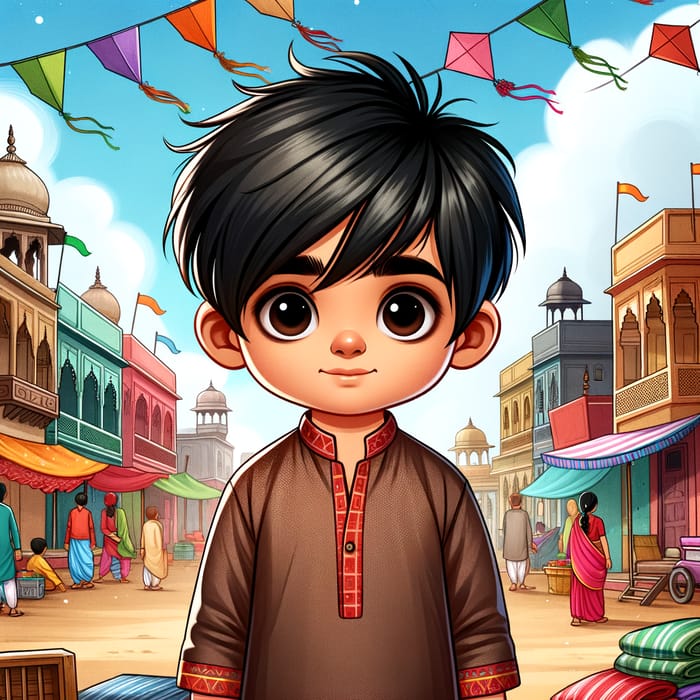
“Mom, if you stick this on your head, your splitting head will heal. Here, take it and stick it on,” said four-year-old Ravi, handing over a roll of round plaster.
“Who told you to stick this for a headache?” Rajani asked in surprise, not quite understanding what he meant.
“Earlier, you told the neighbour aunty that your head was splitting. That’s why I brought it. Whenever something in the house tears, Dad sticks it with this. You should stick it on your head so it doesn’t split,” Ravi replied innocently.
Rajani laughed at her son’s sweet words. As a festival was on in the village, Rajani had invited her parents, siblings, and their families to her home. With everyone staying at her house, her daily chores had increased. Even though she woke up at dawn to start working, she couldn’t finish everything. Just then, the neighbour had come asking for a loan of some sesame oil.
“No matter how much I do, the work never ends. My hands are hurting, and my head is splitting,” Rajani had told the neighbour.
Ravi heard these words, and to help his mom, he brought the plaster his dad used to stick his brother’s torn books. He told his mother to stick it on her head to ease her headache. Now, Rajani understood the situation and laughed at her son’s cleverness.
“Why are you laughing? Won’t the headache go away if you stick this?” Ravi asked innocently again.
“You don’t stick plaster for a splitting head. A splitting head means I have a headache. If I apply Amrutanjan[1], it will go away,” Rajani explained in a way he could understand.
Rajani shared the incident with the rest of the family, and they all had a good laugh.
.
That afternoon, the family sat down for lunch. Rajani served a curry made with chicken eggs to everyone.
“What is this?” Ravi asked. Rajani replied that it was a chicken egg.
“I want a donkey egg,” he said.
At first, Rajani didn’t understand what he meant. Everyone else also looked at Ravi with interest.
“There’s no such thing as a donkey egg. There are chicken eggs and duck eggs,” his grandmother tried to explain to Ravi.
“No, there is. I want that one,” Ravi insisted, starting to cry. No matter how much they tried to explain, he didn’t stop crying.
Ravi’s father suspected that someone must have mentioned it, as kids don’t come up with these things on their own. He took Ravi close and gently asked, “Who told you about a donkey egg? Tell me, and I’ll ask them to bring it for you.”
Hearing this, Ravi’s face lit up, and he pointed to his grandfather.
Everyone’s attention turned to the grandfather. “Did you tell him about it? Is there such a thing as a donkey egg?” everyone questioned him.
“Hold on! Why would I tell him that? Give me a moment to think,” the grandfather replied, trying to recall the incident. After some thinking, he remembered something.
That morning, one of the workers had done a job incorrectly, and in anger, the grandfather had said, “Is this how you do it? This is not a donkey egg!” Ravi, who was sitting on his grandfather’s lap at that time, heard these words. He had asked what a donkey egg was, but his grandfather, in his irritation, didn’t respond.
After learning the real story from the grandfather, the rest of the family laughed. Ravi’s father lovingly explained to Ravi that there’s no such thing as a donkey egg and that it was just an expression his grandfather used. It took some convincing, but eventually, Ravi understood.
.
Ravi also had an elder brother named Ramu, who was eight years old. Whenever Ramu came home from school, he and Ravi would fight over something or the other.
One day, as soon as they returned from school, they fought over the TV remote, leaving Rajani, already exhausted from housework, feeling more frustrated.
“I told you to change out of your school uniforms and wash your hands and feet when you come home. I’ve kept snacks on the table. Instead of eating, why are you fighting? Behave, or I’ll smack you with a hot spatula,” Rajani said.
“Mom, I want that. Don’t give it to my brother. Spank me now,” Ravi cried, running to his mom.
“What did you understand? Do you know what a spank is?” Rajani asked, calming down.
“Oh, I know. It’s a hot pancake. I’m hungry. Please spank me quickly,” Ravi said innocently. Hearing his sweet words, Rajani’s frustration disappeared, and she laughed wholeheartedly.
She kissed Ravi on his cheek and said, “Wait. I’ll get you the snacks,” and ran to the kitchen.
Rajani realised, “We shouldn’t use such words in front of children. They can misunderstand and repeat them in front of others, causing embarrassment.” From that day on, she learned to be cautious with her words around Ravi.
[1] Balm for healing headache
Naramsetti Umamaheswararao has written more than a thousand stories, songs, and novels for children over 42 years. he has published 32 books. His novel, Anandalokam, received the Central Sahitya Akademi Award for children’s literature. He has received numerous awards and honours, including the Andhra Pradesh Government’s Distinguished Telugu Language Award and the Pratibha Award from Potti Sreeramulu Telugu University. He established the Naramshetty Children’s Literature Foundation and has been actively promoting children’s literature as its president.
.
PLEASE NOTE: ARTICLES CAN ONLY BE REPRODUCED IN OTHER SITES WITH DUE ACKNOWLEDGEMENT TO BORDERLESS JOURNAL
Click here to access the Borderless anthology, Monalisa No Longer Smiles
Click here to access Monalisa No Longer Smiles on Amazon International
 Borderless