Book Review by Meenakshi Malhotra
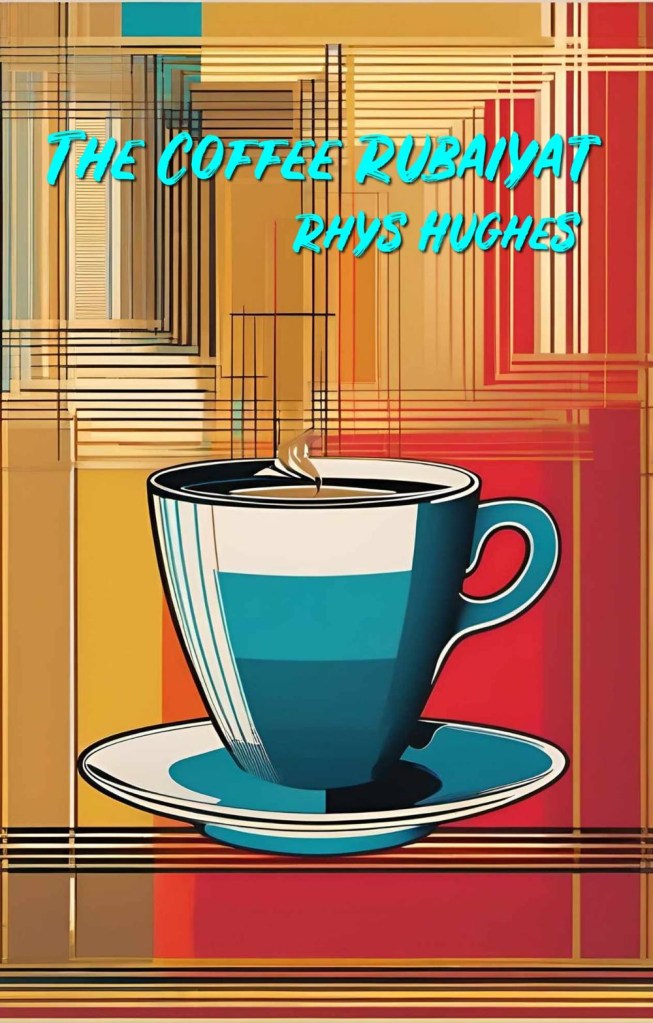
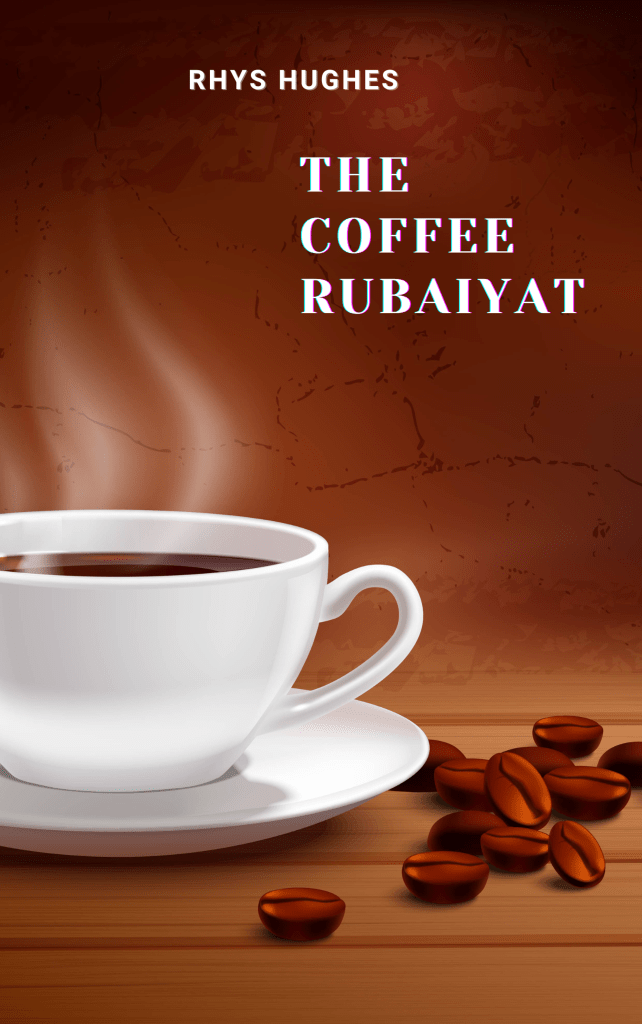
Title: The Coffee Rubaiyat
Author: Rhys Hughes
Publisher: Alien Buddha Press
Rhys Hughes’ creative adaptation of Edward Fitzgerald’s translation of the Rubaiyat of Omar Khayyam[1] is a delightful read. Located somewhere between tribute and parody, it has recreated the tonal and prosodic rhythms of the original translation, quartet by quartet. Yet, there is a thin line between parody and subversion, and Hughes’s adaptation negotiates this with a tongue-in cheek flippancy.
To illustrate the close parallel of the original 1st quartrain of Fitzgerald’s translation and Hughes creative adaptation:
Awake! For Morning in the Bowl of Night

Has flung the Stone that puts the Stars to Flight:

And lo! the Hunter of the East has caught

The Sultan's Turret in a Noose of Light.
The original aubade is wittily recast as:
Awake! For the alarm clock next to the bed

Is ringing the bells that can wake the dead:

And Lo! The ruby rays of the rising sun

Colour the espresso machine a pinkish red.
This paean to coffee is replete with personifications –“Dawn’s lips are coffee-smeared”(vi).
Some of Hughes odes to coffee poke fun at the metropolis and its quirky inhabitants, the poem(s) capture the rhythms of life and its frenetic pace in the urban metropolis. Thus in quatrain 18, we get a glimpse, a veritable word-picture of the tube/metro train commuter:
I sometimes think that never blows so hard,

The commuter who is late, reputation marred,

To cool his coffee so he can catch his train

Before all the doors are closed by the guard.
Literary- and other-Histories of Coffee
In a ‘Brief History of Coffee around the World’, Garrett Oden clarifies that , unlike tea and alcohol which have been around and in use for more than five thousand years, coffee has had a relatively recent history. Although it has supposedly been around for over a 1000 years, its first verifiable documented use was about 500 years ago. Accidentally discovered by a goat herder whose goats turned unusually frisky after consuming some red beans, it became popular in Yemen and the areas surrounding it, the area we know now as the Middle East or as west Asia. The journey of coffee to Europe and beyond is replete with narratives of colonialism, plunder, pillage and scandal. This murky history was often forgotten as the roasted magic bean became a rage in coffee houses across the world.
The dubious antecedents of this heady brew derived from the magic bean is invoked in literary works such as Alexander Pope’s ‘The Rape of the Lock’ where the effects of coffee are thus described:
“Coffee, (which makes the Politicians wise, And see thro’ all things with his half-shut eyes)/Sent up in vapours to the Baron’s brain new stratagems” to fulfil his nefarious designs. Closer to our own times, we have T.S. Eliot’s line in ‘The Love Song of J. Alfred Prufrock’ where his persona declares, summing up the urban ennui of his quotidian existence, “I have measured out my life with coffee spoons”, a line which is yet another testimony to the fact that coffee has become an inseparable and indispensable part of our everyday life.
Echoes of Fitzgerald’s Rubaiyat are interwoven into each quatrain and the poems follow the chronology of the original sequence. From the chess board (p 56-XLVIX) to the image of the “moving finger” which is replaced by the “moving tongue” (LI, p58), in poem after poem, we have many hyperboles to capture the effects of this drink which stands for a way of life. It is a way of life familiar to inhabitants of the modern metropolis where one’s life is lived under the glare of neon lights, and where sleeplessness, stress are all par for the course.
Although the poems employs the resources of several figures of speech like metaphor, personification, hyperbole, perhaps the most apt and commonly used figure is that of bathos. It is an effect of anticlimax created by a lapse in mood from the sublime to the trivial. A typical example is Pope’s line in ‘The Rape of the Lock’ where he says, “Great Anna, whom three realms obey/ Dost sometimes counsel take — and sometimes tea”: In Hughes’s case, “the cosmos is nothing but a frappucino” ,”the inverted cup we call the sky.”
The poems are crafted in a spirit of irreverent good humour and this book is definitely a little nugget, worth savouring. Even if (to persist in the metaphor) one’s cup does not run over, it is definitely a cup that cheers.
Click here to read an excerpt from The Coffee Rubaiyat
[1] The translation was first published in 1859. Omar Khayyam, an astronaut, mathematician, a philosopher and a poet lived from 1048–1131 and wrote in Persian.
.
Dr Meenakshi Malhotra is Associate Professor of English Literature at Hansraj College, University of Delhi, and has been involved in teaching and curriculum development in several universities. She has edited two books on Women and Lifewriting, Representing the Self and Claiming the I, in addition to numerous published articles on gender, literature and feminist theory. Her most recent publication is The Gendered Body: Negotiation, Resistance, Struggle.
.
PLEASE NOTE: ARTICLES CAN ONLY BE REPRODUCED IN OTHER SITES WITH DUE ACKNOWLEDGEMENT TO BORDERLESS JOURNAL
Click here to access the Borderless anthology, Monalisa No Longer Smiles
Click here to access Monalisa No Longer Smiles on Amazon International
 Borderless