Here is my son, as a toddler, an ice cream cone in one hand, the other signing “peace.” Here is my daughter at five, posing in front of the Inland Sea, two fingers held up in the air. Here is my son, aged ten, sitting on a park bench in Charleston, South Carolina. Peace!
From pretty much the time that my Japanese-born children learned to say “cheese,” whenever they’ve found themselves in the presence of a camera, they stuck up two fingers in a “V.” Pick up any family photo from our children’s first ten years, and you’ll find someone making this gesture.
It drove my American parents crazy. “Be natural,” they’d say. “Don’t do that!” Candid shots were nearly impossible because as soon as my kids realised they were about to be photographed, those two fingers went up in the air.
My children were not exceptions, of course. I first noticed this practice when I arrived in Japan over thirty years ago. I have a drawer full of photos of myself and various Japanese kids making the sign. Me, I sometimes did it ironically. For Japanese youth, it seemed to be a Pavlovian response.
It hadn’t always been this way. An older Japanese woman friend told me that when she was a child, no one made a “V” when having their picture taken. She lamented that her own children had picked up the same habit, that her daughter signed “peace” even in her wedding photos. When I asked her how it all got started, she couldn’t tell me. However, theories abound.
According to one source, the trend originated in a baseball manga. A character made the “V” for Victory sign in imitation of Winston Churchill. The gesture caught on, and remains.
One of my foreign friends, hoping to break her kids of the tendency, refused to take their picture if they were making the sign. I was not quite so strict. The peace sign may, in fact, be the Japanese equivalent of the smile. In the United States, whenever someone has their picture taken, the photographer tries to get a grin out of them. I’m sure that many of us have faked a smile in order to comply with custom. I certainly have.
Here in Japan, however, smiling for the camera is relatively new. Back in the day, only the very vulgar would show their teeth. In school and other formal photos, gravitas is seemingly required. Thus, in the group portrait taken at my own wedding, the Japanese guests wear poker faces, better suited to a court date. My American relatives are all smiles, though their posed grins may be frozen in place. No one, I might add, is making the peace sign. My husband and I got married in Hawaii, so everyone’s hands are raised with pinkie and thumb extended, a gesture that means “hang loose” in the islands. Shaka shaka.
These days, thanks to the influence of K-pop artists in Japan, people posing for photos are likely to use another gesture. At a recent party celebrating graduating students at the university where I teach, we all got into formation.
“What should we do?” one professor asked. “Peace signs?”
“How about K-pop hearts?” I suggested. The others agreed. We touched our thumbs and index fingers, forming hearts. The picture was taken.
Suzanne Kamatawas born and raised in Grand Haven, Michigan. She now lives in Japan with her husband and two children. Her short stories, essays, articles and book reviews have appeared in over 100 publications. Her work has been nominated for the Pushcart Prize five times, and received a Special Mention in 2006. She is also a two-time winner of the All Nippon Airways/Wingspan Fiction Contest, winner of the Paris Book Festival, and winner of a SCBWI Magazine Merit Award.
PLEASE NOTE: ARTICLES CAN ONLY BE REPRODUCED IN OTHER SITES WITH DUE ACKNOWLEDGEMENT TO BORDERLESS JOURNAL
Nirupama Kotru, a film buff renews her acquaintance with Chaplin and, in the process, learns a life lesson.
“In that dark room in the basement of Oakley Street, Mother illuminated to me the kindliest light this world has ever known, which has endowed literature and the theatre with their greatest themes: love, pity and humanity.”
— Charles Chaplin, My Autobiography
He has been called a genius by scientists, philosophers, writers, humanists, film-makers and actors. His films continue to fascinate generations. They are timeless in the true sense of the word. As children, we laughed at the slapstick and the physical humour in his films. As adults, we have learnt to appreciate the world-view that lies behind some of his funniest films. Charlie being sucked into the giant machine in Modern Times (1936) remains one of the indelible memories of childhood. Later in life, one came to appreciate the thought – the causes and consequences of the Great Depression (1929–39) – that went into the writing of the film.
Charlie Chaplin has been an important influence in Indian films. Take celebrated actor-director Raj Kapoor, for instance. Raj Kapoor absorbed the mannerisms associated with Chaplin’s Little Tramp, including the waddle. It is a tribute to Chaplin’s genius that this Indian actor came to be universally recognised as the tramp, with his film Awara (the title of the film means a vagabond or a tramp) becoming a huge hit at home and abroad. Many actors after Kapoor, among them Sridevi (Mr India,1987), Mehmood (Aulad,1968), Kamal Haasan (Punnaigai Mannan,1986), and Chiranjeevi (Chantabbai,1986), channelised their inner Charlie into their performances. But it was Noor Mohammed who first adopted the Chaplin persona, and even used the screen name “Charlie” in films like The Indian Charlie (1933), Toofan Mail (1934) and Musafir (1940).
In November 2022, when I was informed that I would have to travel to Geneva for work, my first reaction was far from enthusiastic. I thought Geneva would be bitterly cold; also I needed to start planning my forthcoming family vacation to the United States. The United Nations Conference on Trade and Development (UNCTAD), under whose aegis this program of the Intergovernmental Forum on Mining was taking place in Geneva, had asked India to send a women leader in mining.
Over the next four working days, I came to love Geneva Lake Geneve, the beautiful weather, the lovely architecture and the people. But the highlight of my trip was the last day, which I had taken off. The surprising part was that none of my colleagues, including those posted in the three Indian Missions/Consulates in Geneva, had visited the Chaplin Estate (The Manor de Bain). It was sheer luck that I remembered reading about Chaplin spending the last twenty-five years of his life in Switzerland, until his death in 1977. I discovered in the nick of time that Corsier-sur-Vevey was less than a two-hour drive from Geneva. I realised that this was a once-in-a-lifetime opportunity. A quick booking of tickets on the Chaplin World website and I was off to the Manor de Bain! I decided to combine my Vevey trip with one to Gruyere, the beautiful town which lends its name to a popular kind of cheese.
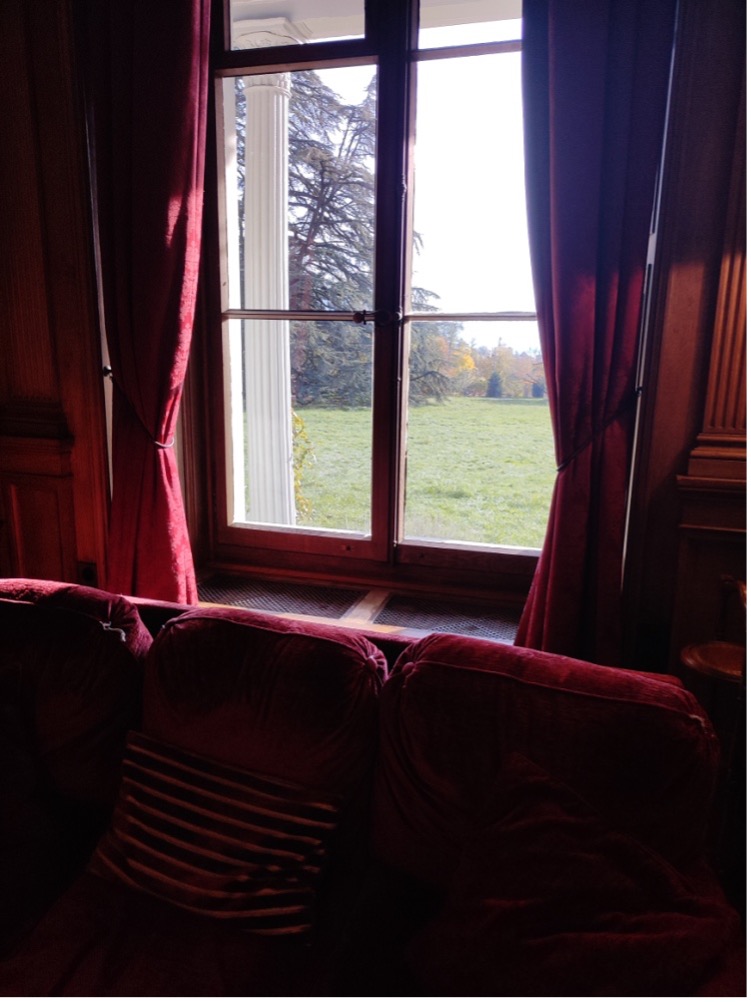
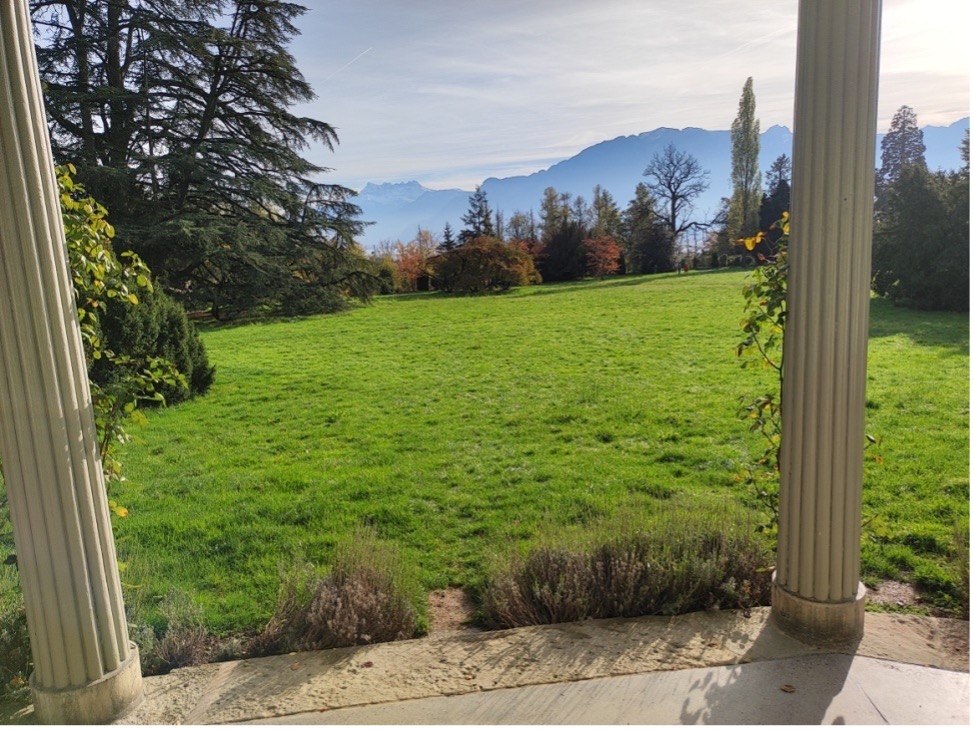
After a quick trip to Gruyere, I set off for Vevey. My heart started racing as I passed the town square in Vevey which had huge murals of Chaplin on some buildings. Finally, I entered the hallowed portals of the estate where Chaplin spent twenty-five years with his wife, Oona, and his children. Passing through his study in the main living quarters, as I entered the drawing room with its cosy sofas, I came across French windows which overlooked the massive grounds of the estate. I stopped to take a picture. Suddenly, my phone camera froze. I panicked. I tried to close the camera app and switch off my phone, but nothing worked. I thought, this was it, I won’t be able to take any more pictures to remind me of this special day. Dejected, I moved into the dining room. A lady guard came to me and asked me if I would like to write something in the visitor’s book, which I did, sitting down on a chair in the corner.
All this while I was feeling disappointed. Suddenly, I looked up to see a home video playing in a loop, of Chaplin enjoying a meal on a sunny day with family and friends. I thought to myself: Was this a sign? Was Chaplin saying, “Why are you obsessed with taking pictures? You have come so far to see my home; I want you to enjoy my estate, look at my work. Don’t let these modern gadgets rule your life. Slow down.Take it all in.”
The last images on my phone when it froze
I calmed down and went back to those French windows in the drawing room to take in the magnificent view of the estate grounds. A man walked towards me. I asked him if he could help unfreeze my phone. He suggested I switch it off and then on again. I did that, and voila! It worked. Though I was relieved when my phone came back to life, I realised that in those intervening ten-fifteen minutes when my phone was frozen, I was forced to take a breather, to reflect upon the beauty I was surrounded by, and all the blessings which make life worth living. And I went back to the study and foyer of the house to spend some more time reading more about the struggles, trials and triumphs of this great artist.
As I emerged from the main building, I thought of rounding off the visit with a leisurely walk around the grounds. Suddenly I noticed a sign which said “The Studio”. I had deliberately avoided researching on what the visit had to offer, so I decided to just go with the flow and enjoy whatever was on offer. There was a screen outside “The Studio” which said that a film screening was to start in nine minutes. I waited, and finally watched the film, a moving take on Chaplin’s life and work, with ten other viewers.
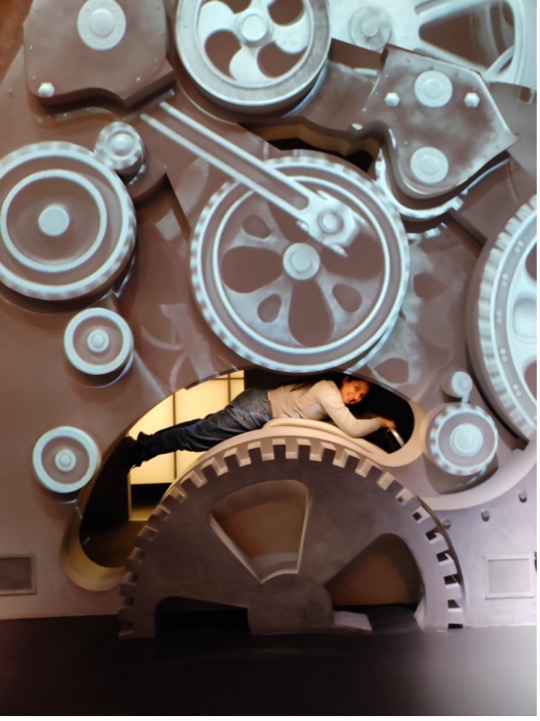
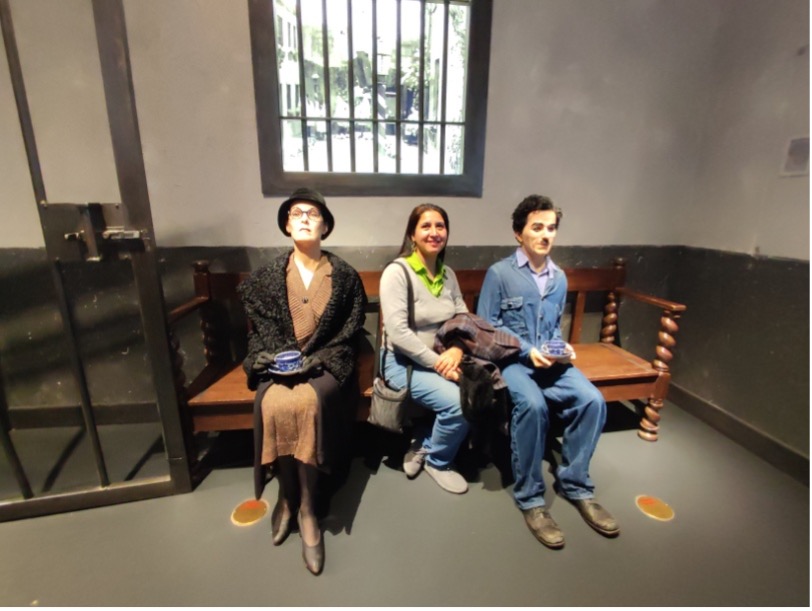
After the film ended, we were asked to move towards the screen. Suddenly, the screen disappeared and lo and behold, I found myself on a beautifully recreated set from The Kid. We were prompted to go behind the set, and to my bewilderment, what followed was one set after another – The Great Dictator, City Lights, Gold Rush, Limelight, A King in New York, whew! It was such a delight to go through those sets, to see the wax figurines, to sit on the chair from The Gold Rush with Charlie peeping from under a table, to pose next to Charlie in my own bowler’s hat, to sit on the jail bench next to him, to be swallowed by the giant machine from Modern Times. Mercifully, my camera behaved throughout the studio visit and I took many keepsake pictures. After a stroll through the beautiful grounds, I picked up some books, including Chaplin’s autobiography, and other memorabilia. I started reading the autobiography shortly after my visit and it reaffirmed my views about Charlie.
Inside The Studio
During my visit and afterwards, I got a lot of time to reflect upon how Chaplin’s films were deeply concerned with the human condition, with all the miseries and challenges brought upon it by events that the common man has no control over. Chaplin’s work includes The Gold Rush (1925), which drew from real-life events such as the Klondike Gold Rush and the Donner Party, and The Great Dictator(1940), a satire on Adolf Hitler. Limelight (1952), which depicted the frustration of a has-been comedian, can be classified as auto-fiction, as can The Kid (1921), while Modern Times has been hailed as an astute commentary on industrialisation. Levity was Chaplin’s forte, but all his films were deeply rooted in his political and social consciousness. More often than not, he had to pay a heavy price for sticking to his beliefs.
Recollecting the making of The Great Dictator, Charles says in his autobiography, “Halfway through, I began receiving alarming messages from United Artists … But I was determined to go ahead, for Hitler must be laughed at. Had I known of the actual horrors of the German concentration camps, I could not have made The Great Dictator; I could not have made fun of the homicidal insanity of the Nazis.”
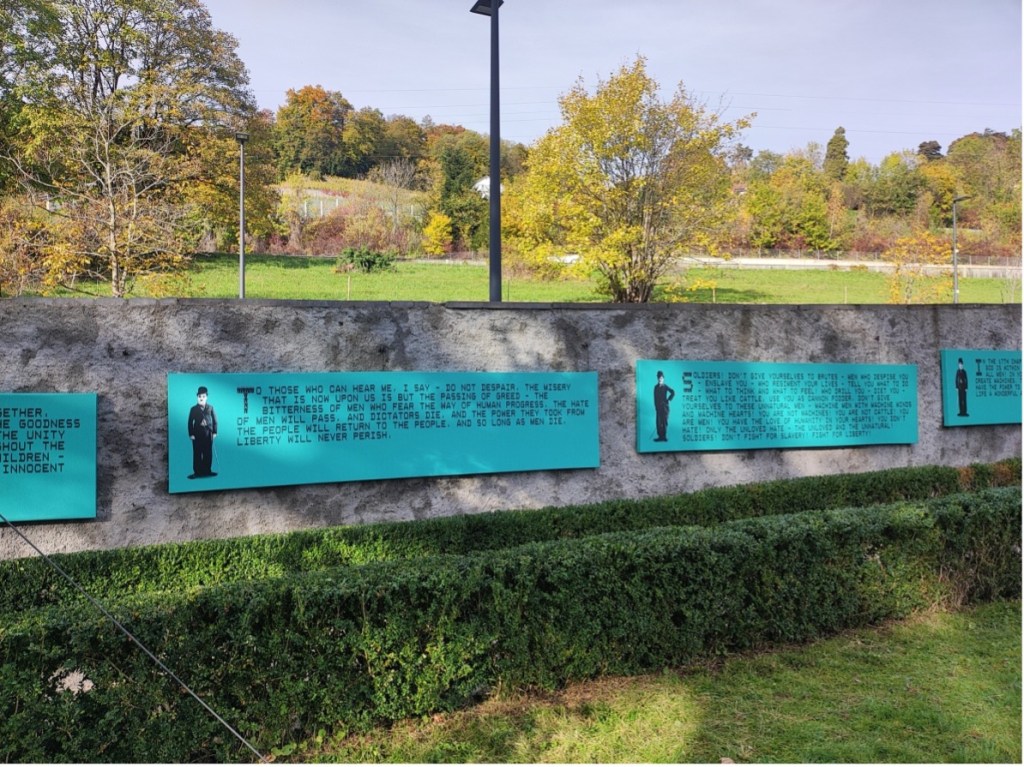
The boundary wall of the Manor de Bain. The sounds of cow bells from across the road drifted towards the estate, making for a mesmerising setting.
Chaplin was a genius who understood the power of the audio-visual medium. Since pantomime was his greatest strength, having performed bit roles in theatres during his childhood days of great hardship and penury, he used this technique to convey pathos through humour. Although he was earning quite well as a comedian-writer-director in Hollywood, by 1919, he was so frustrated with the studio system, which did not give him a free hand to write his own scripts, that he co-founded United Artists along with Douglas Fairbanks, Mary Pickford and D.W. Griffith.
His first major hit under his own banner was The Kid, which drew from his childhood experiences. So strong were his convictions about the silent film that he swam against the tide and released City Lights in 1931, well after talkies had completely taken over Hollywood. Slowly, he started warming up to the possibilities of sound in film. He used sound effects in Modern Times but no spoken dialogue. He composed and sang a charming ditty in gibberish, ‘Titine’,with some random words in French, Italian and English thrown in, for Modern Times which never fails to bring a smile to the face, even eighty-seven years after its release
Whether it was silent films or talkies, Chaplin continued to tell his stories of universal values, of hope amidst great suffering. As an artist, he never shied away from speaking truth to power. Like most great artists, he did not accept manmade boundaries. Although he was English by birth, he was criticised for not fighting in World War I. He had long arguments with Winston Churchill about Mahatma Gandhi and the struggle of the Indian people for freedom. In fact, he met Gandhi-ji shortly after meeting Churchill, during a trip to London, and questioned him at length about his abhorrence for machinery. He returned from the meeting with great admiration for Gandhi-ji’s strategies for achieving independence and his principles of non-violence and truth. His conversation with Gandhi-ji influenced his writing of Modern Times, especially the Gandhian theory about modernisation and rapid industrialisation being the cause of unemployment and rising inequality. The fearless artist once made an uncharitable remark about the English royalty, telling Churchill, “I thought socialists were opposed to a monarchy”, to which Winston Churchill replied, with a laugh, “If you were in England, we’d cut your head off for that remark.”
Being wary of the ways of Hollywood where an artist was judged by his or her success at the box office, he made few friends in the film industry. Chaplin was happy spending time visiting his childhood haunts on his trips to London, and also enjoyed wining and dining with film stars, princes and princesses, prime ministers and presidents, scientists, philosophers, poets and writers. He was friends with Mary and Douglas Fairbanks, Albert Einstein, George Bernard Shaw, H.G.Wells, Harold Laski, Aldous Huxley, Theodore Dreiser, et al. He went to Lucerne in Switzerland to meet India’s first prime minister, Jawaharlal Nehru, expressing his surprise at finding him “a small man like myself”. Chaplin invited Pt Nehru to his estate in Vevey for a meal. They had a long chat on the way, which left Chaplin impressed with the “…man of moods, austere and sensitive, with an exceedingly alert and appraising mind”.
Chaplin was a pacifist and a philosopher, and was derided for his views in America – not just mocked, but harassed by the FBI under its founding director, J. Edgar Hoover. In 1952, the country which has historically been considered the land of free speech hounded Charlie out of its borders under the mistaken impression that he was an avowed communist, and told him to never come back. Chaplin even narrowly escaped an assassination attempt in Japan.
Chaplin’s autobiography ends in 1964, on a poignant yet hopeful note, just like Charlie’s films, with Chaplin expressing his sadness at having to leave America, but also describing his happy days in Switzerland, where he befriended several artists who lived in the area. Eight years later, in 1972, Charles Spencer Chaplin was called back to America by the Academy of Motion Picture Arts & Sciences to receive an Honorary Oscar. After initial hesitation, Chaplin decided to attend the ceremony, which would end his twenty-year exile from America. He went on to receive an unprecedented standing ovation lasting twelve minutes. Cries of “Bravo!” filled the auditorium and Chaplin was clearly overwhelmed. It was an emotional homecoming for the man who had left Los Angeles in extremely unpleasant circumstances in 1952.
Chaplin was knighted by Queen Elizabeth II in 1975, but by then he was frail and had to accept the honour in a wheelchair. He passed away in 1977, but his legacy lives on. I hope cine buffs like me keep rediscovering him, for The Tramp is timeless.
(The photographs have been provided by the author, except for the book cover)
Nirupama Kotru is an officer of the Indian Revenue Service,1992 batch. Ms.Kotru has served in the Income Tax Department at Mumbai, Chennai, Delhi and Pune. On deputation, she served as Director (e Governance) in Ministry of Corporate Affairs and as Director (Films) in M/o Information & Broadcasting, where she looked after policy issues such as censorship, India’s participation in film festivals abroad, archiving, film schools and production of films.
As Joint Secretary in Ministry of Culture she has looked after prestigious national akademis such as Sahitya Akademi and National School of Drama, and national museums such as Indian Museum and Victoria Memorial Hall &Museum. She is presently posted as Joint Secretary& Financial Advisor, Ministries of Coal, Mines & Minority Affairs. She has released an album of bhajans called Upasana. She has also written around thirty articles on cinema and other topics such as parenting. She is currently co-authoring an anthology on Hindi cinema of the 1970s.
.
PLEASE NOTE: ARTICLES CAN ONLY BE REPRODUCED IN OTHER SITES WITH DUE ACKNOWLEDGEMENT TO BORDERLESS JOURNAL.
Santosh Bakaya interviews Tushar Gandhi, the great grandson of Bapu, after paying a brief tribute to the Mahatma
Gandhi (1869-1948) was assassinated on January 30th 1948. This was one of the last photos of him – sometime in 1947 when both, Gandhi and Nehru, apparently were appalled and concerned about the carnage resulting from the separation of India and Pakistan. This photo was published in Newsweek, Aug. 4, 1997. Courtesy: Creative Commons
Before I begin the interview, I would like to pay a small tribute to the great Bapu, the unarmed fighter, the environmentalist, the vibrant economic philosopher, who talked of Swadeshi and self- dependence long before the modern world is slowly waking up to its benefits, who emphasized a people -centered economy rather than a technology centred one, where we find individuals stripped off their dignity, becoming insignificant cogs in the machine. The plight of the migrant labourers during the current pandemic is branded on our collective consciousness, all because of a flawed-topsy- turvy model of development. Only if we had heeded Bapu’s call of making the villages self- sufficient and self- reliant.
Right from the time he refused to ‘cheat’ to correct the spelling of kettle in a class test during the visit of the school inspector, to the time he abruptly called off the Non-cooperation movement, due to violence at Chauri Chaura, well-aware of the repercussions that would follow, he shunned mendacity and violence. Belying his physical fragility, he managed to emerge as a strong moral icon. In a world torn asunder by war and violence, he succeeded in teaching many a world leader lessons in the powerful weapon of non- violence and truth, pitting soul force against brute force. The vulnerable Mohan, full of complexes, foibles, fears and phobias, a boy who was afraid of snakes, ghosts, multiplication tables, metamorphosed into the valiant, venerable Mahatma, [a sobriquet he did not feel comfortable with]. Under the seemingly frail façade, was a man who could flex his moral muscles and shake a comatose nation out of its languor. This unarmed warrior, went on to exemplify self- introspection, self -analysis, self- mastery, and a humongous moral power. Denigrated as the half-naked fakir by Winston Churchill, he was the very epitome of minimalism, but well- clothed in the raiment of love, compassion, fearlessness and forgiveness.
During the Dandi March, women from all sections of society- women who had never been part of public gatherings, women who had not stepped out of the four walls of the house, unlettered village women, poured out on the streets because he had very intelligently linked salt, a common kitchen ingredient to an uncommon call for freedom. Kamladevi Chattopadhyay valiantly stalked into the High Court premises, and while a stunned magistrate gaped, hurled a question at him whether he would like to buy “the salt of freedom”, she had prepared. Songs of freedom rang in the streets, women metamorphosed into human shields blocking the paths of policemen, facing lathi blows and even landing in jails. What do you call such a man – an intelligent strategist? Quixotic? Charismatic? A maverick? Was this not a coup of sorts?
Bapu’s strategy paid off and the Indians realized that throwing off the foreign yoke was not difficult, if heads are held high and spines, straightened. Gurudev Tagore told the Manchester Guardian of 17 May, 1930, “Europe has completely lost her former moral prestige in Asia.” Louis Fischer wrote in the chapter, ‘Drama at the Seashore’, in his biography of Gandhi, The Life of Mahatma Gandhi, “The British beat the Indians with batons and rifle butts. The Indians neither cringed, nor complained, nor retreated. That made England powerless and India invincible”– all because of a seemingly weak, five-foot five man, who sent quivers down the rulers’ backs by a handful of salt.
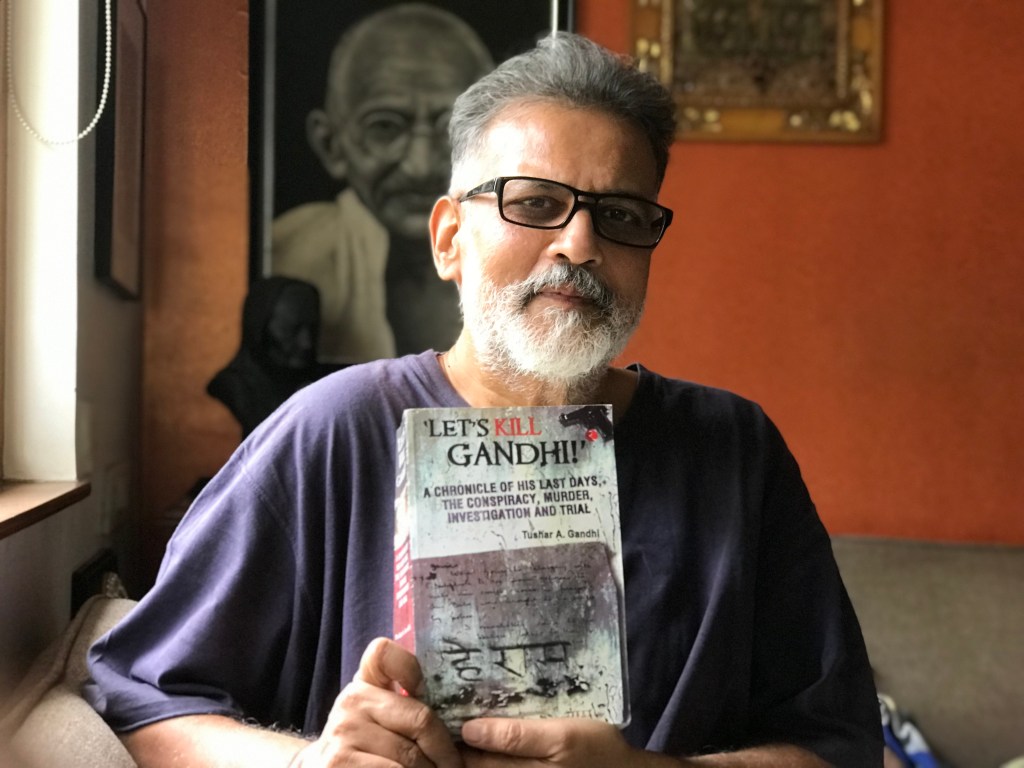
Tushar Gandhi with his book
In this interview with his great grandson, Tushar Gandhi , author of a book called Let’s Kill Gandhi(2007), chronicling the last days of his great grandfather, we hear more on Bapu and Gandhi-ism in the current world.
It is with a feeling of immense awe for the descendant of a great moral icon that I am here with my questions for you, Tusharji. If you remember, this is not the first time I am talking to you. It was in the year 2015 that I not just met you, but presented you my poetic biography of Bapu, Ballad of Bapu, for which you had graciously written the foreword. I remember being awe-struck by your unassuming demeanour coupled with a self-derogatory sense of humour, which your great-grandfather was also known to have had. Please tell us something about yourself, which we don’t know already.
I am an ordinary, simple person of limited abilities who is very lucky to be born a descendant of very illustrious ancestors. Life has taught me that greatness is not an inheritable quality it must be earned. I remember when a celebrity TV presenter Richard Quest was doing a series for CNN called ‘Quest for Greatness‘, he shot the concluding episode at Sabarmati Ashram and invited me to talk to him. His precept was whether places associated with greatness were the source of that greatness. He talked about the greatness of Bapu and about how the place attracted so many leaders of the world to visit it and be inspired by the place and the legacy of the person with whom the place was associated. He asked me if the fountain of greatness was at Sabarmati Ashram and was that the reason leaders visited it to partake of that greatness. My answer was yes, absolutely, sometimes the place inspires great actions and sometimes the aura of the great person associated with the place lingers on to inspire future generations. That draws them to the place.
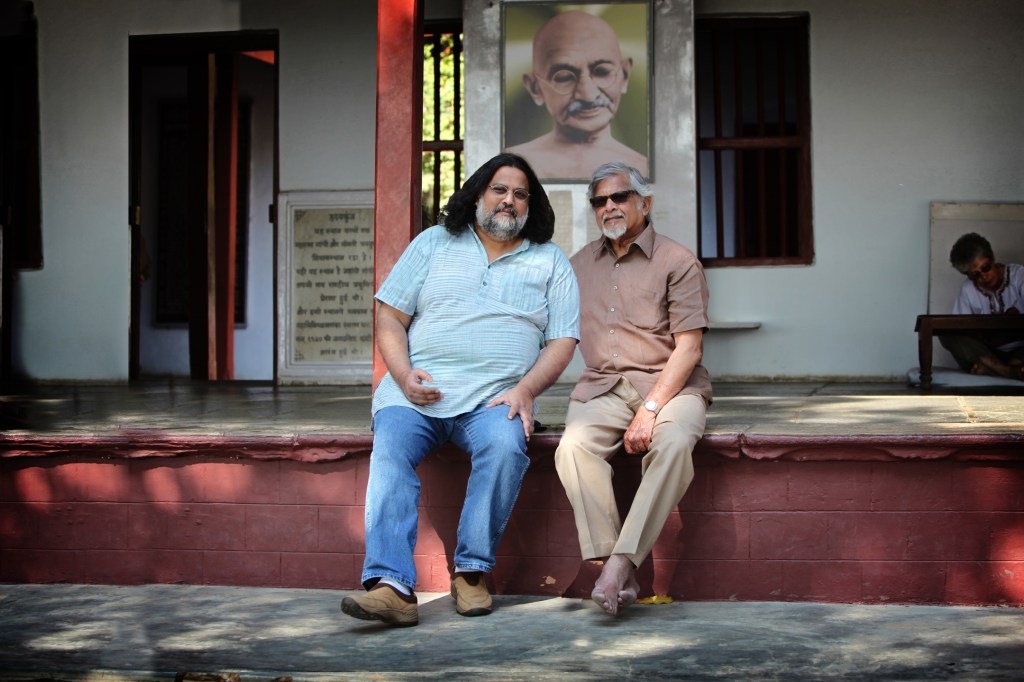
Tushar Gandhi with his father at Hriday Kunj Sabarmati Ashram
Yes, that is absolutely right. The lingering aura of a particular place cannot be shrugged off, and if it is a place associated with our beloved Bapu, it will always keep inspiring people. The fragrance that I inhaled on my visit to the Sabarmati Ashram, is something I can never forget. Its aura and extraordinary energy seems to cling to ordinary visitors.
Richard’s concluding question for the show was directed at me, he asked, “There is no doubt that Gandhi was great. Scientists believe that our nature and what we become is also hot-wired in one’s DNA, genes. Did Gandhi have the greatness gene? As his direct descendant have you, Tushar inherited that greatness gene?”
My answer was immediate and short, I told Richard, “Greatness cannot be inherited, it has to be earned.”
I am overweight, the result of an indulgent lifestyle. I am lazy, when you sent me these questions my first question was how long would you be willing to wait for my responses! I haven’t, as yet developed the courage to be absolutely truthful. I succumb to anger and passion. I am enslaved by the sense of taste, to delicious food. I am unable to reduce my requirements in life. I know Bapu would have disapproved of me.
So, I live within my limitations, aware of my short comings.
No one is perfect. We all have our fads, foibles, idiosyncrasies and shortcomings. Yes, I remember, seeing some pictures, of your early teens, in one of which you are even holding on to your pet dog. What were your dreams then? Were you awareof your monumental legacy? Were you curious to know more and more about your great grandfather?
Yes, Zendy was more of a brother than a pet. I loved him, poor chap was a bit of a cripple, he had very limited abilities in his hind legs and so he would drag himself around or we carried him around. As a child I was inspired by my mother’s brother. He was a pilot in the Indian Air Force. So, from very early childhood I wanted to become a pilot. As I grew older, I wanted to join the Indian Air Force and become a fighter pilot. I even sat for the NDA entrance exam, unfortunately I could not qualify and so abandoned those plans. But my desire to become a pilot was obsessive and so I never considered doing anything else and when that dream crumbled, I was left adrift, not knowing what to do. Finally at my father’s suggestion I joined the Printing Institute to do a diploma in printing, I qualified as a printer, but my heart was never in that work and so after several halfhearted attempts, I gave it up as a career.
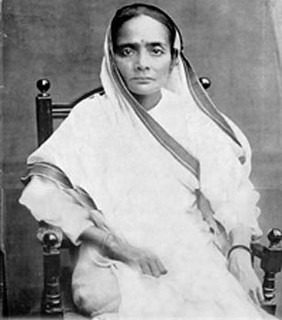
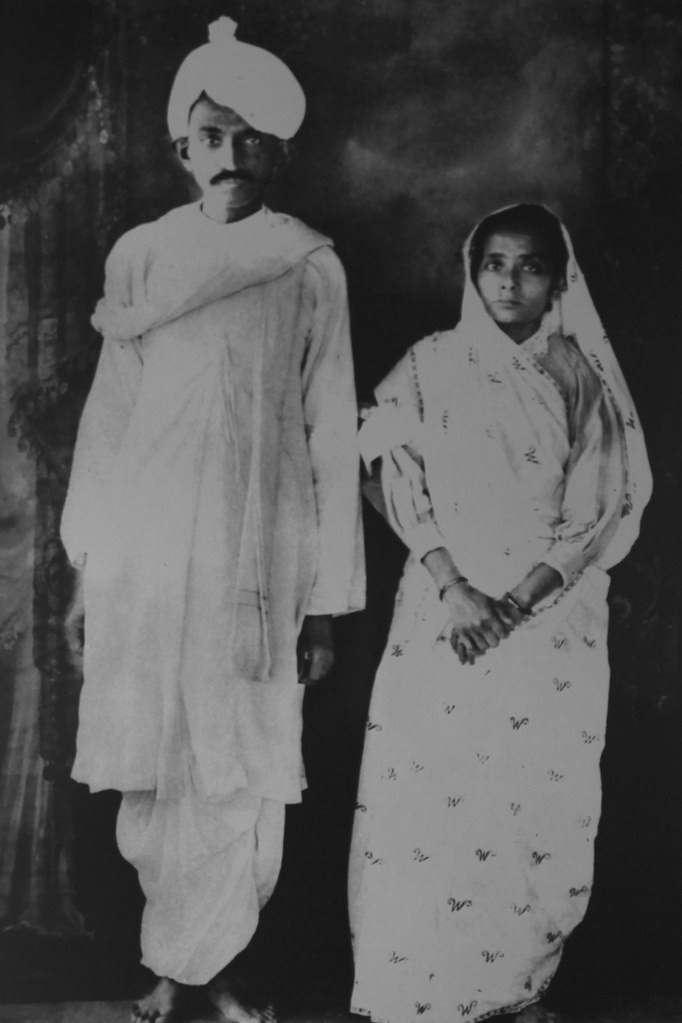
I don’t have any recollection of a moment or age in my life when I became aware of the legacy I had inherited. I feel I was always aware of the greatness of my ancestor, as I grew older, and my understanding increased the awareness about the greatness of Ba (Kasturba, Gandhi’s wife)and Bapu and my grandparents has grown and along with it my pride in the legacy they have bequeathed to me and with it the awareness of my limitations too.
I never had to request my elders about information about Bapu, I remember as a child my bedtime stories as told by my grandmother or by her sisters and cousins were almost always about their recollections of Ba and Bapu. As a child sometimes I would get fed up and throw a tantrum demanding to be told stories of kings and princes, fairies and princesses. But all I got were stories of Ashram experiences and anecdotes with Ba and Bapu. As I grew older, and my abilities of understanding evolved, I realised and understood the profound lessons those stories taught and the reason why my elders insisted on instilling those stories into my psyche.
My study of the ideals and the methods of Bapu continues. That is a lifelong never-ending quest.
We would love to know about your early life — your idols and heroes. Was Bapu also one of them? Are you also known for your candid, straightforward, hard-hitting words like your great- granddad?
My childhood, like me was very ordinary and unremarkable. I was a very average student someone who would have been diagnosed as being dyslexic, I am still spelling-challenged in all the languages I can write. If it wasn’t for the word processor software with their built-in spell checks I would never have been accepted as a writer, let alone a published author.
Were you a mischievous boy in school?
I was known to be a mischief maker and spent a record amount of time in detention. But it turned out to be a boon. In detention we were made to sit on a bench outside our principal’s office. The door of his curtain-less office always remained open, so he kept an eagle eye on all the benched ones.
The rule was that after we told him why we were on the detention bench, we had to go to the library, get a book and read it while sitting on the bench. I was so often on the bench that I got hooked to reading to such an extent that our school librarian when asked, why he was spending more than what was budgeted for library purchase, complained to our principal about how he had to keep buying new books because I had read all the books in the library.
This is hilarious! Your punishments turned you into a bibliophile!
The reading addiction grew so much that by my teenage years I was black listed by four libraries in our neighbourhood, because I had read through their collections of books!
In my childhood, shopkeepers used to keep paper bags made from pages of magazines and newspapers. I remember back home after the purchases had been put away, I would open up the bags and read whatever was printed on them, even though it was incomplete. My obsession with reading continues even today, now on laptops and smart phones, but I still prefer to read stuff printed on paper.
I had many idols during my childhood many still are, my ancestors, naturally. Revolutionaries too. Heroes from the folklore and history, sports icons, armed forces legends and martyrs. Those associates of my great grandfather I was fortunate to meet, Pandit Jawaharlal Nehru, C. Rajagopalachary, Maniben Patel, Khan Abdul Gaffar Khan, once and several others. They all left an indelible impression on my mind.
Since I am well- aware of my limitations I am not as honestly outspoken or frank as Bapu, but I am not known to mince words. Brash, is how I am more often described. But, as we live in a world of increasing hypocrisy, I have realized the need for plain speaking, so I too am becoming more and more outspoken.
To suit myself I have reinterpreted Bapu’s favourite three Monkeys from ancient Japanese and Buddhist lore who were actually four, Mizaru, who covers his eyes and sees no evil, Kikazaru who covers his ears and hears no evil, Iwazaru who covers his mouth and speaks no evil and the obscure fourth Sezaru who covers his lower abdomen and does no evil.
In today’s times I have reinterpreted them, feeling that they more appropriately convey the message: “Don’t shut your eyes and block out evil acts or crimes. Don’t close your ears so as not to hear a cry for help or to the bitter truth. Don’t shut your mouth and remain silent while evil is done, and hate is preached around you. And don’t remain indifferent against injustice, act against it decisively.”
I strongly believe Bapu would have adopted the fourth monkey too and reinterpreted all of them. It is no longer the time for polite and diplomatic talk, we need strong but honest words, not necessarily angry ones and most importantly, actions.
Very rightly said. In his very first public speech, on 4 February 1916, at the inaugural ceremony of Banaras Hindu University, because of his forthright words, Annie Besant had to plead, “Sit down Gandhi”, when he had ridiculed the highly bejeweled princes who were glibly talking about poverty. “Our salvation can only come through the farmer”. Don’t you think these words of Gandhi resonate today with a renewed vigour?
Yes, Bapu did fall foul of the organisers at the foundation stone laying ceremony of the Banaras Hindu University where he was invited to speak, as the hero of South Africa. When he criticised the bejeweled and pompously attired princes and the elite gathered there, Annie Besant who presided over the function, requested him to stop on several occasions.
When he started talking about swaraj (self-rule), the dignitaries on the dais staged a walk out and Ms. Besant called the meeting to a halt, but the student body gathered, insisted on listening to Bapu and trooped out of the venue and held an impromptu meeting on the open ground where Bapu continued his very ‘hard hitting’ and what was then dismissed as, impertinent ravings.
Yes, the students had applauded his candid utterances, saying Hear Hear! much to the discomfiture of the organizers and the princes.
The students were very fascinated by Bapu’s thoughts. It was after this that Bapu forayed into the Champaran Satyagraha, registering a decisive triumph over the colonial power, and gradually taking hold of the reins of the freedom movement.
There is a lot of dissatisfaction and frustration in our country and much that needs to be set right. To begin the process, we need a leader with Bapu’s ability of calling a spade a spade and yet not speaking in an offensive, insulting manner. India today suffers from a very dangerous epidemic of hate, it mustn’t and can’t be countered by counter hate. We must revert to Bapu’s method, honest, truthful words, yet not the language of hate and abuse.
India is witnessing an ongoing protest by farmers from northern states now almost a year old, there is discontent and despair in the entire farm sector, but it is being compromised by a general apathy towards their plight, today it is the farmers, tomorrow it will be another group of us, we must wake up and fight together, united.
Indeed, we need to yank away our comatose stupor, before it is too late. Bapu is said to have had a great sense of humour. Do you recall having heard any incident of Bapu which had tickled your funny bone immensely, as a child?
Bapu is reported to have said that ‘If it wasn’t for his sense of humour he would have gone mad.’ and also that ‘ If he did not have a sense of humour, the ability to enjoy the funny side of everything he would have been driven to despair and committed suicide.’ This is how much Bapu appreciated and valued humour. His humor used to be laced with sarcasm. When an American journalist asked Bapu what he thought about Western Civilisation, Bapu replied “It is a good idea!”
Yes, that witticism by Bapu never fails to bring a smile to my lips.
I recall a personal anecdote told by my grandmother. This happened in Sevagram, Wardha. Bapu received a request from a group of women village sevaks (workers), who wished to greet him on his birthday and spend 2nd October at the Ashram. Bapu welcomed them but said that he was a poor man and so they would have to bring their own meals and not burden the Ashram.
On 2nd October, they came to the Ashram early morning and participated in the activities of the Ashram. At lunch time when everyone at the ashram assembled at the dining hall, Kasturba noticed that the visitors were sitting under a tree, opening the cloth bundles they were carrying. She called my father and asked him why the visitors were not eating along with all the other residents of the Ashram? My father told her of the condition Bapu had laid down to permit the visitors to spend the day at the ashram.
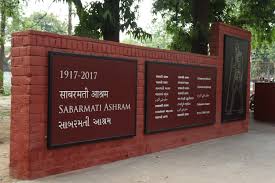
Sabarmati Ashram, Ahmedabad, Gujarat, where Gandhi evolved his ideology within India. Courtesy: Creative Commons
When Ba heard the story, she was very angry, she told my father to call the visitors to assemble in her kutir (hut), she would cook a meal and feed the guests. Unlike her husband, she refused to forget her dharma (duty) as a host. Ba hurriedly cooked Khichadi and fed them. This defiance of his order by Ba was reported to Bapu, everyone expected him to get annoyed and reprimand her. But he smiled, quipping, ‘At one time the British Queen listens to me, but my words hold no authority over Ba.’
A typical Bapu witticism! We have mutated into rodents, running the rodent derby in helter-skelter haste. How would Bapu have reacted to this rodent derby? Would he still have continued to walk alone – taking long strides towards self- discovery, advising\ rebuking people along the way?
Bapu would have warned us about our devolution into rodents. But he would not have just warned us about the evil, danger and unsuitability of our way of life, he would have presented humankind with an evolving alternative way of life and lived it himself. Walking alone was second nature to Bapu, he was so far ahead of his times that he had no option but walk alone, not intimidated by the unknown. Having said that, his belief in the omnipresence of God was so deeply entrenched that he never considered himself to ever be alone.
Please tell us something about yourself as a student, were you obedient and disciplined? How did your peers and teachers treat you? Did you have a rebellious streak in you?
I was a very average student. In our times we were expected to be obedient, and we too believed that we should be obedient, so I also obeyed my elders and teachers. I was only nominally disciplined, there was a rebellious streak in me, muted most of the time, but it did manifest itself from time to time.
Please tell us something about Bapu’s walking habits. He shunned physical classes in school, but later did a lot of physical labour, becoming a very agile walker. “The modern generation is delicate, weak and much pampered.” He said during the Dandi March and walking less than twelve miles a day, he considered, “child’s play”. How did he become such a sturdy walker?
Bapu acquired the habit of walking far and fast in South Africa. He used to compete with his friend Herman Kallenbach to see who walked the longer distance and who was faster than the other. This became a daily lifelong habit and when at the age of 61 he lead the Dandi March, others much younger than him had to run to keep pace with him. There is a very iconic photograph of a child holding on to Bapu’s walking stick and seemingly pulling Bapu along.
Yes, I have seen that iconic photograph.
The child is Bapu’s grandson Kanha, who lived with him when Bapu was briefly staying at Juhu in Bombay. Every evening Bapu would insist that Kanha accompany him on his walks on the beach. Kanha walked very slowly, so, to make him walk faster, Bapu used to push him ahead of him with his walking stick. Over the years some dexterous photo retouching artists touched up the photo to appear as if the child was pulling Bapu along. Bapu had a very long stride which also added to his speed of walking.
Bapu was a staunch supporter of women empowerment, but in the Dandi March, if I am not mistaken, among the 78 handpicked volunteers, who accompaniedBapu on the 240-mile march which lasted 24 days [12 March to 6 April 1930], only a few women joined the retinue from the Sabarmati Ashram to Dandi, other women only joined him later. Did this issue not become a bone of contention among the women?I recall having read that powerful women like Kamladevi Chattopadhyay, Sarojini Naidu and Perin Captain (the granddaughter of Dada Bhai Naoroji) were displeased that they were not part of the handpicked retinue, strongly venting their ire, saying that they would not be satisfied merely by picketing shops. But yes, I remember Sarojini Naidu becoming a part of the March during the last stretch to Dandi, and raising a fistful of salt on 6 April,1930, and saying, “Hail Deliverer”.
There was a reason why Bapu refused to allow women to accompany him on the Dandi March. His objective was to provoke the Colonial Government to deal harshly with him. Threats were also made against the Satyagrahis, news was leaked that the Government would unleash a regiment of Pathan Sepoys to beat them and disrupt the march, not even sparing Bapu. Sardar Patel was arrested a week before the March was to begin and locked up in Sabarmati Prison. This was a warning to Bapu. Bapu wanted such harsh responses. He knew that if women accompanied him the Colonial Government would claim that Gandhi had taken women along as protection.
Gandhi leading the Dandi March, 1930. Courtesy: Creative Commons
He knew that the ‘gentlemanly’ colonial government would not harm women and so he had insulated himself from reprisals by hiding behind a protective shield of women. So Bapu decided that women would not accompany the marchers, hence they were not allowed to accompany him and his handpicked companions on the March from Sabarmati to Dandi.
There was a lot of discontent among the leading women Satyagrahis of that time, and they protested against Bapu, but they obeyed him too.
After he picked up salt at Dandi and broke the law on 6th April 1930 they demanded that now they must be allowed an equal opportunity to participate in Satyagraha in the front lines of Satyagrahis. Sarojini Naidu and Mithuben Petiet welcomed Bapu at Dandi. Eventually a Women’s Conference was held at Dandi and addressing the attendees, Bapu ordered the women to participate in the Satyagraha from then on.
Bapu used symbols very powerfully. Symbols such as minimal clothes, charkha(spinning wheel), salt, khadi were very effectively used by him for mass mobilisation. We would like to know something from you about his strategic use of symbols.
Bapu was a master communicator throughout his campaigns, first in South Africa and later in India, he utilised the power of symbolism to a great advantage. Bapu’s use of symbols and gestures was unlike the very artificial and dramatic use of symbolism, by the ‘leaders’ of today. He used them in a much more honest, sincere and believable manner. After deciding to embrace poverty when he was one of the most prosperous Indian lawyers in South Africa, Bapu chose to live simply to identify with the poor Indians he was leading and living amongst at the Phoenix Settlement. Yet he continued to wear the western attire of a gentleman.
It was only towards the end of his struggle in South Africa after a few Satyagrahis died during the Satyagraha and as a result of the brutal incarceration they were subjected to, that Bapu discarded the western attire and appeared in public dressed as what was then contemptuously described as the dress of a ‘Coolie’. When he arrived in India in 1915, he had started dressing in an elaborate costume of a Kathiyavadi gent. The dress of his home region in India.
In Champaran and before that during his year and half long travels to discover India, Bapu came face to face with the abject poverty of its populace and it was then that he began dressing less. Finally, it was when he saw the farmers of Madurai toiling in the fields, dressed merely in a brief loin cloth, that he discarded the kurti that he wore and adopted the attire of a mere loincloth to identify with the people he wanted to lead.
Yes, that is what riled Winston Churchill and he commented adversely on his attire.
Yes, it was this that bugged Winston Churchill and when Bapu visited Buckingham Palace to have tea with the royalty dressed similarly, Churchill called him ‘the half-naked Faqeer’. When Bapu was questioned by a reporter as to whether he would be dressed as he always did if he was invited to meet the Emperor he had replied that if he dressed up in any other manner he would be dishonest and disrespectful towards the Emperor.
The charkha to him was not just a symbol but a tool for the rejuvenation of India’s traditional crafts and village industries, he used it as a symbol of his idea of the ideal ‘industrial’ revolution in India’s villages he wished to usher in.
Salt was one of his most brilliant and evocative symbolisms, which he turned into a symbol of the British oppression of the masses of India. Their suffering and their aspirations for freedom, dignity and existence. It caught the fancy of the people of India and the attention of the entire humanity.
It goes without saying that through the powerful use of symbols and symbolic language, he was able to drive many a point home. Could you throw some light on his relationship with Kasturba? Both were married at the age of thirteen, and both grew together, and all of us know that Ba’s death devastated him completely. Obviously, with his obstinate ways, he was definitely not an easy man to carry along with. Yet, she was the moral strength behind him.
Ba was Bapu’s anchor. Throughout his evolution he has acknowledged her as his teacher of several important lessons, one of them being Passive Resistance.
Ba had the unenviable task of living with him as he transformed and surviving each of his catharsis. She not only survived but carried the family with her- immediate family initially, her growing sons and then the extended ashram family as she learnt to accept all of them and started feeling responsible for them.
Initially tumultuous, at times it was difficult to believe that their relationship would survive. But what Bapu wrote to the Viceroy and Lady Wavell replying to their message of condolences on Ba’s death, illustrates the depth of their relationship, showing how much Bapu relied on Ba. I quote:
‘I send you and Lady Wavell my thanks for your kind condolences on the death of my wife. Though for her sake I have welcomed her death as bringing freedom from living agony, I feel the loss more than I thought I should.
‘We were a couple outside the ordinary. It was in 1906 that after mutual consent and after unconscious trials we definitely adopted self-restrain as a rule of life. To my great joy this knit us together as never before. We ceased to be two different entities. Without me wishing it, she chose to lose herself in me. The result was she became truly my better half. She was a woman always of very strong will which, in our early days, I used to mistake for obstinacy. But that strong will enabled her to become quite unwittingly my teacher in the art and practice of nonviolent non-co-operation.’
One does not require to say any more.
Do you not find it a daunting task to carry forward the legacy of Bapu?
It is daunting but I have always lived within my limitations, and I don’t bother to live up to the expectations of others, this has made it easier to live with such a ‘heavy’ legacy. I have always considered the legacy I have inherited as a boon and so I have never felt it a burden.
It was Martin Luther King Jr who had said, “Gandhi was perhaps the first person in history to lift the love ethic of Jesus above mere interaction between individuals to a powerful and effective social force on a large scale”, which is indeed the truth. There is no denying the fact that it is a dystopian world that we are living in, where all are caught between the harsh tones of hatred and the insidious currents of revenge and rancor. How can non-violence again be revived as an effective social force?
Even in the past, we have lived in the age of hate, prejudice and strife; family relationships too have become fragile due to this but it’s not entirely a new phenomenon. When Bapu arrived in India, one of the first things he realised was the disunity between Hindus and Muslims due to distrust and hostility. He concluded that to effectively fight the colonial power he had to unite the two religious groups, and he set about working diligently towards it by igniting the passion for freedom in every heart.
He achieved his objective, but the glue was tenuous, and as independence became a reality, it rapidly deteriorated and the traditional distrust and hostility resurfaced. Hate and violence took center stage in 1946. Bapu realised that he had lost his dream in his hour of triumph. In 1946-47 and the first month of 1948 , insanity prevailed in India and the newly-created Pakistan.
It was only Bapu’s murder which shocked Indians and restored sanity for the time being. That sanity lasted for the first fifty years of its existence because of compassionate leadership and the memory of the sacrifice of Bapu. But then opportunist ‘leaders’ stepped into the forefront and unleashed a campaign of untruths and communal hate. The venom has now permeated to our cells and altered our very DNA, and we see its manifestation in every aspect of our existence. Unfortunately, now there is no Gandhi to jolt us back to sanity by sacrificing himself. Even if one was to emerge, I don’t think we collectively deserve such a deliverer.
Yes, we indeed need Bapu to remerge, and pull us back to sanity. Tell me, can walks for peace change mindsets? What triggered the idea of the re-enactment of the Dandi March? I remember, it was the year 2005, the 75th anniversary of the March I was in my MPhil class, and the news of the reenactment of Dandi March was very much in the air, and my students were hurling questions after questions at me – most of them laced with cynicism. Can you tell us something about your experience during these marches? I remember seeing pics of the March where one man was dressed like Bapu. How did this image of Gandhi impact the people?
My reenactment of the Dandi March in 2005, in its 75th anniversary year, was a personal challenge and a token gesture of response to the violence of 2002 the state had endured. That is why I went out of my way to invite the participation of a group of Pakhtoon Khudai Khidmatgaar, descendants of the legacy of Khan Abdul Gaffar Khan. It was a privilege to walk alongside the almost 100 Red Shirts from Pukhtoon Khwa in Pakistan and watch the people of Gujarat warmly embrace them and invite them into their homes.
The personal challenge was that three of my ancestors had walked the entire route in 1930: my great grandfather, Bapu, my grandfather, Manilal and my uncle, Kantilal. It always felt challenging to me. I wanted to test if I had it in me to walk the distance. I was always the proverbial ‘Couch Potato’, so, it was an intimidating task. After putting it off several times, I decided to take the plunge. None who knew me, believed I would complete the journey. On several occasions during the March, I wanted to give up mid-stride, the agony too excruciating. Then I visualized walking with Bapu, imagining his walking stick pushing me along and it gave me the strength to complete the walk-first that day’s walk and then the entire 241 miles.
There were several people who dressed as Bapu during the March, but one had a remarkable resemblance to Bapu, and it was very inspiring, walking the entire distance, barefeet!
That was indeed a commendable feat. Gurudev Tagore, who was deeply revered by Bapu, happened to be in the vicinity of Sabarmati Ashram on 18 January, 1930, and paid him a visit. When asked what plans he had for his country in 1930, Bapu remarked, “I am furiously thinking night and day, and I do not see any light coming out of the surrounding darkness.” But then the Inner Voice spoke to him, and light came in the form of the iniquities of the Salt Tax, and he decided to embark on the path of Civil Disobedience. What exactly was the nature of this Inner voice, for him?
For Bapu his inner voice was his conscience keeper. He acquired the ability to hear it after much effort. Once he began hearing the ‘still faint voice’ it became his search light, it guided him, showed him the direction and illuminated his objective.
Bapu was not against technology as such, but he was staunchly convinced that our education system bred mediocrity. What would he say about the education system of today?
Bapu had rejected the western education system outright as unsuitable for Indian needs. He believed it till his end, begging with his sons in South Africa and then in his Ashrams in South Africa and India he developed a new system of basic education that he believed would cater to the varied needs of India. It was based on the principle of Enlightening the mind, Awakening theheart and Empowering the hands. He named his model of Basic Education Buniyadi Talim and then Naee Talim.
True to his brutally honest utterances, he would have termed the education system in India today as a curse on India and Indians and would have crusaded to destroy it completely, at the same time, offering a more suitable sustainable alternative.
We are witnessing that our basic education model has completely failed and only churns out substandard students, worth next to nothing. Same is the case with the higher University education system. Upon graduation, students realise that their ‘qualifications’ are worthless, they are not able to get jobs which their parents were able to secure upon graduation. Even with professional degrees, it is the same. Engineers acquire a degree in Management even after specialising in a field of engineering, even after a masters. Doctors study for super specialisation after specializing to enhance their earning ability. Education from being a medium of enlightenment has been reduced to merely being a means of earning. That is the resounding failure of education system the world over, but starkly so in India.
Yes, it is indeed pathetic. If you happen to meet him again, what would your first question to him be? Any niggling doubt that you would want to clarify?
If I were to have an opportunity to meet Bapu now, my question to him, even though I know what his answer would be is, “Bapu, how may I seek revenge for your murder?” My biggest regret is that I did not get to learn from him and so the rest of the time I would sit patiently and absorb whatever he thought I needed to learn. I would not waste my time in asking questions.
In this era of Instant gratification, truth and honesty have become outdated. How would Bapu react to the WhatsApp forwards, short cuts, cutting corners, passing the buck and the inhumane behaviour of the human beings that have become so much a part of the present socio- political- psychological ethos?
Bapu would have rejected it all and made a bonfire of all of it.
Do you think Bapu was a disillusioned man in the last days of his life? On 14\ 15 August 1947 midnight, when the thrilling words of Nehru’s epochal “Tryst with Destiny” speech rang through a free India, sheathed in a celebratory fervor, a frail but morally strong man, lay on a frayed mat in Beliaghata in Calcutta praying, fasting and relentlessly spinning, considering the partition ‘a spiritual tragedy’, ruing the vacuity of such a freedom, but still not losing faith in humanity. Mulling over many things– if he had erred somewhere, maybe he could set it right, somehow? What do you think were the issues that were going on in his mind that day?
The last years of his life were tragic for Bapu, as he had faced betrayal, he felt abandoned, cast away by those he had trusted. He saw the true nature of his people, his countrymen and women, whom he had assumed he had transformed. But his personal grief would have been enhanced because for all the things he saw going wrong with his people and in the nation, he had helped liberate, he would have blamed some weakness of his own character some flaw in his actions and he would have been harsh on himself. That was the greatest agony he had to endure.
On the first Independence Day, he pondered over his anxieties but continued to work to set things right and guide his people back on the right path and to do penance for everything wrong, that he blamed himself for.
After India won freedom, in a message to the cabinet of ministers of West Bengal, he wrote, “From today, you have to wear the crown of thorns. Strive ceaselessly to cultivate truth and non-violence. Be humble. Be forbearing… Do not let yourself be entrapped by its pomp and pageantry. Remember, you are in office to serve poor in India’s villages.” Humility is needed like never before. Is the India that we see today the India of his dreams? Are the poor in India’s villages being served?
India became Independent on August 15, 1947. But it never achieved ‘Purna Swaraj’ that Bapu had aspired for, 75 years later it still hasn’t.
I quote Bapu to show what he believed ‘Purna Swaraj’ was. In 1925, in the issue of Young India of 29th January he wrote. ‘Real Swaraj will come not by the acquisition –of authority by the few but by the acquisition of the capacity by all to resist authority when it is abused. In other words, Swaraj is to be obtained by educating the masses to a sense of their capacity to regulate and control authority.’
Then again writing in the April 16, 1931 issue of Young India, Bapu said, ‘ Let there be no mistake what Purna Swaraj means. It is full economic freedom for all the toiling millions it means no unholy alliance with any interest for their exploitation. Any alliance must mean their deliverance.’
One does not need to illustrate how far India has diverged from Bapu’s concept of Purna Swaraj for his people. Today those he commanded to become servants of the people have become their Overlords.
Martin Luther King Jr. had pointed out, “He lived, thought and acted, inspired by the vision of humanity evolving toward a world of peace and harmony. We may ignore Gandhi at our own risk.” Ever thought of recreating a New India based on Bapu’s principles, with you heading it?
I am not capable of the task. I have admitted my short comings right in the beginning and once again let me remind you ‘Greatness cannot be inherited it has to be earned’.
It was an absolute honour interacting with you and getting to know a lot more about you and Bapu. Immensely grateful for this enriching and enlightening discussion. Thanks for your precious time.
The pleasure and privilege are mine. Thank you.
.
Dr. Santosh Bakaya is an academician, poet, essayist, novelist, biographer, Ted Speaker and creative writing mentor. She has been critically acclaimed for her poetic biography of Mahatma Gandhi [Ballad of Bapu]. She has more than ten books to her credit , her latest books are a biography of Martin Luther King Jr. (Only in Darkness can you see the Stars) and Songs of Belligerence (poetry). She runs a very popular column Morning meanderings in Learning And Creativity.com.
.
PLEASE NOTE: ARTICLES CAN ONLY BE REPRODUCED IN OTHER SITES WITH DUE ACKNOWLEDGEMENT TO BORDERLESS JOURNAL








 Borderless