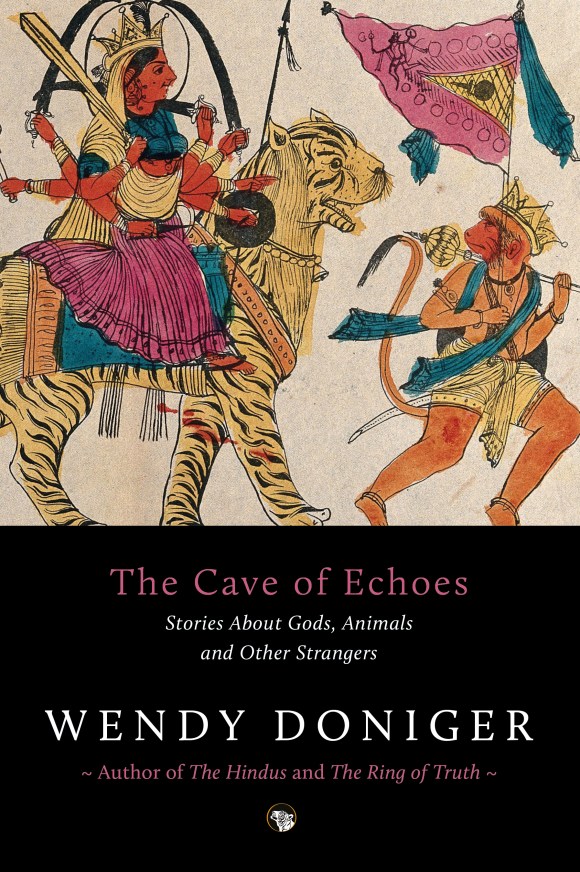
Title: The Cave of Echoes: Stories about Gods, Animals and Other Strangers
Author: Wendy Doniger
Publisher: Speaking Tiger Books
It is impossible to define a myth, but it is cowardly not to try. For me, the best way to not-define a myth is to look at it in action, which is what have tried to do throughout this book: to see what myth does, rather than what myth is. It seems to me that by the time you’ve defined your terms in an argument, you’ve lost interest in the problem. But at this point, as we begin to reexamine our own assumptions about myths, it might be useful to list some things that I think myths are not: myths are not lies, or false statements to be contrasted with truth or reality. 1bis usage is, perhaps, the most common meaning of myth in casual parlance today. Indeed, other cultures, too, call myths lies. The Malagasy end the recitation of any myth with a traditional tag-line: “It is not I that lie; this lie comes from olden times.” In our culture, in particular, myths are often given the shadowy status of what has been called an “inoperative truth,” when in fact they might better be characterized as operative fictions. Picasso called art a lie that tells the truth, and the same might be said of myths.
What a Myth Is and Is Not
The desecration of the word “myth” to mean “lie” began with Plato, who contrasted the fabricated myth with the true history. It is, I think, an irony that our word for myth in most European languages, together with our basic attitude to myths, comes from ancient Greece, one of the very few cultures in the world from which we have almost no example of real, live myths, of myths as a part of a vital tradition; by the time most of the Greek myths reach us, they have been so thoroughly reworked in artistic and philosophical forms that they are mythological zombies, the walking dead. Plato was, as Eliade pointed out long ago, the first great demythologizer; he “deconstructed” the myths of Homer and Hesiod. It was Plato who challenged, successfully, the status of the poetic myth-carvers and myth collectors and banished them from his Republic. We can see in Plato a spectrum of mythmakers: at one end are anonymous wet nurses, who transmit the old myths to helpless infants; at the other end are the poets, like Hesiod and Homer, the “mimetic clan” who cannot imitate the true forms since no one has ever seen the forms and the poets can only imitate what they have seen.
Plato warns us that we must not tell these poetic myths about the gods even if they are true; in this, I think, he affirms the power of myths to influence human life; for he fears that a bad myth will make a bad life. (We shall see, in chapter 6, other Greek arguments against the evil effects of the myths in Greek tragedies.) Moreover, it is hard to escape from this image of the bad life; the stories that we learn in childhood have a marvelous hold on our memory.
Yet it is necessary for people to believe in good myths, even if they are false; this is the argument that Plato advances for the “noble lie” (gennaion pseudos) in the Republic, the statement that distorts an outside surface in order to convey an inner truth. Some of these good myths come from the old days; Plato distrusts this sort of “mythologizing,” the stories about centaurs and Chimaeras and Pegasus and so forth, but he distrusts even more the people who analyze them away as metaphors for the North Wind and so forth ( anticipating Friedrich Max Miller by some twenty-four hundred years); such analyses are altogether too clever and waste an awful lot of time. 13 People do have to have myths, Plato concedes; if they don’t believe in the old ones, we must construct new ones for them, logically, and this is very difficult to do, for we must convince them, in the cold light of reason, of the truth of the myths in order to make them accept the laws that we wish to give them:
“How can one assert in cold blood that the gods exist? Because we must hate and find unbearable those who, today as in the past, due to having refused to allow themselves to be convinced by the myths related to them since earliest childhood by a mother or a nurse giving them the breast, have obliged us, and still do so, to develop the arguments which take up our time now.”
For this reason, despite his opposition to myths and mythmakers, Plato himself was also a great “remythologizer” who invented the drama of the philosophical soul and made it a new kind of myth, a reasonable, logical, “likely” myth, to challenge the old myths of centaurs and so forth. In this way, when it came to myth, Plato managed to hunt with the hounds and to run with the hare. As Marcel Detienne has put it: “Plato’s work marks the time when philosophy, while censuring tales of the ancients as scandalous fictions, sets about telling its own myths in a discourse on the soul, on the origin of the world, and on life in the hereafter.” It was Plato who transformed ancient mythic themes to make the myth of Er, the myth of Eros, and the myth of the creation of the universe. Though Plato’s “likely or resembling story” can be a myth in the sense of a narrative ( and in that sense is interchangeable with logos meaning “narrative”), it is not a myth in the negative sense of a bad copy, like the myths of Homer ( which are negatively contrasted with logos meaning “reason”).
Yet Plato does apply the word “myth” ( mutbos) to the story of the world that he creates in the Pbaedo, a myth that he says is “worth hearing,” though it is merely another “likely story”:
“Now, to assert vehemently that things like this are really so as I’ve narrated them, doesn’t befit any man of sense. But that this is so, or something pretty much like it, about our souls and their dwelling place, since it is clear that the soul is immortal-it is quite fitting that we say that. “
The likely story is not the truth; but it resembles the truth, and is as close as we can ever get to the truth about certain subjects. Plato confesses that he resorts to telling myths, despite the fact that such stories are not literally true, because there is no other way of using words to produce even the effect of truth.
Plato regards the myth that he constructs in the Pbaedo as an essential vehicle for salvation, a kind of religious or magic charm:
“It is well worth running the risk that these things are so for anybody who thinks them so. (For it’s a fair risk.) And he must recite these things over and over to himself like a magic charm, even as I at this moment and for a long time past have been drawing out this myth.”
Plato ends the Republic with his own myth, the myth of Er, which he certainly does not regard as a lie: “And so the myth was saved and was not lost, and it will save us, if we believe it, and we shall safely cross the river of Lethe and we will not sully the soul. “
For Plato admits that a myth says something that cannot be said in any other way, that cannot be translated into a logical or even a metaphysical statement. A myth says something that can only be said in a story.
Which brings me to what I think a myth is. Let me begin with a rather cumbersome and rather functional definition: A myth is a story that is sacred to and shared by a group of people who find their most important meanings in it; it is a story believed to have been composed in the past about an event in the past, or, more rarely, in the future, an event that continues to have meaning in the present because it is remembered; it is a story that is part of a larger group of stories.
The assertion that a myth is a story is basic to my argument; for I think that the myth is persuasive to us because the action itself is persuasive. Even when what happens in the myth is not physically possible in this world ( as when, for instance, a man turns into a fish), when the event is described in detail, as something that happened, we can see it happening, and so it enlarges our sense of what might be possible. Only a story can do this.
About the Book
The Cave of Echoes celebrates the universal art of storytelling, and the rich diversity of the stories—especially myths—that people live by. Drawing on Hindu and Greek mythology, Biblical parables, and the modern mythologies of Woody Allen and soap operas, Wendy Doniger—renowned scholar of the history of religions—encourages us to feel anew the force of myth and tradition in our lives, and in the lives of other cultures. She shows how the stories of mythology—whether of gods, sages, demons or humans—enable cultures to define themselves. She raises critical questions about how myths are interpreted and adapted, and the ways in which different cultures make use of central texts and traditions. Drawing connections across time and place, she proposes that myths are not static beliefs but evolving narratives, and that by entering into other cultures’ stories, we may unexpectedly rediscover our own.
Written with scholarly depth and characteristic wit, this is a landmark work in the comparative study of mythology. It’s essential reading for anyone interested in how we understand others—and ourselves—through the stories we tell.
About the Author
Wendy Doniger is the author of several acclaimed and bestselling works, among them, The Hindus: An Alternative History; Hindu Myths; The Ring of Truth; Women, Androgynes and Other Mythical Beasts; Dreams, Illusion and Other Realities; Winged Stallions and Wicked Mares; An American Girl in India; and translations of the Rig Veda and the Kamasutra (with Sudhir Kakar). She is Mircea Eliade Distinguished Service Professor Emerita of the History of Religions at theUniversity of Chicago, and has also taught at the School of Oriental and African Studies, University of London, and the University of California, Berkeley.
PLEASE NOTE: ARTICLES CAN ONLY BE REPRODUCED IN OTHER SITES WITH DUE ACKNOWLEDGEMENT TO BORDERLESS JOURNAL
 Borderless