Categories
Poetry

The Girl Who Went Fishing

By Biju Kanhangad

(Translated by Aditya Shankar)

Beneath the blue waterline,

father’s catch basks in the sunlight: a fish.

The gray-black of crows shroud the pale oar.

Reddish crabs reach the shore, transcending

the festered basket discarded by mom.

In the houseboat, the yellow flowers on

the worn rouka* are still wet.

Unable to submerge the shark, remnants of

the blue spreads into the sky, bawls.

*Bodice in Malayalam, can also be used to see connections

Biju Kanhangad is a poet, painter and post graduation in Malayalam literature. In 2005, he represented Malayalam in the national poetry seminar conducted by Sahitya Akademi. He was awarded the Mahakavi P poetry prize (2013), Moodadi Damodaran prize (2015), Joseph Mundassery Memorial Award (2017), Thamarathoni Kavita prize (2020) and other awards of repute. Thottumumbu ManjayilayoKanhangdu, Azhichukettu, June, Ucha Mazhayil, Vellimoonga, Puliyude Bhagathaanu Njanippozhullathu, Ullanakkangal, Ochayil Ninnulla Akalam, Mazhayude Udyanathil are his anthologies of poems. Essays: Vaakinte Vazhiyum Velichavum, Kavitha Mattoru Bhashayaanu. His poems have been translated into English, Hindi, Kannada, and Tulu.   

Aditya Shankar is a Pushcart and Best of the Net nominated Indian poet, flash fiction author, and translator. His work has appeared in international journals and anthologies of repute and translated into Malayalam and Arabic. Books: After Seeing (2006), Party Poopers (2014), and XXL (Dhauli Books, 2018). He lives in Bangalore, India.
Categories
Poetry

New York & more…

Poems by Pavol Janik, a virtusoso of Slovak Literature

(translated by James Sutherland Smith)

PAVOL JANIK | VIRTUOSO OF SLOVAK LITERATURE 


NEW YORK 


In a horizontal mirror
of the straightened bay
the points of an angular city
stabbing directly into the starry sky.

In the glittering sea of lamps
flirtatious flitting boats
tremble marvelously
on your agitated legs
swimming in the lower deck
of a brocade evening dress.

Suddenly we are missing persons
like needles in a labyrinth of tinfoil.

Some things we take personally –
stretch limousines,
moulting squirrels in Central Park
and the metal body of dead freedom.

In New York most of all it’s getting dark.

The glittering darkness lights up.

The thousand-armed luster of the mega city
writes Einstein’s message about the speed of light
every evening on the gleaming surface of the water.

And again before the dusk the silver screen
of the New York sky floods
with hectoliters of Hollywood blood.

Where does the empire of glass and marble reach?
Where do the slim rackets of the skyscrapers aim?

God buys a hot dog
at the bottom of a sixty-storey street.

God is a black
and loves the grey color of concrete.

His son was born from himself
in a paper box
from the newest sort of slave.


A DICTIONARY OF FOREIGN DREAMS


At the beginning it was like a dream.
She said:
“Have at least one dream with me.
You’ll see – it’ll be a dream
which you’ve never dreamt about before.”

Descend deeper with me,
dream from the back,
dream retrospectively
in a labyrinth of mirrors
which leads nowhere.

The moment you come to the beginning of nothing
you’ll dream an exciting dream.

Frame it
and hang it in your bedroom.

So it will always be before your eyes
because a dream which is removed from the eye
is removed from the mind
in the sense
of the ancient laws
of human forgetfulness.

Dream your own.

Dream your dream
which is reflected on the surface 
of a frozen lake.
A dream smooth and freezing:

Grieving keys,
a downcast forest,
curved glass.
The tributes of mirrors.

The rising of the moon
in a dream of water.

Recoil from the bottom
of the mirror’s dream.

In the gallery of dreams
then you’ll see
a live broadcast from childhood
fragments of long-forgotten stories.

Because our obsolete dreams
remain with us.

Don’t be in a hurry, dream slowly, completely
until you see the crystalline construction
of your soul
in which dreams glitter.
- intentionally and comprehensibly like flame.

Perhaps you’ve already noticed
that new dreams always decrease.
They wane.

Soon we’ll light up
in the magical dusk
of the last dream
the despairing cry
of a starry night.

Pay a toll to the dream’s
deliverance from sense.

You repeat aloud
the intimacies of secret dreams,
with the dull gleam
of your persistent night eyes
you explicate a mysterious speech of darkness.

You dream, therefore you exist!


UNSENT TELEGRAM


Inside me a little bit of
a blue Christmas begins.
In the hotel room it’s snowing
a misty scent – of your
endlessly distant perfume.
We’re declining bodily
while in us the price
of night calls rises,
waves of private earth tremors
and the limits of an ocean of blood
on the curve of a lonely coast.

*New York has been translated to 21 languages

PAVOL JANIK | VIRTUOSO OF SLOVAK LITERATURE 


NEW YORK 


In a horizontal mirror
of the straightened bay
the points of an angular city
stabbing directly into the starry sky.

In the glittering sea of lamps
flirtatious flitting boats
tremble marvelously
on your agitated legs
swimming in the lower deck
of a brocade evening dress.

Suddenly we are missing persons
like needles in a labyrinth of tinfoil.

Some things we take personally –
stretch limousines,
moulting squirrels in Central Park
and the metal body of dead freedom.

In New York most of all it’s getting dark.

The glittering darkness lights up.

The thousand-armed luster of the mega city
writes Einstein’s message about the speed of light
every evening on the gleaming surface of the water.

And again before the dusk the silver screen
of the New York sky floods
with hectoliters of Hollywood blood.

Where does the empire of glass and marble reach?
Where do the slim rackets of the skyscrapers aim?

God buys a hot dog
at the bottom of a sixty-storey street.

God is a black
and loves the grey color of concrete.

His son was born from himself
in a paper box
from the newest sort of slave.


A DICTIONARY OF FOREIGN DREAMS


At the beginning it was like a dream.
She said:
“Have at least one dream with me.
You’ll see – it’ll be a dream
which you’ve never dreamt about before.”

Descend deeper with me,
dream from the back,
dream retrospectively
in a labyrinth of mirrors
which leads nowhere.

The moment you come to the beginning of nothing
you’ll dream an exciting dream.

Frame it
and hang it in your bedroom.

So it will always be before your eyes
because a dream which is removed from the eye
is removed from the mind
in the sense
of the ancient laws
of human forgetfulness.

Dream your own.

Dream your dream
which is reflected on the surface 
of a frozen lake.
A dream smooth and freezing:

Grieving keys,
a downcast forest,
curved glass.
The tributes of mirrors.

The rising of the moon
in a dream of water.

Recoil from the bottom
of the mirror’s dream.

In the gallery of dreams
then you’ll see
a live broadcast from childhood
fragments of long-forgotten stories.

Because our obsolete dreams
remain with us.

Don’t be in a hurry, dream slowly, completely
until you see the crystalline construction
of your soul
in which dreams glitter.
- intentionally and comprehensibly like flame.

Perhaps you’ve already noticed
that new dreams always decrease.
They wane.

Soon we’ll light up
in the magical dusk
of the last dream
the despairing cry
of a starry night.

Pay a toll to the dream’s
deliverance from sense.

You repeat aloud
the intimacies of secret dreams,
with the dull gleam
of your persistent night eyes
you explicate a mysterious speech of darkness.

You dream, therefore you exist!


UNSENT TELEGRAM


Inside me a little bit of
a blue Christmas begins.
In the hotel room it’s snowing
a misty scent – of your
endlessly distant perfume.
We’re declining bodily
while in us the price
of night calls rises,
waves of private earth tremors
and the limits of an ocean of blood
on the curve of a lonely coast.

All these poems are excerpted from his book, A Dictionary Of Foreign Dreams

Mgr. art. Pavol Janik, PhD., (magister artis et philosophiae doctor) was born in 1956 in Bratislava, where he also studied film and television dramaturgy and scriptwriting at the Drama Faculty of the Academy of Performing Arts (VSMU). He has worked at the Ministry of Culture (1983–1987), in the media and in advertising. President of the Slovak Writers’ Society (2003–2007), Secretary-General of the SWS (1998–2003, 2007–2013), Editor-in-Chief of the literary weekly of the SWS Literarny tyzdennik (2010–2013). Honorary Member of the Union of Czech Writers (from 2000), Member of the Editorial Board of the weekly of the UCW Obrys-Kmen (2004–2014), Member of the Editorial Board of the weekly of the UCW Literatura – Umeni – Kultura (from 2014). Member of the Writers Club International (from 2004). Member of the Poetas del Mundo (from 2015). Member of the World Poets Society (from 2016). Director of the Writers Capital International Foundation for Slovakia and the Czech Republic (2016–2017). Chief Representative of the World Nation Writers’ Union in Slovakia (from 2016). Ambassador of the Worldwide Peace Organization (Organizacion Para la Paz Mundial) in Slovakia (from 2018). Member of the Board of the International Writers Association (IWA BOGDANI) (from 2019). He has received a number of awards for his literary and advertising work both in his own country and abroad.

Pavol Janik’s literary works have been published not only in Slovakia, but also in Albania, Argentina, Bangladesh, Belarus, Belgium, Bosnia and Herzegovina, Bulgaria, Canada, Chile, Croatia, the Czech Republic, France, Germany, Hungary, India, Israel, Italy, Jordan, Kosovo, Macedonia, Mexico, Moldova, Nepal, Pakistan, Poland,  the People’s Republic of China, the Republic of China (Taiwan), Romania, the Russian Federation, Serbia, South Korea, Spain, Syria, Turkey, Ukraine, United Kingdom, the United States of America and Venezuela.

James Smith Sutherland is a writer, critic, poet and translator.

Categories
Poetry

Poetry of Jibonanada Das

(Translated by Suparna Sengupta)

BANALATA SEN

For a thousand years, am I trailing the paths of this earth --
From the oceans of Ceylon, amidst darkling nights, to the Malay seas
Much have I wandered; To Bimbisara and Asoka’s ghostly days
Have I been; even farther, to the distant dark Vidarbha wen;
I am a tired being, all around me foams life’s ocean,
A moment’s peace came only from Natore’s Banalata Sen.

Her tresses, dense and dark, unbeknown like Vidisha’s nights,
Her face, like Srabosti’s sculpture; in the seas distant,
Like the rudderless sailor, who loses way,
A land of green grass, in the cinnamon island, when suddenly he sights, 
So too, in the dark, I sighted her; She said, “Where, for so long, have you been?”
Like a bird’s nest, her eyes uplifted, Natore’s Banalata Sen.

At a long day’s end, like the drop of a dew
Comes duskfall; its sun-scented wings, rubs off the eagle,
All shades of earth dimmed, the manuscript prepares anew,
For then stories, like fireflies, glow and twinkle;
All birds come home--all rivers--emptied, all loss and gain.
Alone this dark remains, for a face-to-face with Banalata Sen.


      1946-47

Daylight casts thither on uncertain mortal racket;
On lanes-bye lanes, on broadways, tramways, footways;
Some stranger’s home will be auctioned right away—perchance,
At throwaway rates. 
Everyone tries to hoax to heaven
Beating everyone else, everyone you bet.

Many, perforce, rush breathless—yet
Those auctioned houses, those furniture—or what’s not for auction,
All those stuff --
Only a few, depriving others, can still purchase.
In this world, interests accrue, but not for all.
Doubtless, the treasury, rests with one or two.
The demands of all these lofty men, dominate
Upon one and all, women too left unsaved.
All the rest, in dark, like ceaseless autumnal fall,
Wishes to meander, somewhere to a river
Or maybe upon earth--within some germinating seed,
Themselves embedded.  Knowing this earth has had several lives, still
They return sun-scented, to dust, grass, to flowering elixir’s
Long-known bliss, to light, the humble heirs must reclaim them—

Musing thus, they submerge unto darkness. 
Disappeared thus, they are currently all dead.
The dead, to this earth, never come back.
The deceased are nowhere; are they?
Excepting some autumnal ways, some sauntering gentleman’s
Arterial trails, the dead might be nowhere else,
May be then, before death’s onset, light, life, liberty and love
With serenity, could have been better greeted.

Lakhs of Bengal’s hamlets lie drowned, hopeless, despairing, still and lifeless.
As the sun sets, a well-tressed night, as if
Comes to dress her braids—but by whose hands?
Vaguely, she stares—but upon whom?
No hands, no humans are here—lakhs of Bengal’s hamlet-nights, once upon a time,
Like hand-drawn designs, like vivid scroll drawings, had grown into 
Wide-eyed prophets—all extinguished.

Here, even the other day, new harvest they had scented;
Upon new-born paddy sap, sunbathed, so many crows met;
The flock from this hood replied to the chatter from that hood--
Airmailed they came, lapping up the sap.

Not a whisper now, even in those cauldrons;
Skulls and skeletons are not beneath human counting;
In Time’s hands, they are unending. 

Over there, on a full-moon night, in the fields, the farmers danced,
Drinking mystical paddy-sap, the majhi-bagdi’s
Divine daughter beside. 
Some pre-marital—some still extra-marital—presaging birth of a child.
Those children in today’s evil state, are muddled,
Drained, this society has stamped them out
Nearly dead; the predecessors of today’s rustic class,
In blissful ignorance, stacking the evil Zamindar’s
‘Permanent Settlement’ atop a charok gaach, have passed away.
Not that they were too well-off; still,
Today’s famine, riots, hunger and illiteracy
Have blinded the distressed rustic beings, such that 
A distinct, clearer world, in comparison, once there was. 

Is all in doubt today? To see through things, is quite problematic now;
In dark times, divulging half-truths
Has its own rules; consequent, in this murk,
Gauging the residue truth, is a practice 
That remains; everyone looks askance at everyone else.

Nature’s hidden truth seems malicious.
Nature’s hidden truths, in all our sincerity,
Draw upon the shadow of our own doubts, to 
Uncover our own pains. In Nature’s hills and rocks, in 
Her exuberant falls, have I discerned, how first waters flush red 
With a dead creature’s blood, thence the tiger hunts down the deer, even today!
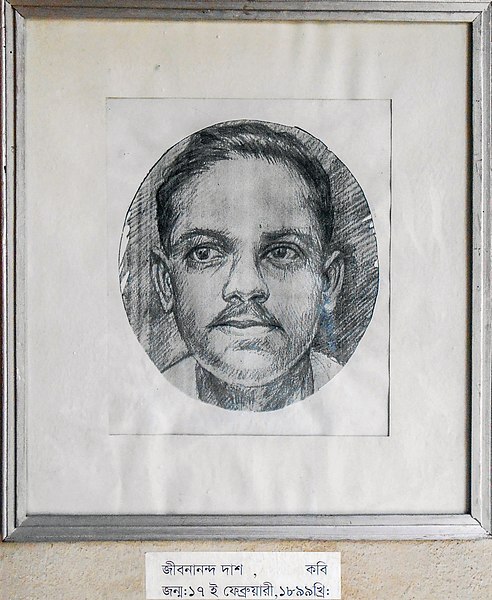
Jibonananda Das

Often hailed as the most influential poet of the post-Tagore generation, Jibonananda Das remains one of Bengal’s most intimate and incisive observers. Born in 1899, at the cusp of change raging across India and indeed the world, Jibonananda started his poetic career as a Romantic celebrant of Bengal’s vast green fields, sun-dappled rivers, lush horizons, its minutest of elemental forces. As years rolled by, a variety of societal changes impacted this landscape and indeed his own life—colonialism, World Wars, the Bengal Famine, communalism and the dark days of Partition.  His poetry and sensibility gradually took a turn to the urbane introspection of existential loneliness, tradition and its clash with modernity, death, sickness, and the newly evolving concept of the nation. However, the theme that towered over his thought-process was the concern of human civilization, its evolution and achievements and the paradox of death, disease and violence that this civilization always was confronted with. Both the pieces translated, ‘BANALATA SEN’ and ‘1946-47’ capture these romantic/humanist approach. ‘BANALATA SEN’ is perhaps his most-quoted poem, where the enigmatic, eponymous damsel offers respite and peace to the world-weary traveller-persona. What is striking in this piece, is the catalogue of places that the persona travels to—all strung together by a distinct Buddhist civilizational motif. Perhaps, he is quietly reflecting on India’s departure from its ethos of non-violence, peace and tolerance, across ages.

BANALATA SEN

For a thousand years, am I trailing the paths of this earth --
From the oceans of Ceylon, amidst darkling nights, to the Malay seas
Much have I wandered; To Bimbisara and Asoka’s ghostly days
Have I been; even farther, to the distant dark Vidarbha wen;
I am a tired being, all around me foams life’s ocean,
A moment’s peace came only from Natore’s Banalata Sen.

Her tresses, dense and dark, unbeknown like Vidisha’s nights,
Her face, like Srabosti’s sculpture; in the seas distant,
Like the rudderless sailor, who loses way,
A land of green grass, in the cinnamon island, when suddenly he sights, 
So too, in the dark, I sighted her; She said, “Where, for so long, have you been?”
Like a bird’s nest, her eyes uplifted, Natore’s Banalata Sen.

At a long day’s end, like the drop of a dew
Comes duskfall; its sun-scented wings, rubs off the eagle,
All shades of earth dimmed, the manuscript prepares anew,
For then stories, like fireflies, glow and twinkle;
All birds come home--all rivers--emptied, all loss and gain.
Alone this dark remains, for a face-to-face with Banalata Sen.

GLOSSARY:

  1. Bimbisara: a 5th century BC king of the ancient kingdom of Magadha; remembered for his military exploits and his patronage of the Buddha
  2. Asoka: Celebrated as one of the greatest imperialists in Indian history, he is remembered in history for his dramatic conversion from an aggressor to a Buddhist who spread the message of non-violence and peace. 
  3.  Vidharba: The north-eastern territory of Maharashtra, on the banks of Godavari.
  4. Natore: a district in northern Bangladesh. Legend has it that a Zaminder was once travelling by boat looking for a suitable place to build his principal residence. While travelling through Chalan beel (lake), he saw a frog being caught by a snake. His astrologers interpreted it as a sign of the end of his search for a place of residence. The Raja called out to his boatmen: ‘Nao Tharonao’ as in, ‘stop the boat’. From a corruption of this exclamation, the place eventually came to be called ‘Nator’.
  5. Vidisha: Situated very to the Buddhist pilgrimage city of Sanchi, Vidisha was an important trade centre under Buddhist rulers in the 5th century BC.
  6. Sravasti: Currently in modern day Uttar Pradesh, the city is one of the premiere centers of Buddhism.

‘1946-47’ is a landmark poem on the history of violence and bloodshed that came in the wake of Partition. The poet is a chronicler of Bengal’s changing landscape, her ethos and values in the modern times. But above all, Jibonananda voices the subaltern, especially the Bengal peasantry, whose plight and suffering under colonialism is deeply etched on his mind.

GLOSSARY:

  1. majhi-bagdi: Denoting the caste of fisherfolk and tribal warrior communities of rural Bengal
  2. Permanent Settlement: A revenue agreement between the East India Company and Bengal’s landlords to fix taxes/revenues to be raised from land.
  3. charok-gaach: a maypole erected out of the stump of a tall tree during the season-end festival of the last month of Bengali calendar, Chaitra. On top of this tall maypole are tied bundles of jute and flags with which a merry-go- round is built. Congregants whirl around the top of the maypole, supported by the ropes and hooks.

Although he spent his early days in earstwhile East Bengal, yet he moved to Kolkata where he graduated with an Honours in English in 1919 and thereafter earned an M.A., also in English, from the Calcutta University in 1921. Following his tragic death in a road accident in 1954, a vast body of novels and short stories, written by him, were discovered. Throughout his life, he shied away from public attention as posthumously he emerged to be a modern poetic giant in the annals of Bengali Literature.

Suparna Sengupta lives in Bangalore, India and is a faculty, Department of English at the Jyoti Nivas College for more than a decade now. She has translated various poets from India and Bangladesh and has been published in literature magazines. Her translated poem has been published in “Silence Between the Notes”, an anthology on Partition Poetry (ed. Sarita Jemnani and Aftab Hussain). She also features in the Annual Handbook of “Words and Worlds”, a bi-lingual magazine (PEN Austria Chapter) as also in ‘City: A Journal of South-Asian Literature’, Vol 7, 2019 (City Press Bangalore).

Categories
Poetry

Poetry from Nepal: Eyes and tears

Poetry by Sangita Swechcha, translated by Jayant Sharma

Dr Sangita Swechcha
Over the rim of the eyes
welled weary the tears,                                        
asking the eyes—
“Should I trickle or not?”
The poor couple turn oculus in utter surprise,
respond in a staggering and gruelling shape—
“How do you yearn to roll down?”
The tears sob at the oddity of the question
and reply in a state of being offended and distressed—
“If you’re embarrassed to show up in open,
I shall glide my way inside.
If you are in solitude otherwise,
I shall spill out in a surge.”
How wise the tears are—full of empathy!
To save the eyes from being abashed
they are ready to repress their outburst.
And to loosen up the eyes
they are all set to gush out
from creeks across the cheeks.
The eyes, meanwhile, are silent;
their heart already hard as stone.
And so retort—
“I get fused easily
even after countless fragmentation
only to be never fragmented again.”
Thus is the difference—
between the eyes and the tears.
The eyes are fixed
But the tears get dismembered many times only to be shattered again.
Hence—
The tears that once dropped off inadvertently in despair
have started asking for permission nowadays
before making their way out.
And the eyes that were inept in giving consent before
have started giving permission these days.
Thus is this alchemy between the eyes and the tears—
The tears ask—
“Should I trickle or not?”
And the eyes respond—
“How do you yearn to roll down?”

Dr. Sangita Swechcha has been an ardent lover of literature from an early age. She has published a novel ‘Pakhalieko Siudo’ (Washed Vermillion) and co-authored a collection of short stories ‘Asahamati ka Pailaharu’ (Hoofmark of Discord) before the collection ‘Gulafsanga ko Prem’ (The Rose: An Unusual Love Story). Her second novel is under publication and her short story collection is being translated into English. She has many short stories and poems published in various journals and online portals including Radio Nepal, Nepal Television, Global Literature in Library Initiative (GLLI) – USA based site and Your2Read, a London based venture dedicated to short story genre.    Email: sangyshrestha@hotmail.com , Website: www.sangitaswechcha.com.


Jayant Sharma is the publisher and editor of an English literary magazine Sathi which promotes Nepali literature through English translations and the founder of translateNEPAL which is an initiative to represent Nepal to the global literary scene. As a writer and translator, Jayant also contributes to major national dailies and South-Asian journals regarding arts, literature, and culture.