By Ratnottama Sengupta
Varied. Appealing. Accomplished.
These, to me, are the hallmark of the works of these six artists: Abhijeet Bhattacharya, Maitreyi Nondi, Mitali Gangopadhyay, Shampa Bhattacharya, Silajit Ghosh and Vani Chawla, in alphabetical order. And I am delighted to bring this motley group living and working in diverse geographical points of the Indian map, in this exhibition, befittingly titled C’est la Vie![1]
Let me expand on my response.
Variety, they say, is the spice of life. Why so? Variety, the dictionary would have us believe, is the quality of doing the same thing in different ways. In other words, even if the six artists here were using the same medium – oil perhaps? Or acrylic? May be water colour? Or if they boast the same palette, or the same brand of paintbrush, or canvas of the same thickness — they are not doing the same thing.
And I am not limiting the observation to the broad classification of figurative painting, abstract images, or landscape art. If Mitali is painting landscapes, Abhijit is painting humans in a landscape. If Vani is painting detailed or surrealistic human forms, Shampa’s humans have their contours distorted, for stylisation. Or perhaps to make a certain statement. If Maitreyi’s statement is garbed in the signs of the zodiac, Silajit enunciates his thoughts through the sheer flow of pigments.
What makes for the difference in their visual expression? Their different experiences. If these make life more interesting, can it be any less for art?
The difference in experiences accounts for the changes in life, likewise it accounts for the changes in the forms that come alive on their framed spaces.
*
Maitreyi, a Bachelor of Visual Arts from the Rabindra Bharati University, has been expressing herself through dynamic images of humans and icons, gods and goddesses, and not excluding life embracing animals and symbolic creatures. The Feminine Mystique, the Nirbhaya incident that had jolted the nation, Prakriti and Mahamaya, Ganesh Janani or Durga, the dreams and reflections of women — yes, and of men too. Why not, when she expresses her homage to, say, the Kargil heroes? She finds acceptance then, with the Society of Oriental Arts as with Arts Acre, with Dhoomimal Gallery of Delhi as with the artists group led by Jogen Chowdhury.
Needless to add that the forms and focus of this artist are driven by a consistent striving to empower women. But the war she thus wages is fuelled by the power of storytelling. It is a creative energy that flows through her veins as she claims the lineage of Dakshina Ranjan Mitra Mazumder, the word-smith celebrated across the boundaries of age, or maps, for Thakurmar Jhuli and Thakurda’s Tales[2]. So, her art constantly tries to explore new ways of recounting lived experiences.
*
Abhijit, born in the tea gardens of Assam, and raised in Visual Arts at Agartala, now heads the Government College of Art and Craft of Tripura. His art practice revolves around dreams and memories — but it has also gained its punch from the time he spent working as an illustrator for publications and designer for advertisements.
His art weaves in elements of fantasy to create a surreal atmosphere that takes viewers away from the stresses of ground reality. It is a foliage dotted with orange kadamba flowers against which his Krishna plays a flute — and, in dalliance, his Radha sprawls herself out on a luscious bed of luxurious green.
Elsewhere, a Buddha merges with a tree and a tall tree grows into a halo that surrounds a form of divinity which protects a snowhite dove at the core of its being.
*
Vani is nudged by balmy nature to breathe life into her canvases. Flora and butterflies and birds too flit through her frames then, as do quadrupeds and bipeds. Women in particular are her protagonists: attired in starkly modern clothes, they share their space with elemental forms. But like the English poet who wrote, “God made the country, and man made the town[3],” Vani is irked by the drastic changes humans have wrought to the natural landscape.
This artist, who majored in the stream of Commerce, is saddened by the greed that is overwhelming the planet’s green foliage with brick and mortar, concrete and steel. Her surroundings are criss-crossed by skyscraping structures of high-rise buildings and six-lane flyovers. Is this the region, the soil, the clime we must change for heaven? This fog-filled gloom that is overshadowing the celestial light of blue skies? What happened to the happy coexistence that once marked the harmony of food chains and cycles of life? How can we chant the Biblical hymn of “Peace on earth, goodwill to men?” Or the Shanti Mantra of benevolence towards not merely humanity but every spec under the sun?
*
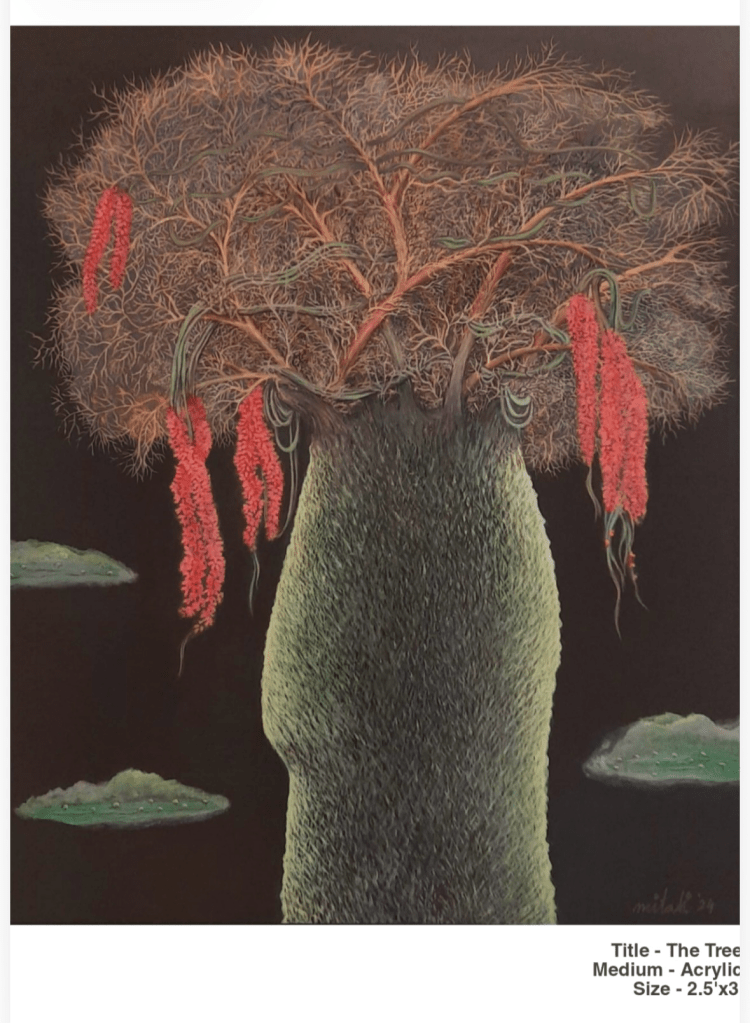
For Mitali, the bright flowers that change with every season and the silence of undulating hills are not merely decorative art nor purely landscapes. One stands for impermanence; another for stability of aeons. But in the curves and rhythms of these contrasting forces of nature, she finds a reflection of her outer and her inner self. And in the fragility of petals? She sees her own resilience!
Is this a quest for identity, or a desire to belong to the bounteous world of Nature? The latter, methinks. For, nature has endowed women with the blessing of motherhood. That is creativity of the highest form — in the entire universe.
*
When Shampa designed a Durga for the Pujas last autumn, the Third Eye of the Icon took the shape of a pen. “The pen is truly the sword in today’s world,” she believes. Realism clearly is a counter point for mysticism in her art. Naturally the inner radiance of the forms created by this figurative artist — also born in Assam, and shaped by an MA in Philosophy — transcend the external circumstances of their natural existence. Witness the series of darkened women she mounts here: their vibrant smiles spell hope. And resilience. In fact, they symbolise the triumph of inner strength over outward appearance.
This is a philosophical expression of her credo: There’s no absolute sorrow nor pure happiness, just as day and night are a continuum…
*
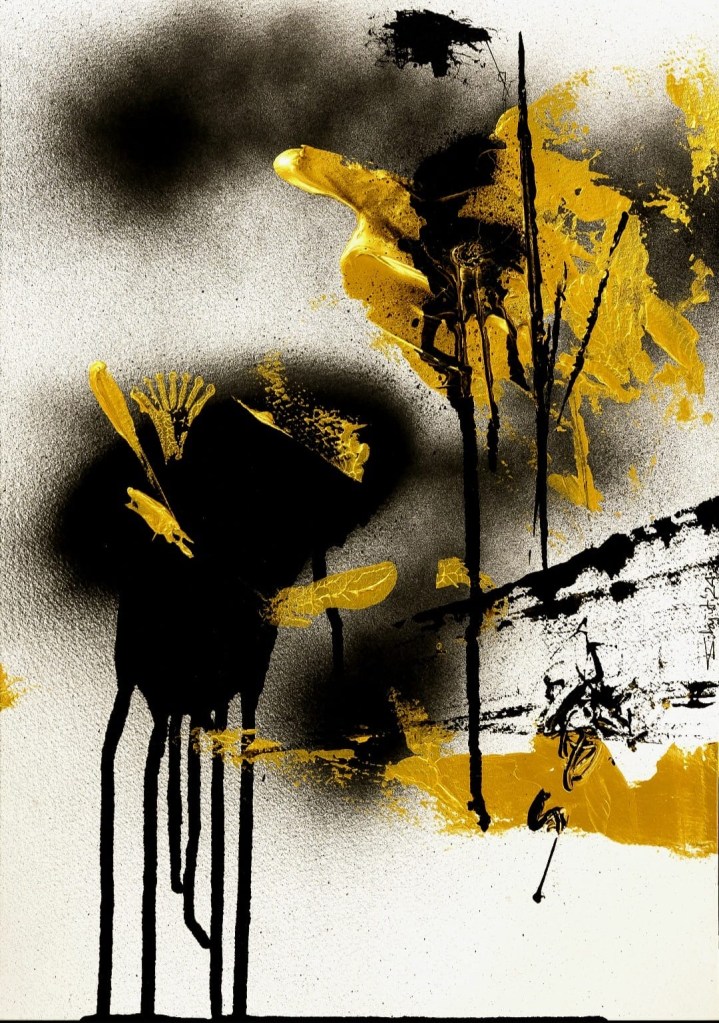
Silajit’s paintings are envisaged as a space for the cohesive bonding of sharp, vibrant, even strident colours. The colours flow much like the Ganga, from north to south. They zigzag through the canvas but their course does not meander. They are very much like this self-taught artist who does not claim adherence to any art school nor formal initiation through a hoary institution. They are an expression of his deepest mental state, his meditative best. Yet the visuals are heightened by a certain experiential detachment. Silajit seems to be contemplating on the concept of zero — or a state of absolute void. As he puts it, through these paintings he observes himself as a medium of creation, not the creator himself.
*
Nearly 250 years have passed since the English poet William Cowper wrote in ‘The Task’ that “variety gives life all its flavour.” The lines have gone on to become a proverb which underscores that unexpected turns make life more fulfilling. I would then urge all the artists who have gathered under the umbrella of C’est la Vie to try new experiences, venture into untrodden landscapes, and catch a glimpse of new vistas. I will egg them on to be so adventurous as to break the monotony of even ‘vibgyor’ and create new rainbows…
[1] Translation from French — Such’s life!
[2] Translation from Bengali. Grandmother’s Bag and Grandfather’s Tales: Folklores and children’s fairytales from Bengal.
[3] A line from ‘The Task’, a poem by William Cowper(1731-1800)
.
Ratnottama Sengupta, formerly Arts Editor of The Times of India, teaches mass communication and film appreciation, curates film festivals and art exhibitions, and translates and writes books. She has been a member of CBFC, served on the National Film Awards jury and has herself won a National Award.
.
PLEASE NOTE: ARTICLES CAN ONLY BE REPRODUCED IN OTHER SITES WITH DUE ACKNOWLEDGEMENT TO BORDERLESS JOURNAL
Click here to access the Borderless anthology, Monalisa No Longer Smiles
Click here to access Monalisa No Longer Smiles on Amazon International
 Borderless