Book Review by Mohammad Asim Siddiqui
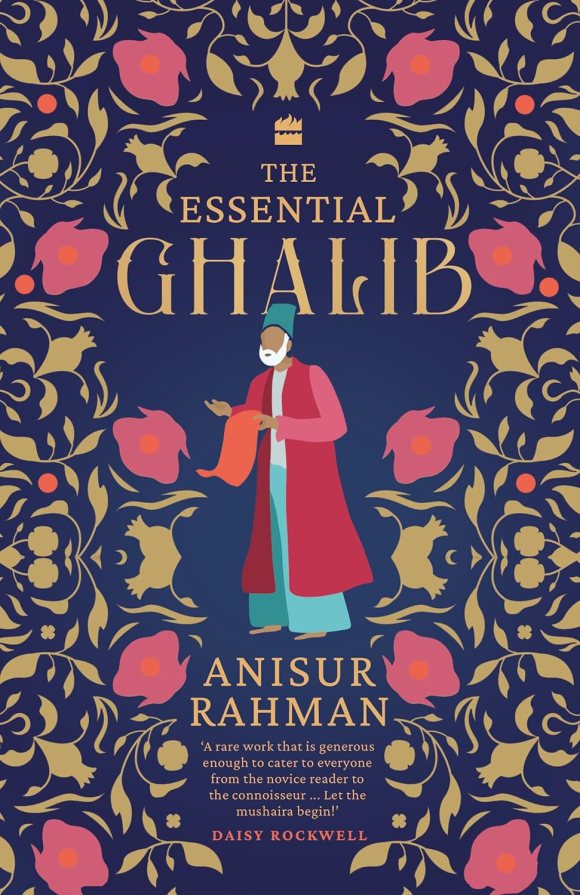
Title: The Essential Ghalib
Author and Translator from Urdu: Anisur Rahman
Publisher: HarperCollins
Mirza Asadullah Khan Ghalib (1797-1869), often considered a difficult poet by critics, offers both nuggets of philosophical wisdom and sparkling wit in his poetry. He wrote in both Persian and Urdu, but it is his Urdu poetry which has bestowed iconic status on the poet. Presenting a blend of classicism and modernism, a deceptive lucidity and a visible obscurity, playful naughtiness and transcendental raptures and above all an endearing humanism, Ghalib has a range which remains unsurpassed in Urdu poetry. His ghazals always open new possibilities of meaning and interpretation. An important poet in the court of Bahadur Shah Zafar and a mentor of Sir Syed Ahmad Khan, Ghalib has inspired and influenced almost all later Urdu poets.
Anisur Rahman’s The Essential Ghalib is a welcome addition to many already existing translations and selections of Ghalib’s poetry. But such is the appeal of Ghalib’s verse that he continues to be read, loved and celebrated and there remains a scope for new books on his poetry, especially in English for a wider readership. In this regard Surinder Deol’s arduous task of translating Gopichand Narang’s book as Ghalib: Innovative Meanings and the Ingenious Mind, a study using insights of Indian aesthetics, and Maaz Bin Bilal’s excellent English translation of Ghalib’s famous masnavi Chiragh-e-Dair as Temple Lamp: Verses on Banaras, the best possible paean to the holy city,are admirable efforts. Other better- known academics like Khurshidul Islam and Ralph Russell, translators and editors, Frances W. Pritchett, to whom Rahman dedicates his book, Mehr Afshan Farooqi, who endorses Rahman’s book, have devoted a lifetime to present Ghalib before Anglophone readers.
Anisur Rahman knows that translating all of Ghalib’s ghazals can be daunting, a task which was attempted recently by Najib Jung. However, as Rahman has not only made a selection of 200 shers[1] of Ghalib, but has also written an insightful commentary on each of them. Admitting that making a selection is always a subjective choice, Rahman has tried to represent Ghalib “in all his thematic and stylistic varieties” by developing his individual methodology, “a linguistic register and a pattern of rhyme and rhythm… that could represent Ghalib”. He also needed his “own diction with a certain echo, deciding on my number of syllables with certain weight and volume, determining the line breaks and their length to ensure their readability in translation, and finally approximating Ghalib’s tone and voice which differed from verse to verse”. Another criterion that he has followed is to select verses which were “translatable ones”, implying that a lot of Ghalib presents an insurmountable challenges for translators.
A short Introduction presenting important facts of Ghalib’s life and times, which of course have been documented in a number of books, provides a context to appreciate fully the selection and elucidation of verses that follow. A brief timeline of Ghalib’s life and works presents information in a capsule form helping the reader further.
A distinctive aspect of The Essential Ghalib is its neat and precise organization of verses and their interpretation. A two-line verse extract from a ghazal of Ghalib, which obviously can have an independent existence because of the very nature of the ghazal form, appears in Urdu and Devanagari script on the left side of the page. The page also carries a glossary of the difficult Urdu words and the English translation of the verse. On the right side of the book, the commentary of the verse explains its most obvious meaning as well as the philosophical and figurative layers hidden in the two lines. In other words, like a couplet of a ghazal, each page of the book also stands independently in the book. With his long experience as a university teacher of English poetry, Rahman has seen to it that his commentary of the couplet also does not go beyond a single page and yet it remains complete. A sequential reading of the book is not required, and the reader can open the book on any page, or savour it back and forth.
Rahman’s selection and translation includes the variety of emotions, tones and themes that Ghalib’s poetry offers. Ghalib’s wit can be seen in the following verse:
Maine chaaha thaa ke andoh-e vafaa se chhuuTuu.
nvo sitamgarmire marne pe bhi raazii na huaa

I had wished to get rid of love’s grief and pain
But that tyrant didn’t even let me die in bane
Ghalib had the rare talent to turn an often-thought idea into a fine poem:
Bas-ke dushvaar hai har kaam kaa aasaa.n honaa
aadmi ko bhi mayassar nahii.n insaa.n honaa

It’s hard to make it easy; past man’s acumen
Just as it is for a man to be a human
Rahman’s short commentary on each couplet is undoubtedly the most important feature of the book. He brings out many layers of meaning of the couplet in a clear and precise prose. Rahman knows that one way of reading poems is to read them in relation to other poems treating the same idea. In his commentary, Rahman often cites a verse from another poet not only to stress Ghalib’s influence on other poets but also to suggest the intertextual nature of poetic imagination. In the following verse Ghalib talks about the oppressive nature of the beloved:
ki mire qatl ke b’aad us ne jafaa se tauba
haai us zuud-pashemaa.n kaa pashemaa.n honaa

She vowed not to be oppressive,
after ravaging me
Ah! Her repentance too soon!
Ah! Her idiosyncrasy!
While explaining this verse, Rahman quotes Shahryar’s verse:
Ham ne to koii baat nikaalii nahinn.n Gham kii/vo zuud pashemaan pashemaan sa kyu.n hai.

(I didn’t utter anything sad/ Why does she look repentant {my translation])
At other places in the book, Rahman quotes the relevant verses of Sheikh Ibrahin Zauq, Siraj Aurangabadi, Firaq Gorakhpuri, Faiz Ahmad Faiz, Munir Niyazi and Parveen Shakir to show the resonance of Ghalib’s poetry.
Such is the beauty of Urdu poetry, of Ghalib’s in particular, that it never loses its relevance and can be cited to refer to many contemporary issues and controversies while Ghalib’s irreverence and “note of impudence” in referring to angels is beautifully captured by the following verse:
pakre jaate hai.n farishto.n ke likhe per naahaq
aadmi koii hamaaraa dam-e tahrir bhi thaa

I am unjustly caught for what the angels
Recorded of me
Was there someone for me to see
What they reported of me
Very proud of his poetry, Ghalib was never known for his modesty. Paradoxically, he can sound both vain and self-deprecating:
Ye masaail e tasavvuf ye tiara bayaan ghali
tujhe ham valii samajhte jo na baada khvaar hotaa

There mystical matters, these sparkles
 You bring me, Ghalib
If not a boozer, I would take you
For a saint, Saahib
Simple but not simplistic, scholarly but interesting, The Essential Ghalib is a good introduction to Ghalib’s poetry especially for a beginner.
[1] verses
Mohammad Asim Siddiqui, a professor of English at Aligarh Muslim University, is the author of Muslim Identity in Hindi Cinema: Poetics and Politics of Genre and Representation (Routledge 2025).
PLEASE NOTE: ARTICLES CAN ONLY BE REPRODUCED IN OTHER SITES WITH DUE ACKNOWLEDGEMENT TO BORDERLESS JOURNAL
Click here to access the Borderless anthology, Monalisa No Longer Smiles
Click here to access Monalisa No Longer Smiles on Kindle Amazon International
 Borderless