Categories
Stories

Nico Finds His Dream

By Paul Mirabile

From Public Domain

Vasiliki and Nico boarded the passenger steamer for Burgaz Island at Sirkeçi pier at Istanbul. As the steamer moved out slowly from the crowded port, Nico gazed at the dreamy silhouette of this storiedcity where for four days they had woven in and out of lanes and alleys, gardens and markets, prayed in the Greek churches.

They had left Hydra six days ago by boat and bus, arriving in Istanbul after a night spent in Thessaloniki. Now they were off to Vasiliki’s island of birth. He had never been back since his departure at the age of twelve, and the thought of returning excited him. “Look grandpa at the setting sun over Topkapı Palace,” shouted an elated Nico. And indeed Nico’s elation was not feigned.

The cypress trees and domes of the mosques and minarets were outlined against a sky alive with streaks of reddish flames whose reflections could be discerned in the unruffled waters of the Marmara Sea. The crenelated walls of Topkapı Palace undulated eerily in the ruddy, pastel twilight as did the silhouettes of the many domed mosques that embossed the mighty palace with a pinkish tinge. Nico stood hypnotized at the stern imagining himself as part of one of the yarns of A Thousand and One Nights. A sensation of estrangement, of magical transport had arrested his movements. Suddenly a flock of seagulls descended screaming into the wake of the steamer, snatched as many fish as possible and flew off towards Galata Tower, which they circled and circled until vanishing in the evening shadows beyond the hilly banks of the Bosphorus Strait, the yalıs[1], Dolmabahçe[2] and Berlerbeyi Palace.

“A fairytale city, Nico.” Vasiliki said, interrupting his grandson’s spellbound state.

“Yes, grandpa. It looks like one of the coloured pages of my A Thousand and One Nights.

 Vasiliki chuckled. “Perhaps it is, my boy.” And they both contemplated that marvellous city until it, too, disappeared under the orb of the sea …

They disembarked two hours later …

“Burgaz ,” sighed Vasiliki, stepping foot on to the soil of his birth. He took Nico’s hand and hurried him from the throngs of the port into the quiet of the main plaza where the statue of Saït Faïk greeted them. “There he is, Nico, one of the finest poets and short-story writers of the Turkish language.” Nico moved closer :

“He looks very thoughtful, grandpa. What do you think he’s thinking about?”

“That’s a good question. But for now we have to get a horse-drawn carriage to Zorba’s home before nightfall.”

For some unknown reason Nico’s thoughts roamed back to his Nefteli. “Do you think the Nefteli lay anchor at this island on her voyage to China, grandpa?” Vasiliki knitted his brows.

“I’m not so sure. She would have taken a more westerly route.” Nico nodded, unable, however, to imagine his beautiful Nefteli never having moored at this beautiful island with such a famous poet standing so thoughtful in the middle of the plaza. Whilst the boy ruminated these thoughts, Vasiliki hailed a horse-drawn carriage, and in broken Turkish directed the driver to take them to Soknar Sokak [3]located on the western side of the island.

“You speak good Turkish, grandpa,” Nico commented.

“My parents spoke it at home, but when we left Burgaz to settle in Greece, they chose to speak more Greek than Turkish. The Greeks never took a liking to us Greeks who lived in Turkey.”

“Why?”

“Oh, that’s a long and sad story. I’m too happy to be here on Burgaz to tell you now.” So Nico was left unsatisfied. “My brother’s friend’s name is Zorba,” Vasiliki continued. “He’s in the textile business in Istanbul. He comes to Greece often. His wife died two years ago and now lives alone in a big villa on a hillside overlooking the sea. He’s very wealthy and in his spare time writes poetry.”

“Like Saït Faïk?” Vasiliki puckered his lips.

“No one can write poetry like someone else, Nico. If that happens, it’s like imitating a poet’s poems and you shouldn’t do that. Anyway, you’ll soon meet him. And you’ll also meet my father’s friend Abi Din Bey, a Turkish Alevite who lives down on the beach. He knew Saït very well. He writes poetry, too. I remember one of his verses: ‘I wished to smell a rose./It feigned reluctance./No, it said, bring my scent …’ Oh, I forgot the rest.”

“But why did the rose not want to be smelt?” asked Nico curiously.

“I have no idea, my boy. It’s only poetry. Besides, I’m a fisherman, I haven’t had much instruction on those things.” And on that unscented note, Nico espied a flock of seagulls chasing the early evening cloudlets galloping far off towards the East.

They arrived. Vasiliki paid the driver and up they climbed a long flight of wooden stairs through a well-kept garden of intoxicating scents. Above them loomed a massive sun-bleached white, wooden pillared portico, above which rose three-balconed stories, surmounted by two towering turrets in the middle of which spiralled even higher a fretted gable. Nico stood awestruck as if he had come upon one of Zeus’s palaces. A minute later a huge, flabby-faced, moustachioed man burst through the front portico door to greet them in broken Greek.

“Welcome! Welcome! Come into my humble home, please,” Zorba gesticulated theatrically, dragging both guests into his home, which in the eyes of his two guests was far from humble …

Dragged I say through the lofty portico whose colonnade must have counted over twenty Doric-like pillars, then into a vestibule at the end of which a floating double staircase wound breezily above a bubbling marble fountain then on to a cambered, U-shaped landing bedecked with azaleas, wisteria and dwarfish palm plants. Hanging on the walls of the vestibule and the cambered landing were landscape paintings and several stately portraits. Zorba immediately escorted them into a brightly lit drawing-room whose frescoed ceiling teemed with Greek heroes and from which a shone a gigantic chandelier. Deep velvet-red draperies afforded a nineteenth century posh atmosphere, an atmosphere of opulent repose. They were seated on a plush, baize-covered ottoman. Refreshments were hurried into the room by a maid, set delicately on a superb pearl-inlaid coffee-table.

“Welcome to Burgaz, Vasiliki and Nico,” Zorba beamed, delicately seeping a large glass of mango juice. “Where will be your first visit if I may ask?” Vasiliki set his mango juice down, licking his lips.

“To Abi Din Bey’s beach home,” replied Vasiliki.

Zorba frowned. “Rather a shabby place his cabin on the beach,” he retorted gruffly.

“Perhaps, but I must see him. You know, he was a very good friend to my father.”

“Yes … yes, of course,” grumbled Zorba, ostensibly displeased at the mention of the beach comber. “Whatever ! You are my guests here and may stay as long as you please.” He looked at Nico affectionately: “What a wonderful adventure for your grandson. To relive his grandfather’s and father’s past …”

“And who knows, Zorba … perhaps his future …”

Zorba, a bit puzzled by that remark, smiled a gold-toothed smile, nevertheless. The smile seemed to set his well-fed, pasty face aquiver.

“Excellent, Vasiliki. But now we must dine.” Zorba ushered his guests into the tapestry-hung adjoining dining room where a long table had been set with all the delicacies that Burgaz Island could offer : sumptuous mezes[4]: stuffed vine leaves, eggplant caviar, marinated red peppers, homus[5], followed by lentil soup, fish and köfte[6]. This gargantuan meal terminated with strawberry sorbet and künefe[7].Two hours laterVasiliki and Nico sat back in their red upholstered chairs utterly exhausted.

Refusing any liquor, Zorba showed his guests their enormous room on the first floor whose bay-window overlooked a dark stretch of forest which gradually merged with the slow-moving lights of the steamers and cargoes on the Marmara Sea. Vasiliki and Nico, after unpacking, fell asleep as soon as their heads touched the pillows.

They awoke at nine o’clock, washed and rushed down the elegant, floating staircase for a quick breakfast. They ate alone, Zorba having breakfasted very early in order to meet customers in Istanbul, so said the maid. They set out for Abi Din Bey’s beach home, a half-hour’s walk down a winding path through the wooded hillside.

The sound and smell of the sea below, the laughing seagulls above thrilled Nico with an unequivocal joy. He felt drawn into an adventure. Once on the beach, they veered to the right and in two or three minutes stood at the Alevite’s welcoming gate, open to all and sundry. Charging out of the front door of a flat-roofed, one-storey little house, a handsome, stalwart, balding man greeted them with so many handshakes and kisses on the cheeks. He led them inside his three-room home, built under an arching rock shelf, overhung with a thick network of running vines and bougainvillaea which dangled over the front walls of the house.

Nico was astonished at all the books strewn on the rug-covered floor or lying open on the arms of a worn-out sofa. A low, wooden table, where a tea-pot and glasses had been set, comprised the rest of Abi Din’s ‘drawing-room’ furniture. The walls lay bare of pictures and the two front pane less windows bore no curtains. One naked lightbulb hung limply from a rafter. Nico, seated on the sofa, stared at the bareness of Abi Din’s abode. He could not decide whether the poet lived in poverty or simplicity.

As if reading his thoughts, Abi Din Bey, who had since served them black tea, said in his deep, authoritative voice: “Simplicity remains the poet’s true companion. All he needs is the whistling of the wind, the lapping of the waves, the rustling of the leaves. The true poet touches reality with his or her ears more than the eyes before voicing that reality, poetically. But I will acknowledge that the poet opens his or her senses to the moon at night and to the horizon-filled fishermen tossing their nets at the edge of the briny sea in the day.”

“You have been afflicted with Saït Faïk’s poetic madness,” laughed Vasiliki, translating his friend’s words for Nico.

“Anyone who came into contact with Saït became a poet … good or bad I am not to judge ! Who else listened to the talking seaweed or the weeping mussels?” Vasiliki agreed with a nod then translated for his grandson.

“Grandpa, how can seaweed talk and mussels weep?”

“Well, poets can hear things that we cannot, Nico.”

After tea, Abi Din Bey led them out to his front garden where the fragrances of oleander and honeysuckle muddled Nico’s imagination, already running amok due to  all this talk of weeping mussels and talking seaweed. Out beyond the wooden fence the glint of Marmara glowed turquoise.  

Vasiliki and Abi Din Bey spoke of Vasiliki’s father and grandfather, of a time when Burgaz bathed in a mellow light of unruffled peace and perfumed tranquillity. “And now look — Istanbul’s ‘hippies’ camp on weekends in the forests and on the beaches littering, smoking and drinking. Tourists swarm the island as if it were la Côte d’Azure. If Saïk or your father were alive … “ Abi Din Bey would repeat … but would never finish …

Towards late afternoon after a pleasant nap in their host’s hammocks, Vasiliki and Nico left Abi Din Bey to his domestic chores to stroll along the beach, avoiding the vast wracks of seaweed. “Let’s walk up to the Monastery of the Transfiguration on Bayrak Tepe,” Vasiliki suggested. “It’s the highest spot on the island. The monastery was built in the XIXth century and has never changed, so my father told me. We can talk to the Pope and his wife, they’re Greek … well, Turkish Greek.”

“You said there’s a difference, grandpa.”

“You see, the Greeks who came from Turkey to settle in Greece were never really liked by the Greeks because of their way of speaking Greek and their Turkish customs.”

“Why?” the boy insisted. But at that moment they halted in their tracks. A shirtless and shoeless man was busy erecting little pyramidal piles of stones here and there on the beach. Before Nico could enquire about this curious occupation the man turned towards the sea, opened his muscular arms wide, and in an eerie, sing-song voice chanted:

 “Women light the lamps of spirit with a blue light as they warm up coffee.

During the nights, in the darkness, on the peak of a mountain

a miller, his eyes closed,

sleeps, face down.

Villagers would come

To sell their copperware at the market,

To sell yogurt.

A naked child, begging in the street, was knee-deep in snow.

At the head of a bridge in the Big City

I would throw myself over,

Suspended above the waters.

I would hear the waters that I would cleave,

 Would see

The waters as I fell,

The waters that spurt up at the bridge.”[8]

The man turned his back to the sea and resumed his Sisyphean labour …

“What did the man chant, grandpa?”

“A poem by Saït, I think. A sad poem. You know, the life of a fisherman is not easy, but the life of a poet is not to be romanticised. Outwardly life may seem merry and bright. But deep inside, Nico, a poet’s lot is not to be envied. Saït’s short stories and poetry are filled with solemnity. Zorba thinks he understands this solemnity. Abi Din Bey is less pretentious; he leads a simple, lonely life and reads Saït for comfort. This solemnity has offered him a gratifying livelihood. He liked Saït so much and sought his companionship. But Saïk chose alcohol for a companion. Abi Din is a religious man, he doesn’t drink alcohol. Alcohol should never be a poet’s companion.”

Nico said nothing as they trudged up Bayrak Tepe to the Greek monastery, where after tea and honey cakes with the pope and his wife, they hurriedly trekked down the opposite side of the island, keeping the sea to the right. Two hours later they reached Zorba’s hillside home before nightfall. The sky blazed a crimson red as the sun set under the waveless Marmara.

Dinner having finished, Zorba and Vasiliki were served wine in the drawing-room and Nico a glass of lemonade. Zorba, exceptionally cheerful after a fruitful day in Istanbul, stood, poured himself another glass of wine and recited a few verses of his poetry :

“Honey is certainly a special nourishment;

Is truly medicinal.

He who eats honey thinks soundly;

He who does not, thinks ignorantly.”

Zorba sat down absorbed in the silence of his guests. “How I try to imitate Saïk,” he sighed at length.

“Can anyone imitate Saïk?” queried Vasiliki distractedly.

Zorba placed a pudgy hand to his heart: “Poets live to write and not write to live.”

Vasiliki agreed, heard the grandfather clock strike midnight, yawned and sleepily suggested that they be off to bed. Zorba acquiesced, promising a few more strophes the following night. A weary Vasiliki smiled perfunctorily …

Waking up with the larks, Vasiliki and Nico were served breakfast. Zorba had again left for Istanbul very early. The two tourists walked to the centre of town to visit Saint John the Baptist’s[9] church, then Saïk Faïk’s house-musuem and gardens. Saït’s former two-storey, balconeyed home rose into the blue island sky, the gable rising even higher than the palm trees that served as sentinels. The gardens were similar to Zorba’s — exceptionally well-kept. Inside, Nico was taken aback by the refined taste of the poet’s family: the exquisite, velvet cushioned chairs and sofas, the poet’s private library where many bookshelves contained poetry magazines, dictionaries and novels in Turkish, French and Greek. Nico surmised that the poet was a studious man.

“A very well-educated man,” whispered Vasiliki. “He translated too. His knowledge of languages inspired his short story and poetry writing.”

“Do you speak French, grandpa?”

“I’m afraid I don’t, my boy. You know, I’ve had little instruction. But you, Nico, look at those leather-bound volumes ; you may become a boat-building poet someday if you work hard at school.”

Nico’s little round eyes glowed a brilliant glow. How he loved to read, to touch the crispy pages of a book, to smell the print and paper. Spellbound by all this literature, he suddenly heard a fey voice :

“A table,

Flowerless.

Newspaper for cloth

Wine for love

 And for fancies …” [10]

The mysterious voice trailed off. Nico searched the room frantically for his grandfather. There he stood in front of a hanging portrait of Saït Faïk.

“Grandpa.”

“Yes, my boy.”

“I would like to be a poet.,” Nico asserted.

“A boat-building poet?”

“Yes, write poems and short stories like that man hanging on the wall. He has such a handsome face … a kind, smiling face. He must have been a gentleman.”

Vasiliki nodded. “I’ve no doubt he was. Those eyes speak the tremors of his soul, a soul filled with the love of life, all life : mineral, animal, vegetable, human.”

Nico screwed up his eyes which met those of Saït’s, a deep blue like the sea. Laughing eyes, like the seagulls’ … Five minutes later they stepped into the blazing Burgaz sun, white white …

The rest of the morning and afternoon was spent in Abi Din’s front garden, drinking tea, chatting about Burgaz fishermen. They ate grilled-cheese sandwiches and sardines for lunch.

The loquacious Abe Din turned to Nico: “A poet’s life has its highs and lows. It’s best to keep to the middle, no jealous rivals to spread scandal, no avaricious publishers to milk you like a cow. Thieves, all of them ! Just write poems, Nico. Don’t waste your energy on market reception, critic’s reviews or what publishers expect from you. Your poems speak for themselves. And do you know why ?”

Nico did not know why for two reasons: he couldn’t understand Turkish and he never wrote a poem. The animated man continued, nevertheless: “Because you organise the movement of the poem with your own voice, a poem is an activity not a product. Poems make poetry; poetry does not make poems. A poet has no regards for schools of poetry, for modes of poetry, for signs-of-the-time poetry. Writers of poetry express the signs of their times; writers of poems suggest images of untimely inspiration. Writers of poetry idolize poetic forms ; writers of poems organise their poems subjectively, free from poetic occult pedantry and cryptic complexity. Listen ! Listen to those outer and inner inspirations.”

Vasiliki translated his friend’s fiery tirade as best he could and when Nico had understood the ‘Listen! Listen!’ The obedient boy listened even harder. Abi Din Bey’s voice rose higher: “A poem is first heard in the heart then expressed by word of mouth or on paper. Open your ears wide, Nico, open them wide!” When those last words of wisdom were translated, Nico attempted to open his ears as wide as he could. It was not an easy task, much harder than opening his eyes wide …

When the sun began to set Vasiliki and Nico bid farewell to the poet, promising to return the following year. Little did they know that the solitary poet would pass from this world in the near future …

They spent four more nights as Zorba’s guests eating like kings, listening to their host’s business conquests and after-dinner poetry over a glass of wine or lemonade. They left Zorba on the long flight of steps, he waving good-bye with a pudgy hand as the horse-drawn carriage bounced his guests up and down towards Burgaz pier.

“Grandpa, I’m going to work hard at school and read Saït Faïk’s short-stories and poems.”

“We’ll find translations of them, Nico. I told you that Burgaz Island plays strange things on people who come here. Her soil inspires us. Her energy rises from the core of the earth into our hearts and spirits. Burgaz possesses a mystery that no one has ever solved.”

“Not even Saït Faïk, grandpa?” Vasiliki scratched his white beard.

“I have no answer to that one, my boy. Maybe he did solve it. Poems and stories were his livelihood, like my fishing, a daily labour of love and effort. Perhaps someday you’ll solve the mystery of Burgaz.”

“By boat-building and writing poems?” Vasiliki gazed up at the circling seagulls.

Nico was not sure. Meanwhile, ahead lay the pier and the steamer now steaming into port, smoke bellowing from her stack. Ropes had been thrown down to moor her as passengers straggled off and on. Grandfather and grandson rushed into the vortex of that rolling movement and disappeared within the bustling throngs …  

[1]        Wooden mansions or villas along the Bosphoros Strait.

[2]        Atatürk’s presidential palace.

[3]        ‘Street’ in Turkish.

[4]        ‘Appetizers or hors-d’oeuvres’.

[5]        ‘Mashed chick peas’.

[6]        ‘Meat rissole’.

[7]        A sweet dessert made of angel hair, (kadaif), cheese, butter and topped off with honey sirop and crushed pistachios.

[8]        Losely translated from ‘Bir Zamanlar’ ‘One Time’.

[9]      Iohannas Prodromos in Greek. It was built in 1899.

[10]      From Sait Faik’s poem ‘Masa’ ‘Table’, partially translated.

Paul Mirabile is a retired professor of philology now living in France. He has published mostly academic works centred on philology, history, pedagogy and religion. He has also published stories of his travels throughout Asia, where he spent thirty years.

.

PLEASE NOTE: ARTICLES CAN ONLY BE REPRODUCED IN OTHER SITES WITH DUE ACKNOWLEDGEMENT TO BORDERLESS JOURNAL

Click here to access the Borderless anthology, Monalisa No Longer Smiles

Click here to access Monalisa No Longer Smiles on Kindle Amazon International

Categories
Essay

A Turkish Adventure with Sait Faik

Narrative by Paul Mirabile with photographs by Françoise Mirabile.

The Treewood sculpture by Çağdaş Ercelik of Sait Faik greets the visitor at the Burgaz docks on his or her arrival.

To have sojourned on Burgaz Island was such a marvellous experience. This experience resulted from the fact that I worked twelve years in Istanbul and had rented a small flat on the island from an Armenian woman whose daughter had been a student of mine at University.

I rented the small, rooftop flat for about five or six years. Then I met one of the protagonists of my story, Abi Din Bey, a Turkish Alevite[1] who had been living on Burgaz since the 1940s in his two room wooden dwelling on the beach, opposite Yassi (Flat) Island and Sivri ( Pointed ) Island in the Marmara Sea, which he and his brother had built. He sold coffee or tea with little cakes or grilled cheese sandwiches to infrequent visitors, hikers or swimmers who happened to stumble across his home on the beachhead. That was in fact how he made his living. We got to know one another well, and soon he offered to rent me the smaller room of his lodgings whenever I arrived on the island for week-ends or for the longer holidays at a much more advantageous price than my flat in the village. I took him up on it without a second thought …

Abi Din Bey’s front gardens, peppered with shady fruit trees, under which he had placed long or square tables with benches or chairs for the occasional visitors, touched the stony beach. From those gardens one had a wide open view of the Sea of Marmara. It was truly a place of magic ! In the mornings we would take our coffee or tea in the gardens and contemplate those placid waters lapping the pebbly strand, a slight breeze coming in from the North, the sky and the sea, enamel blue. Hikers or visitors would stop in after eleven, and he would serve them cold beverages and grilled cheese toast, which he prepared in his kitchenette. I would help him on the week-ends when students arrived with their tents to stay on for a day or two on in the wooded areas.

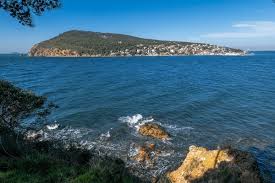
Marmara Sea seen from Abi Din Bey’s front gardens. Pointed (Sivri) and Flat (Yassi) Islands can be seen in the background

Burgaz, the second of the four Princes’ Islands of the Sea of Marmara, known to the Greeks as Antigone, was as popular if not more than the first island Kınalada (Prōtē), the third, Heybeliada (Halki) and the largest Büyükada (Prinkēpos). Their Greek names fell out of use after the Greek-Turkish War in 1921, and following the founding of the Turkish Republic in 1923. Burgaz was a world of poetry, in rhythm wth the movements of steamers coming and going, lapping waves and rough winds … screaming seagulls, the long solitary walks up into the hilly woods and along the sandless beaches, by the evening strolls amongst the white-washed nineteenth century wooden Ottoman-era mansions of Burgaz village, whose fretted pitches mounted from the cornice to the high gabled roofs of the façade. Bougainvillaea and wisteria of bright blues, purples and whites overflowed from the cast-iron balconied façades. Neatly kept gardens hugged the quiet lanes and streets fringed with mimosas and pomegranate trees, pricked here and there with aging trees, one of which near the House of the Alevites, was said to be over six-hundred years of age.

Indeed, life on Burgaz contrasts so starkly with that of Istanbul: no vehicles, no mass movements of people rushing to and from work, no tram, metro or train ; a world of enchantment and marvels, of monasteries, churches and cathedrals, of dancing boats at the piers, of leather-faced fisherman casting nets or having tea; of forested hills, rocky cliffs, of bougainvillea sagging in great clusters and copses of cypress … of crimson sunsets dipping into the Marmara. Truly, Burgaz is ideal for the painter’s palette …

How I inhaled and exhaled those wonderful visions as I made my way down upon the winding path towards Abidin Bey’s home — splashes of roses, honeysuckles and oleanders blazing orange and crimson through the deep forest greens. And as I did, the voice of my foremost protagonist, the hero of this story, Sait Faik Abasıyanık[2], would implore me to reanimate his presence on this island paradise, to hearken to and bring forth, as if snatched up in some dreamy reminiscence of poetic éclat, that forlorn, melancholic voice:

 Several late evenings I would sit

And write stories ;

Like a madman !

Whilst I wrote the story

The people in my head

Would go out to fish. [3]

Yes, that Sait Faik voice, elliptic, forlorn and melancholic, as if he solicited an unaffected sincere souvenir of his masterful art: the Art of Poetics … of the short-story, a palatable keepsake of his short-lived grandeur :

The wind that bears the salt to the shore,

I hear the swimming of the fish

I listen to the seaweed talking amongst themselves,

To the mussels weeping.

There is a wing of love, it is red

it is pierced,

blood flows,

There is a wing

Poison greenish. [4]

So many journeys into the past borne by that doleful voice of the solitary poet and story-teller of fishermen, wood-choppers, street vendors, birds, steamers, cafés; of motley dressed street children, long, starry nights meditating the brushing waves of the Marmara Sea along the indented coasts of Burgaz … of insular Freedom …

What exactly is insular Freedom? A land free of noisome noise; the islanders hear only the laughing seagull in flight, the chants of fishermen repairing their nets, the brays of donkeys, the wheedling of jays and the coarse hawking of merchants on market days, the neighs and snorts of work-horses, the cock-a’doodle doos of roosters at the break of dawn.

A land where the naked eye embraces gold-gilded sunrises and dragon-red sunsets at the not so distant point where the azures of the sky touch those of the briny sea.

A land of a myriad flowery perfumed fragrances, free from the toxic fumes of vehicle emission, from chemical discharge and human waste. A land of powerful telluric forces where the islanders’ footfalls tread dirt tracks, sandy or stony beachheads, soft, leafy trails; where he or she communes with the trees, the sea, tastes the salty air free of pollution. Even the taste of Burgaz coffee smacks of that island brew, a nice commingling of robust richness and timeless tincture! Freedom which releases all the senses from their ensnared urban uniformity, their artificial, conventional urbanity of foot-shuffling routine and tiresome ennui …

So I descended and descended towards Abi Din Bey’s strand home, winding steeply in zig-zag fashion, alive to that distant but clear, impelling voice:

 Late evening comes

Whilst everyone quits their work.

Amongst the clustering clusters at the tram

A lovely child’s face smiles.

Unchaste, late evening comes.

How I seize it I know not

Preparing to love my beloved

At sixteen years of age

To hold her hand in mine

For a good twenty-four hours

Desiring to hear one warm word … [5]

When reading or listening to these verses I experienced a veil of despondency, a dash of fury that underscores a struggle of consciousness, of surpassing vanity as the principal motivation of solitude within an island envelope. The consciousness may be called nostalgia; that is, suffering of and from a past, familiar lieu, a stead-sickness of some remote time within the fantastic unfolding of a man’s former existences. And yet, these former existences may not be as remote as I believed. So I continued to lend an ear as I approached the beachcomber’s humble abode:

My whistling at the stern of the steamer,

My song upon the rainy bridge

Are but a pretext to approach you,

Otherwise my darling, not to forget you,

It is evident that only after you

The lies that have been imparted to humankind

It is evident that after you, only

The emptiness of all things

Together with you, the cups are to be filled

The wines with you, revelled

The cigars with you, smoked

The hearths with you, aflame

The meals with you, eaten. [6]

Ah, Sait, you have been my faithful road companion ; the herald of the short story, of the furtive glimpse, of the snap-shot of possible realities which have been the ardent desire of our existential Way … the Flame of Life …

Here, at long last, Abi Din Bey has come to greet me at his welcoming gate — a hearty greeting indeed. Abi Din Bey towers over me in all his nobleness; he is a descendent of the great Ali, fourth Caliph of the Sunna, first Imam of the Shia.[7] He took great pleasure and pride in showing me his genealogical tree finely printed out on vellum in triptych form as he had done in the past every time  I visited him. He had it done by specialists at the Vatican for a meagre fee. He never fully explained why he had it done at the Vatican.

Noble, humble, ascetic and combative like his distant descendant, he stands erect for his advanced age (perhaps eighty), and remarkably lucid when discussing religious matters and Sufi poets. He was well versed in Ali’s conquests as well as Sait Faik Abasıyanık’s life and personality, whom he knew personally in his younger days. How many nights under a speckless sky did my friend and host narrate Saik’s life to me, abridged of course, and oftentimes modified to enfold the atmosphere of that night’s solicitude, the turbulence of the waves pounding the jutting rocks, the scrapings of the pines against the rising cliffs that arched over his diminutive home.

It was the month of May in the year 2006. The mimosas were in full bloom as we sat in his front gardens, breathing in the fresh balmy air of the calm, morning sea. The fragrance of rose attar mounted from the morning dew which clung to the garden trees like hoarfrost. The tea, too, had a fresh taste to it. Abi Din Bey looked out upon the cool blues of the late morning sky and waters :

“Sait was a rebel !” he began abruptly in his deep, coarse voice. “You know, he didn’t look to transform the world like some revolutionary, he wanted to be as useless as possible to the whims and caprices of our political and economic decision-makers, to the ideological escapades of social redeemers or misfits so as to accomplish his own destiny for the benefit of all Humanity.”

“Is that why he wrote ‘The Useless Man’?” I ventured, a lovely short story that I had translated several years back.

“Yes, for the whole of Humanity,” he continued excitedly as if not hearing my rhetorical question. “That may sound strange because he lived such a hermit’s life, a socially useless life, especially here on Burgaz. However, if you’ve noticed, and I’m sure you have noticed, he always wrote ‘on the road’ : at the docks waiting for the steamers, on the steamers, in cafés, whilst strolling about the island plunged in his world of creative imagination … even when fishing or rowing. He loved to stroll up the dirt tracks into the forested hills and visit the Greek priest on Hristo’s Hill in his chapel.

“Nothing revolutionary. No message to peddle or to plead, only the solemn and sober cheerfulness of his flamboyant and oftentimes eccentric character which he consciously or unconsciously weaved into his short stories and poetry. His voice was not the authoritative, pompous voice booming from above, but the unfettered voice of pure simplicity, describing simple gestures, simple acts, simple conversations, freed from conventional social and literary shackles. A rebel is neither serf nor master: he is absolutely free from social rank and class …”

Abi Din Bey paused to take a sip of tea. This man, too, lived an unfettered, unconventional life in his two-room cabin on the pebbly strand of Burgaz, alone, besides the occasional visitor. But he was no rebel ; his parents had long since been deceased, and since he had never married had no children. His only brother died many years ago of alcohol in middle age. And so there we sat, alone, the sun rising high on the wooded hills of the Kalpazankaya peninsula bay, Abi Din Bey spinning his own tale of Sait, a timeless reminiscence where story-telling reveals not only the pleasures of listening, of sharing, but more important still, the essence of identification with the Other of that story …

“You know, he hadn’t always lived on Burgaz; he had his schooling in Bursa, where he lodged at a boarding school for boys. His father wished him to be a merchant or a diplomat, but this lifestyle suited him not. Deep in his heart, Sait yearned to be a wandering, carefree writer who observes the details of life that wheel and whirl around him. It was in High School where he wrote his first story ‘The Silken Handkerchief‘ (Ipekli Mendil). It aroused much interest from his literature teacher who encouraged him to work harder to flesh out his ideas, rear in his galloping imagination. His father, on the other hand, disliked the route his son was taking, so he promptly sent him to Switzerland in 1931, I think, to study economics. Unstable as he was, the agitated student dropped his studies and left for France, exploring its towns and literature, especially those short stories of Maupassant, the finest of the French short-story writers, which he read in the original, as he developed a solid base in that language. Finally in 1935, he returned to Istanbul via Marseilles by ship, and there took up different employments, ignoring his father’s growing obsessions about lumber merchant opportunities. He even taught Turkish at an Armenian School for orphans …He translated, too. Since he excelled in French, he translated André Gide’s books for the literary journal Varlık (Existence). Translation served as an exercise in style and intellectual perspicacity for his own writings, which by the way, were gaining more and more attention within the small literary cliques of Istanbul.”

Abi Din Bey stopped for a moment to gather his thoughts. This was not the first time he was narrating Sait Faik’s story to me (and assuredly to others), with of course the usual modifications. I noted, however, that his memory seemed to wane and to compensate for its loses and lapses, he filled in the gaps with judgemental remarks. Oddly enough, his attitude towards Sait became more and more distant, almost academic, as if Sait’s person, long since passed, betrayed Abi Din Bey’s own anguish of passing … His relation to Sait had been casual, not intimate ; yet, there were moments when recounting the events of Sait’s life that Abi Din Bey gave the impression that he was reliving his own past, concomitantly with Sait’s ! This might have explained the urgency in his voice, often broken, the lapses and chronological errors. Did he already know that he would be expropriated in the not so distant future? I cannot say …

“He never earned a great deal of money from his stories, although they were quickly catching the eye of important literary critics and publishing firms. It was his father’s money that provided his bread, tea … and alcohol. More and more collections of his narratives poured out from his energetic pen, written in every possible place on every possible situation that he experienced. How many I cannot say or remember … I haven’t read them all …”

I interrupted to refresh his memory, “Semaver (The Sarmovar), Lüzsüz Adam (The Useless Man), Alemdağ’da Var Bir Yılan (There’s a Snake on Alemdağ), Son Kuşlar (The Last Birds), Az Şekerli (A Wee bit of Sugar), Havuz Başı (At the Poolside), Mahalle Kahvesi (The Neighbourhood Café), Şahmedan (The Pile Driver).”

“Yes! Yes, so many stories in those collections!”

“There are twenty or so in each collection,” I added quickly. 

“Have you read them all?”

The question posed so bluntly caught me off guard. I shook my head : “No, perhaps twenty or thirty. I’ve only translated seven or eight of them.”

“Yes, seven or eight,” he echoed in a flat voice, gazing dreamily out to sea beyond his front garden fence. A few young people were strolling amongst the smooth rocks jutting into the sea.

“You know, Abi Din Bey, his stories are not easy to translate,” I rejoined, observing that my loquacious host remained unusually silent. “His vocabulary jumps from Ottoman word-hoards to Burgaz jargon ; from street talk to poetic solipsism. His syntax, so elliptic at times, coils like a snake on the branch of a tree on others ; to follow this coiling I had to slither like a snake.” Abi Din Bey broke into a wide grin : he enjoyed simile and metaphor. “Saik Fait’s reasoning defies Cartesian logic with his uncanny sounding rhythms and odd visual associations ; he had such an eye for details.” I pursued after Abi Din Bey had withdrawn into his cabin to procure a few cakes and returned to our table. “I’m sure I have done violence to the English language with my translations. Then again, my approach to translation has always been a Poetics one ; that is, a unique adventure by which Sait’s enonciations and utterances, his ‘style’ of writing if you like, are ‘transferred’ to my poetic expression in English. Poetics in translation is not one of language to language, but discourse to discourse …” Abi Din Bey nodded kindly in my direction. He knew nothing about translation, but had been grateful to me for having translated his deceased brother’s poems, a marginal poet amongst the plethora of Turkish poetic writers[8]. Yet, Abi Din Bey refused that I seek out a publisher for them; his brother’s tragic death would not be flaunted and besmirched publicly by the blood-thirsty horde of scandalmongers who called themselves literary critics. His poetry, whatever its worth, translated or not, would remain a ‘family affair’ … which it did … Abi Din Bey poured out some more tea, then resumed his reminiscing. He was drifting into his favourite souvenirs, those to which, I am sure, he identified himself: “Many so-called critics despised Sait. Not his stories but his way of living ! They trumped up intrigues against him, accused him of political incorrectness, of social disorder. But this man never advocated any political ideology, nor did he mingle with criminals, as some imbeciles claimed. How the mediocre can conjure up calamitous falsehoods through jealousy, malice and hate. He reacted badly to these accusations and insinuations, withdrawing from the world’s fair ; it was also then that he began to drink very heavily and lead a very unproductive life.

“His father died, and Sait, fed up with all that puerile scandal-mongering, left for Burgaz, where he inherited his mother’s lovely two-storey house near the Greek Cathedral of Saint John. A whole new existential vista opened up for him on his island retreat, far from vanity and pseudo-intellectualism. On Burgaz, he regained that the freedom of the beachcomber, that artful notion of being humane to all living creatures, confronting Nature’s formidable forces, interlacing his childhood dreams and fantasies with natural surroundings. He explored the psychic of individuals of meagre living and of strenuous trades. Sait Faik’s daily existence transpired on the pages of his stories : modest or tragic family events, streets filled with vendors or motley children, fishing expeditions, prawn catching at midnight, flocks of seagulls on the wing and shoals of fish frolicking in gay abandon. He recorded the voices that echoed off the walls of cafés filled with fisherman, spoons tinkling in their glasses, the crisp sounds of cards shuffled or dominoes tumbling. His was an unaffected world of banal circumstances acted out in harmony or disharmony with roaming wildlife, teeming vegetation or simple, working people.

“Sometimes I met him at his favourite café, which no longer exists. There we chatted and chatted for hours; I know he was using me as his first reader, narrating details of his day’s activities, and those of the islanders.

Sait Faik’s house and Gardens on Burgaz facing the façade of Saint John’s Cathedral

“You know at that time very little Turkish was spoken on Burgaz ; many of the inhabitants spoke Greek, Armenian or Jewish-Spanish. Sait savoured these foreign sounds, so exotic to his ears since he none of these languages. But he listened as if he understood them perfectly. Anyway, we would meet every now and then, stroll about or just have tea or coffee in the village. He led a simple, hermit’s life.”

“Like yours?” I put in slyly.

He turned a bit red, the limpidity of his eyes losing their usual sunset softness. He rubbed his arching nose: “Perhaps. But I never wrote a sentence or verse in my life ; that was my brother’s destiny. And please, don’t publish those poems of his that you translated,” he admonished me in a colourless voice. 

I promised not to do so for the hundredth time. Abi Din Bey, relieved for the hundredth time, resumed rather pedantically: “Sait rubbed shoulders with people of whom he had ignored the very existence, whether in Bursa or in Istanbul, and by all this rubbing, however awkward or uncouth, he came to realise that his Destiny was one of Freedom, a philosophy of Life, an Art of Existence that he gradually cultivated here on Burgaz, and which blossomed out into the most beautiful bouquet of literary flowers.”

“Yes, Abi Din Bey,” I began slowly, pleased at my host’s sudden poetic élan.  “A Destiny of a sovereign being who regards each and every being as equal in value. An equality of value that can be gauged not particularly by choice of theme, but rather in the glimpses of detail that strikes the ear and eye: a miaowing cat, a reduplicated adjective or noun, the howling wind or soft breeze, a bright scarf on a darkening day, a bird hopping among the trees or on the wing ; details that play not a major role in the setting of his stories but should not be regarded as mere rhetorical artifice. They produce not a ‘local atmosphere’ but generate an intensity to his oftentimes plotless narratives or actionless plots. In fact, they rhythm the levels of narrative threads that weave the dramaless narrations no matter how insignificant or banal. I have never experienced a climax or a ‘dénouement‘ in any of his stories.”

 Abi Din Bey agreed, then added: “Unlike most Turkish writing, Saik’s stories are written in plain language, they carry no overweening pomposity.” (Here I refrained from objecting : Orhan Pamuk[9] does not write in any overweening, bombastic language !). “They are unburdened by bloated images. His choice of vocabulary captures the accents of Greek, Armenian, Jew and Turk of Burgaz and Istanbul at that time. You noticed, of course, that there are no proverbs in his writings, so salient in Turkish literature ?” I of course had noted. And it is true that Sait shied away from the Persian and Arabic influences in Turkish literature, still read in modern or contemporary Turkish writers. “You know why?” I did, but shrugged my shoulders ; I preferred to hear his opinion on the subject. “Because proverbs are associated now with the Ottoman aristocratic literati, the çelebi we call them, now with the folk sayings of the Anatolian Turkish villagers. Sait created a new form of writing in Turkish …”

“On the road writing or insular writing?” I chanced. He took out a handkerchief and wiped the perspiration from his large forehead. I wasn’t sure whether he subscribed to my viewpoint or simply ignored it. “Sait was not a writer who sought desperately to compose a great œuvre, but one who arranged movement by movement the myriad glimpses of human reality. There lies his universality!”

There followed a profound silence between us. The waves broke against the rocks. The pines scraped against the flat roof of his abode. The seagulls screamed. Abi Din Bey scratched the remaining white bristles on his round head then spoke in a half whisper:“He was such a mild-mannered man, so gentle, so attentive to others, never intrusive, only curious of life’s gifts to mankind.” He shook his big head sadly: “Can you imagine, the literati of Istanbul dared call him a tramp and a vagrant!”

“They were devoured by jealousy, Abi Din Bey. The majority of those critics hardly ever wrote one sentence that could rival with Sait’s whimsical seizing of gestures and conversations, his alacrity and precision in story-plot and transition. Had any one of them ever traced a vision of the world where animals commingle with humans, children with adults, elders with youngsters? Ostriches and seagulls are compared to human beings; he even compares himself to an ostrich! Had any one of them ever composed homespun characters who express their inner world of trials and tribulations without the narrator meddling in their affairs, however tragic or exuberant? Had any one of them ever experienced the insular life as a source of narrative inspiration, then externalise it, touching the sensitive notes on the scale of universality? His was the open, horizonless, borderless life, in spite of an existence as a ‘recluse’. Instead of sentences written at a desk and smelling of the oil lamp, his literary creations exude the aroma of cypress and spruce, the fragrance of the salty sea, of the fisherman’s catch and the common man’s labouring moils. The rusticity of his new life on Burgaz was in no way condescending, nor the parenthetical plunge of a dilettante.” I concluded.

“Sait never caroused with the literary lackeys and scribblers during his short life.” Abi Din Bey stated emphatically with a bit of harshness in his tone. “He told me that he had found comfort and inspiration here on Burgaz, and that we were all children of a timeless present … of a past fallen into oblivion.”

“So true,” I rejoined immediately. “The writer explores the many levels of reality which diverge and converge as silently and indiscreetly as dreams, phantasies and musings cohere with daily mundane events. Does this not mark the novelty of the modern short story, of which Sait was one of the initiators, artisans and masters ?”

“I shall not object to that!” he laughed. “He even won a prize for his stories, but I have forgotten the name.”

“The Mark Twain Prize,” I reminded him. “In 1953. I remember it because it was the year of my birth.”

“Mark Twain … an American short-story writer, I think? Yes. How tragic, he died a year later of cirrohis, like my brother … They both drank too much rakı[10] … Horrible stuff ! It has killed off many excellent Turkish poets. His doctor, the good Selahatin Hanın, warned him about his heavy drinking, but the doctor, too, would indulge in bouts of boozing with Sait! What a shame … You know, we would sometimes meet. He would chat about the events of the island, his writing, or this or that. Then he would just get up and leave, stroll slowly along the beach, stop to converse with a visitor or an islander. He was not a man who impressed you by his stature or knowledge or personality; he would just carry on a conversation whilst dreamily looking out to sea, or follow the flight of the seagulls. He never invited me to his home, although I visited it when it became a museum. What a shame …”

With those words said in a broken voice lacking in resonance, Abi Din Bey stood and with a half smile trudged languidly into his lodging to retire for an afternoon nap ; the heat was becoming unbearable. I observed him disappear into his room. I noted that his footfalls had lost that former blithe spring to them, and his hunched back seemed more and more enshrouded in a halo of solitude … of quiet resignation. I turned my attention to the sheen of the sea growing bluer and bluer, the seagulls plunging downwards to fetch their silvery prey. Tonight would be my last night on Burgaz. The next afternoon I had classes at the university …

In fact, it would be my last night spent with Abi Din Bey. For little did I know that in a few months I would begin a three-year teaching sojourn in Siberia. And when I did return to Istanbul, take the boat to Burgaz and amble down that old and winding path to my friend’s humble home nothing appeared to have changed : the steep path, the dense, leafy vegetation, the briny fragrance of the sea, the laughing seagulls. Yet upon reaching the welcoming gate it had been sealed shut by order of the municipality! The shutters of his home were closed. The tables and chairs in his garden overturned and strewn about. The plants and trees unattended … lifeless. The barefoot islander who, for some unknown reason, would pile up the stones on the beachhead every day into huge cairns here and there, strolled over and informed me that the authorities had expropriated the ‘old man’s’ property, which forced him to leave Burgaz. Apparently he died of loneliness and of a broken heart. So said the bare-footed stone cairn piler of Burgaz …

Abi Din Bey was the last descendant of the great Ali ibn Abi Talib, and the last person to have personally known Sait Faik Abasıyanık, one of the finest short story writers of the twentieth century … 

Portrait of Sait Faik Abasıyanık by Sabri Erat Siyavuşgil hung in Sait’s Burgaz museum-home

[1]  Alevites are a branch of Muslim Shias who settled in Anatolia Turkey during the Middle Ages.

[2] Turkish writer, 18 November 1906 – 11 May 1954

[3]    From the poem ‘Once’ (Bir Zamanlar).

[4]    From the poem ‘Red Green’ (Kırmızı Yeşil).

[5]    From the poem ‘Despair’ (Yeis).

[6]    From the poem ‘Letter I'( (Mektup I).

[7]    Ali ibn Abi Talib was Mohammad’s son-in-law, having married Fatima, the Prophet’s only daughter.

[8]        Ali Ekbar Aksu, and his collection of poems ‘Bir Göz Orda Bir Göz Burda‘ (A Glance There A Glance Here) and ‘Ya Arif Kul Ya Boş Çul‘ ( Ether a Wise Servant Or an Empty Moneybags).

[9]    Turkish novel writer who won the Nobel Price for literature in 2006.

[10]      A strong alcoholic beverage commonly referred to as arrack in English.

Paul Mirabile is a retired professor of philology now living in France. He has published mostly academic works centred on philology, history, pedagogy and religion. He has also published stories of his travels throughout Asia, where he spent thirty years.

.

PLEASE NOTE: ARTICLES CAN ONLY BE REPRODUCED IN OTHER SITES WITH DUE ACKNOWLEDGEMENT TO BORDERLESS JOURNAL