Categories
Review

Thus Flow the Verses…

Book Review by Malashri Lal

Title: Nadistuti: Poems

Author: Lakshmi Kannan

Publisher: Author Press

The title plunges us into the sacrality of resonant words, the Nadistuti sukta being a hymn in the Rigveda in praise of rivers. Poet, novelist and translator Lakshmi-Kaaveri equates the flow of the waters with ‘the flow of poetry’, the quiet mingling of streams of remembrance and phrases that shape into lines of verse. Her book is dedicated to Jayanta Mahapatra ‘who lives on’ and an exordium titled ‘Naman’ offers gentle tribute to H.K. Kaul, who was among the founders of the Poetry Society of India and passed away during the recent pandemic. Nadistuti is a brilliant and thought-provoking collection of poems that charts the timeless continuums while being aware of the fragility of human existence.

The book begins with a prayer to the River Narmada (meaning ‘the giver of pleasure’), which divides the north from the south of India. Yet the rippling waters have no boundary—a philosophical observation that I find marks much of this remarkable volume. Remembering Ganga, Yamuna, Godavari, Saraswati, Narmada, Sindhu, Kaaveri, devotees recite the shloka[1] at their morning bath seeking the blessings of the rivers. Though such rituals are mostly forgotten in modern times, the climate crisis should remind us of the consequences of such amnesia. The invisible Saraswati is possibly a metaphor for such “forgetting” simply because of her partial invisibility. Lakshmi Kannan’s vibrant lines recall the disappearance of the river as also of Saraswati’s appearance in another form as a revered Goddess invoked by “students, writers, musicians, dancers, painters”. From the Nadistuti I learned the word— ‘potomologist’—the study of rivers, but the book is far greater than an academic enquiry—it’s a recognition of the civilisational bloodline that is linked to the ancient rivers which  were the earliest cradles of humankind.

Some extraordinary and innovative aspects Lakshmi’s book deserve special mention. First, the remarkable prose- poem called ‘Ponni Looks Back’ which stretches the boundaries of imagination in a charming manner.   Ponni is the name of the river Kaaveri in classical Tamil Literature.  It flows through Tamil Nadu and Karnataka and is always perceived as a woman. Lakshmi tracks Ponni’s autobiography as though writing a Bildungsroman, the education and growing up of an innocent girl and her experiences along the way. Therefore, Ponni is born as a small unobtrusive stream on the Mysore-Coorg border. Then she becomes prominent and significant, and a vital witness to history—the Hoysala kingdom, the classical arts of Belur, Halibid, Somnathpur, then carrying on further to wrap around the islands of Srirangapatnam and Srirangam and so on. I enjoyed the autobiographical voice of Ponni reveling in her centuries of testimony to all the changes she has observed and imbibed—till we come to the new politics that is destroying rivers and society today. Ponni says, “One day I heard different voices floating over my waters…they sit around tables, shout at each other and refer to me dryly as the Kaaveri dispute, wrenching my waters apart”. Like yet another goddess, Sita, she chooses to end her journey. Ponni merges with her mother, the Bay of Bengal —her love and amity having completed what tasks she could undertake towards humanitarian goals. The world of manmade disasters is a chapter River Kaaveri would rather not participate in.

My question here is: “Do poetry and politics merge?…  Can poets continue to be as Shelley called them ‘the unacknowledged legislators of the world’?”  This brings me to another significant aspect of Nadistuti: Lakshmi’s brand of subtle feminism. Predictably, I am drawn to the poems that argue against son-preference, challenge gender stereotypes, and poke gentle barbs at unenlightened men.

Second, I cite a longish poem called “Snake Woman” from the section titled Chamundi, because it combines rituals, dream imagery, gender prejudice and the paradox of son preference. The ritual is called Nagapuja and has strict rules of abstinence from certain foods like snake gourd, and it entails hours of prayer—the chant being:

Please grant me a male child
Oh, King of Cobras
I will name him Nagaraja
In your honour.

Something strange started happening that the pregnant woman could never dare reveal to the world. She dreamt every night of a female baby cobra wearing jhumkies (long earrings) and a jeweled girdle and sporting a red dot on her forehead. Well, the baby born was female—and the happy mother, though a little fearful, called her Nagalakshmi. The mother-in-law showed acute displeasure: “She can have any name.  Who cares!”

Another pregnancy, again the rituals of Nagapuja—more stringent than before. No dreams this time. And an eagerly welcomed boy-child is born, enthusiastically named Nagaraja. And guess what? As he grows up, he ‘hissed at is mother’, ‘bared his fangs at his father’ and ‘spewed venom on his sister’.  These are poet Lakshmi Kannan’s vivid vocabulary for the revered son! And the snake woman sister, what happened to her? She sloughed off her skin seasonally, grew strong, capable and emerged as a “lustrous one”.

I selected this poem for more than just Lakshmi’s clever reversal of gender prejudice. Snakes have a central place in the folktales and folklore of India. The word used, “theriomorphic”,  denotes  situations, where animals and human beings interchange  bodies and identities. Snakes are not evil—they are often the progenitors of good deeds and the shapeshifting happens for many commendable reasons.  The figuration of the snake as exclusively evil does not derive from Indian mythology. Lakshmi’s poem, this one and several others, tread this beautiful territory of humans and non-humans sharing a common abode, the Earth, and there is an implied lament that we have ignored this vital connectivity.  

And finally, I am delving into the emotive, personal poems that end the collection. Called  ‘Fireside’, it invites   memories of WB Yeats’ classic lines:

When you are old and grey and full of sleep,
And nodding by the fire, take down this book…

Lakshmi addresses many members of her family; they are named, thanked and remembered for their acts of love and compassion. Because Lakshmi believes in history and continuities, as we have seen in ‘Ponni Looks Back’, and the Nagalakshmi reference, these too are poems about lineage, heritage, respect and love—the attributes that make life worthwhile. Lakshmi’s mother (addressed in the poems as Amma) was Sharada Devi, an acclaimed painter in Mysore and Bangalore whom the daughter remembers with her easel-mounted canvas gently acquiring colours, the landscapes emerging from the contours of her imagination. Today, Lakshmi Kannan, the poet of Nadistuti, looks at a blank sheet of paper and compares that to her Amma’s canvas—the words will surely incarnate. Another poem has a redolent title ‘In Search of Father’s Gardens’, upturning African American writer Alice Walker’s book In Search Of Our Mothers’ Gardens, but for me it’s a tale reminiscent of Lakshmi’s early novel Going Home that I had reviewed decades ago. It was a book about ancestral homes and families breaking up. In the reconfigurations over time, Nadistuti’s final section presents poems to members of Lakshmi’s immediate family, named, but not too personalised, making this an exemplary template for those who hesitate to present the private in public poetry.  With beauty, grace, gratitude, humour, irony—each person emerges as a tributary in the flow of the poet and writer we know and love as Lakshmi- Kaaveri. The last poem ‘If You Want to Visit’ is deeply poignant.  It’s not a farewell poem—instead it’s an invitation to an eternal companionship:

Come
Visit me now
I’ll not have a word of complaint
I’ll gather all of these and leave with you.

Here is the confluence of all that Nadistuti says: the day’s prayer in the morning, the Ponni River encapsulating history, the rituals that pass through many generations, and the legacy of a poet’s words embedded in the annals of time. An exquisite and meaningful collection of poems, Lakshmi has introduced concepts of poetic writing that are evocative of the ancient Rigveda and equally provide the guiding lamps for modern choices.

[1] Holy chants

Malashri Lal, Former Professor in the English Department, University of Delhi, has published   twenty one  books of which Mandalas of Time: Poems, and Treasures of Lakshmi: The Goddess Who Gives   are the most recent. Lal has received several research and writing fellowships.  She is currently Convener, English Advisory Board of the Sahitya Akademi.

.

PLEASE NOTE: ARTICLES CAN ONLY BE REPRODUCED IN OTHER SITES WITH DUE ACKNOWLEDGEMENT TO BORDERLESS JOURNAL

Click here to access the Borderless anthology, Monalisa No Longer Smiles

Click here to access Monalisa No Longer Smiles on Amazon International
Categories
Review

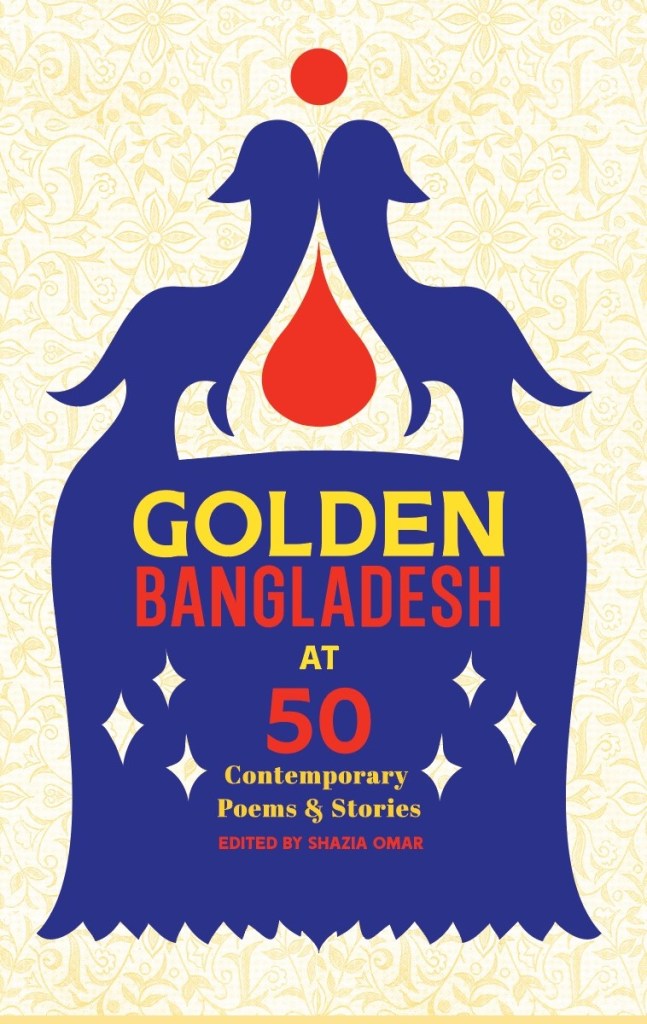
Golden Bangladesh at 50: Book Review by Aruna Chakravarti


Title: Golden Bangladesh at 50, Contemporary Poems & Stories

Editor: Shazia Omar

 Publisher: The University Press Ltd, 2021

The title of the collection of poems and short stories under review is apt for two reasons. First, that it derives from Rabindranath Tagore’s lyric Amaar Shonar Bangla … the national anthem of the country. Second, that the book has been published in 2021, the Golden Jubilee year of the formation of Bangladesh.

The political partition of Pakistan in 1971 caused one of the greatest convulsions in the history of the subcontinent. The Bengalis of Pakistan suffered barbaric violence and bloodshed because they valued their distinctive identity above everything else and refused to submit to a harsh regime’s determination to quell and subdue it. Civil wars have been fought before but never, in the history of mankind, over a language and culture.

Interestingly, Rabindranath’s poem, too, was written as part of movement led by him against Lord Curzon’s infamous Partition of Bengal bill in 1905. The intention of the government was clear. Bengalis were waking up to a sense of nationhood and coming together through the growth and spread of the Bengali language and literature. A blow had to be struck to curb it. And what could be more effective than division based on ethnicity and religion?

The editor Shazia Omar deserves our congratulations for bringing together a vast range of voices. Some are new and unknown, some old and established and some culled from across a wide diaspora. From New York, Chicago and San Francisco. From London, Rome, Toronto and Hongkong. This anthology, to use her own words is, “a way of honouring all that we have learned, yearned for, found and let go. To give our readers a sense of who we are now.” Accordingly, itencapsulates the joys and sorrows, hopes and aspirations, losses and anxieties of two generations of Bangladeshis both from home and abroad.

That partition trauma continues to shape the literature of Bangladesh is apparent from this volume. But the new enquiry has moved away from a nationalistic obsession with the horror of the event to a closer probe into people’s history through recollections of lived experience. Social, familial and personal attempts at restoration of identity seems to be the primary concern in these stories.

The contributions are all in English. The last few decades have been marked by a great deal of discourse about the decolonization of the language. In the past, much colonial creativity has felt throttled by the dominance of English as written and spoken by the ruling class. Today the fragmented pieces of the old empire are striking back with a vengeance. Each erstwhile colony has come up with its own brand of English. This book is a triumphant vindication of Binglish… tried and tested in the literature of West Bengal and Bangladesh. The volume is replete with cultural nuances. Phrases like eta ki, amaar kukoor, or naam, madhur hanshi and names of seasons and festivals phagun, boishakh, agrahayan, eid, nabanno are used freely without footnotes or glossary. The writers have felt no compulsion to translate kinship terms, exclamations and natural phenomena. English has triumphantly broken its original grammatical and syntactical mode and become a hybrid — both a native and a foreign language.

The issues examined in this collection are varied. Class struggle, patriarchy, dogma, superstition, displacement, loss and reclamation of identity. The characters are culled from a wide spectrum of society. From the very rich to the very poor; from the shamelessly privileged to the shockingly deprived. Such yawning gaps, some of the writers seem to imply, are a reality in Bangladesh even in its 50th year of Independence.

 Some stories depict a polarisation of power along the lines of gender. Women are victims of exclusion and varied forms of subjugation. Some are seen as trapped in the iron fist of a feudal order. A few others, westernized and seemingly empowered, share the same fate though the mode of suppression is refined and sophisticated.

Yet, that is not always true. Many of the stories are set in the bustling metropolis of Dhaka where women from all religions, classes and persuasions roam freely. The city is seen as a place of pluralism and diversity. One senses freedom of thought and action as well as a strong sense of belonging to larger whole.

The book is a rich multi-site ethnography that spans continents and traces personal histories and movements of Bangladeshis. It is a notable addition to the literature of the diaspora in that the stories present sensitively nuanced accounts of the East West encounter. In ‘Neighbours’, Nadeem Zaman explores the dilemma of a Bangladeshi woman trying to make a life in Canada during the Liberation war. Struggling against a harsh climate and what she considers an unloving culture, she is forced to pause and reflect when she becomes friendly with her next-door neighbour. She finds his identity troubling, since he seems to combine a sensitive, warm and compassionate outlook with a violent relationship with his wife and indifference to his daughters. The Other seems embodied in paradox.

 Neeman Sobhan’s ‘Bengali Lessons’ is a poignant diaspora story stretching across space and time. Employing a seamless mix of three languages, English, Bengali and Italian, she moves her story between two worlds and timeframes. Two eras run parallel. War ridden Bangladesh of 1971 and Covid afflicted Rome of 2020. The central character, a professor teaching Bengali to a group of Italian girls on Zoom, remembers her traumatic childhood, trapped in her grandfather’s house in 1971, and finds it astonishingly similar to her present-day situation in another country and another time. It is a severed world she remembers but one in which a Muslim child saves a Hindu soldier from an excruciatingly painful death.

Another excellent examination of child psychology is contained in Fatma Ahmad’s ‘Phultokka’ . Childhood is often considered to be the happiest phase of a person’s life. That the notion is far from the truth is seen in the mental struggles, failed aspirations, jealousies and misunderstandings suffered by the intelligent and sensitive teller of the story. She is called Taalgaach (palm tree)a derogatory reference to her height and complexion, by the school bullies. Why do bullies bully? Why can’t some children, especially exceptional ones, cope with the real world and retreat into an inner one, while others have no difficulty in merging and being part of a larger whole? These are some of the questions raised in the story.

 ‘Charaiveti’ and ‘Kalpanta Sthayina’ by Lubna Mariam, derive from the ancient Hindu texts Rigveda and Hitopadesha. The first describes an undefined urge to go on a journey without a destination. Man’s existential freedom drives him towards an imagined Utopia. Keep going,” the sages say, “because life itself is the journey; an inner journey from darkness to light, from ignorance to knowledge”.

Kalpanta Sthaniyah is a Sanskrit phrase meaning enduring till the end of the Universe. A grandfather’s replies to his grandchild’s innocent question about where the river comes from and where it goes, encompass deep philosophical concepts. He speaks of beginnings and ends, past and present, old and new…flowing in an unbroken stream. A glorious merging in the free flow of time. An unending celebration of life.

I conclude with a few words on the poetry section. From the whimsical effusions of ‘Ode to a sari’ to evocations of sights, sounds, smells, taste and feel of their beloved country in ‘Daydream’ ‘Midnight blues’ and ‘For you’, the writers offer a carpet rich with colour and design, light and life. Capricious and fanciful at times, a glimpse of truth is invariably offered at the end of each poem.

 Zeesham Khan’s ‘Banglar desh’, one of the best of the collection, portrays the generosity and compassion of nature as against the callous brutality of the human race. Here is a personification of nature that is amazingly poignant, graceful and symmetrical. The world pulsates with life. Trees have flesh and blood. All organisms speak; feel pain and pleasure. An achingly immediate, hauntingly sensuous, world! The all too real river under a canopy of moon and stars. Paddy fields, bamboo shoots, wild flowers, butterflies and moths. Should not all meld together with humans to make a complete whole? But does such a whole exist in the universe? The writer thinks not. He deplores…

I have seen blissful harmony pause
To give way to aggressive survival
And humans being homo sapiens
Unencumbered by unnecessary compassion.

Glossary:

Amaar Shonar Bangla –My Golden Bengal.

eta ki, amaar kukoor, or naam, madhur hanshi – what is this, my dog, or name, sweet smile

Phultokka — A game played by children. Phool means flower and tokka, touch. One child is blindfolded while others touch the youngster lightly. The blindfolded child has to guess who the person is.

Aruna Chakravarti has been the principal of a prestigious women’s college of Delhi University for ten years. She is also a well-known academic, creative writer and translator with fourteen published books on record. Her novels JorasankoDaughters of JorasankoThe Inheritors have sold widely and received rave reviews. Suralakshmi Villa is her fifteenth book. She has also received awards such as the Vaitalik Award, Sahitya Akademi Award and Sarat Puraskar for her translations.

.

PLEASE NOTE: ARTICLES CAN ONLY BE REPRODUCED IN OTHER SITES WITH DUE ACKNOWLEDGEMENT TO BORDERLESS JOURNAL