Meredith Stephens sails the rough, dark seas
“Alex, I’m scared.”
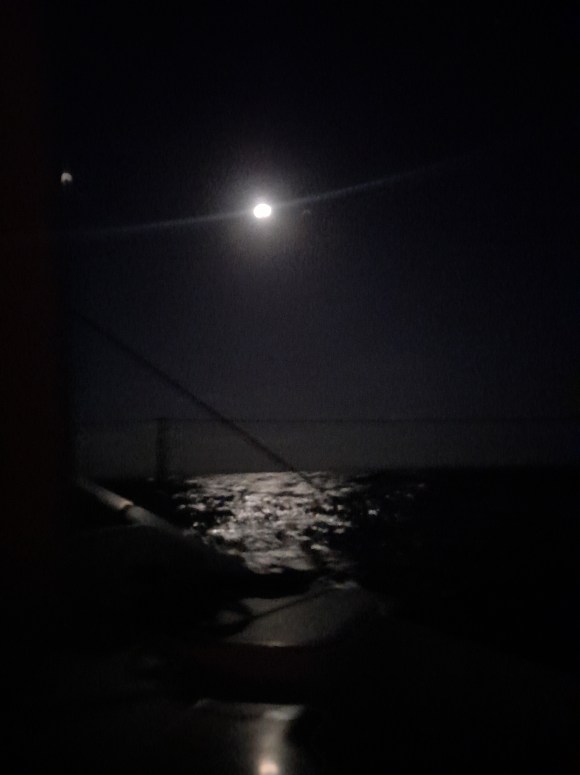
I looked out at the waters beyond the stern. The black waves danced in the moonlight. The swell pushed the boat in all directions, slapping against the water. I was unable to move around the boat without planning every movement. Thankfully, all the edges were rounded so even if I bumped into something I would not get hurt. I had remained in my pyjamas all day because I was unable to stay still enough to open drawers, retrieve clothing, and get dressed. I was unable to comb my hair because walking to the cupboard and retrieving my comb was too hard given all the bumps. Our bags had all fallen to the floor.
“I’m not scared,” replied Alex.
He looked at me straight in the eye. Suddenly I knew that it was not dangerous. If not dangerous, it was uncomfortable, but as far as Alex was concerned, we were not in danger.
We had left False Entrance off the mid-west coast of Western Australia at 4 am. There was an easterly wind predicted at this time. At 3 am, the anchor alarm had sounded. Alex rose and confirmed that this was because of the wind change. He spent thirty minutes trying to raise the anchor because the windless was malfunctioning. I could hear the anchor chain churning above the cabin where I was lying. Alex had to raise it by hand.
“At least I’ve done my morning workout!” he quipped.
Then I heard the motor turn on, and before long we left the safety of False Entrance for the swell of the Indian Ocean. The easterly blew for several hours pushing us south but then changed direction. This required us to head away from shore towards the Abrolhos Islands. Once the wind shifted Alex had to turn the motor on, and we thumped across the swell. Because of the high cliffs lining the mainland coast there would be no bay to shelter in for twenty-four hours. This wild stretch of coastline had claimed dozens of ships since Dutch vessels first arrived in the 1600s.
“What’s our latest estimated time of arrival?” I asked.
“The forecast was off, so we won’t be at Port Gregory until 3 am.”
We continued riding across the slapping swell. All I could complain about was the discomfort. I knew from Alex’s tone that we were not in danger, and we need not worry. He remained at the helm until we were safely at Port Gregory, while I rested in the cabin and braced myself for every slap against a wave. I put two pillows under my head to cushion myself.
I heard the familiar dropping of the anchor and realised we must be in Port Gregory. Alex spent the next ten minutes making everything ship-shape before going to bed. I looked at my phone. It was 2.57 am. Our voyage had taken almost 23 hours.
“It was tedious,” was his only complaint the next morning. Not scary, uncomfortable, or exhausting. Just tedious, in his typical understated way.
We gratefully slept until the sun forced its way through the cabin hatches at 8 am, and then, we roused ourselves for a comfortable breakfast at anchor. The skies were blue, and the waters calm.
“The wind is in the right direction. We’ll get to Geraldon in five or six hours. We should be able to sail the whole way, without motoring.”
How could the wind change so suddenly? How was it possible to have capricious winds one day and friendly ones the next? Alex raised the sails, and for the next six hours the wind ushered us on our way. Instead of erratic slapping, the keels produced a regular whooshing sound. The bucking bronco[1] had turned into a docile, ageing Clydesdale[2]. The first sign of the approaching Port of Geraldton was bulk carriers anchored out at sea, waiting their turn to load grains for export. As we entered the bay we had to make our way through the massive channel markers and dodge the lobster pot buoys. Once in the bay, we were greeted by live music from the amphitheatre on the shorefront lawns. We heard the sound of children playing in the water, on the beach, and on the playgrounds.
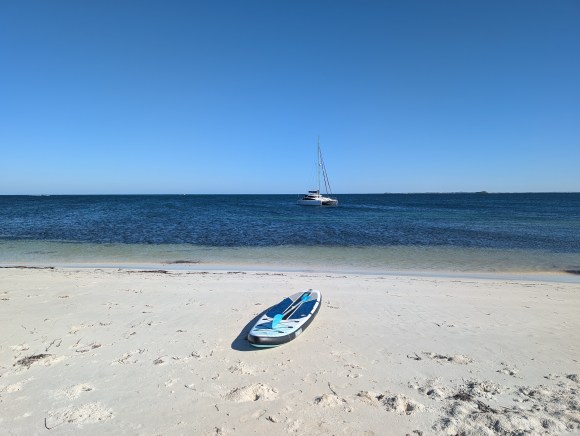
Alex anchored and by this time the windless had stopped malfunctioning. We then lowered the paddleboard. Alex knelt at the rear and I at the front, relieved to dismount our steed of the seas. I held myself steady as he paddled firmly behind me to the shore. We alighted at the sand, pulled the paddleboard to a safe height, and washed the sand off our flip-flops under a tap. A wall of hot air from the land accosted us, and the ground continued to gently canter beneath us as our bodies recalibrated to being on terra firma. Our discreet entry on the paddleboard had attracted no attention. We walked past children playing in the foreshore fountain, found a place to sit on the lawn alongside other family groups, and tuned in to savour the comforting 1970s pop music being performed by the live band.
.
[1] A partially or untrained horse used in rodeos
[2] A Scottish breed of heavy draft horse
Meredith Stephens is an applied linguist from South Australia. Her recent work has appeared in Syncopation Literary Journal, Continue the Voice, Micking Owl Roost blog, The Font – A Literary Journal for Language Teachers, and Mind, Brain & Education Think Tank. In 2024, her story Safari was chosen as the Editor’s Choice for the June edition of All Your Stories.
PLEASE NOTE: ARTICLES CAN ONLY BE REPRODUCED IN OTHER SITES WITH DUE ACKNOWLEDGEMENT TO BORDERLESS JOURNAL
Click here to access the Borderless anthology, Monalisa No Longer Smiles
Click here to access Monalisa No Longer Smiles on Kindle Amazon International
 Borderless