By Farouk Gulsara
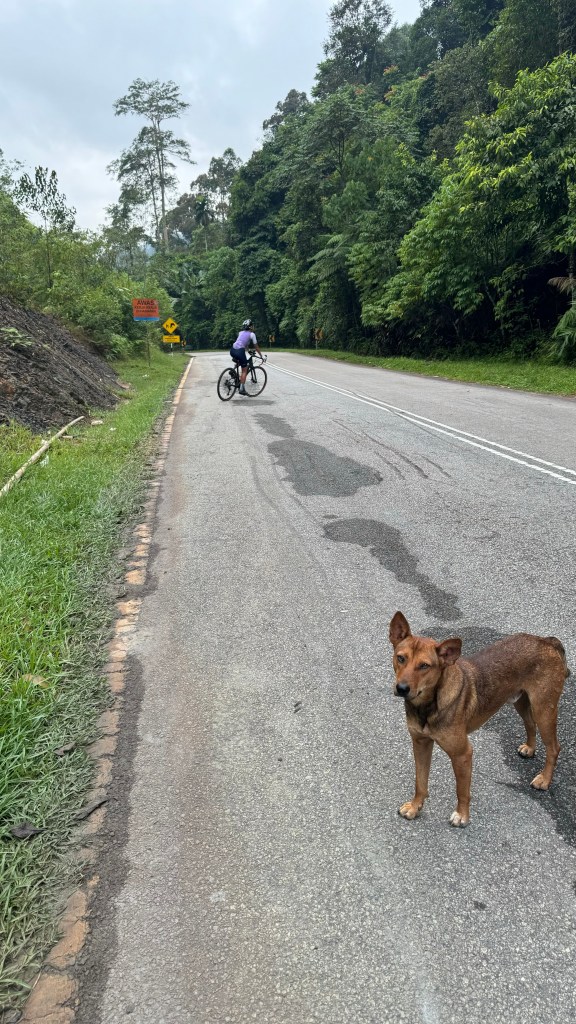
During my early days of cycling, as I trained during the early hours before dawn, my greatest fear was not the darkness. Beyond fearing fear itself, the next thing that frightened me was the possibility of a head-to-head encounter with a pack of stray dogs that throng the country roads leading up to Genting Peres, the border between the districts of Hulu Langat in Selangor and Jelebu in Negeri Sembilan.
The dogs are not from the wild. Some of these ‘man’s best friends’ served as guard dogs for the numerous orchards and homes of indigenous dwellers along the valley. A few packs of dogs must have been abandoned by their owners for various reasons. In Malaysia, a peculiar tradition during the Lunar New Year is to adopt animals based on the celestial animals associated with that year. Dogs, rabbits, and pet roosters are highly sought after until the excitement of the new year diminishes. Afterwards, people often look for ways to discard their pets. Where do you think they end up? Here, at the edge of civilisation. Fortunately, tigers and dragons, which are also animals in the Chinese calendar, cannot be kept as pets for obvious reasons. Imagine abandoning these creatures into the wild after the flavour of the month!
Over time, we occasionally hear of dogs attacking cyclists or cyclists falling off their bikes after being harassed by these canine creatures. The interesting thing about these wild animals is their need for vigilance. Creatures of the wild generally live by the rule of survival. They base their behaviour on constant vigilance. In a universe where ‘might is right’ and the law of the jungle dictates that the winner takes all, a misjudgment could be their last. Their default behaviour is to establish dominance in any given situation. If the opponent appears uncertain, frightened, or even runs away, the animals will try to assert dominance. Conversely, if they seem disinterested or exude confidence, the wild animals will likely just slither away. It is all about exerting dominance, marking territory, and size—these really matter.
Imagine a child who, after being frightened by the appearance of a stray animal, immediately reacts with fear and runs away. This kind of submissiveness can be easily detected by predators. It is 101 in their survival toolkit. Next comes the attack. The more one bows, the more he will be smacked down. This is the law of the jungle before Earth became civilised, but is it relevant still?
We like to believe that civilisation ushers in less violence. A civil society is meant to resolve conflicts through negotiation and arbitration. The higher one climbs the ladder of education, the less one resorts to swords and machetes to prove one’s point. At least, that is the belief we have been taught.
We were also told that we are not the sole owners of the planet. We share it with other beings, both human and non-human, to pass it on to the next generation in the pristine condition in which we received it. Every being deserves its place in the Sun.
Someone from my secondary school WhatsApp group recently sent a gruesome video of a toddler being mauled by a stray dog on a busy street. It is unfair to speculate about the events that led to the incident, but suffice it to say, rabies is quite rare in the community, and the dog was quickly captured and probably put down.
The whole fiasco brought to mind the recent ruling of India’s Supreme Court on stray dogs[1]. After a six-year-old girl died from rabies following an attack by a stray dog in Delhi, society recognised the seriousness of the stray dog problem in India. There are about 15 million stray dogs in that country [2]. The Supreme Court decreed that all strays should be removed from the streets and be vaccinated, neutered, and placed in shelters permanently.
What followed was a farcical display of comedy. Animal activists were furious, accusing others of cruelty for confining animals in cages. The highest courts reversed their decision and allowed the dogs to be returned as strays after sterilisation and immunisation, as if that would reduce dog attacks. Perhaps if the gonads are removed, they would be less aggressive.
Many talk shows and YouTubers appeared in the media, debating the issue and trying to find common ground. Some activists may have lost perspective, forgetting that human lives are involved. They personify the stray animals, attributing more importance to them than to children, and prioritise animal rights and freedom. Some animal enthusiasts even link animal aggression to human behaviour. In my books, children and human lives may take precedence over animals. Some conspiracy theorists went so far as to say that PETA [3]and animal sympathisers are foreign agents to discredit India and maintain the Indian demand for rabies vaccines.
The rising sales of pepper sprays only confirm that we should be more wary of fellow humans than other beings[4]. The increasing avenues for ladies (and men) to call for help in case of domestic or sexual assaults do not speak well of our ‘civil’ society. The ongoing stories about horrific crimes further serve as evidence of these crimes[5]. Leaders whom we elected democratically to protect us are determined to turn the world upside down, aligning with the military-industrial complex. They seek to wage war, not to promote peace. They play the fiddle while their capital goes aflame. They indulge in cakes when the common man has no bread.
We may convince ourselves that we, as a society, have become less violent. As a hunter-gatherer, our lifetime chance of a violent death was close to 15%[6]. In modern times, however, despite years of introspection, aggression still occurs. A growing concern is violence against oneself in the form of suicide, war and genocide against others due to differing ideologies, homicide for self-interest, and killing other animals for recreation. And we call ourselves cultured. Animals only kill for food, territory and mates for the continuity of the species. We do it for recreation during the hunting season, and for a psychopath, it gives him power, control, grandiosity and ecstasy with no remorse[7]. (6)
(P.S. Like how a mafia would walk into the neighbourhood and receive a cursory nod from the town folks, the pack of stray dogs and I have established a working relationship. They do their thing of barking and exerting authority, whilst I simply pass through unceremoniously. It is an understanding between a wandering dog and a cycling dog!)
[1] https://www.bbc.com/news/articles/c5yejnze4p1o
[2] ). https://visionias.in/blog/current-affairs/stray-dogs-management-in-india-balancing-public-safety-with-animal-welfare#:~:
[3] People for Ethical Treatment of Animals
[4] https://timesofindia.indiatimes.com/city/chennai/woman-partner-get-life-in-jail-for-killing-her-kids/articleshow/122888742.cms
[5] https://www.bbc.com/news/world-us-canada-46269794
[6] https://cliospsyche.org/articles/fuchsman-k-2014-the-complexities-of-being-civilized-clios-psyche-214-256-264
[7] https://leb.fbi.gov/articles/featured-articles/psychopathy-an-important-forensic-concept-for-the-21st-century#:
Farouk Gulsara is a daytime healer and a writer by night. After developing his left side of his brain almost half his lifetime, this johnny-come-lately decided to stimulate the non-dominant part of his remaining half. An author of two non-fiction books, Inside the twisted mind of Rifle Range Boy and Real Lessons from Reel Life, he writes regularly in his blog, Rifle Range Boy.
Disclaimer: The opinions expressed are solely that of the author and not that of Borderless Journal.
PLEASE NOTE: ARTICLES CAN ONLY BE REPRODUCED IN OTHER SITES WITH DUE ACKNOWLEDGEMENT TO BORDERLESS JOURNAL
Click here to access the Borderless anthology, Monalisa No Longer Smiles
Click here to access Monalisa No Longer Smiles on Kindle Amazon International

 Borderless