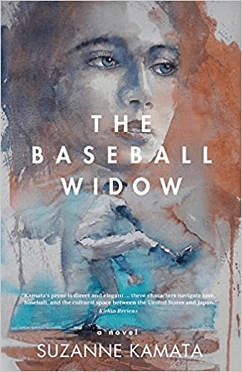
Title: The Baseball Widow
Author: Suzanne Kamata
Publisher: Wyatt-MacKenzie Publishing (2021)
Christine loved Trina’s oak table. She loved this kitchen with its American-sized refrigerator decorated with animal magnets and children’s art, its scent of baked bread, and the cross-stitch samplers on the wall. She loved Trina’s dishes, painted with blue Chinese landscapes, like the ones that she ate from at her grandmother’s house when she was a child. She remembered that once her oyster casserole or Thanksgiving sweet potatoes were cleared away, she’d wondered about the pagoda on her plate, wondered what it would be like to visit such a place. And then finally she had. She’d been to China, Thailand, Singapore, Malaysia, and of course, Japan, where she now lived. Ironically, although Christine had fled America in search of the exotic and adventurous, Trina’s Blue Willow patterned dishes, this room itself, now filled her with yearning for all that she had left behind.
“How was the send-off?” Elizabeth asked from across the table, snapping Christine out of her daydream. Elizabeth looked great, as usual. Even though she’d given birth just a little over a month ago, she managed to keep her bottle-blonde hair touched up, and her poplin blouses ironed and unstained. Right now the baby slept nestled in her arms.
Christine smiled. “It was fine. Nobody cried. Not even me.” She’d thought that sending her son off on his first day of elementary school – on foot no less, since the children were required to walk to school in groups — would have been more wrenching, but what she’d felt was mostly relief. For the first four years of her life, her daughter Emma had been in and out of hospitals, and then there was that one terrifying week when both kids were in the ICU at the same time with pneumonia. But now they were healthy and sturdy and ready to be out in the world. Plus, it was nice to finally have some time for herself.
Trina gently tapped a spoon against her “Support Our Troops” mug. “I hereby call this meeting of the American Wives’ Club to order,” she said.
Christine raised her coffee cup to Trina in a toast. “The American Wives’ Club” — AWC for short — wasn’t an official organization. There was no club secretary, no president. They got enough of protocol with the Japanese P.T.A. and Kodomo Kai and other Japanese mothers’ groups. In reality, the AWC was composed of the three of them – Christine, Elizabeth, and Trina, wife of a Japanese professor, whose two chestnut-haired children, not yet school-aged, were now under the table clawing at knees. Elizabeth’s eldest child, a daughter, was in the second grade at a private academy with an English immersion program.
Although coffee was enough of an excuse for a gathering, on this morning they’d gotten together to give Elizabeth a baby shower. According to Miss Manners, a baby shower was supposed to be held in the eighth month of pregnancy, but etiquette be damned; the members of the AWC put enough time and energy into keeping track of and adhering to Japanese customs (exactly how much to spend on a summer gift for one’s boss, where to stand in an elevator, which days were inauspicious for hospital visits, etc.). Sometimes a little anarchy was just the right thing. The belated celebration was also out of deference to Christine, whose daughter had been fourteen weeks ahead of schedule, during Christine’s seventh month of pregnancy. For days, weeks, months, Emma had struggled in an incubator at the university hospital, and they had all learned not to take a baby’s easy delivery and good health for granted.
The doorbell rang then, and Trina jumped up. “Oh, I forgot to tell you all. I met a woman at the library the other day. I thought she might like to join us. She’s Canadian, but I think we can make an exception. We can be the North American Wives.”
“Yes, of course,” Elizabeth said. “The more, the merrier.”
Trina went to open the door, and the others moved their chairs to make room for another guest. Their heads turned when a slender, pale woman with strawberry blonde hair stepped into the room. She held a little boy of about three by the hand. Christine could tell by his eyes and brownish hair that he was biracial (“hafu” as the Japanese said) just as all of their children were.
“Hi, I’m Sophia Lang,” she said. She extended her hand to Christine, and then to Elizabeth.
“Sophia has just signed on as an adjunct at Tokushima University,” Trina said. “Her husband is a scientist at Otsuka.” Christine nodded. They were all familiar with the pharmaceutical company, one of the area’s largest employers, and maker of that ubiquitous, ridiculously named sports drink, Pocari Sweat. Elizabeth’s husband worked there, too. “They just moved here from – where was it?”
“Maryland,” Sophia said. “My husband is originally from Tokushima. We thought it’d be nice for Kai, here, to get to know his father’s family better. And also, work on his Japanese language skills. My husband asked for a transfer, and here we are!”
She had that fresh-off-the-plane look about her. Christine had read somewhere about the stages of culture shock – she’d experienced them herself. First, was the euphoric falling-in-love stage, where everything was new and exciting. Pretty soon the shine would wear off, and irritation would set in. She’d get sick of having little kids point at her hair, and of people asking if she could use chopsticks. She’d discover that the bank machines closed early, at nine p.m., and that if she didn’t have her laundry out by eight in the morning (so late!), the neighbours would chat about her.
“Have a seat,” Trina said, ushering Sophia into a chair. “And Kai, maybe you’d like to go play with Misa and Kenta. Kids! Out from under the table! Show this nice little boy your toys!”
Trina’s two and three-year olds emerged, giggling and ran out of the room. Kai looked up at his mother for confirmation, before scrambling after them.
“Ah, peace at last,” Trina said, pouring coffee for Sophia into a University of Virginia mug.
They went around the table and introduced themselves.
“I’m Elizabeth Tanigawa, from Kentucky. I’m doing some research about expatriates in Tokushima,” she drawled. “I’m planning on writing a book or an essay or something.” She was always immersed in some project. For awhile, it had been indigo dyeing, and before that pottery, and even longer ago, she’d been obsessed with local folklore. During the latter phase, she’d compiled dozens of stories about trickster raccoon dogs, but she’d never tried to publish them. It was just something to keep her busy.
“Well, that sounds interesting,” Sophia said politely. “I didn’t know there were enough expats here for a book.”
It’s true that there were hardly any foreigners in Tokushima Prefecture. Christine had gone days without seeing another non-Japanese in the capital city, weeks, even. Although bridges now linked the island of Shikoku via sparsely populated Awaji Island with Honshu, there were no high speed bullet trains zipping across the island. There were few jobs for foreign women outside of teaching English or pouring drinks in hostess bars, and tourists from abroad rarely added the island to their agenda.
“Oh, but there have been lots,” Elizabeth said, and here, she nodded at Christine, “missionaries from South Carolina, an entire camp of German Prisoners of War, and there was also a Portuguese sailor who settled here and married the little Japanese girl that was his housemaid. Kinda like Madame Butterfly. There’s a museum about his life up on top of Mount Bizan.”
“A girl?”
“She was quite a bit younger,” Christine put in. “But she was an adult. I’m sure she knew what she was doing.” In truth, Christine thought the sailor, who appeared in photos with a long white beard, was way too old for his bride, but she suddenly felt perversely defensive of all things Tokushima. It was her home now, after all.
When it was her turn, she said, “I’m originally from Michigan, most recently from South Carolina. I’ve been living here for ten years. My husband is a high school baseball coach.”
“We call him the ‘imaginary husband,’” Trina said, “because no one has ever seen them together.”
Christine forced herself to join in the laughter, even though she was the one who’d first come up with the moniker.
“She’s a baseball widow,” Elizabeth explained to the bemused Sophia, who hadn’t been in Japan long enough to understand how demanding high school sports could be. There was no such thing as a baseball season. Once students joined the club, they were busy practicing and playing all year round. The only days off were during the ten days of winter vacation. The rest of the time, even during the “off-season,” from the end of October till about the beginning of February, they had training sessions every day after school and on weekends. Hideki was almost never home.
“I saw your husband on television,” Elizabeth said. “Just a couple of weeks ago. His team made it to the quarter-finals, didn’t it?”
Christine nodded. “Yeah, I was there. Up in the bleachers.” Before the kids had come along, she’d gone to all of his games, but they were too young to enjoy baseball. The one time she’d brought Emma to the stadium, she was dismayed to find that there was no wheelchair access, even though the arena was relatively new. She’d had to ask a couple of high school boys to help carry Emma and her wheels up the concrete steps, into the stands. And then of course, after glimpsing Daddy at the sidelines and waving furiously with no response, both Emma and Koji had grown quickly bored. Now Christine mostly watched the games on TV. Once the number of teams was whittled down to eight, the games were broadcast on the local NHK station, or at least public access TV. It was hard to concentrate, though, when Koji and Emma were grabbing at the remote control, pushing for cartoons. The other day, Christine had asked her mother-in-law to babysit so that she could watch Hideki’s team live. Even though they’d lost, she’d felt emotionally involved in the game. Being there made her feel closer to Hideki, almost as if they were in it together.
“Do you have any children?” Sophia asked, bringing her cup to her lips. Christine saw that her fingernails had been manicured. A diamond glinted off her ring finger. In a couple of months, she won’t be wearing that, Christine thought. She’d figure out that it was way too gaudy for rural Japan.
“Yes, two. A boy and a girl.”
“Do they go to school?” Sophia asked.
“Koji’s at Aizumi West. He just started first grade today.”
“And your daughter? You said you have a little girl?”
Christine nodded. “Her name is Emma, after Queen Emma of Hawaii.” Christine and Hideki had gotten married at a plantation on Oahu. Afterwards, they’d done some sightseeing around the islands, and Christine had become captivated by the biography of Queen Emma, who was both Anglo and Hawaiian – a multicultural woman who did good deeds, a mixed race royal. The perfect role model and namesake, Christine thought. “My daughter goes to the kindergarten at the School for the Deaf.”
“Oh!” Surprise and pity flashed across Sophia’s face. By now, Christine was used to apologies and embarrassment at the revelation of her daughter’s disabilities. She forced a smile to show that it was no big deal, that there was no need to feel sorry for them. Everything was fine!
“Have you thought about taking her to the States?” Sophia asked. “My husband and I had a little scare after an ultrasound, and we decided that if our child had any handicap, we would stay in the U.S. Japan is a couple decades behind in that area, isn’t it?”
Christine felt the blood rush to her face. “We’re keeping our options open,” she murmured, though that wasn’t exactly true. Hideki was passionate about his job and she would never ask him to quit. He had become something of a local celebrity. People respected him, just as they seemed to respect her for being married to him. Whenever she dropped by the baseball field, say, to bring Hideki his forgotten cell phone, or drop off Koji to “help out” with Saturday afternoon practice sessions, the players doffed their caps and bowed to her, the coach’s wife. It made her feel like a First Lady. More importantly, as a public school teacher, Hideki was assured lifetime employment, and he also had good health insurance. With a kid like Emma, you had to have ample coverage. Christine suspected that with all of her pre-existing conditions, Emma was uninsurable in the States. And last, but not least, as the only and eldest son of his widowed mother, Hideki was expected to look after her and act, when necessary, as head of the family, representing the Yamada clan at weddings and funerals that his mother didn’t want to attend. He had responsibilities.
Not every family had the resources – or desire – to up and move across the world every time circumstances changed. And yet, Christine had often wondered if Japan was the best place for their daughter. Or for their son, for that matter. At times, she thought they’d be better off in Sweden, where parents were required by law to teach their deaf children sign language. (Here in Japan, Hideki was too busy to study anything but baseball stats, and Christine often had to interpret between father and daughter.) Other times she fantasized about moving to Hawaii, where multicultural was the norm.
“Well, then, ladies,” Trina said, clapping her hands together. “I think it’s time for some games.”
About the book:
When Christine, an idealistic young American teacher, meets and marries Hideki Yamada, an aspiring Japanese high school baseball coach, she believes that their love with be enough to sustain them as they deal with cultural differences. However, Hideki’s duties, and the team of fit, obedient boys whom he begins to think of as a surrogate family, take up more and more of his time, just as Christine is struggling to manage the needs of their multiply-disabled daughter and their sensitive son. Things come to a head when their son is the victim of bullies. Christine begins to think that she and her children would be safer – and happier – in her native country. On a trip back to the States, she reconnects with a dangerously attractive friend from high school who, after serving and becoming wounded in Afghanistan, seems to understand her like no one else.
Meanwhile, Daisuke Uchida, a slugger with pro potential who has returned to Japan after living abroad, may be able to help propel Hideki’s team to the national baseball tournament at Koshien. Not only would this be a dream come true for Hideki, but also it would secure the futures of his players, some of whom come from precarious homes. While Daisuke looks to Hideki for guidance, he is also distracted by Nana, a talented but troubled girl, whom he is trying to rescue from a life as a bar hostess (or worse). Hideki must ultimately choose between his team and his family.
The Baseball Widow explores issues of duty, disability, discrimination, violence, and forgiveness through a cross-cultural lens. Although flawed, these characters strive to advocate for fairness, goodness, and safety, while considering how their decisions have been shaped by their backgrounds.
About the author:
American Suzanne Kamata has lived in Japan for over thirty years. She first arrived in Tokushima Prefecture as an Assistant Language Teacher in public schools. In her second year in Japan, she met her husband, a Japanese high school teacher (and later, high school baseball coach). While raising twins, she wrote and published Losing Kei (Leapfrog Press, 2008), her first novel for adults. Since then, she has published several more award-winning books including the novel Gadget Girl: The Art of Being Invisible (GemmaMedia, 2013) which was awarded an Asian Pacific American Librarians Association Honor Award for Young Adult Fiction; Indigo Girl (GemmaMedia, 2019), winner of a Gold Nautilus Award and an SCBWI Crystal Kite Award; and Squeaky Wheels: Travels with My Daughter by Train, Plane, Metro, Tuk-tuk and Wheelchair (Wyatt-Mackenzie Publishing, 2019) winner of a CIBA Hearten Award and a Next Generation Book Award. She is an associate professor at Naruto University of Education.
.
PLEASE NOTE: ARTICLES CAN ONLY BE REPRODUCED IN OTHER SITES WITH DUE ACKNOWLEDGEMENT TO BORDERLESS JOURNAL

 Borderless