By Dolly Narang

With him are Dolly Narang (who conceptualised the show) and others. Fifty one artists from all over the country were invited to participate. The exhibition included M.F. Husain, Raza, Ganesh Pyne, Paritosh Sen, Arpana Caur, Vivan Sundaram along with promising and emerging artists. Photo provided by Dolly Narang
It was 1989 when I turned my passion for art into reality by opening The Village Gallery. My experience from conceptualising till the launch of my new initiative, as I negotiated unchartered waters, brought me in contact with artists and the art world. And I had some interesting experiences as I began to fathom the nuances of this unique field.
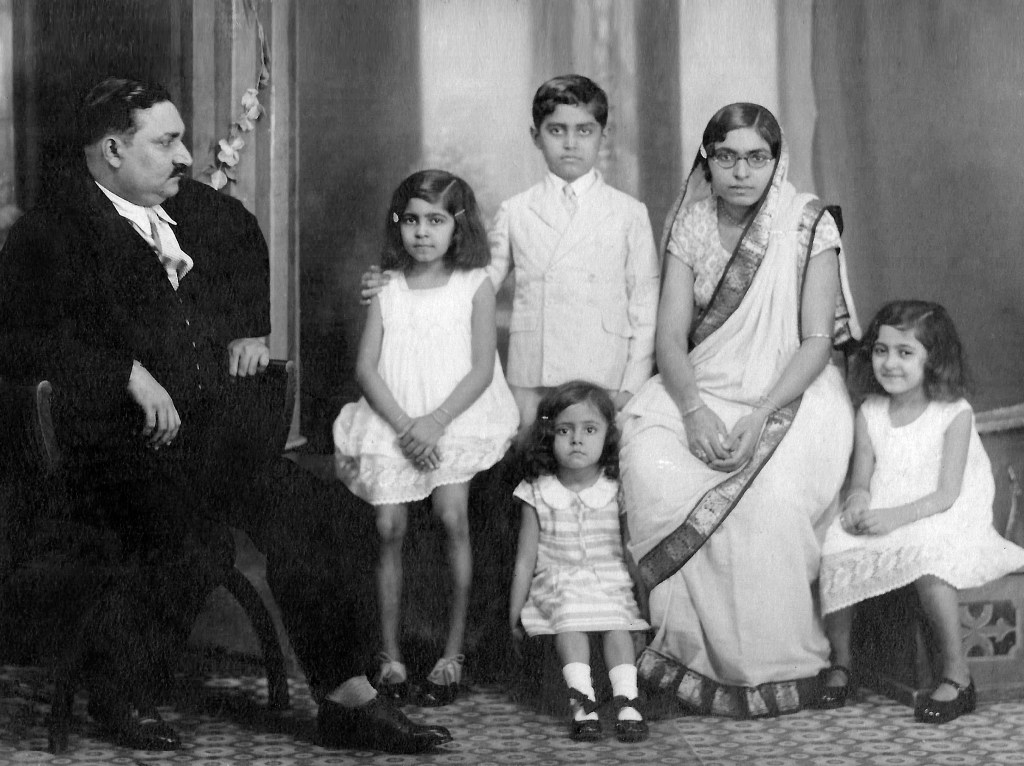
Growing up, I was a dreamer living in my own world of happy make believe. Enveloped by the warmth and attention of my joint family I was the cherished firstborn of my parents and my grandfather, Bauji[1]. Their adoration wrapped me in a cocoon sheltering me from the outside world. I grew up safe, protected and loved in our home in East Patel Nagar in West Delhi.
My mother laid claim to my creative spark. She revealed one day that while she was in the serene hills of Shimla with her parents as she carried me, she was learning how to paint. My mother proudly attributed my artistic side was all because of the genes passed on from her. Her creativity much later matured into fashion design and she became a successful fashion designer in the 1960s opening a high fashion boutique catering to New Delhi’s expat and diplomatic community. Her design skills were honed. She was much ahead of her time.
My Naniji[2] embroidered sequins and beads (maternal grandmother) on small evening clutch bags as gifts. That was her passion as it helped to overcome the grief of the loss of my grandfather who passed away suddenly in his mid 40s following the Partition and the trauma of 1947, when the Indian subcontinent was split into two. My Uncle, my father’s youngest sibling, unleashed his photographic skills to capture my childhood. He won a prize for one of these photographs.
I remember as a child being fascinated by Bauji making decorative paper lanterns. He used fragile kite paper of vibrant green, pink and yellow, slowly and meticulously applying glue on the paper to paste them onto thin bamboo sticks. I must have been four or five years old. The memory is so clearly embedded in my consciousness. He was a banker with a hectic work schedule involving travel. Our family had been uprooted during the Partition from Lyallpur in 1947 and we were in the throes of resettling ourselves. Yet, he found time to follow his creative calling.
As a child, I was fascinated by art and spent hours by myself doodling and drawing. Growing up, I have fond memories of my art class when I was in 7th or 8th grade in school. This was my happy space. My art teacher, Mrs. Dorothy Rahman, I remember was helped me to nurture my creativity with kindness and patience. She gave me special permission to work in art class during lunch hour. I loved working with my hands. Feeling the clay between my hands was exhilarating so clay was my chosen medium. Mrs. Rahman gave me a piece of soapstone a soft material and chiselling tools to chisel. This new medium opened up thrilling moments of more exploration.
My class had some students who were naturally gifted. Their effortless creativity left me feeling somewhat inadequate. At the same time, this pushed me to work harder to hone my skills. The confluence of my family’s creative influences and the circumstances unfolding before me led me to dream of starting an art gallery and I did do exactly that.
I nurtured a desire to start my gallery with the art of the famed MF Husain. Though it seemed an impossible dream, it happened. I went ahead and I shared my idea with Arpana Caur, my childhood playmate and college mate who had made a niche for herself in the art world and received recognition as a painter of great talent and promise. Caur encouraged me to chase my dreams. The first one person show at my newborn gallery was of Husain serigraphs and lithographs. It was a coup of sorts if I may say so myself for a new and unknown gallery and it stirred some excitement.
When I tried to contact him, Husain Sahib finally answered the phone. The conversation was polite and formal. He gave me appointment at his Canning Lane residence in Delhi, a charming colonial style government accommodation.
I had been warned of his proclivity for not arriving on time or not showing up at all. I reached his house expecting in all probability not to find him there.
His single storey home lay in a verdant environment. I was seated in a simple and well-appointed living room surrounded by vibrant colors of his paintings adorning the walls. Without keeping me waiting, a towering, calm and dignified figure emerged from the adjoining room. I introduced myself somewhat timorously trying to read his expression as I spoke. I remember saying, “Husain Sahib, I am planning to open a gallery in a new location, Hauz Khas Village. I would like to have a show of your limited-edition prints. I won’t be able to buy your works though. I was wondering if it would be feasible to pay for the prints once they are sold at the exhibition.”
This was the general tone of my brief monologue as he listened politely and patiently. I waited anxiously for his response. There was none.
Our meeting must have lasted fifteen minutes with mostly me muttering something to prove my credentials and at the same time trying to gauge his reaction as I continued with my monologue.
Once I finished talking, he stood up and walked into a room attached to the living room where we were sitting. I waited, confused by his disappearance. Soon he emerged with a thick roll of black sheets and handed it to me saying you can have a show of these prints. I accepted it in complete disbelief. Thanked him and left. I thought later that I did not give my contact details and neither did he ask for them. This was my first meeting with MF Husain.
Once the gallery interiors were ready I requested Husain Sahib if he could come to see the new space and give his suggestions before the inauguration. He arrived on the appointed day accompanied by his son Mustafa, a tall and dignified young man who came with a camera slung around his neck.
Both father and son walked around the gallery silently. It had a raw rustic interior with a cement floor and lime washed walls. I waited for their reaction, not quite sure how they would respond to the raw rusticity of the environment both internal and external. To make matters worse, a buffalo belonging to a villager put its head through the entrance door and snorted loudly. ‘This is all I need,’ I thought, ‘especially when I am trying to make an impression.’ Just as I was going to apologize, to my surprise Husain Sahib smiled and softly said, “That’s nice.”
Mustafa added: “My father loves the rustic environment”. Both lingered for a while enjoying the peaceful and unpretentious village setting as Mustafa took photographs.
While planning the execution for the show of his graphics, I had the opportunity to interact more frequently with Husain Sahib. He wanted the show to have the title ‘Husain Graphis 89’. “The word graphics to be spelt without a ‘c’, as it is spelled in French,” he said. Cards were printed announcing the exhibition of “Husain Graphis 89”. As the exhibition cards were delivered to their addressees, I was inundated with calls advising me that the word “graphics” had been misspelled in the card. I had a lot of explaining to do in call after call.
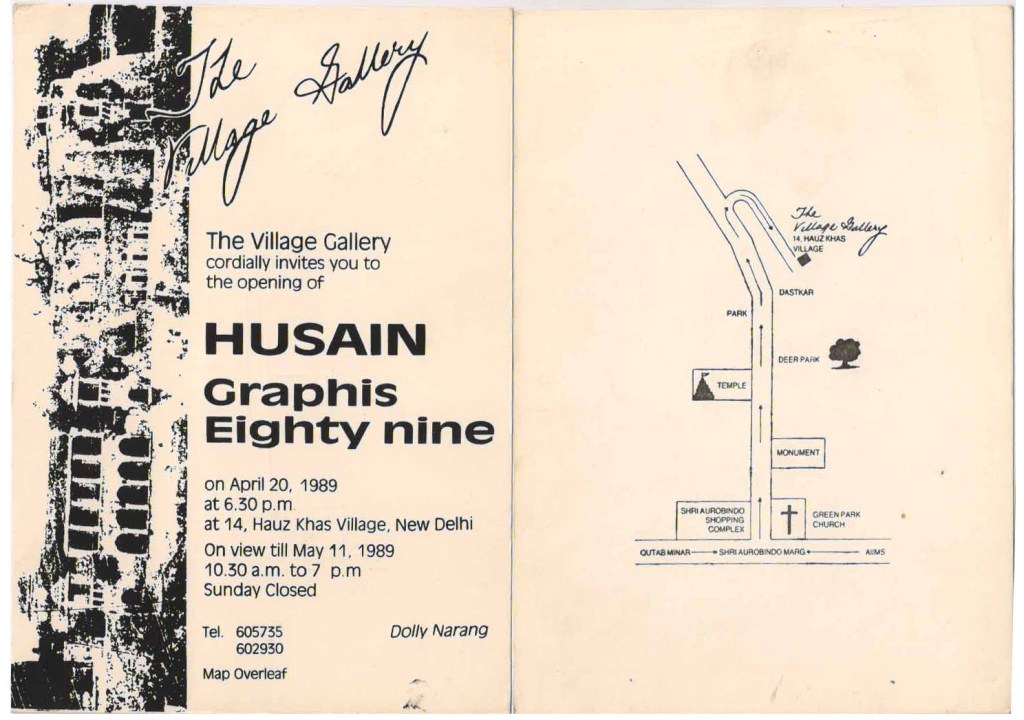
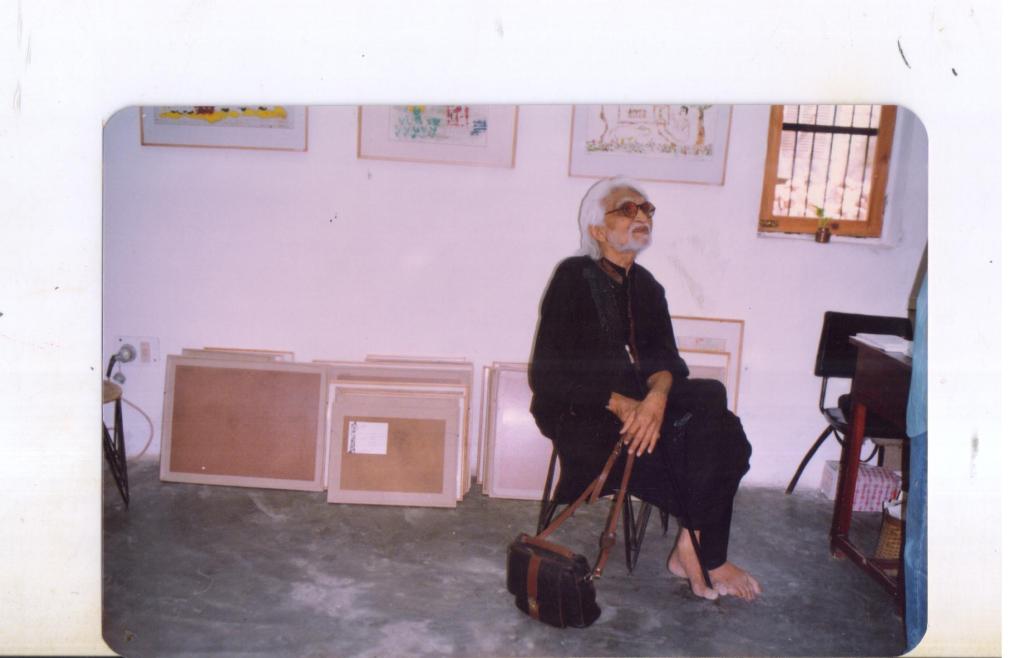
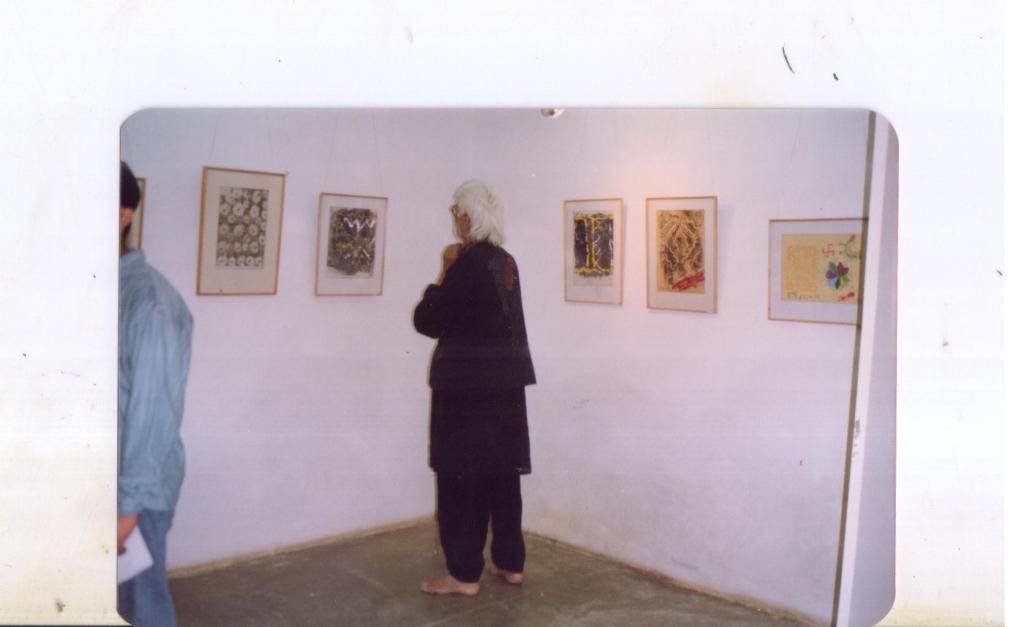
The prints were up on the gallery walls. A few days before the opening of Husain Graphis ‘89, the artist himself visited the gallery. As he made himself comfortable in the midst of his serigraphs and lithographs, he said something that has stayed with me as a source of guidance ever since. He waved his hands gently across the wall and said: “Make the walls of your gallery something that every artist will be proud to hang their works on.” These words illuminated my path forward as I was inspired to conceptualise a series of shows which went onto make history.
The inauguration of Graphis’ 89 was done by SK Misra, the Secretary of Tourism at the time and a close friend of Husain Sahib’s. He had wanted him to inaugurate the show. Husain Sahib flew off to Bombay the same evening so was not present at the inauguration. Of course, we were all disappointed. The inauguration was on schedule with Misra painting a lamp on a canvas. This unique idea was suggested by the eminent scenographer, Rajeev Sethi. Misra was caught off guard when asked to paint a lamp instead of lighting it. However, he painted with the flourish of a seasoned artist.
There was a self portrait of Husain on display in Graphis’89 exhibition which had a thick red line running down the face. It generated much curiosity and many queries from viewers who wanted to know the deeper meaning behind the red line, expecting a profound philosophical response about the artist’s thoughts or his life experience behind this. During a visit to the gallery, I mentioned to Husain Sahib that I was being asked repeatedly by visitors what was the meaning behind this thick and bright red line. He simply said: “I liked it and I painted it.”
The next exhibition that I curated in 1989 was ‘Self Portraits’. Twenty-four artists, from masters to beginners, were invited to showcase self-portraits in this exhibition held in October 1989. Husain Sahib loaned his self-portrait, an oil on canvas. Fortunately, Husain Sahib was in Delhi for the opening. He arrived walking barefeet down the kuccha[3] path leading to the gallery. Just a few feet ahead of the gallery he saw the Choudhry[4] of the village reclined on his charpai[5] smoking his hookah. Husain Sahib was so excited by this sight that he requested for the charpai to be shifted outside the gallery. I conveyed his request to Choudhry Sahib who immediately agreed and pulled his charpai over. Both Husain Sahib and Choudhry Sahib sat together on the charpai savoring the experience.
The guests at the opening, several of them old friends of Husain Sahib were surprised to catch him here. There was rambunctious camaraderie and backslapping in full public view on this village street. It occurred to him that he wanted to have his good friend and gallerist DV Chawla there. He requested that I send the car to pick him up from the Oberoi Hotel where his gallery was located. Delhi being free from the dense traffic that the city is afflicted with today, he arrived soon enough.
As Mr Chawla arrived, there was more lively celebration of old friendships. they all enjoyed the exhibition. The self-portraits were replete with humor or marked by self-mockery. Some were self-effacing while others, thought provoking
Husain Sahib joked that the real Husain was in the painting hung on the wall of the gallery and the flesh and blood sitting outside was fake.
The exhibition of self-portraits was followed by ‘The Other Ray’ in 1990, an exhibition of the graphic design, children’s drawings, and film sketches, set design drawings, film posters by Satyajit Ray. Together, we selected the works for the exhibition. In the process Ray was surprised to see all the work that he had created compelling him to remark: “I had forgotten I had done all this work.”
The opening was in October 1990. I met Husain Sahib to invite him for the preview. When he heard of ‘The Other Ray’ exhibition he asked me where the works were lying as he wanted to see them. I told him that they were lying at home and suggested it would be better to view them once they are properly hung in the gallery. But he was insistent on seeing them right away and didn’t want to wait for the opening. So, we drove to my house from AIFACs. He was overwhelmed to see the works and started to reminisce of his association with Ray. Unfortunately, I did not have a tape recorder at the time to record his thoughts but fortunately The Illustrated Weekly carried these reminiscences as an article in an issue. It’s a truly poignant piece filled with precious memories.
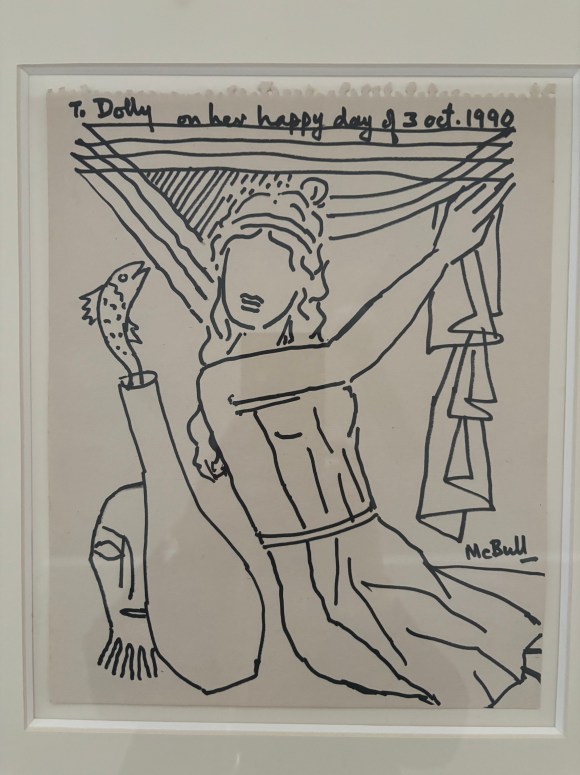
We got into the car to drive him home and had driven away for just a few minutes. All this while it was churning in my mind. Should I, should I not. But finally plucked up courage to tell him that it was my birthday a few days later and could I request him for a drawing.
He asked the driver to turn back to the house. He asked for sketch paper. And resting the paper on the bonnet of the car made a drawing.
These are some of the memories I am penning down here. There are many more…
.
[1] respectful address for an elder patriarch of the family
[2] (maternal grandmother)
[3] Untarred and uncemented path
[4] Village chief
[5] A cot made of a wooden frame and rope
Dolly Narang , a gallerist, has conceptualised innovative pathbreaking exhibitions. A recent student of sculpture, she has the satisfaction of experiencing both personal and spiritual evolution as a Pranic healer and as a grandmother.
.
PLEASE NOTE: ARTICLES CAN ONLY BE REPRODUCED IN OTHER SITES WITH DUE ACKNOWLEDGEMENT TO BORDERLESS JOURNAL
Click here to access the Borderless anthology, Monalisa No Longer Smiles
Click here to access Monalisa No Longer Smiles on Kindle Amazon International


 Borderless