Categories
Festive Special

Goodwill and Peace on Christmas

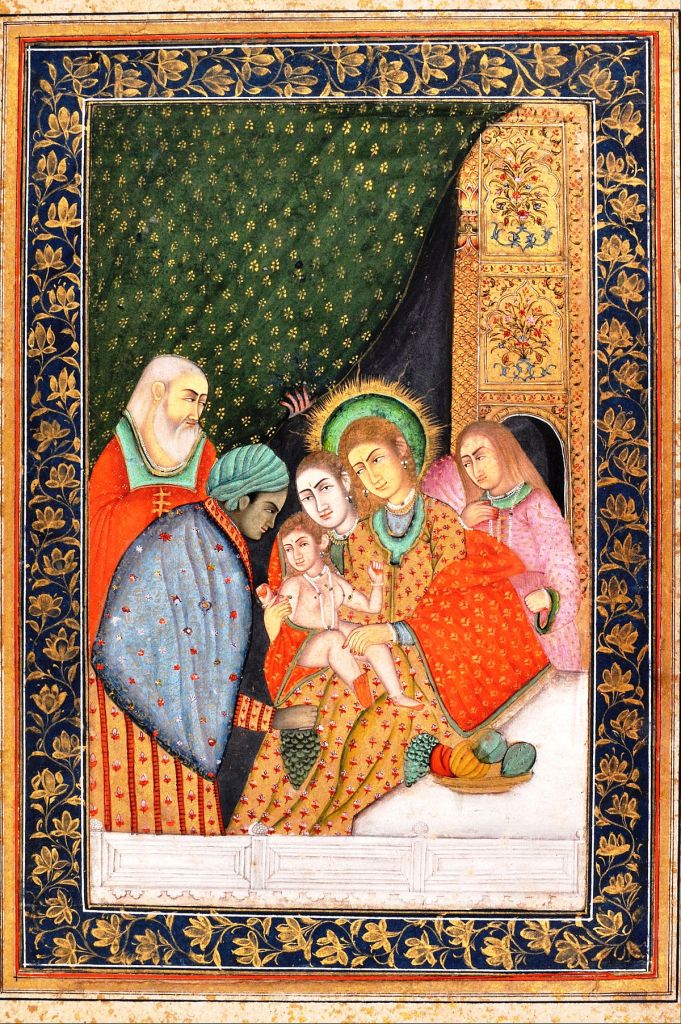
Nativity of Christ, painted in the Mughal empire, around 1800 AD

“The central celebration is the birth of a child. There is no culture that does not celebrate this event, because all of us who belong to the human race can see our collective future in the pudgy little face. We marvel at this conjuring act, the miniature miracle, at its tiny fingernails and budlike nose.” — Jerry Pinto, Indian Christmas: Essays, MemoirsHymns, an anthology edited by Jerry Pinto and Madhulika Liddle

Christmas centres around the birth of a child who impacted a large part of the world and urged us to love others despite differences, to be kind, to embrace those who suffered… and that is the spirit that continues to unite humankind to move towards a future where people thrive in harmony, with love in their hearts. Despite all the darkness that broods over the world, Christmas has come around. The sun still moves forward in time and at some point, the darkness will give way to light. Perhaps, Christmas will remind people of the values they need to uphold to live in a world that is not filled with fear, greed or the lust for power and they will stop killing ruthlessly and without any sense of coherence. With that in mind, we have tried to evoke the spirit of Christmas cheer by presenting writings that talk of celebrations.

This is a season that should be filled with hope, goodwill, peace and love. The celebrations — depicting variety, a departure from conventional norms — by writers who reach across borders and time, rekindle our belief in the wonder created by these values, which is what Christmas is all about. We start with Tagore, a Brahmo by religion but his poem in English dwells on the wonder he feels at the idea of this unique birth of Christ. Our other writers from across the world pitch in with what Christmas means to all of them, whether it creates a sense of goodwill, nostalgia, invokes curiosity or just evokes plain laughter. Hopefully, we can all join together to ring the bells of kindness, love, humanitarian help and peace this year!

Poetry

An excerpt from Rabindranath Tagore’s ‘The Child‘ a poem originally written in English by the poet to celebrate Christmas. Click here to read.

One Star by Ihlawha Choi. Click here to read.

Christmas Cheer by Malachi Edwin Vethamani. Click here to read.

Prose

Indian Christmas: Essays, MemoirsHymns, an anthology edited by Jerry Pinto and Madhulika Liddle has been discussed by Somdatta Mandal. Click here to read.

In I Went to Kerala, Rhys Hughes treads a humorous path while exploring Christmas in Kerala. Click here to read.

In Hold the Roast Turkey Please Santa , Keith Lyons writes from New Zealand, where summer solstice and Christmas fall around the same time. Click here to read.

In My Christmas Eve “Alone”, Erwin Coomb has a strange encounter on Christmas eve… Is it real? Click here to read. 

Nativity, a fresco by Italian artist Boticelli, created around 1467
Categories
Excerpt

Greening the Earth

Title: Greening the Earth: A Global Anthology of Poems

Editors: K. Satchidanandan & Nishi Chawla

Publisher: Penguin Random House

Preface

Humanity’s power to degrade the environment has become unprecedentedly dangerous. In fact, we have already changed the environment irreversibly, and suicidally so. What we call nature is no longer nature in its pristine glory. Human intervention has transformed it into something sub- rather than semi-human: a combination of climate, topography, the original environment and the effects of the long history of human intervention. If it was agriculture that had transformed the landscape once, it is now urbanization that has affected the broader areas of our environment. Managing the environment is becoming a practical rather than a theoretical problem. It is not enough that we create theme parks or conserve a select few areas. ‘Museumizing’ nature and landscape will not be enough. Several animals and birds are on the verge of extinction; the list is growing, and human beings can easily be next in the at-risk list. What we require today is not isolated action, but concerted action at the global level. Techno- fascism that leads to eco-fascism—both have their roots in human greed and aggression—is one of the inevitable fall-outs of blind and unsustainable patterns of development.

While a few poems in this anthology offer a perspective on how humans can respond to the reality of extinction, others give us an awareness of how we can struggle to keep what we still have. Some poems share earnest insights into our own evolution, and others offer grim warnings or raise voices against the imminent threat of extinction and the fate of our planet. Some poets spin interconnected incantations and weave healing nature through their blood, and others honor it by connecting the sustainable with their personal poetic bones. The environmental theme of most poems can inspire meditation as well as a commitment to apocalyptic action. The poets anthologized here offer landscapes of beauty and joy, of rustic retreat, of communion with our natural world, against the larger looming questions of human survival, of spurring towards conservation and preservation, of recognizing our ancestral knowledge, of a complicated pact and a complex impact. The anthology, in short, is our kind of shock tactic to the glaring lacunae within our urbanized, post-industrial society. What distinguishes us further, is that our anthology is a global chorus of poetic voices. We cannot stress enough the ‘sustainable’ route felt in the ‘sustainable’ poetic voices of our anthology. Along with our conscious eco warrior poets, Greening the Earth is our kind of responsible activism.

Extinction

Maren Bodenstein

here

on the prairie we measure

the years

by the extinction of insects

that visit our porch lamps

the brittle

longhorn is gone

for a while now the giant

stick insect no longer flares its scarlet wings even

the bluewhite chafers have succumbed

to the heat

by day we dwell in the creek

my sisters and I

one of us pregnant

but I keep forgetting

if it is me

look I am full term now

I tell them stroking my flat belly

on the horizon

a fire roars

through the grasses and over

the houses it marches

the last army of insects

into the bellies of storks

a confusion of vehicles

full of belongings flees

towards us

Ma in her car

with the poodle

comes rushing at us

get in she shouts

misses the bridge

plunges deep

we must rescue her

I tug at the metal

but my sisters

heavy with chatter

do not hear

Ma broken mermaid sneezes

opens her blue-eyes

happy

to see me

Beholden

Erin Holtz Braeckman

I come to you as Crow. But not before you first come to me. My bones are left like tinder in the dark ashes of my feathers when you find them. Crouching low in the crisp clutch of Spring the way the grandmothers once did, you speak words of ritual from the cave of folk memory you’ve walked right into without knowing. And you ask—before you hear my totem call from the pines high overhead; you ask before you slip one of my bones into your pocket. Because wrapped inside the song of that old teaching circle you stepped within was this telling: what you collect, you become the caretaker of. Not the thing itself, but its living story. Those crystals on your altar? You are the steward of their mountains. Those shells lining your windowsill? You are the custodian of their oceans. The pressed petals and dried acorns and vials of sand—the bones; in them there are entire fields and forests and feral ones of whom you are a curator. Which is why I come to you this time, a cackle-caw of shade-shifters stalking through your sister spruces. The others fly when you near, leaving me below in the corner fencing, the wing you took the bone from a tangle of black shadow throwing back the light. I feel the moment you are beholden, Crow-Keeper; how you fold the wild beating of my body into your hands, placing me like a stone on a cairn into the bracken beyond; how those grandmothers come to braid feathers into your hair.

(Excerpted from Greening the Earth: A global Anthology of Poetry, Penguin Random House)

About the Book:

Greening the Earth is a rare anthology that brings together global poetic responses to one of the major crises faced by humanity in our time: environmental degradation and the threat it poses to the very survival of the human species. Poets from across the world respond here in their diverse voices-of anger, despair, and empathy-to the present ecological damage prompted by human greed, pray for the re-greening of our little planet and celebrate a possible future where we live in harmony with every form of creation.

Editors:

K. Satchidanandan is a leading Indian poet He is also perhaps the most translated of contemporary Indian poets, having 32 collections of translation in 19 languages, including Arabic, Chinese, Japanese, English, Irish, French, German and Italian, besides all the major Indian languages. He has 24 collections of poetry, four books of travel, a full length play and a collection of one-act plays, two books for children and several collections of critical essays, including five books in English on Indian literature besides several collections of world poetry in translation. He has been a Professor of English, and also the chief executive of the Sahitya Akademi, the Director of the School of Translation Studies, Indira Gandhi Open University, Delhi and National Fellow, Indian Institute of Advanced Study, Shimla. He is a Fellow of the Kerala Sahitya Akademi and has won 52 literary awards from different states and countries, including the Sahitya Akademi award, India-Poland Friendship Medal from the Government of Poland, Knighthood from the Government of Italy and World Prize for Poetry for Peace from the Government of the UAE. His recent collections in English include While I WriteMisplaced Objects and Other PoemsThe Missing RibCollected Poems, Not Only the OceansQuestions from the Dead and The Whispering Tree: Poems of Love and Longing.

Nishi Chawla is an academician and a writer. She has six collections of poetry, nine plays, two screenplays and two novels to her credit. Nishi Chawla holds a Ph. D. in English from The George Washington University, Washington, D.C. USA. After teaching for nearly twenty years as a tenured Professor of English at Delhi University, India, she had migrated with her family to a suburb of Washington D.C. She has taught at the University of Maryland from 1999 until 2014. She is now on the faculty of Thomas Edison State University, New Jersey, USA. Nishi Chawla’s plays get staged both in the USA and in India.

PLEASE NOTE: ARTICLES CAN ONLY BE REPRODUCED IN OTHER SITES WITH DUE ACKNOWLEDGEMENT TO BORDERLESS JOURNAL
Click here to access the Borderless anthology, Monalisa No Longer Smiles

Click here to access Monalisa No Longer Smiles on Kindle Amazon International

Categories
Essay

Beyond Ideological Borders

By Anu Karippal

I was doing an interview with a retired college professor and Bharatanatyam dancer a few weeks ago for Humans of Kerala Instagram page. The interviewee, a teacher by the name of Gayathri, learnt to dance as a child, is a single mother and teacher, and when she was about to retire, resumed dancing and has performed widely in the last four years. Her voice was filled with the affection of a teacher and humility for her achievements. Something distinct in the interview was that, she was not a product of any -isms and ideologies that define our generation today — feminism, liberalism, environmentalism, activism, atheism etc. Gayathri was different. She belonged to another era when there were no burdens of ideologies for a layperson to attain something or establish an identity. She became a professor and a dancer and accomplished everything unbound by any ideological objective. She was only bound by her passion. Doing something or defining ourselves within an ideological framework was not popular back then as it is today.

This is not to discount the values such ideologies have enriched our lives with. Feminism empowered women and men. Liberalism opened up the rights discourse. Environmentalism educated us to own up to our responsibility towards nature of which we are a part. Activism taught us that we need to be a collective and make a little noise to stir meaningful and useful changes. I, as a girl, was sent to school just like my brother without a second thought because of the years of the struggle by the women who fought for it in the past.  Labour unions can challenge the exploitative and environmentally destructive changes because ideologies provided us with the sense of awareness of the power dynamics. To forget this is to undervalue the achievements of such struggles that have now given us a comfortable life. While it empowered us and made us better people in many ways, they also came with their limitations.

One must be aware of all of the above ideologies and question power in our daily life, what if in the attempt, our life becomes ideology-centric? When an environmentalist sees everything solely as an environmental issue or an activist sees everything solely as an issue or propaganda by state or corporate, one loses out on the other perspectives of seeing life and makes life a war to be fought. An old saying is worth remembering here, “If you look with yellow eye, everything will look yellow”. This can turn dangerous. Probably, this is something that the dance teacher, Gayathri, could have taught our generation — that we can do good, accomplish our passion without being ideologically assertive and let our life speak as our identity/ideology.

Perhaps, the rising interest to define our lives within dictates of any ideology has intensified with the intrusion of social media into every aspect of our lives, acquainting us with several ideas. I can vouch for it because I have done it too, and continue to do this over and over again. The way ideological battles are fought out in politics and public domain shows how listening to an opinion that is not in agreement with our ideological orientation is becoming an impossibility.

While opinions regarding public matters were left to a few earlier, it is in the hands of anyone with a phone and internet now. This has promoted inclusion of opinions, but it has also led to polarisation of identities and ideologies. Internet was supposed to uphold the spirit of democracy, but it has actually made people intolerable towards each other. There is a continuing loss of intimacy among people in the name of ideologies, easy judgement of people and the constant use of “unfollow” button that we easily press when somebody does not agree with our ideological thoughts on social media. We forget that we cannot press a “delete” button in the real world and that the world is always made of different people with different perspectives.

It took me three year-outside-academia life to begin to understand that life and its ways cannot be contained in any ideology. During my three-year stint at ATREE (Ashoka Trust for Research in Ecology and the Environment, Bangalore, India), my dear friend Kumar taught me several things on our post-lunch walks. Once our topic was feminism, its possible misinterpretations among men and women and how it might be taking the wrong track. I was immediately angry and asked him why.

He said, “These days sometimes women want to do something because men are doing it. The fact that you want to do something should drive your goals and not the question whether or not men are doing it.” He added, “Do you want to dance, sing, jump, swim, be a CEO, pilot, doctor, anything? Go do it. But do it because you want to and not because men are doing it.” It took me months to understand the gravity of what he was saying. This is not to imply that we shouldn’t ask questions regarding why men and women do different things or why we are different. Our question should be a quest to understand than to react. And our goals should emerge from our passion.

As I was sharing these thoughts with a friend, she told me that doing something for the sake of any ideology gives a “restricted contentment”. When you do something because you like it, it is a fulfilment, a larger contentment of inner peace and elation that cannot be fit into any ideology. If you don’t want to buy a pink doll because pink has largely been associated with feminine, that is a vain battle to fight. If you like a pink doll, buy it. If you want to reduce plastic use because capitalism has been environmentally drastic and overpowering, then it might not give you enough contentment. Reduce plastic use because you care immensely about nature and you want to do your part. If you decide to grow long hair because men have primarily been associated with short hair and wants to break the stereotype, that is a limiting happiness. Grow long hair if you like long hair. If a husband and wife begin to look at everything in life through rights and equality, then marital life might create tensions and frictions. One who mocks arranged marriages as traditional and one who mocks love marriage as modern both know that despite the nature of acquaintance before marriage, married life anywhere is filled with adjustments and compassion. Life is always beyond ideologies.

Once, as the man I first fell in love with and I were walking back after our class. I was walking on the pavement to his right, touching the road. He held my hand and moved me to his left side, away from the road. He wanted me to be safe and if anything happened, that I would be spared. We were just friends at that time, so I smiled inside, enjoyed how my heart had felt a free fall and walked with him. If I were to call this as an instance of benevolent patriarchy and tell him I can take care of myself, I would be being so unfair to that act of love and destroy my happiness and his.

Even if it were a power relation, can it be scraped off with a reactionary attitude like a stain on the plate? Probably we are then replacing one form of power with a politically correct, elegant looking form of power. How ironic! And this is one of limitation of any ideology. If we begin to look at every little thing through liberalism, feminism and rights discourse, then all we might see is inequality, power and our life can get burdening. If we look at it through love, respect and kindness, life can be easier to live.

How easier said than done, right! I try to let go of my personal ideological thoughts, but it is one of the most difficult things for me to do. In the few retrospective moments of thinking and writing, it is easy to appreciate that one must go beyond the ideologies to understand life. Difficult as it may be, we must still try to not let ideologies influence all our actions. Life can best be viewed in simple terms. At the end of the day, environmentalism, feminism, activism and liberalism can turn as restricting as capitalism and fascism if we don’t treat them carefully. Even the idea of freedom can be limiting and can bind us. Ideologies are as transient as anything else in this world. Yuval Noah Harari shows how the world has gone through different historical epochs such as imperialism, communism and now liberalism in 21 lessons for the 21st century.

Let’s ask questions to understand and not to react. If we approach anything with a predisposed reactionary attitude, we will merely spread our opinion on the matter before understanding it. If we do something in the name of an ideology despite wanting something else, our life wouldn’t be as fulfilling. This self-fulfilment is not be misunderstood as selfishness, but as the open-mindedness to see life beyond ideologies and live a fulfilling life.

An ideology can get twisted and turned and corrupted in no time. But staying true to your passion and dedicating your time and effort,  will give a certain contentment that is unparalleled. In one of his lectures, the Indian mystic, Sadhguru, despite his biases, refers to the thought that our minds are becoming a market place, where we weigh everything. The thought struck me. If we give something and expect the exact quantity in return in friendships and romance, we might end up being disappointed and angry at everything. Moving beyond ideologies; feminist, liberal, capitalist, activist, right-wing, left-wing etc. can probably lead us to a satisfied life. 

Social media is all intrusive. While it brings lost friends and families together and keeps the world functioning even as the pandemic struck, it also catalyses polarising identities and proliferation of ideologies. While we imagined our house or immediate locality to be the world before, now we imagine our self-curated social media to be the world. We follow and unfollow people to create a desirable world of similar ideologies that we can easily agree with and offer a collective critique of ideologies we disagree with. And we become intolerable of the vast differences of opinion in the real world. Paying attention to passion is probably more important and fulfilling than assembling a life out of ideology, only to be discounted by another ideology of sound arguments. Writer Howard Rheingold wrote: “Attention is a limited resource, so pay attention to where you pay attention”.

Anu Karippal is a student of Anthropology and Sociology at Graduate Institute, Geneva. She is from Kerala and she writes personal essays, movie reviews, short stories and poetry occasionally. 

.

PLEASE NOTE: ARTICLES CAN ONLY BE REPRODUCED IN OTHER SITES WITH DUE ACKNOWLEDGEMENT TO BORDERLESS JOURNAL