Book Review by Somdatta Mandal
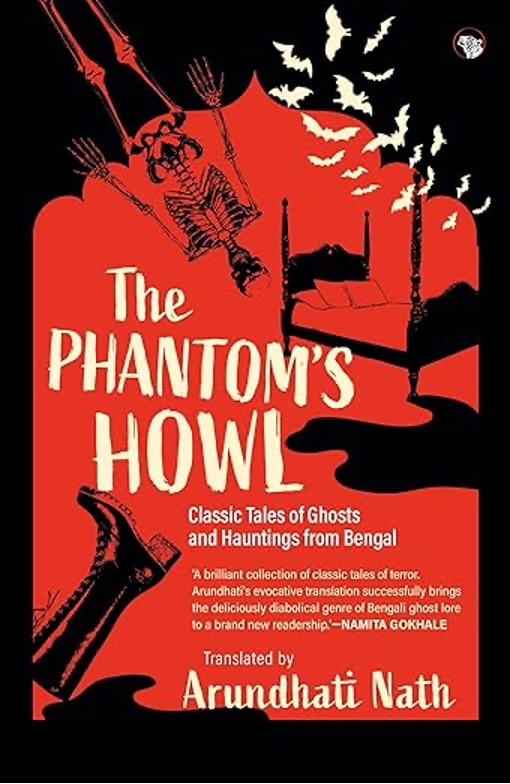
Title: The Phantom’s Howl: Classic Tales of Ghosts and Hauntings from Bengal
Translator: Arundhati Nath
Publisher: Speaking Tiger Books
Bengalis have always had a curious relationship with the supernatural and so stories of ghosts or bhoots are omnipresent in Bengali literature through generations. The Phantom’s Howl: Classic Tales of Ghosts and Hauntings from Bengal brings us a new collection to savour this genre once again. Written for adults and children by some of the best writers in the language, these stories have entertained generations of readers since they first appeared. Comprising eleven stories in all, from legendary authors such as Rabindranath Tagore, Bibhutibhushan Bandyopadhyay and Hemendra Kumar Roy (who contribute two stories each) to lesser-known writers like Jogeshchandra Bandyopadhyay, Niradchandra Majumdar and Amarendranath Munshi, the stories elucidate the supernatural elements in different forms. Manik Bandyopadhyay and Pramatha Chaudhuri, though well-known for writing in other genres, have also contributed their share in creating spooky tales.
Rabindranath Tagore’s immeasurable talent as a storyteller is well-known. In both Konkal (The Skeleton) where a vainglorious skeleton reminisces about her past beauty, and Kshudito Pasan (The Famished Stone), the supernatural element takes over in a slow burn and our understanding of the other-worldly is a cerebral exercise that is an interplay between emotion and intellect. Bibhutibhusan Bandyopadhyay’s repertoire of ghost stories is well-known. Two of his short stories about hauntings included in this anthology are Bhoutik Palonko (The Spectral Bed) and Paitrik Bhita (Paternal Legacy), and both have an enticing and intangible everyday quality in them. In the first story we are told of a mysterious cursed bed of a Chinese man whose dissatisfied soul still lurks every night and disturbs anyone who sleeps on that bed. In the other story, the generations-owned massive homestead of Radhamohan is inhabited by the ghost of a young girl Lokkhi, who happened to be their youngest paternal aunt who died at the age of twelve and she slips in and out of his conscious memory.
Hemendra Kumar Roy is known for adapting many Western writings of his time and creating his own brand of short stories. In his Bari Buro Bhoot (The House, the Old Man, the Hunting Boots), the ghost has ‘sahebi’ chops and in Bhooter Raja (The King of Ghosts), Mr. J. Taylor is a typical British Raj prop who being posted as the Police Superintendent of Santhal Pargana, had access to encountering the bizarre after spending the night in a hunting lodge in the jungle.
Manik Bandyopadhyay’s horror stories explore the psychological underpinnings of supposed ghost sightings and examine what the mind can do to the perception of a lived experience – something that stands out in Pora Chhaya (The Singed Shadow). In a totally different vein, Pramatha Chaudhuri in First Class Bhoot (The First-Class Ghost) tells the story of a proud English ghost who creates trouble on a train from Kolkata to Kashi and it is steeped in humour.
As the translator mentions, she discovered the three lesser-known writers from the pages of the Bengali magazine Shuktara with its special collection of 101 ghost stories. In Bon Kolmir Bile (Inside the Water Spinach Forest Marsh), Amarendranath Munshi creates a ghostly ambience where the lonely spirit of a young girl forever rows its boat in the marshes. In Sanket (The Signal), we are told of two friends who land up in a remote corner of Aara district and take up residence in an old, rambling, dilapidated house and are narrowly saved after they come across an innocuous black cloth that spells danger for all who wave it. In Preter Kanna (The Phantom’s Howl), Jogeshchandra Bandyopadhyay tells us how the protagonist Debkumar was trapped motionless in a maze of indescribable fear and horror only to discover how the skeleton of a dead lady’s dissatisfied soul left her secret hideaway and then whatever happens is probably a re-enactment of reality.
Though most of the eleven stories that have been included in this collection are well-known to Bengali readers who grew up during the forties and fifties decades of the 20th century, The Phantom’s Howl is a quintessential representation of Bengal and its fascination with its many ghosts and stories of haunted houses. Basically, Arundhati Nath’s translations bring these household favourites to a new generation of readers. Most of the selected stories have undergone translation several times and even non-Bengali readers might already be familiar with some of them and therefore, for many readers they would seem like warmed up fare. In the translator’s note at the beginning of the text, Nath mentions her personal choices as she began listening to ghost and horror stories from her grandmother and reading some of them in Bangla from the books her parents bought for her as she grew up outside Bengal. So, the selection was ‘tinged with the wistfulness of memory.’ But unlike the stories of Dracula, we really do not find these stories ‘as thrilling and sometimes as spine-chilling’ as she claims them to be. At best they give us a lucid picture of the different kinds of ‘bhoots’ and some spooky tales prevalent in Bangla literature.
.
Somdatta Mandal, critic and translator, is a former Professor of English at Visva-Bharati, Santiniketan, India.
.
PLEASE NOTE: ARTICLES CAN ONLY BE REPRODUCED IN OTHER SITES WITH DUE ACKNOWLEDGEMENT TO BORDERLESS JOURNAL
Click here to access the Borderless anthology, Monalisa No Longer Smiles
Click here to access Monalisa No Longer Smiles on Amazon International
 Borderless