Categories
Slices from Life

‘When will we ever learn? Oh, will we ever learn?’

Pete Seeger (1919-2014) lamented about the futility of war, but he also imparted hope, says Ratnottama Sengupta, as she recalls her memorable meeting with folk legend Seeger, in a tete-a-tete with friends

Courtesy: Creative Commons

Last week, as people crowded the Kiev railway station to flee the Ukrainian capital, visuals started trending of the giant staircase inside the pedestrian bridge over the Yauza River to the Kiev Railway Station, the deepest station in the world. It reminded Sonia, my batchmate from Elphinstone College, of the hours she’d spent on the fabulous stairs that take you all the way down with her father who had an attack of trachycardia as they arrived in Kiev by a train from Moscow. “With great difficulty we made our way to the waiting hall from which you have to descend by this enormous staircase. I remember all the Ukrainians helped us, just as all the Russians would help us. And father kept taking Calmposes until I supported him down the stairs into a cab that took us from the station to the hotel.”

Only after that Sonia had called for an ambulance. But why not do that two hours ago? “Because father did not want me to engage with the local health authorities as we didn’t know whether they would have the drugs he used and had forgotten in India,” she explained. “And as soon as I made that call, within five minutes the ambulance was there – with that drug.” Only after that Sonia found out that Kiev has the fastest ambulance service in the world – “and the finest,” she added – “because of what they faced in WWII…” 

All through those few hours Sonia felt so supported by the local people. “I didn’t have to explain anything to the cab driver or the hotel staff – we were whisked into our room and then I went back to check in!” So today Sonia wonders how people in the bunkers are coping with small necessities such as brushing their teeth. Even as she sends Kiev her love and prayers, she feels that “peace keeping forces have to go in rather than arming Ukraine.”

“But who will stand in the line of fire?” quips Liz George, another college mate. “So, may God help the people who are facing such terrible times!” she echoes Sonia. “May god protect everyone in Kiev,” Bhamini Subramanian’s heart goes out to the innocent civilians who lost their lives and the countless families displaced, fleeing and seeking shelter to save their lives…

Watching images of the bizarre war at Kiev opens a floodgate of memories amongst us. “Yet, put aside politics and people anywhere in the world are ready to go out of their way to help people in dire situations,” Sonia sums up. And, like her, I have seen from my travels around the world that people are the same everywhere – they just want the humdrum of a normal, peaceful day to day life. But circumstances – “and policies,” Sonia adds deny a whole lot of them that. “Wish we could find a less harmful way to settle disputes,” we sigh.

*

The mention of the staircase made me think of the Potemkin Steps – the giant stairway in Odessa, another landmark habitation in Ukraine. Originally known as the Boulevard Steps, or the Giant Steps, these are considered the formal entrance into the city from the sea. Odessa, perched on a high steppe plateau, needed direct access to the harbour below which was, in days of yore, connected only by winding path and crude wooden stairs. A hundred years eroded ‘the monstrous stairs’ built with greenish grey sandstone shipped from Italy – and so in 1933, the sandstone was replaced by granite and the landings by asphalt. And in 1955, the Soviet government renamed it as the Potemkin Stairs to honour the 50th anniversary of the mutiny on the battleship Potemkin. After Ukraine gained independence it restored – as it did with many other streets and landmarks — the previous name of Primorsky Stairs.

But why did I recall this bit of history? Because of Sergei Eisenstein’s Battleship Potemkin . “That silent 1925 film is a handbook for every editor!” –  Hrishikesh Mukherjee had said to me as he must have to hundreds of other students of cinema in India. And just seven years ago, in 2015, the European Film Academy put a commemorative plate on the stairs to indicate that the Potemkin staircase is a memorable place for European cinema.

*

Watching the news unfolding tirelessly on the idiot box my friend Shireen Elavia is reminded of the Hindi film Airlift (2016), which had dealt with the evacuation of the Indian expatriates stranded in that state bordering Iraq and Saudi Arabia, at the outbreak of the Gulf War in 1990, when the soldiers of Saddam Hussain’s Iraq had walked into Kuwait and run over it… “In a massive rescue operation in which our friend Raji had also participated, Air India under its regional director Mascarenhas had airlifted 170000 people…” Sonia pitched in. “I was at that time posted in Moscow.”

“It is not a question of the negativity of war,” again Sonia recounted what a dear friend of hers – Polish by birth and Indian by marriage – has said. “Ukraine suffers because of its geopolitical position.” History repeatedly shows that “Countries suffer either because they have a certain geopolitical position or because they sit on earth filled with riches.” How very tragic! For, if they now forget they are all still in East Europe, we all forget that we are inmates of the same home – this planet.
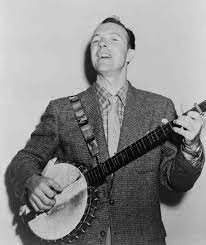
Pete Seeger: Courtesy: Creative Commons

A profound truth that we often overlook – or render to oblivion. A truth that Pete Seeger (1919-2014) had driven home to me in Delhi sometime in 1996. “The point is not to ask for yourself alone — one has to ask for everybody: Either we all are going to make it over the rainbow or nobody is going to make it. And that is how suddenly a song about the greens becomes a song that takes a step forward. This is what I call the folk process.”

*

The human drama unfolding between Russia and Ukraine, the two countries that have been described by a cartoonist as ‘divorced spouses,’ led yet another of my university friends, Usha Kelkar Srivastava, to re-play Where have all the flowers gone (1955), that old Pete Seeger favourite “which turns out to be a Ukrainian folk song”. The poignant melody was a favourite of ours when we went to university – much like Bob Dylan’s Blowin’ in the Wind (1962) and John Lenon’s Imagine (1964) – and for decades after he’d penned it, regardless of which country he was in, the guru of country singing would sing the peace songs and the audience would sing with him. “They would sing the songs in schools and in summer camps. Some of us sang in churches and unions, some sang in coffee houses and people would gather around us and sing with us old songs and new…” Pete had recounted in the course of the four days I was really fortunate to have spent in his company. The legend who sang in defence of humanity, had come to Delhi at the invitation of the Indian Council of Cultural Relations (ICCR) — and when he returned to America, he gifted me a set of CDs signed to me which are among my prized possessions. 

“Just as a river takes the shape of the land it flows through, a song can echo the raw emotions of a land and people,” said Usha culling from her background in Music History. “Rarely has any song touched the world like the simple Where have all the flowers gone…” It has the cyclic structure of another Hebrew folk song about violence that I’d heard in an Amos Gitai film. Pete, while travelling in air, had come across a few lines in Sholokov’s And Quiet Flows the Don: “Where are the flowers, the girls have plucked them. Where are the girls, they’ve all taken husbands. Where are the men, they’re all in the army.” 

The lines from a Caucasian folk song “are sung in the Ukrainian countryside as Tovchu tovchu mak and Koloda Duda,” Usha added. Pete had adapted these words, adding the refrain of ‘Long time passing and Long time ago’ almost as a chorus. At some point in time he combined it with the tune of a traditional Irish lumberjack song – “only, I slowed down the energetic and full of vigour rendition,” and thus was born the haunting song. The three verses were later expanded by other country singers who added two more verses that underscore the tragedy thus: ‘Where have all the soldiers gone? They’re in the graves, everyone of them…and Now the flowers have come back, on the graves…’

“My only complaint is that this song is not specific enough,” Pete once said at a live concert in Sweden. “It’s too easy just to say, ‘When will we ever learn? Oh when will we ever learn?’ without saying what you want people to learn.” Yet, how potent this critique of war is can be gauged by the number of recordings, and the spread of languages in which it has been rewritten. 

The Kingston Trio first recorded it in 1961 not knowing it to be authored by Pete Seeger. In 1962 Marlene Dietrich performed it in English, French and German at a UNICEF concert – “and she sings it even better,” Seeger had said. On a tour of Israel, she rendered it in German, breaking the taboo of using that language publicly in that country. The song has versions in Dutch, Polish, Czech, Croatian, Hungarian, Irish. It has been adapted to the piano, it exists in an instrumental version, and also as a parody! In 1964, Columbia Records released it in the Hall of Fame series and in 2002 Seeger was inducted into the Grammy Hall of Fame in the Folk category. In 2010 New Statesman listed it among the Top 20 Political Songs worldwide.

I had the opportunity to hear the other American icon, Joan Baez, sing the contemporary folk song with operatic flourishes, in Manchester sometime in 1977. The activist songwriter had included the German version in her 1965 album, Farewell, Angelina. The very next year the much-loved voice of Harry Belafonte had recorded it in a Benefit concert in Stockholm. A Russian version was recorded in 1998 by Oleg Nesterov, who founded the Moscow based rock band Megapolis just before Perestroika. In the present century Olivia Newton-John recorded it in her 2004 album Indigo: Women of Song while Dolly Parton recorded it in 2005 for her album Those Were the Days. On August 9, 2009, it was sung at the funeral of Harry Patch, the last surviving British soldier of WW1.

In Kolkata, where I now live, Anjan Dutt had covered “the old but always relevant song” in Rawng (Colour) Pencil, going on to remind us at the outset of the Gulf War, “Ekii chinta Bangla tey korechhe Lalon, Notun korey eki gaan geyechhe Lenon, Shei eki katha aaj gaichhe Suman, gaichhi aami shei eki gaan (The same thought had inspired the Baul Lalon Fakir; the American John Lenon, and Kolkata’s own Suman and me, to ask — When will they ever learn?)” As for Kabir Suman, who penned the Bengali version, Kothay gelo tara: he had himself rendered it on stage with Pete during that India tour of 1996.

Back then Pete was “very happy that the Berlin Wall came down so peacefully”. I distinctly recall asking the self-effacing giant if the wide reach of Where have all the flowers gone indicates that the world is finally learning about not going to war. The Times of India had carried his answer: “I don’t know whether songs really change things. All I do know is that throughout history, leaders have been particular about which songs they want sung!” And then the balladeer sang of a youth who was asked the same question, to say, ‘I don’t know if I can change the world… But I will make sure the world doesn’t change me…’ 

“That was a good song,” Pete had concluded. “When people around the world say that — that’s when the world will be changed.” 

Notes:
Shlokov received the Nobel prize for And Quiet Flows the Don in 1965. The book came out in four parts from 1928 to 1940.

Ratnottama Sengupta thanks the people mentioned here: Both Sonia Singh and Raji Sekhar are her batchmates from Elphinstone College, Bombay (now Mumbai). They worked in Air India. Usha Srivastava and Elizabeth George (then Vergese) were singers in Pranjyoti Choir. Usha Kelkar Srivastava, trained in Western classical music, later went on to give lessons in Music History at the American Embassy School, New Delhi. Bhamini Subramaniam is a designer while Shireen Elavia. Havewala, is a retired banker.

.

Ratnottama Sengupta, formerly Arts Editor of The Times of India, teaches mass communication and film appreciation, curates film festivals and art exhibitions, and translates and writes books. She has been a member of CBFC, served on the National Film Awards jury and has herself won a National Award. 

.

PLEASE NOTE: ARTICLES CAN ONLY BE REPRODUCED IN OTHER SITES WITH DUE ACKNOWLEDGEMENT TO BORDERLESS JOURNAL

Categories
Musings

Julie Felix: Singer, star-gazer and child of the universe

By Keith Lyons

There’s some wise advice that you should never meet your heroes in person, for fear of destroying their aura of invincibility. But what happens when you meet a childhood hero, the singer of a song which is still on rotate in the back-catalogue jukebox of your mind? This is a tribute to the great, late Julie Felix, a legend in her lifetime, who was more than just a bohemian folk singer who knew no borders.

Julie Felix

It is not easy to classify Julie Felix, who died the week before last, aged 81. Most of the labels don’t fit. Sure, you could tag her as a folk singer, as she had one of the longest careers in folk music, spanning more than half-a-century. The singer-songwriter was also a humanitarian and human rights activist, having been politicised in the 1960s and was active in peace and environmental movements. But to dismiss her just as a protest singer of yesteryear would be to ignore her much larger contribution.

Californian-born and raised Catholic (as a child she wanted to become a nun), Julie started singing at beach parties and coffee bars, then tripped around Europe, where she had a fateful meeting with Leonard Cohen on a Greek island in 1962. Arriving in the UK with just her guitar and duffel bag, the woman in her mid-twenties known for her strong voice and long black hair rose to prominence in 1960s beatnik England as folk music gained in popularity. She ended up spending much of her time on that side of the Atlantic, including a stint in Norway, dying peacefully in her sleep in a village north of London once rated the happiest places to live in the UK.

With Mexican, Welsh and Native American ancestry and heritage, the American, British-based recording artist was very much a global citizen who defied being placed in a box. Her passion for music was instilled by her father, a Mexican mariachi ensemble musician who played guitar and accordion, while her Welsh American mother liked the mournful ballads of Burl Ives — both her parents had Native American blood.

In 1964, even the British record label Decca Records didn’t know whether to place her debut album in the classical category for folk music or take the risk in marketing her music as ‘pop’ and mainstream. It was eventually decided she was a pop singer. That decision was a key moment in her career. She became a household name, TV star and Top Twenty recording artist. In the late sixties, perhaps oblivious to her Californian origins, The Times newspaper described the musician as ‘Britain’s First Lady of Folk’. She had an engaging voice and a charming manner, but never learned to read music. She put it down to being at the right place at the right time. “Fate whisked me along,” she said in an interview last year. And it was fate that led to me meeting Julie almost 30 years ago.

There’s a wise saying that you should never meet your heroes in person. Obviously, I chose to ignore that advice when I met Julie, my childhood hero of sorts.

I knew of her because she sang a song popular at primary school and on the radio, particularly on the New Zealand Sunday morning children’s hour show Small World where ‘Going to the Zoo’ was a popular request along with Spike Milligan’s fairytale ‘Badjelly the Witch’. ‘Daddy’s taking us to the zoo tomorrow . . . And we can stay all day!’ starts out with the catchy chorus: We’re going to the zoo, zoo, zoo, How about you, you, you? You can come too, too, too, We’re going to the zoo, zoo, zoo.’

The action song, complete with onomatopoeic animal noises, was a big hit at Nayland primary school, and it was a soundtrack on constant loop when we made a school trip to the nearby Tahunanui Zoo (now known as Natureland Wildlife Trust and more into wildlife conservation than a petting zoo), back before zoos became places to avoid because of their treatment and captivity of animals.

So, in 1992 I met up with Julie in the South Island of New Zealand and travelled around the Catlins area near Dunedin for almost a week with the legendary folk singer, hosted by Fergus and Mary Sutherland of Catlins Wildlife Trackers. At the time I was a budding writer, fresh out of post-graduate journalism school. As well as tagging along to write some stories for newspapers and magazines, I was quickly identified as the unofficial local guide, the fixer, and the fetcher. I was tasked with taking photos, opening wine bottles, and carrying her prized guitar. We hiked trails to spectacular waterfalls in the lush forest, visited panoramic coastal viewpoints, ventured into limestone cathedral arches, combed beaches looking for petrified tree fossils, and watched dolphins play in the surf.

At night, with no street lights, if the skies were clear, we’d go outside to admire the Southern Hemisphere stars with the Milky Way and its just-visible breakaway of large Magellanic cloud, and the constellations unfamiliar to Julie, such as the Southern Cross, or ones easily recognisable, such as Orion, which were differently oriented compared to night skies in Europe and North America. “This is where I belong,” she declared after a long session of awed gazing, “I am a child of this wonderful universe.”

On that adventure was the glamorous American health and beauty author, Leslie Kenton, daughter of jazz musician Stan Kenton. There was a little bit of tension on our sightseeing trip, as Leslie, former health and beauty editor at Harpers and Queen, and author of Raw Energy and The X Factor Diet was into raw food for vitality and longevity, while Julie was more into living in moment rather than her appearance, the future or order. She didn’t wear make-up, she dressed in comfortable clothes, and she enjoyed the occasional puff on hand rolled cigarettes. It wasn’t quite a reckless rock n’ roll lifestyle, more of a down-to-earth, unpretentious, good-hearted existence.

Julie’s habits were met with a disapproving look from radiant Leslie, who was three years younger — though it was health freak Leslie who died earlier, in 2016, aged 75, near Christchurch, having been charmed enough by New Zealand from that first visit to decide to move permanently.

The slight clash of personalities, Julie later confided to me, was mainly astrological. Fortunately, we got on well, possibly because I didn’t want to change her in any way, had no expectations, and I also shared Julie’s skepticism, about the virtues of coffee enemas. Though I must admit, I did hope that at some stage she would sing THAT song.

Julie would roll her eyes after another plea from Leslie to try a new-fangled supplement, recently-discovered treatment or life-changing product. “Where are we going to tomorrow?” she once asked me to divert Leslie’s attention, so she could go out for some fresh air and a smoke. “To the zoo,” I replied, hoping to subtly remind her of the song I wanted to hear her sing.

During the trip, Julie didn’t feel the need to impress, even though she had an impressive CV and contact list. She had become the first solo folk performer to sign with a major British record label, and in 1965 she was the first folk singer to fill the Royal Albert Hall – that same year she was the first ‘popular’ singer to perform at Westminster Abbey. She even had her own primetime BBC TV programme (the first colour series produced by the BBC), after being a member of David Frost’s satirical ‘Report’ team.

Her own series ‘Once More With Felix’ included guests The Bee Gees, The Kinks, Fleetwood Mac, The Hollies and Spike Milligan. Julie, with her dark, long hair, was often compared to (and sometimes mistaken for) fellow American and Californian resident Joan Baez. Even though she still had an exotic West Coast accent, a US passport, and sang songs penned by American’s Woody Guthrie, Bob Dylan, and Paul Simon, she was once dubbed ‘Britain’s answer to Joan Baez’.

Among her contemporaries and friends were Bob Dylan, Arlo Guthrie (‘This Land is Your Land’), Dusty Springfield, Paul McCartney, Cat Stevens, Jimmy Page, and Leonard Cohen. She once opened for Dylan at the Isle of Wright Festival, later did a cover of his peace song ‘Masters of War’, and so liked the fellow Gemini’s music, she recorded a double-album of his songs. Julie was one of McCartney’s girlfriends, and it is said he sang ‘Strawberry Fields Forever’ to her before it was first performed publicly. She is credited with being the person who taught Cohen how to turn his poems into songs. If you get the chance, there’s a Youtube clip of her singing with Cohen ‘That’s No Way to Say Goodbye’ (https://www.youtube.com/watch?v=f1EJ-ITAcEU). It was Cohen’s British TV debut.

Julie was born in Santa Barbara, but couldn’t get her musical career off the ground in the US, so with savings of US$1000 in her pocket, and inspired by Jack Kerouac’s ‘On The Road’, she hitchhiked across Europe (meeting Cohen in Greece on the bohemian island of Hydra and lending him her guitar), and then found a bigger audience in the UK, where she stayed for decades.

She once got arrested at Heathrow airport for possession of cannabis and carrying more than the allowable amount of cash — that was more than 50 years ago.

She first came to New Zealand in 1971, singing to a record-breaking crowd of 27,000 at Western Springs in Auckland, urging Kiwis to reject conscription for the Vietnam War. But she wasn’t just a singer of protest songs, she had a deep concern for the world, the environment, and its people, particularly those less well off. As well as being a singer, social justice, human rights and peace were important to her, and she was involved in many initiatives, charities and humanitarian causes for women’s rights, refugees, and victims of oppression, including projects to end the military use of landmines in Third World countries, and as an ambassador in the Middle East and Africa for Christian Aid.

One of her most requested songs is ‘Deportee (Plane Wreck at Lost Gatos)’, about the mistreatment of migrant farmers, while her top hit was ‘If I Could’, best known as the Simon & Garfunkel version ‘El Condor Pasa’ which starts off with the ‘I’d rather be a sparrow than a snail . . .’ And of course, among a younger audience, she was the voice behind the ‘Going to the Zoo’ song, which featured in her second album released in 1966 (that song was also sung by Peter, Paul & Mary).

At the end of the week, with Julie rejuvenated from the New Zealand natural scenery and serenity, (and with better access to tobacco, alcohol and spicy, ‘well-cooked’ food), she had a concert in Dunedin, and I got to be her temporary road manager, carrying her guitar, the treasured one from her father. After the soundcheck, one of her devoted fans, who had met her two decades earlier during the anti-Vietnam War era, snuck into the green room, and pressed upon her a tinfoil containing marijuana that he’d especially prepared just for her.

There was a surprisingly large turnout, with an older audience of loyal followers eager to hear her voice again, which had gone a little dusky over the years (she was then in her mid-50s), similar to the vocal trajectory of Joni Mitchell, thanks to the nicotine habit. On some of her songs, everyone sang along. After helping her out (‘Keith, where can I get . . . ‘ she would ask), I thought perhaps she’d do ‘Going to the Zoo’ as one of the encore pieces.

So if you haven’t heard it before, or if you did a long, long time ago, you can still hear Julie sing ‘Going to the Zoo’ (https://www.youtube.com/watch?v=WgCiE_tiyQo). It is quite a good song if you currently are in coronavirus lockdown with children to entertain or care for. It ends with this:

Well we stayed all day and I’m gettin’ sleepy, Sittin’ in the car gettin’ sleep sleep sleepy, Home already gettin’ sleep sleep sleepy, ’Cause we have stayed all day.

Listening to her sing, as I stood backstage, I realised why I liked her, and it was because her voice reminded me of a simpler time, when I was young, when things seemed more black-and-white. “This world goes round and round, green leaves must turn to brown, what goes up must come down, It all comes back to you,” she sang out Tom Paxton’s ‘World Goes Round and Round’. “People knocking at the golden door, they got plenty but they still want more, don’t know what they’re looking for, the world goes round and round.” She has also sung Paxton’s ‘The Last Thing on My Mind’. It was Paxton who wrote ‘Going to the Zoo’. But did I get to hear her sing that zany song? Nope.

The next day, before Julie headed off on her travels (she wanted to go bungy jumping over the Shotover River in Queenstown), she confided that she did sometimes sing ‘Going to the Zoo’, but the performance was usually reserved for a much younger audience. “Keith, I’ve been singing that damn song for more years than you’ve been on this precious earth.”

She took away a few pebbles and shells we’d found on our shore and estuary ramblings, and I made her a booklet of photos from the trip. After our time together, we kept in touch.

A few years ago, she said that when she sings live, she taps into a great energy, and it was her way of praying. “Music is like breathing to me,” she declared. In one of her most recent interviews, she said she missed her youth and the energy she once had but was grateful at being able to make music and share it with others.

She was still touring, recording and performing into this year, with an album released in 2018 of her own songs, and a schedule of concerts planned for 2020. She had even teamed up Mike D’Abo from Manfred Mann to do songs they’d performed together more than half a century ago, including Bob Dylan’s ‘Fare Thee Well’ with the lines ‘So it’s fare-thee-well, my own true love, We’ll meet an-other day, an-other time’ (see this from 1967 https://www.youtube.com/watch?v=BsH0xPFbV0g).

She died on Sunday 22nd March, a couple of days after another 81-year old who had made a contribution in expanding the audience for a music style and making it more mainstream, Kenny Rogers, and on the weekend when the UK went into lockdown.

Julie leaves a deep legacy not just musically, but in her ideals, and how she strived to make a difference. She was both a product of her time, and ahead of her time, in wanting to make the world a better place, and being prepared to speak up, particularly for those without a voice. In a divided world, she saw no divisions, only an unrealised global consciousness, that we are all one, all children of the universe.

Keith Lyons is an award-winning writer and creative writing mentor, originally from New Zealand, who has lived in Asia for more than a dozen years. His creative non-fiction, short stories, and poetry have been published in journals, magazines and anthologies around the world, and his work has been nominated for the Pushcart Prize. He edited and co-authored ‘Opening up Hidden Burma: journeys with – and without – author Dr Bob Perival’ (2018, Duwon Books), and is currently working on a book about finding Asia’s last island paradise, the Mergui Archipelago.