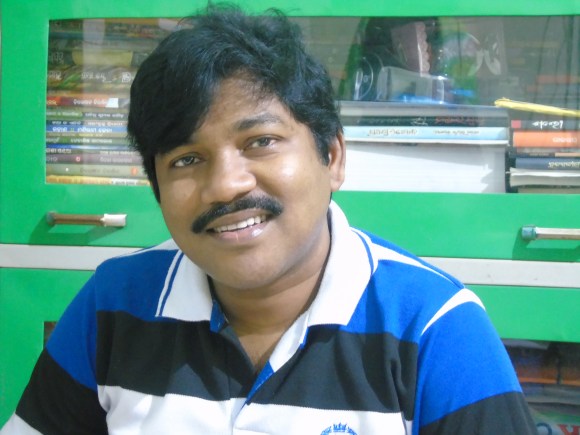
By Rajendra Kumar Roul
After nearly twenty years, perhaps more, I bumped into Sadhu Kaka[1] again.
That meeting—sudden, strange—pulled me back. Back to a time before Google was born. When the world still moved at its own unhurried pace, unshackled by the glow of mobile screens; when days stretched longer; when people were simply, quietly human.
That morning, I sat at the bus stop with my wife and daughter. The air was still; the sunlight tender. We were on our way back to Bhubaneswar when he saw me—came running, shouting my name, and clasped my hands tightly. I felt the roughness of his palms, the faint tremor of age in his grip. A smile lingered on his lips—gentle, unguarded, like the soft fragrance of fresh jasmine. And yet, no matter how hard I tried, I could not bring myself to smile. Something within me had gone still, as if time itself had forgotten to move.
I looked at my wife, bewildered and uncertain. My guess had been right. By then, her face had set like stone, her eyes dulled by silence. She looked at me once, then at him, and turned away. A grimace flickered across her lips, carrying the sting of quiet satire. She stepped aside and stood there wordlessly, her gaze fixed on the road. Cars passed in a slow rhythm, their noise distant and unreal, as though the world around me had quietly lowered its volume.
I wasn’t surprised by my wife’s reaction. She had always flinched whenever I surrendered to the weakness of my heart. I knew my failing well, and what rose in me was not anger but a slow, lingering guilt. Men like Sadhu Kaka have long taken advantage of the tenderness in me, and each time, it was my family that carried the scar. Once, in a moment of misguided affection—or perhaps a surge of foolish tenderness—I had pushed my daughter into danger for his sake, and now, it was my turn to bleed before the world—this time, for the same fragile sentiment that refused to die, the one I still hold for my childhood friend, Jagabandhu.
There was a time when Jagabandhu and I sat side by side in class—sharing the same bench, the same cracked slate, the same fragile dreams that fluttered like paper kites in the dusty afternoon air.
Then one day, poverty came and sat beside him—silent, patient, and unyielding. From that day on, his place in the classroom remained empty. He began walking to the fields with his father instead, turning the soil where once he had turned the pages. The spade and the hoe became his prayer, the sun his only witness.
I went on, class after class, until the village felt too small for my growing dreams. I left, but he stayed behind, as though the earth itself had claimed him, unwilling to set him free.
The words came unbidden as I walked to the bus stop. Without intending to, I turned down the narrow lane that led to Jagabandhu’s house.
He was sitting beneath the guava tree in his courtyard, the same spot where I had seen him years ago. The tree had grown denser, its shadow trembling on the cracked earth. A brown cow stood nearby, chewing its cud in slow, unhurried rhythm.
When I saw Jagabandhu, I hesitated. It took a moment to recognise him. His face had grown thinner, his eyes sunken, as if time had quietly worked its way through him. His life, I thought, could have belonged to one of those tragic stories that never make it to paper.
The years had pressed heavily on him. The weight of poverty had bent his frame. Life, for him, had withered into a cruel jest of fate—an endless hum from some tired, indifferent machine. His wife lay ill inside the house. Last year, his eldest daughter had died. The papers called it suicide, but Jagabandhu whispered that her in-laws had murdered her. Three unmarried daughters still lived with him, and he carried their future like a stone in his chest. At night, he said, a dull pain rose from his stomach and stayed there until morning.
My eyes welled with tears the moment I heard of Jagabandhu’s plight. I have always been an emotional soul; sorrow, whether on screen or stage, seeps into me until I lose sense of where the story ends and my own ache begins. But this was no performance. This was the truth of a man’s suffering, and I was only a witness, powerless to soften his suffering.
A heaviness gathered in my chest. I laid my hand upon Jagabandhu’s shoulder. A long, tremulous sigh slipped out of me, as though my heart itself had grown tired of carrying sorrow.
“Give me five thousand rupees,” I said to my wife.
Startled, she looked up. Her eyes widened—half fear, half disbelief. I ignored her and pressed on, my voice firm. “Didn’t you hear what I said?”
For a moment, a spark of rebellion flared in her eyes, but she held it back. Wordlessly, she opened her purse. Her fingers trembled. She drew out a bundle of hundred-rupee notes and placed it in my hand as though it weighed a mountain.
I passed the money to Jagabandhu and whispered a silent prayer to Lord Jagannath. Not for fortune, but for mercy. Then I turned away and walked toward the bus stop, leaving him behind with his burden of sorrow.
The road stretched empty; my footsteps sounded hollow. It felt as if every sound within me had fallen still—as though the earth itself had grown quieter than it should be. I seemed to sink into a darkness so deep that I had not known it existed within me.
How does Jagabandhu live beneath such sorrow? How does he bear a life so heavy? Is what he endures truly a life—or a curse disguised in the clothes of living?
If I were in his place…
No. My body trembled. I tried to imagine it, but I could not. It was not merely difficult—it was impossible, like trying to build a ladder that reaches heaven.
Just as I was making a futile attempt to step into Jagabandhu’s shoes, and failing all the same, my wife’s voice drifted through the silence.
“You gave the last note to charity. Do you have money for the bus fare?”
I snapped out of my thoughts and asked, “Why? What about the money I gave you the day we came to the village?”
As though she had already anticipated my question, she quietly handed me a notebook where every expense was recorded, down to the last coin.
“The money you gave your friend was the last you ever gave me,” she said. “Now you’ll have to take care of the bus fare yourself.”
It was as if a cold hand had struck me awake. I stepped out of my daze into the harsh glare of truth: I was penniless. I didn’t even have enough to buy the bus tickets.
What madness drove me to Jagabandhu’s house? Why had I stopped there on my way to the bus stop?
He is my friend, yes—but that doesn’t mean I must lose my head every time I think of him. More than anything, why had that sudden tide of emotion risen in me the moment I saw him?
It would have been different if I’d been alone. But I wasn’t. My wife and daughter were there, silent witnesses to my grand stupidity. How could I tell the bus conductor, without shame, “Brother, I have not a paisa left. Take us to Bhubaneswar for nothing”?
My mind went blank. Darkness pressed close, thick and suffocating. I wished I could slap myself. And if anyone asked why, I’d tell them plainly: because I earned it.
Sadhu Kaka broke my trance. “Are you disturbed?” he asked gently. “Your wife doesn’t seem well. Has there been some disagreement between the two of you?”
I forced a smile. A thin, artificial smile.
I wanted to tell him, Life isn’t as simple as you think, Sadhu Kaka. You, who have stepped away from the world, can never truly understand it.
I studied, loved, built a home, became a father—and soon, I’ll be the one giving my daughter’s hand away. And yet, I still wonder if I’ve ever truly grasped the delicate mathematics of living.
If I had, would I, once again ensnared by emotion, have placed my last bit of money in Jagabandhu’s hands today—just as I did twenty years ago, when my daughter burned with fever and I gave you the money meant for her medicine?
I still remember it clearly: my daughter’s asthma had flared again after days of fever. The doctor had ordered an urgent injection, and I set out in haste to buy it.
Sadhu Kaka caught me in the traffic. He ran to me, gasping, and gripped my arm.
“Jayant, disaster has struck. I must leave for the village right now, but my bag is gone. Lend me some money. I’ll send you a money order the moment I reach home.”
I opened my wallet, not even sure why. There were three thousand rupees inside. The instant his eyes fell on them, he said, “That will do. Don’t worry, I’ll return it as soon as I reach the village.”
Before I could protest, he tore the notes from my hand and disappeared onto a bus.
I went back home with nothing. No medicine, no words to explain. My daughter’s condition worsened that night, and by morning she was in the ICU.
That morning never left me. Even now, the sound of an ambulance makes my chest tighten.
Twenty years have gone by since then.
And now, Sadhu Kaka again, after twenty long years.
I wanted to cry out, to shout until my voice broke. I wanted to grab Sadhu Kaka by the shoulders and plead:
“I desperately need that money today, Sadhu Kaka. Otherwise, the bus conductor will humiliate me in front of my wife and daughter. If only you could return what I gave you twenty years ago, it would save me now.”
But I said nothing. His vacant eyes, his frail face, left no space for words.
Long ago, he had loved someone. She betrayed him, and he never recovered. He lived only as long as duty required—until his parents were gone. Then he simply let the world slip past.
People say he has no place to call his own. No one knows what he does or where he lives. How could I expect anything from a man who has already abandoned everything, even himself?
The bus pulled in at the stop. My wife caught our daughter by the hand and climbed aboard. I loosened my grip on Sadhu Kaka’s hand and turned to follow them. But before I could reach the door, he ran after me. With trembling fingers, he straightened my collar and smoothed the stray hair from my forehead. Perhaps he wished to speak, but no words came.
For an instant, I faltered, my mind adrift. His face glowed before me like that of the Lord Buddha at the Peace Pagoda in Dhauli—calm, compassionate. Then I turned away in revulsion. I’ve always been vulnerable to such people. Who would help me now? Sadhu Kaka, or Jagabandhu?
My face hardened in defiance. I pushed him aside, climbed into the bus, and sank onto the three-seater beside my wife. My eyes closed. Inside me, it felt as though the cyclone of ninety-nine was still raging.
Ah, why does this keep happening to me? Why do I remain a slave to my own emotions? Even after stumbling into trouble time and again, why can’t I understand that charity is good—but never at the cost of losing yourself?
I don’t know when I drifted into sleep. A soft touch pulled me back. I opened my eyes. The bus conductor stood before me.
Oh my God!
Startled, I cried out silently. Sweat broke across my skin; the ground seemed to give way beneath my feet. My blood turned cold. I saw my wife and daughter staring at me, their faces pale with fear.
“Mr. Jayant, right?” the bus conductor said, smiling. “Here—your ticket to Bhubaneswar. And three thousand rupees.”
I looked up, uncertain I had heard him correctly.
A ticket… money… what was all this?
The bus conductor’s smile lingered.
“Sadhu Kaka bought the tickets for you,” he said. “He told me to give you the money as well. He was afraid you might refuse if he tried to hand it to you himself.”
So, this time in the crowded market place, both my wife and I smiled and looked with contrition at him. Before we could speak, he smiled and said, “Stay well!” Then he disappeared.
[1] Kaka means “uncle” and is often used in Odia as a respectful form of address for an elderly man. Thus, Sadhu Kaka may be understood as “Uncle Sadhu.”
Rajendra Kumar Roul is an acclaimed bilingual fiction writer. A professional feature journalist, he has written more than a hundred short stories, over a thousand feature articles for Odia daily newspapers, two novels and several plays for the stage.
.
PLEASE NOTE: ARTICLES CAN ONLY BE REPRODUCED IN OTHER SITES WITH DUE ACKNOWLEDGEMENT TO BORDERLESS JOURNAL
Click here to access the Borderless anthology, Monalisa No Longer Smiles
Click here to access Monalisa No Longer Smiles on Kindle Amazon International
 Borderless