Categories
Slices from Life

The Toughness of Kangaroo Island  

By Vela Noble

A lone house juts out of the cliffs on Kangaroo Island, like a villain’s lair in a James Bond movie. Its floor-to-ceiling windows are marred only by salt spray and swallow poo. The receding orange cliffs set against a fierce ocean makes for a view even the stonemason called, ‘the best on the island’. I slink down into the backseat of our car and admire the azure downhill view of Cape Jervis, where the ferry departs. Today my dad, his partner and I are driving to our holiday house for a short trip planting trees. On the North Cape of Kangaroo Island, the fields of matted grass pocked with weeds make for a melancholic landscape. Having been ravaged by decades of farming, helping revegetate is the least we can do.

My bedroom on the island has large eastern-facing windows. This gives me a view of Boxing Bay, a beach only visited by tourists willing to brave the potholed dirt road. Bleached book spines featuring nautical adventures or “101 Guide to Prepping” line the bookshelf. Dusty DVDs, mostly starring Ben Stiller, have also been faded by the elements. A box reveals an arsenal of art supplies my mum ordered online. I unearth my mum’s fancy French Sennelier watercolours. They come in a navy carry bag with crisp brushes begging to caress a canvas. Staring at these items hits a nerve, but I tenderly place it in my backpack.

That same afternoon we plant some trees. We have around sixty to get through this trip, mostly bristly casuarinas and muntrie berry bushes. I gently pat around each seedling and send a prayer into the earth. After I have done the bare minimum, I do what I usually do every trip; I wander off. I decided to make the trek from Boxing Bay up the hill to the solitary lighthouse. Passing a droopily arching tree, I tentatively open my sketchbook and bring pen to paper. The earth and sky don’t like me much. Juicy fat ants keep biting me and my pale arms are getting fried. The drawing comes out horribly, so I shove the sketchbook away. Life isn’t just tough for me, but for everything out here. We once caught a monitor lizard so thirsty that it was licking a leak in our hot tub. We offered it a drink, from which it drank like a dog from a bowl. On the North Cape, you can often glimpse the grand wingspan of a sea eagle surveying the hills in search of prey, such as mice. Echidnas are a bit rarer to spot. They must have it tough too, for they could get mistaken for a chubby mouse. Everywhere I look, there’s subject matter pleading to be painted. It’s in the flattened fields where settlers heaved limestone into neat little rows, or in the sheep skull perched on the wire fence. Around halfway to the lighthouse, I see some abandoned machinery in the corner of a field. I attempt to sketch. Yet again, something isn’t quite right. So, I tear an angry gash with the pen instead. The overcast weather rolling in urges me to slouch on home.

A storm hits tonight. The windows in my room shiver under every gale. The little sprouts we had just planted are getting a brutal welcome to their new home, but at least the earth gets a drink. Below the house on the cliffside, a grove of wizened casuarinas grow sideways as a result of with this abusive weather. Somehow, they still grow. I teeter to the toilet in the middle of the night.

My mum took charge of designing this home and her dedication is apparent even in the bathroom, where a nifty hidden wooden panel pops out to reveal storage for toothbrushes and toilet paper. She passed away in 2020 and didn’t get to enjoy that hidden toilet paper compartment. Both here and at home, there is no escaping the memory of my mum. In the morning, the sun beams straight into my slumbering retinas. I had hardly slept. Dad cranking up the coffee machine doesn’t help.

“What are you going to do today?”

“More terrible art, probably.”

“Go for a walk. Look for some sea eagles. There’s so much to do out here.”

I walk down to the grove of gnarly casuarinas. A solitary sheep that strayed from the feral herd appears in front of me. It startles, the dags on its butt dangling with every leap. I follow it and reach a sandy spot on the clifftop. These trees survived last night’s storm, why can’t I survive this?

I rummage through my bag and realise I have my mum’s watercolours. I admire the glossy hues snuggled in their metal tins. It’s as if her dreams are laid to rest in this little plastic case. After my mum passed away, I suffered a psychotic break which impaired my ability to do art. Art had been my passion. Professionals tell me it’s not damaged and I’ll get better but, I have yet to see any proof of that. Seeing the dirty sheep posing right in front of me, I can’t help but have hope. This time I don’t draw, I paint. I pop open the water filled jam jar and bring the brush to the ultramarine. The blue spills onto my page. Next is the sky that’s freckling my skin. I am not just painting, I am soaring on wings and scurrying through the undergrowth on tiny paws. Like the almighty creator, I lay down the stoic earth. Before I know it, I have a picture. Hey, it turned out alright! Above all else, I was happy making it. That evening I showed the picture to my dad.

“That’s fantastic Vela! Why do you keep saying you’ve lost your art?”

He puts it on the stonemason crafted mantelpiece, next to a bowl of seashells and under the happy gaze of my mum’s self-portrait.

It’s a pale purple dawn when we depart. The white drop cloths draped over the furniture to protect them from the sun makes the living room appear full of ghosts. We putter down the crushed limestone road, the rumbling white dust proclaiming our departure to all the thirsty lizards and echidnas shuffling in the bush. I take a final look at the wind-bent casuarinas on the cliffside. I too, feel beaten down by life, by relentless winds trying to rip me out by the roots. The trees get tougher and tougher, clinging into that poor soil. It may not be the best conditions, but when I think about the harshness of life on Kangaroo Island, I realise there’s something I can learn from it. Something in me can thrive too. The North Cape has made me just that little bit tougher.

.

.Vela Noble is a South Australian artist who is currently developing her own indie games. She has many years of experience working in animation for Netflix and Dreamworks. 

.

.

PLEASE NOTE: ARTICLES CAN ONLY BE REPRODUCED IN OTHER SITES WITH DUE ACKNOWLEDGEMENT TO BORDERLESS JOURNAL

Click here to access the Borderless anthology, Monalisa No Longer Smiles

Click here to access Monalisa No Longer Smiles on Kindle Amazon International

Categories
Slices from Life

From Gatwick to Kangaroo Island

Phtographs & Narrative by Meredith Stephens

When I recently flew from Australia into Gatwick Airport, London, I was struck by the ease of passing through customs and immigration. Once I exited the plane, I was ushered to an empty lane and directed to a machine to present my passport. As I had nothing to declare I walked through the green lane. A group of four customs officers were engaged in conversation and did not notice me. I had entered the UK seamlessly in about five minutes without making eye contact with a single person.

Not so when travelling within my home state of South Australia. Alex, Verity and I were on our way from Adelaide to Kangaroo Island, situated across Investigator Strait off the southern coast of South Australia. We would have preferred to sail there, but Alex’s boat was high and dry, awaiting repairs to the mast and windows in Yaringa, eight hundred kilometres away in the state of Victoria. We had made a booking for the three o’clock ferry from Cape Jervis to Penneshaw, on Kangaroo Island. We left Adelaide at 1 pm, allowing ninety minutes for the drive and thirty minutes to board, as we always do.

Half an hour into our trip, we were stuck in a traffic jam along the arterial roadway heading south. We had never been trapped in a traffic jam in this direction before, because it was leading away from Adelaide towards sparsely populated farmland.

“Oh no! It’s the Tour Down Under! The road is closed for the cycling race,” lamented Alex.

He did a U-turn and headed west to the side streets in the hope of finding an alternative route along the Esplanade. After winding through the coastal suburbs, we arrived at a T junction facing the Esplanade, and were greeted by a woman in a bright orange vest holding a prominent sign saying ‘Stop!’

Onlookers lined the streets holding their cameras ready to snap the cyclists. We waited, all the while nervously checking the time on our phones, wondering whether we would miss our ferry. A few minutes later we heard an excited murmur run through the crowd, and sure enough, a group of cyclists whizzed past.
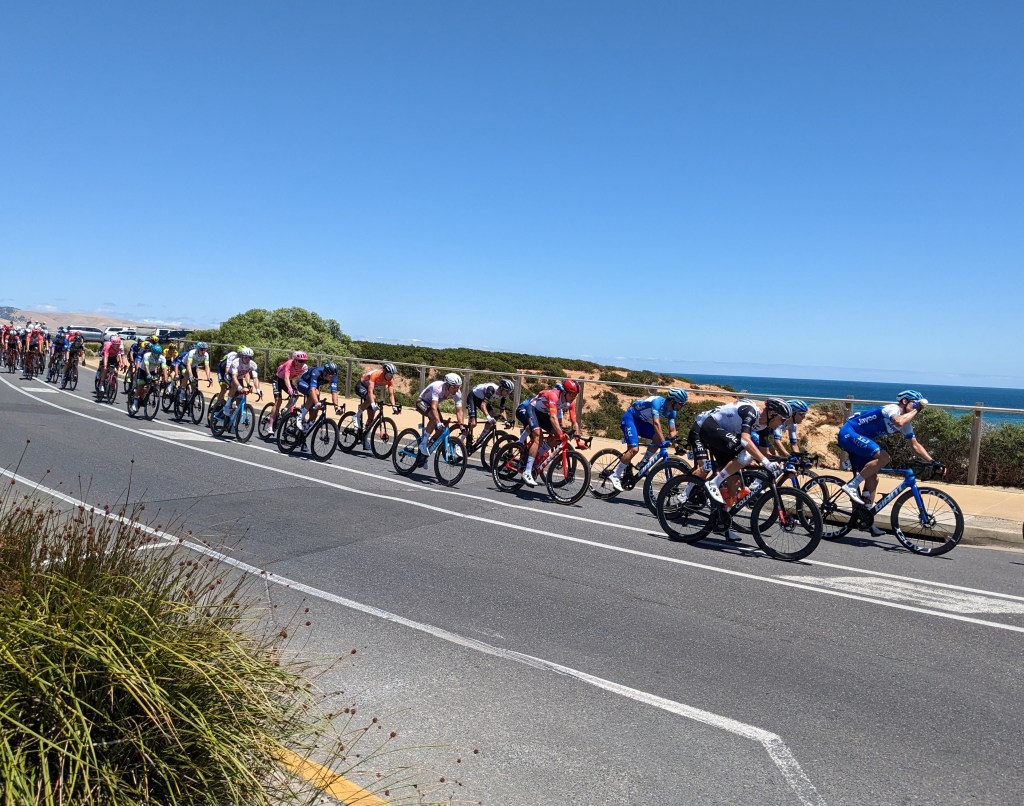
We glanced at the woman in the orange vest, hoping she would let us pass. She was on her walkie talkie and shook her head at us. Soon another group of cyclists raced past. Then the woman let us on to the Esplanade and we headed south. Soon after we were stopped by a police officer on a bicycle, who directed us away from the Esplanade. We turned east to weave our way back to our original route.

“We won’t make it to the ferry on time!” complained Alex, pressing heavily on the accelerator.

We arrived back on the highway that we had originally departed from and tried to turn right so that we could head south to Cape Jervis. A line of cars from the north were trying to turn right into our street.

“We’ll be here for hours. Best turn left and then do a U-turn,” announced Alex.

Alex turned left, accelerated, and braked when he found a gap in the oncoming traffic. He quickly did a U-turn and then headed south, passing the line of cars waiting to turn right onto the road where we had been waiting.

Would all of this be in vain? Would we get to Cape Jervis just after 3 pm to watch the ferry departing, on its way to Penneshaw? I held my phone to check the distance to Cape Jervis and noted that the estimated time of arrival was 2.54 pm. Alex tried to make up time by driving to the speed limit. A truck was labouring up the hill in front of us. Alex waited until we reached a passing lane, and then floored the accelerator. The estimated time of arrival was now 2.52 pm. Sitting next to Alex as he sped along the highway was more exciting than rides on a fairground had been when I was a child. I trusted his judgment and felt safe all the while enjoying the exhilarating speed. Next, there was a red car dawdling in front of us. Again, Alex waited until we reached a passing lane, and overtook them. The estimated time of arrival was still 2.52 pm. At least we had not been losing time as we were delayed by the slow coaches ahead of us. We entered the township of Cape Jervis, rounded the hill, and then descended to the ferry port, arriving as predicted at 2.52 pm. We expected boarding to be well underway. Instead, four lanes of cars were waiting in the line-up to board the empty ferry, which was running late. We slid into the shortest lane and turned off the engine. A biosecurity officer approached Alex’ window, his curly auburn ponytail blowing in the wind. Alex wound down the car window.

“Do you live on Kangaroo Island or are you just visiting?” he asked.

“We’re just visiting.”

“Oh, lovely! Do you have any honey?”

“No honey.”

“Do you have any bee-keeping equipment?”

“No, definitely not.”

“How about fruit?”

“We have some apples.”

“Are they from the supermarket?”

“Yes.”

“Where did you buy them?”

“In Adelaide.”

“How about potatoes?”

“No.”

“Do you have any plants?”

“We have some caper plants in the back.”

He looked at the back of our vehicle in acknowledgement.

“Oh capers! They look nice. Where did you get them?”

“From a business in Port Adelaide.”

The biosecurity officer seemed satisfied and waved us on.

“Have a lovely trip!”

Shortly after we boarded the 45-minute ferry for Penneshaw. We had been asked more biosecurity questions than at any other place on our travels, and we hadn’t even left our home state. I yearned for the ease of passing through immigration at Gatwick Airport. I had felt perversely miffed at Gatwick for having been ignored by immigration and customs officials.

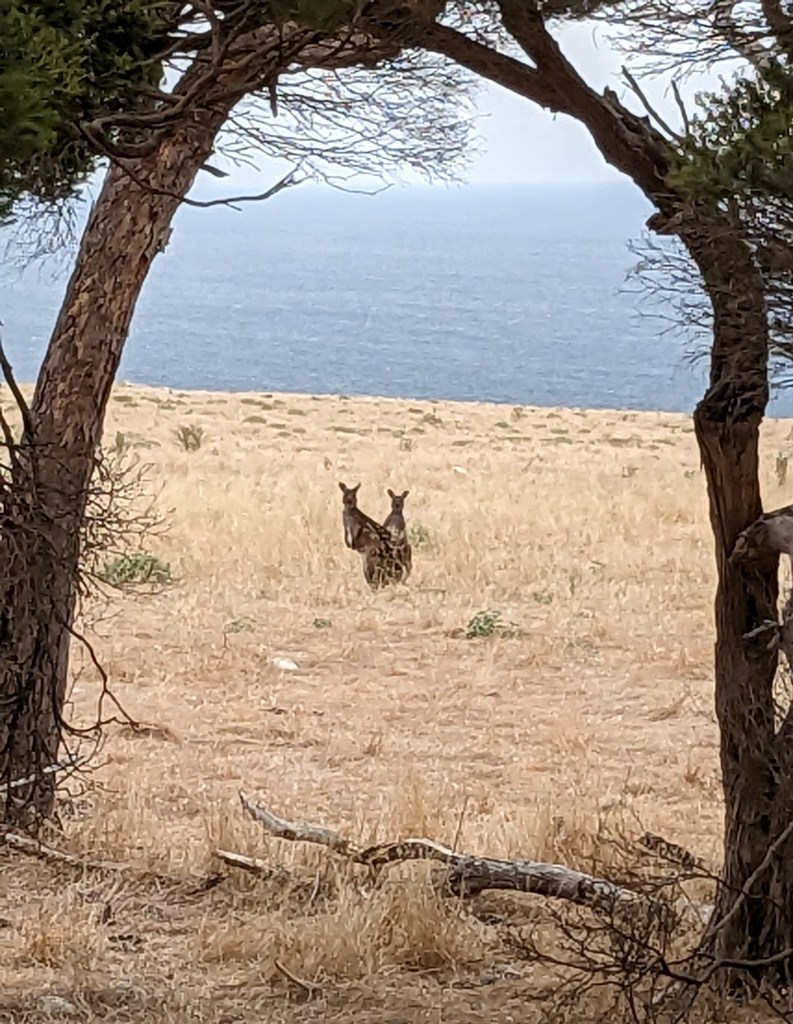
No sooner had we arrived at our destination though, did we spot a marvellous mob of kangaroos bounding across the property.
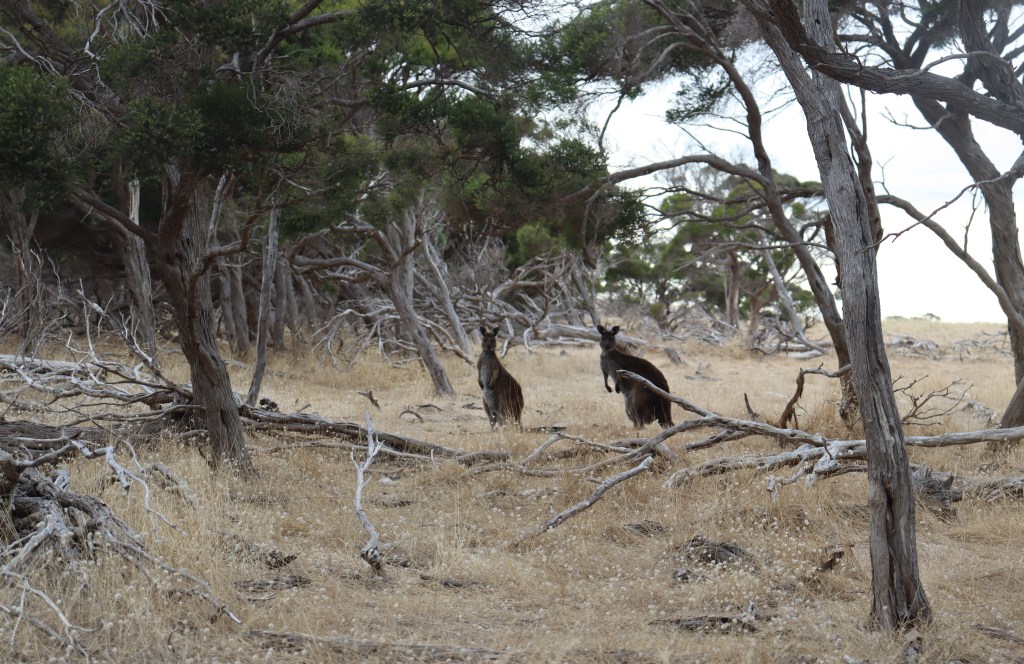
Then the following day we had a charming encounter with a Rosenberg’s Monitor looking for a drink of water – a species that is endangered on the mainland.

Rosenberg’s monitor lizard

Verity later came across an elusive short-beaked echidna.
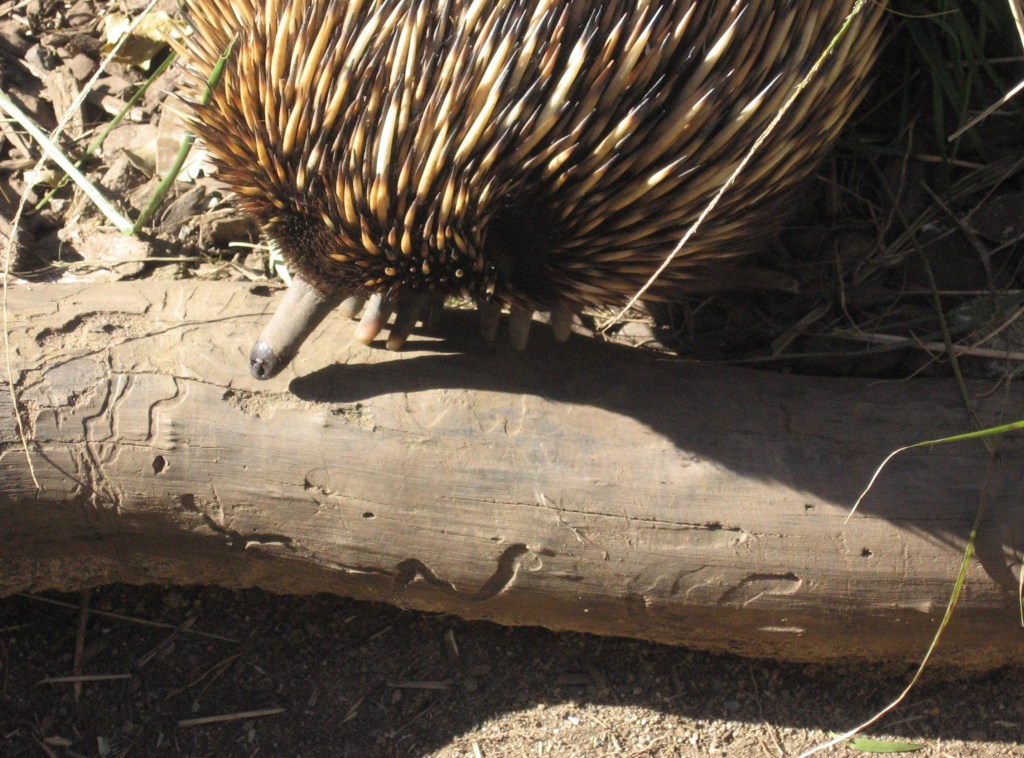
Short-beaked echidna

At last I could appreciate that protecting the fauna and flora of Kangaroo Island was important and necessary, and well worth the interrogations of a biosecurity officer.
Meredith Stephens is an applied linguist from South Australia. Her work has appeared in Transnational Literature, The Muse, The Font – A Literary Journal for Language Teachers, The Journal of Literature in Language Teaching, The Writers’ and Readers’ Magazine, Reading in a Foreign Language, and in chapters in anthologies published by Demeter Press, Canada.

PLEASE NOTE: ARTICLES CAN ONLY BE REPRODUCED IN OTHER SITES WITH DUE ACKNOWLEDGEMENT TO BORDERLESS JOURNAL

Click here to access the Borderless anthology, Monalisa No Longer Smiles